

GCSE Compound Interest Questions Made Easy
GCSE compound interest questions made easy: learn multipliers, formulae, depreciation and reverse growth with worked examples and exam tips.
The moment compound interest stops feeling like magic
In GCSE maths, compound interest questions often feel unfair because the numbers seem to grow (or shrink) faster than your instincts expect. You do one careful percentage increase, you get a sensible answer… then the question says “for 5 years” and suddenly your calculator is showing a long decimal and your confidence drops. That reaction is normal. Compound interest isn’t hard because the maths is complicated; it’s hard because it’s repetitive, and repetition is exactly where small mistakes multiply.
The good news is that compound interest questions have a surprisingly small set of patterns. Once you learn to spot the pattern, the method becomes calm and automatic. And that’s what tends to score the marks in GCSE papers across Edexcel, AQA, OCR and Eduqas: clear multipliers, correct powers, and a sensible final rounding.
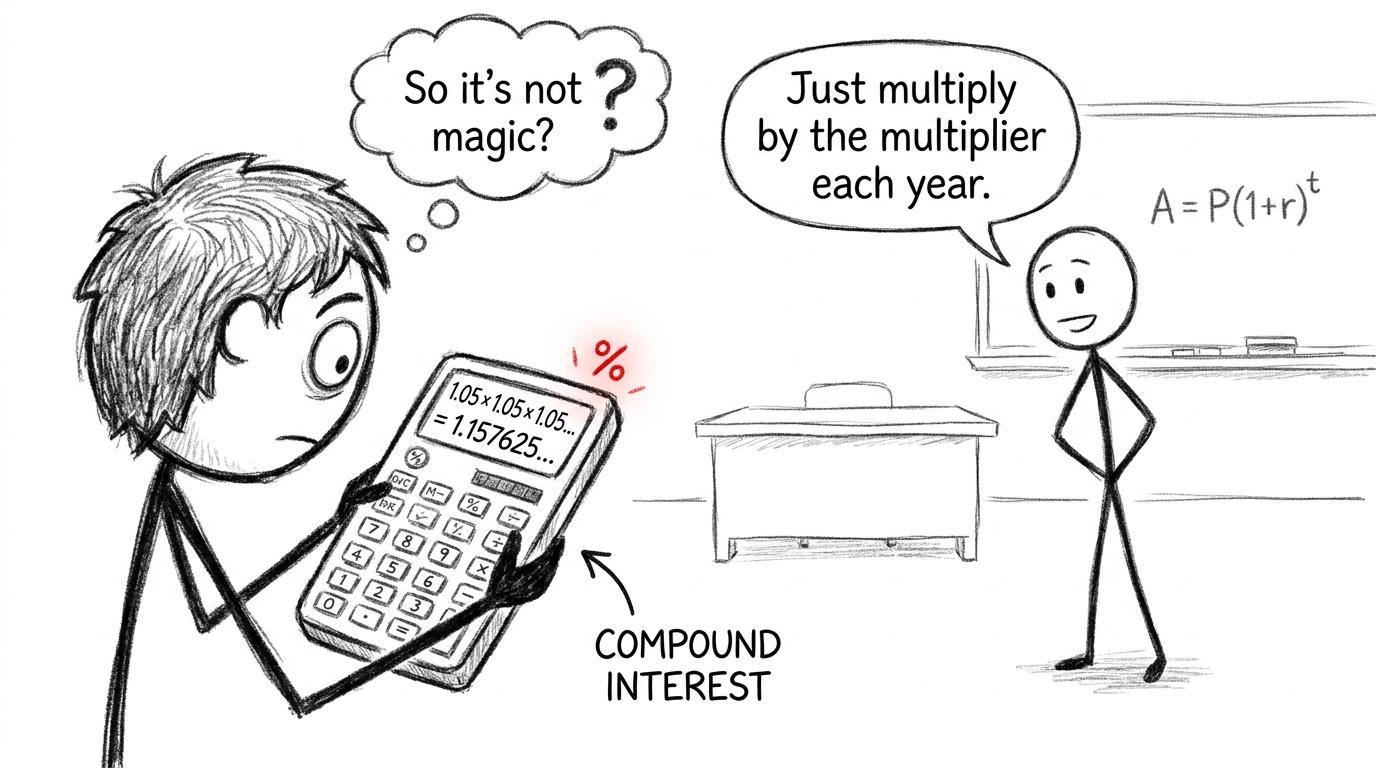 Student vs calculator: compound interest isn’t magic
Compound interest questions: a quick checklist
Before you touch your calculator, run this checklist (it saves more GCSE marks than any shortcut):
- Is it growth or decay? Interest increases; depreciation decreases.
- Find the multiplier:
- Increase by r%r\%r% means multiply by 1+r1001 + \frac{r}{100}1+100r.
- Decrease by r%r\%r% means multiply by 1−r1001 - \frac{r}{100}1−100r.
- Count the number of time periods (years, months, etc.). That becomes the power.
- Write the model: A=P×mnA = P \times m^nA=P×mn.
- Rounding: money usually to 2 decimal places unless the question says otherwise.
To practise these patterns, keep the topic pages open while you work: Compound Interest and Depreciation, Percentage Change, and the Repeated Percentage Change questions.
The core idea behind every GCSE compound interest method
The multiplier does the heavy lifting
In GCSE compound interest, you are repeatedly applying the same percentage change to the new amount each period.
If the annual interest rate is r%r\%r%, the multiplier is:
m=1+r100 m = 1 + \frac{r}{100} m=1+100rAfter nnn years, the total amount is:
A=P×(1+r100)n A = P \times \left(1 + \frac{r}{100}\right)^n A=P×(1+100r)nThat one line is the backbone of almost every compound interest and depreciation question you’ll see on a GCSE higher or foundation tier paper.
Worked example: straightforward compound interest
A savings account pays 3%3\%3% compound interest per year. You invest £250025002500 for 444 years. Find the value after 444 years.
Step 1: Multiplier
m=1+3100=1.03 m = 1 + \frac{3}{100} = 1.03 m=1+1003=1.03Step 2: Apply the power
A=2500×1.034 A = 2500 \times 1.03^4 A=2500×1.034Calculate:
1.034=1.12550881 1.03^4 = 1.12550881 1.034=1.12550881So:
A=2500×1.12550881=2813.772025 A = 2500 \times 1.12550881 = 2813.772025 A=2500×1.12550881=2813.772025Answer (money to 2 d.p.)
A=£2813.77 A = \pounds 2813.77 A=£2813.77If the question asks for interest earned, that is A−PA - PA−P:
Interest=2813.77−2500=£313.77 \text{Interest} = 2813.77 - 2500 = \pounds 313.77 Interest=2813.77−2500=£313.77For more exam-style practice, the Compound Interest and Depreciation booklet is ideal because it matches GCSE mark schemes closely.
Depreciation is the same story (just a different multiplier)
In GCSE depreciation questions (cars, phones, machines), the value decreases by a percentage each year.
If it depreciates by r%r\%r% each year, the multiplier is:
m=1−r100 m = 1 - \frac{r}{100} m=1−100rWorked example: depreciation over several years
A car costs £180001800018000. It depreciates by 12%12\%12% each year. Find its value after 333 years.
Step 1: Multiplier
m=1−12100=0.88 m = 1 - \frac{12}{100} = 0.88 m=1−10012=0.88Step 2: Apply compound change
V=18000×0.883 V = 18000 \times 0.88^3 V=18000×0.883Compute:
0.883=0.681472 0.88^3 = 0.681472 0.883=0.681472So:
V=18000×0.681472=12266.496 V = 18000 \times 0.681472 = 12266.496 V=18000×0.681472=12266.496Answer (money to 2 d.p.)
V=£12266.50 V = \pounds 12266.50 V=£12266.50This exact pattern appears frequently in GCSE papers, and it’s well supported by the questions and solutions on Stage 7 where compound interest and depreciation sit together.
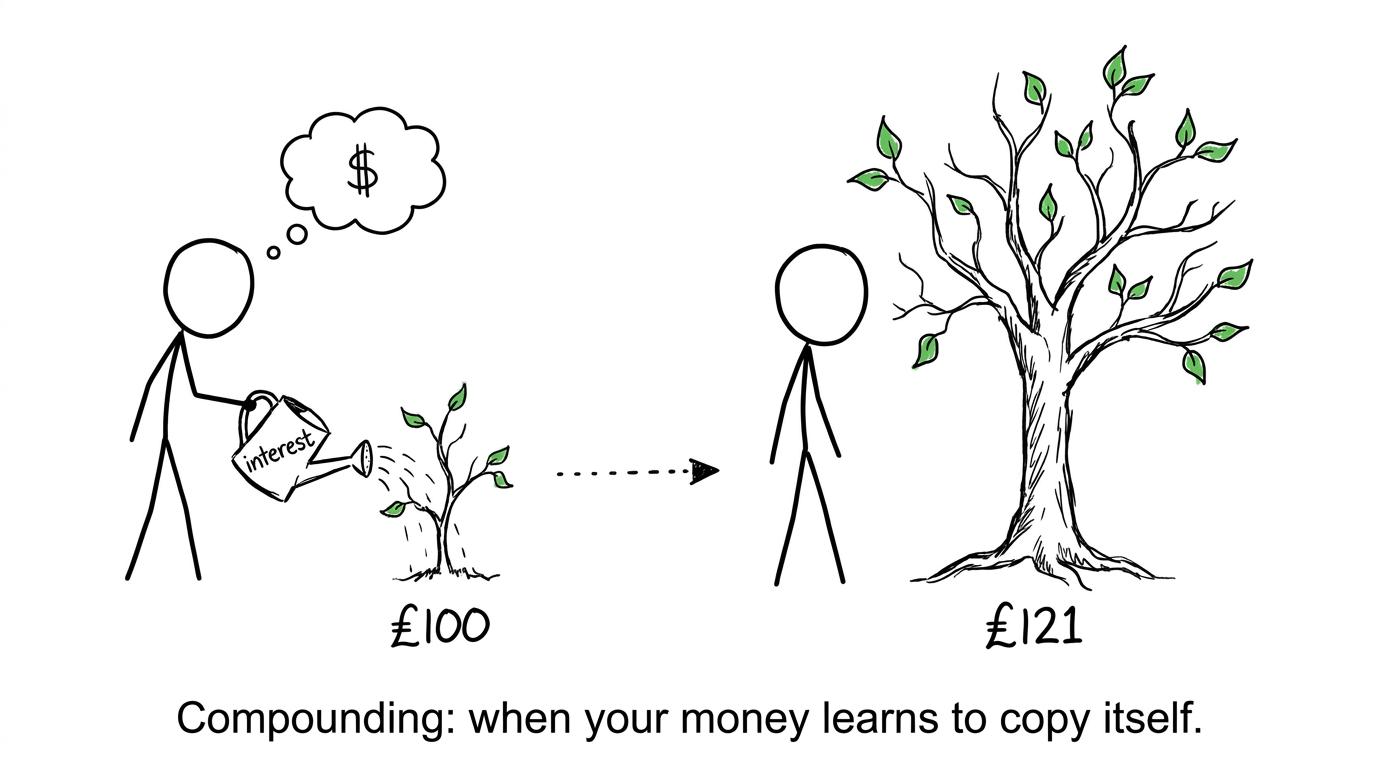 Money tree compounding visual gag
Reverse compound interest (finding the original amount)
Reverse questions are where many GCSE students lose marks, not because the idea is hard, but because they panic and start guessing.
If:
A=P×mn A = P \times m^n A=P×mnthen:
P=Amn P = \frac{A}{m^n} P=mnAWorked example: find the starting investment
A bank account pays 4%4\%4% compound interest per year. After 333 years, the balance is £5680.565680.565680.56. Find the amount originally invested.
Step 1: Identify values
- A=5680.56A = 5680.56A=5680.56
- m=1.04m = 1.04m=1.04
- n=3n = 3n=3
Step 2: Rearrange
P=5680.561.043 P = \frac{5680.56}{1.04^3} P=1.0435680.56Compute:
1.043=1.124864 1.04^3 = 1.124864 1.043=1.124864So:
P=5680.561.124864=5050 P = \frac{5680.56}{1.124864} = 5050 P=1.1248645680.56=5050Answer
P=£5050 P = \pounds 5050 P=£5050If you want more of these “work backwards” styles, use Repeated Percentage Change alongside Percentage Change; the topics feed into each other across GCSE and even early A Level modelling.
When the interest rate changes (two multipliers)
A very common GCSE twist is: one rate for the first year, then a different rate afterwards. The method is still calm: multiply year by year, or multiply the multipliers.
Worked example: different rates across years
£800080008000 is invested. It earns 2.5%2.5\%2.5% in the first year and then 1.8%1.8\%1.8% for the next two years. Find the final amount.
Year 1 multiplier:
m1=1.025 m_1 = 1.025 m1=1.025Years 2 and 3 multiplier:
m2=1.018 m_2 = 1.018 m2=1.018Total:
A=8000×1.025×1.0182 A = 8000 \times 1.025 \times 1.018^2 A=8000×1.025×1.0182Compute:
1.0182=1.036324 1.018^2 = 1.036324 1.0182=1.036324So:
A=8000×1.025×1.036324 A = 8000 \times 1.025 \times 1.036324 A=8000×1.025×1.036324 A=8000×1.0622321=8497.8568 A = 8000 \times 1.0622321 = 8497.8568 A=8000×1.0622321=8497.8568Answer (to 2 d.p.)
A=£8497.86 A = \pounds 8497.86 A=£8497.86This style appears in exam questions and also in real GCSE papers. If you’re building exam stamina, the Edexcel June 2019 Paper 3H includes compound interest in a realistic, calculator-friendly way.
Common mistakes that quietly cost GCSE marks
- Using ×0.03\times 0.03×0.03 instead of ×1.03\times 1.03×1.03 for an increase. 0.030.030.03 finds the interest only; 1.031.031.03 finds the new balance.
- Adding percentages across years (e.g. “5%5\%5% for 3 years means 15%15\%15%”). That’s simple interest thinking, not compound.
- Rounding too early. Keep full calculator accuracy until the final line, then round to 2 d.p. for money.
- Mixing up increase and decrease multipliers. Depreciation by 12%12\%12% is ×0.88\times 0.88×0.88, not ×1.12\times 1.12×1.12.
- Wrong power. If it says “for 5 years”, you need m5m^5m5. If it says “after 5 years”, it’s still m5m^5m5.
- Forgetting what the question asked: total amount vs interest earned vs value after depreciation. In GCSE mark schemes, the final interpretation line often carries a mark.
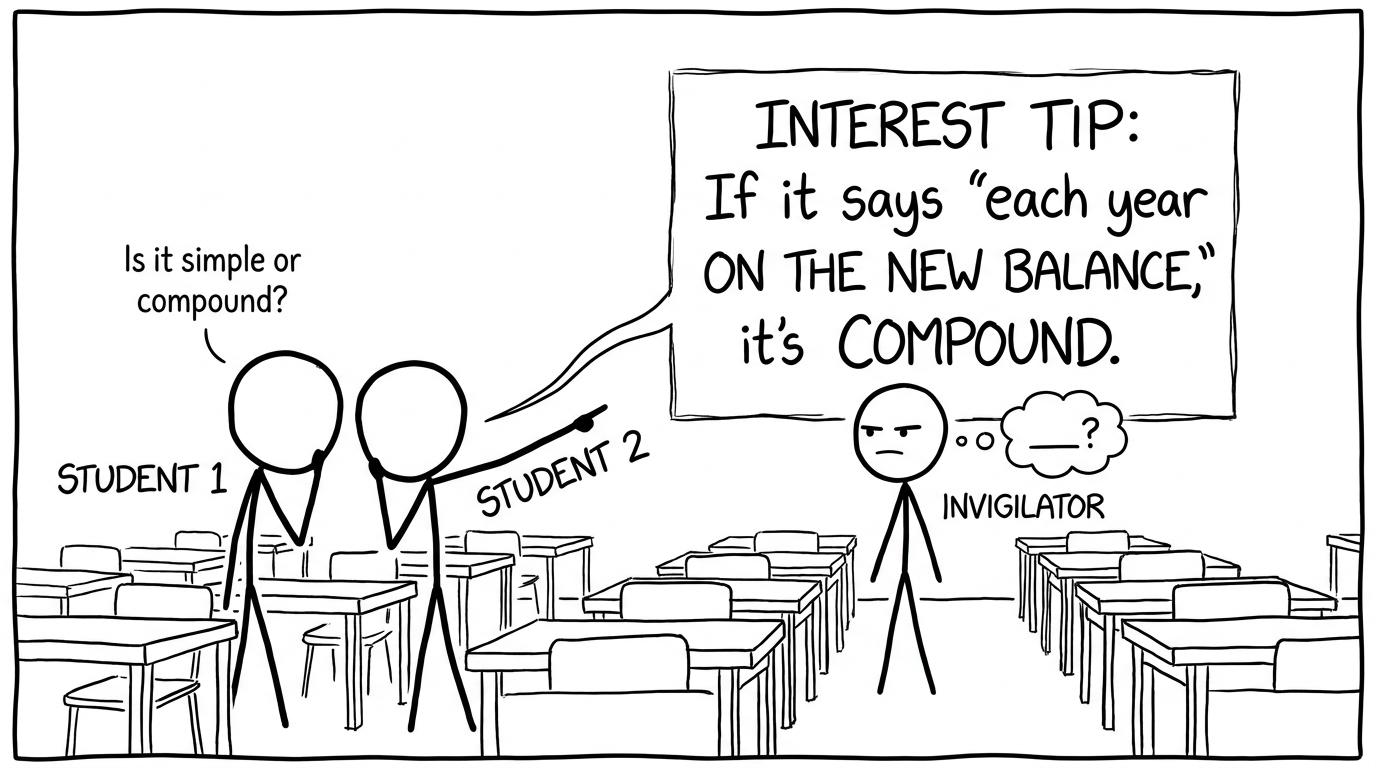 Exam hall: simple vs compound confusion joke
Bringing it all together (and how to practise efficiently)
Compound interest questions become “easy” when you stop treating them as separate puzzles and start treating them as one story: multiplier, power, interpret. That story appears again and again in GCSE papers from Edexcel, AQA, OCR and Eduqas, whether the context is savings, house prices, populations, or depreciation.
Your best next step is targeted practice with feedback. On Maths Genie you can:
- Learn the method with the Compound Interest and Depreciation revision lesson.
- Build accuracy using the Compound Interest and Depreciation exam questions booklet.
- Strengthen the foundations with Percentage Change and Repeated Percentage Change.
- Pressure-test your skills on real exam papers like Edexcel June 2019 Paper 3H, using the mark scheme approach Maths Genie supports across its resources.
If you want a simple plan: watch the revision content, do a small set of exam questions, check solutions, then repeat a few days later. That spacing is where the confidence comes from. And when compound interest shows up on your next GCSE paper, it won’t feel like magic; it will feel like a familiar pattern you’ve already practised.










