GCSE Combined Science Results Day Questions Answered
GCSE combined science results day questions answered clearly: understand double grades, boundaries, reviews, sixth-form choices and sensible next steps.
Results day can make a small envelope feel unusually heavy. You may recognise every subject on the page, yet Combined Science presents two numbers where you expected one. The most common GCSE Combined Science results day questions have reassuringly clear answers: it is a double-award qualification, the two grades come from your overall performance, and support is available if a result seems wrong or affects your next step.
For 2026, GCSE results are released to candidates on Thursday 20 August. Your school or college will explain when and how to collect them.
What should I check first on results day?
Before comparing grades with friends, check the practical details:
- Is your name and candidate information correct?
- Is Combined Science listed as a double grade?
- Does the result meet the published entry requirements for your chosen course?
- Is any result marked as pending or missing?
- Who at school can answer questions about sixth-form places or post-results services?
Keep the results sheet safe and take a clear photograph. If something looks unfamiliar, ask an examinations officer or teacher rather than trying to interpret it alone.
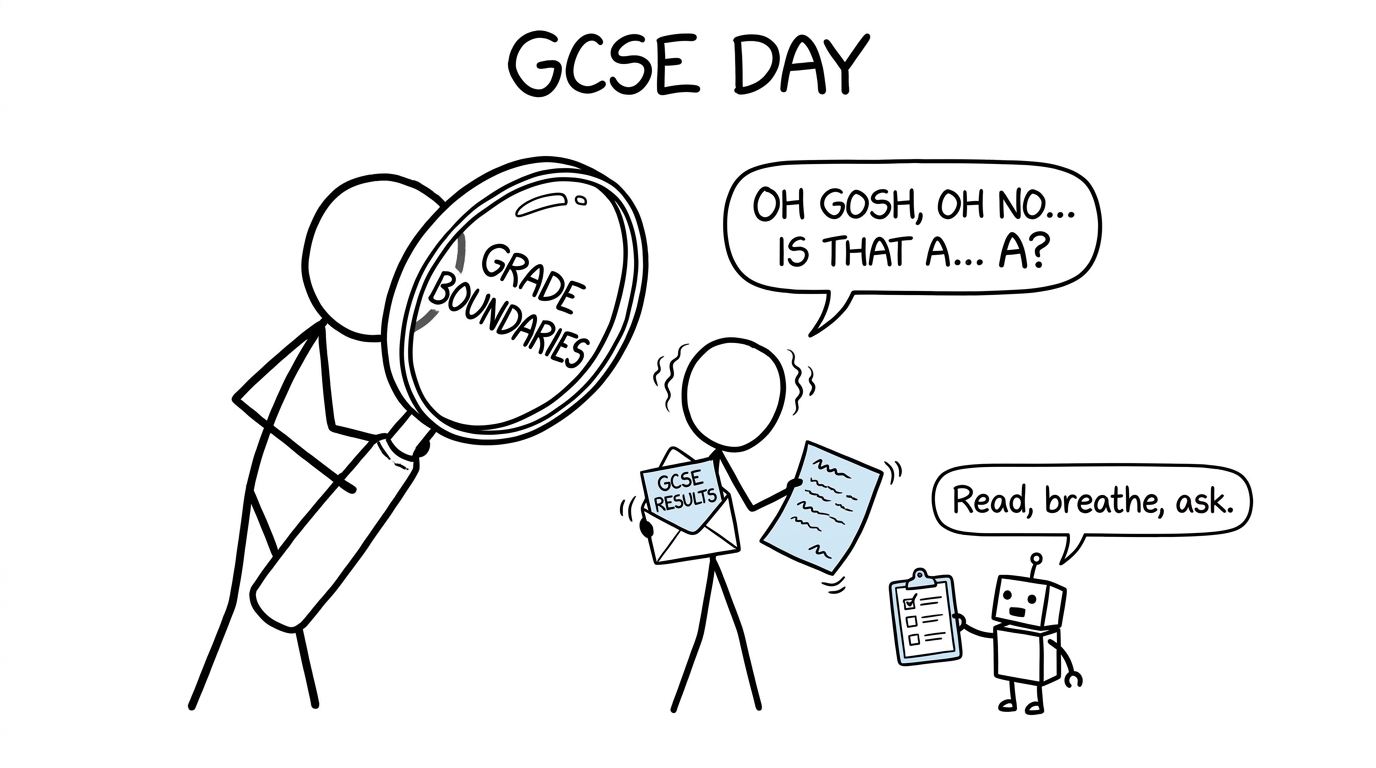 A student calmly checks a results-day list while a parent investigates grade boundaries
Why have I received two Combined Science grades?
GCSE Combined Science is worth two GCSEs. It therefore produces a double grade, such as 7-77\text{-}77-7, 6-56\text{-}56-5 or 4-44\text{-}44-4.
The grades must be equal or adjacent. Possible outcomes run from 9-99\text{-}99-9 down to 1-11\text{-}11-1, with the higher number written first when they differ. A result such as 7-57\text{-}57-5 is not possible.
This structure applies to regulated GCSE Combined Science qualifications, although paper arrangements differ between AQA, Edexcel, OCR and Eduqas. Always check the information for your examination board and specification.
Are the two grades for different sciences?
No. The first number is not Biology and the second is not Chemistry or Physics. Your marks across the Combined Science assessments are brought together at qualification level and converted into one double grade.
That matters because a difficult Physics paper does not automatically become a separate low Physics grade. Stronger performance elsewhere can contribute to the overall result. You do not receive individual GCSE grades for Biology, Chemistry and Physics unless you entered the separate science qualifications.
Students following AQA can revisit the structure through AQA GCSE Combined Science revision, including Foundation and Higher content.
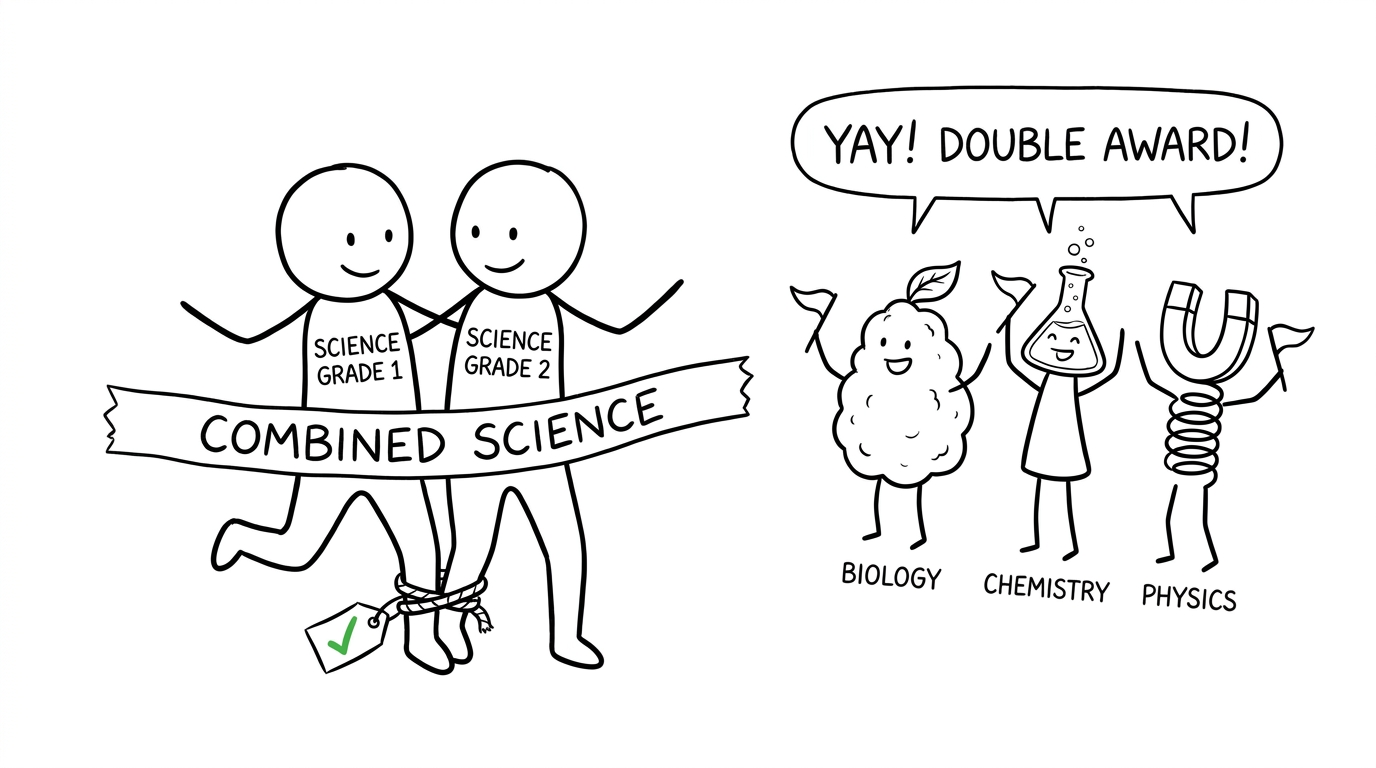 Two science grades complete a three-legged race as Biology, Chemistry and Physics cheer
What do grades such as 5-45\text{-}45-4 and 4-34\text{-}34-3 mean?
Both numbers count towards your GCSE profile. For example, 5-45\text{-}45-4 represents two GCSE grades: one at grade 555 and one at grade 444.
However, schools, colleges and apprenticeship providers decide their own entry requirements. One provider may request a particular Combined Science double grade, while another may consider your overall GCSE profile. Ask the provider directly if its wording is unclear. Do not assume that “grade 555 in Science” automatically means every double-grade combination containing a 555 will qualify.
How were my Combined Science grades calculated?
Your raw marks across the relevant papers are combined. The awarding organisation then compares the total with that examination series’ qualification-level grade boundaries.
Grade boundaries are not reliable predictions made months beforehand. Awarding organisations set them after the papers have been taken and marked, taking account of paper demand and evidence from the awarding process. This is why boundaries can change between years.
A mark near a boundary can feel especially significant, but distance from a boundary does not by itself prove that marking was wrong.
Can I see my marks and grade boundaries?
Your results information may show a qualification mark, but the exact detail provided varies between schools and awarding organisations. Your examinations officer can tell you your mark, the relevant boundary and whether a marked script can be accessed.
Use only the boundary for the correct exam board, qualification, tier and examination series. A boundary from another year or from separate Biology, Chemistry or Physics is not comparable.
For future practice, AQA Combined Science past papers let students pair papers with official mark schemes and review how marks are awarded.
Can I request a remark?
The formal service is normally called a review of marking, not a fresh remark. It checks whether the original mark scheme was applied correctly. A clerical re-check instead checks matters such as mark totals, recording and whether all parts were marked.
Requests are usually made through your school or college, and candidate consent is required because a reviewed mark can rise, fall or stay unchanged. For the June 2026 series, JCQ lists 24 September 2026 as the deadline for awarding bodies to receive GCSE review-of-results requests. Your school will set an earlier internal deadline, so speak to staff promptly.
Ask whether viewing the marked script first would help a teacher judge if a review is sensible. Fees and school policies can vary.
What if my grade affects my sixth-form or college place?
Contact the provider immediately. Bring your results and explain the situation calmly. The provider may confirm your place, suggest another course or explain whether it can wait for a post-results decision.
Entry requirements are set by individual institutions, so there is no universal answer. If you plan to take A Level Biology, Chemistry or Physics, the provider may consider Combined Science alongside GCSE Maths and other results.
You can keep numerical skills moving with GCSE Maths revision or structured Edexcel GCSE Maths lessons. These skills remain important in science, particularly for equations, graphs, proportional reasoning and data.
Do I have to resit Combined Science?
There is no general national requirement comparable to the post-16 resit rules for GCSE English language and Maths. Whether you should retake science depends on your intended course, the provider’s requirements and the options available locally.
Discuss the decision with your school or college. A different course may be more appropriate than committing immediately to a resit, especially if your wider results meet your longer-term goals.
What should I do after the initial results-day conversation?
Turn uncertainty into a short written plan:
- confirm your course place;
- record any school deadline for script access or a review;
- identify topics that need strengthening;
- begin a manageable revision routine if you are resitting or progressing to science-heavy study.
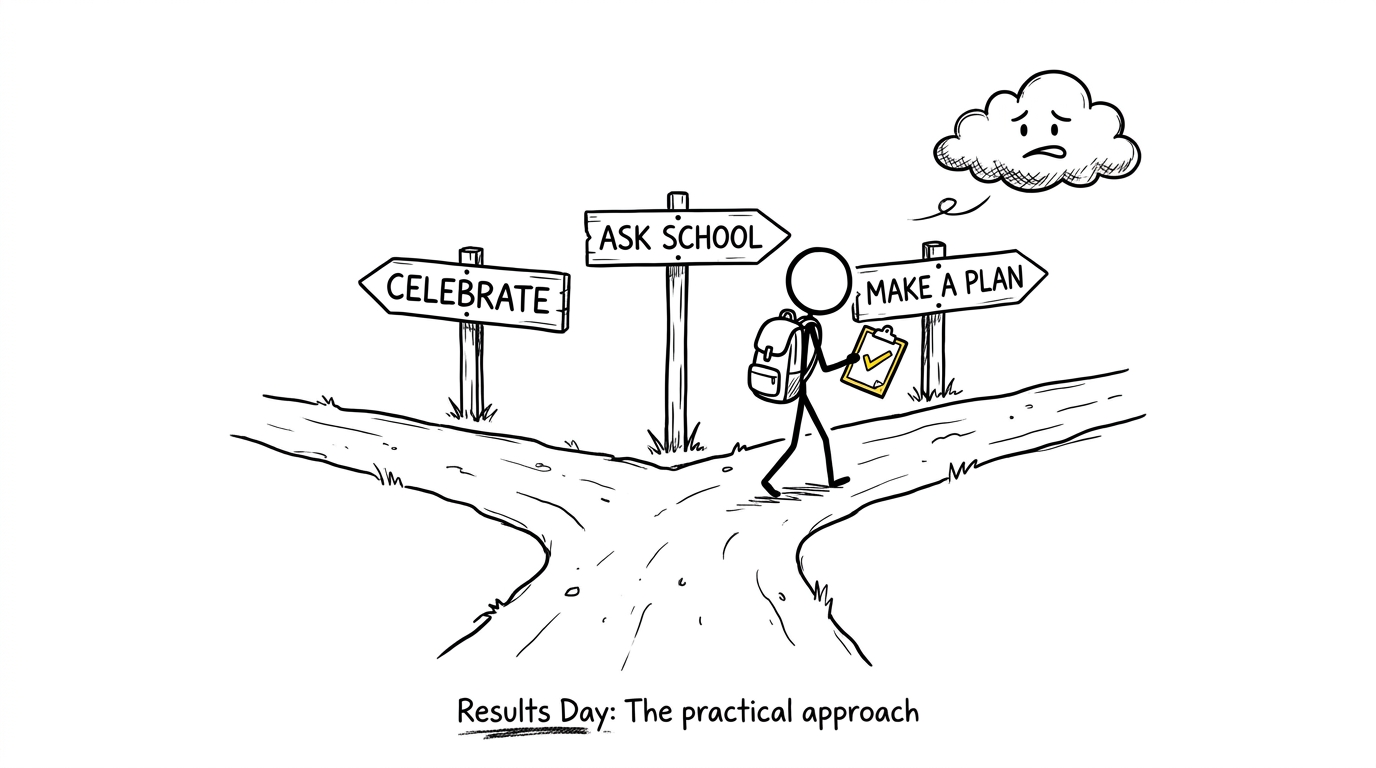 A student chooses a calm written plan instead of following an anxious results-day cloud
Explore all GCSE subjects, use the MathsGenie revision resources, or read the MathsGenie revision blog when planning your next steps.
Common results-day mistakes
Avoid comparing marks with boundaries from the wrong year, board or tier. Do not interpret the two grades as separate sciences, and never request a review solely because you are close to a boundary. Most importantly, do not wait until an official deadline: schools need time to discuss, obtain consent and submit requests.
Results day is important, but it is not a complete verdict on what you can learn next. Read the result accurately, ask the right person and make one decision at a time.
Start with MathsGenie’s free GCSE Combined Science resources, then use revision lessons, practice questions, past papers, predicted papers, mini tests and mark schemes to make your next stage more deliberate. Calm progress often begins with a much smaller action than students expect.