GCSE Chemistry Grade 7 Meaning: A Clear Guide
GCSE chemistry grade 7 meaning explained: ability, old letter-grade comparison, changing grade boundaries and ways to improve vital calculation skills.
A results sheet can make one number feel unusually powerful. But what does that number really say about what you know?
The GCSE chemistry grade 7 meaning is straightforward: in an English GCSE graded from 999 to 111, a grade 777 represents strong performance and is broadly aligned with the old grade A. It indicates that you can usually recall detailed chemical knowledge, apply it to less familiar situations, interpret evidence and handle demanding calculations. It is not a fixed percentage, and it does not mean that every part of your chemistry is equally strong.
That distinction matters. A grade describes your overall performance across the assessments, not your intelligence, future potential or worth as a student.
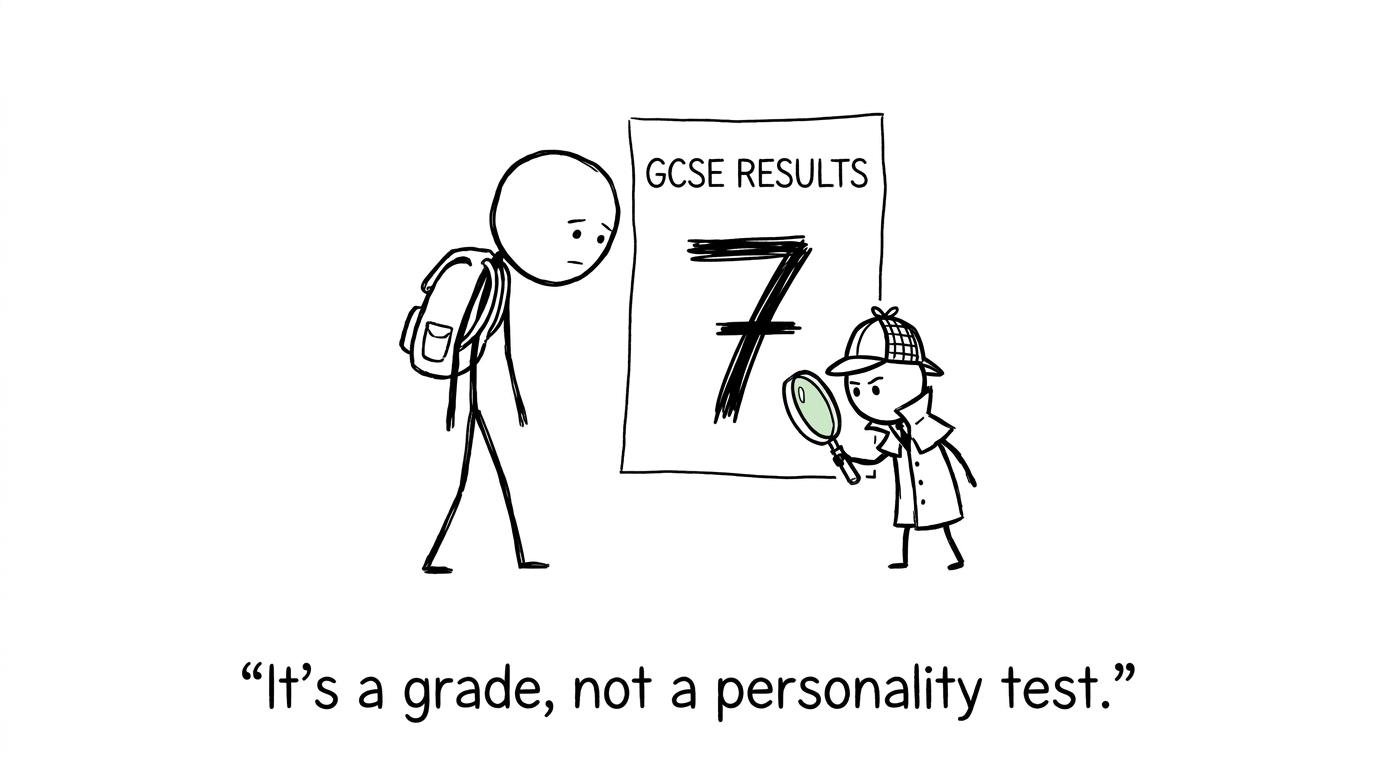 A student investigates what a grade seven really means
Grade 7 at a glance
Here is the short version:
- A grade 777 is a strong GCSE result.
- It is broadly comparable with the old grade A.
- It sits above grades 444, 555 and 666, but below grades 888 and 999.
- There is no permanent percentage needed for a grade 777.
- Grade boundaries vary by exam series, exam board and specification.
- Separate GCSE Chemistry gives one grade; Combined Science gives two grades, such as 777-777 or 777-666.
- Reaching this level requires both chemical understanding and accurate mathematical work.
If calculation questions are limiting your chemistry marks, the free GCSE maths revision lessons on MathsGenie can help you strengthen the underlying skills.
What does a grade 7 represent in terms of ability?
A grade 777 does not correspond to one rigid checklist of abilities. Your final grade is based on your total mark, so two students can reach the same grade through different combinations of strengths.
Even so, a student working securely around grade 777 will generally be able to do more than reproduce memorised facts.
Secure chemical knowledge
You need a well-connected understanding of the specification. Depending on the exam board, this includes areas such as atomic structure, bonding, quantitative chemistry, chemical changes, energy changes, rates, equilibrium, organic chemistry, chemical analysis, the atmosphere and resources.
At grade 777, knowledge is increasingly useful rather than merely familiar. You should be able to select the relevant idea without always being told which topic is being tested.
Application in unfamiliar contexts
Higher-demand questions often place familiar chemistry inside an unfamiliar experiment, substance or industrial process. The scientific principle has not changed, but its packaging has.
A strong student can separate the important information from the surrounding detail. That might mean recognising a rate-of-reaction principle in a new practical context or using particle ideas to explain an observation that was not presented in exactly the same way during lessons.
Analysis and evaluation
A grade 777 also reflects an ability to interpret data, identify patterns, judge conclusions and evaluate experimental methods. You may need to explain why evidence supports a claim, suggest a source of uncertainty or identify how a procedure could be improved.
Precision matters here. Statements such as “make it more accurate” are rarely enough on their own. Strong answers identify a specific change and explain why it improves the evidence.
Confident quantitative work
GCSE Chemistry contains substantial mathematical content. Official subject requirements mean that at least 20%20\%20% of the marks in GCSE Chemistry assess mathematical skills, although those marks remain chemistry marks within the examination.
Relevant skills can include:
- ratios and proportional reasoning;
- percentages and percentage yield;
- rearranging equations;
- standard form;
- converting units;
- reading graphs and calculating gradients;
- using significant figures;
- substituting values into chemical equations;
- interpreting numerical data.
These are not separate from chemistry. They are often the language through which chemical understanding is assessed.
Is grade 7 the same as an old grade A?
A grade 777 is broadly equivalent to the old grade A, but the comparison needs care.
When the 999-111 system was introduced in England, the lower boundary of grade 777 was aligned with the lower boundary of the former grade A. Grade 444 was aligned with the lower boundary of the old grade C, while grade 111 was aligned with the lower boundary of the old grade G.
A useful broad comparison is:
| Current grade | Approximate relationship to old grades |
|---|---|
| 999 | Higher than the former A* standard at its top end |
| 888 | Between the old A and A* benchmarks |
| 777 | Broadly aligned with an old A |
| 666 | Broadly around an old B |
| 555 | Between the old B and C benchmarks |
| 444 | Broadly aligned with an old C |
This is a comparison of grading benchmarks, not a perfect candidate-by-candidate conversion. The qualifications, assessment structures and questions changed when the reformed GCSEs were introduced. It is therefore safer to say that grade 777 is broadly aligned with an A rather than claiming the two are identical.
The 999-111 scale applies to GCSEs in England, including qualifications offered there by AQA, Edexcel, OCR and Eduqas. Grading arrangements differ elsewhere in the UK. GCSEs in Wales and Northern Ireland generally continue to use letter grades, while Scotland has a different qualification system.
Why there is no fixed grade 7 percentage
Students often ask whether grade 777 means achieving 70%70\%70%. It does not.
Exam boards set grade boundaries after the papers have been taken and marked. Boundaries take account of the demand of that examination series so that students are not unfairly advantaged or disadvantaged by a paper being slightly easier or harder than another year’s paper.
As a result, the grade 777 boundary can vary:
- between AQA, Edexcel, OCR and Eduqas;
- between separate Chemistry and Combined Science;
- from one examination series to another;
- between specifications with different total marks and paper structures.
A raw mark from one paper cannot safely be compared with an unrelated paper without checking the correct official boundary. During revision, it is more useful to track the questions you can answer reliably than to assume that one percentage guarantees a particular grade.
Separate Chemistry and Combined Science grades
The phrase “grade 777 in chemistry” can refer to two different routes.
If you take separate GCSE Chemistry, sometimes called triple science, Chemistry is its own qualification and you receive one grade from 999 to 111.
If you take Combined Science, your performance across biology, chemistry and physics contributes to a double award. You receive two grades, such as 777-777, 777-666 or 666-666. You do not normally receive an independent GCSE Chemistry grade on your certificate.
This means a Combined Science grade 777-777 is not simply a separate grade 777 in each science. It is an overall double grade calculated across the Combined Science assessments according to the specification and grading arrangements.
Higher-tier science papers provide access to grades up to 999. Foundation tier normally awards grades from 111 to 555, so a target of grade 777 requires higher-tier entry.
Why maths can decide whether grade 7 is within reach
A student can understand the chemistry and still lose marks because a unit was not converted, a ratio was reversed or an equation was rearranged incorrectly. These errors feel small. Across several papers, they accumulate.
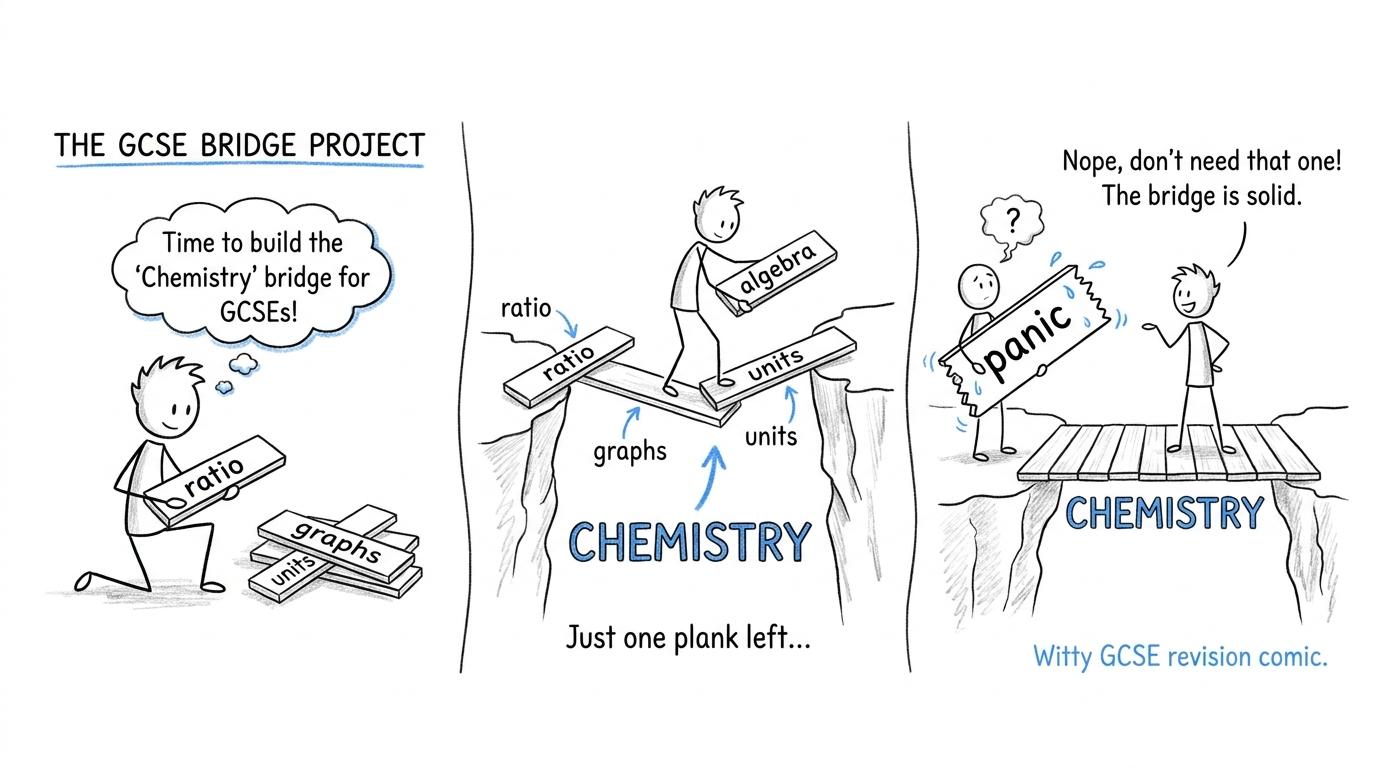 A student builds a bridge between maths and chemistry
The good news is that mathematical accuracy is trainable. Begin by identifying the type of difficulty:
- If formulas become confusing, practise changing the subject and substitution.
- If quantities seem disconnected, revise ratio and proportion.
- If very large or small numbers cause errors, revisit standard form.
- If graphs cost marks, practise scales, gradients and interpreting trends.
- If your method is correct but the final answer is rejected, check units, rounding and significant figures.
MathsGenie’s free GCSE revision hub organises lessons and practice by grade, making it easier to repair a specific weakness rather than revising everything at once. The GCSE maths past papers are also useful for building fluency under timed conditions.
A focused route towards grade 7
Revision becomes more effective when it produces evidence. Reading notes can create a comforting sense of recognition, but an exam asks whether you can retrieve and apply an idea without seeing the page it came from.
Diagnose before revising
Complete a suitable paper or set of questions under realistic conditions. Mark it carefully and sort lost marks into categories:
- knowledge not remembered;
- knowledge remembered but misapplied;
- calculation error;
- command word misunderstood;
- insufficient detail;
- time pressure or an unanswered question.
This turns “I need to improve chemistry” into a smaller, more useful problem.
Connect topics rather than isolating them
Grade 777 questions may combine ideas. Quantitative chemistry can involve equations, ratios and unit conversion. Rates can involve practical methods, particle theory and graphs. Electrolysis can involve ionic equations as well as explanations of observations.
Build links between ideas and ask why each formula or rule makes chemical sense. Connected knowledge is easier to retrieve when the question looks unfamiliar.
Use the mark scheme after attempting the question
A mark scheme is most valuable after you have committed to an answer. Compare its required points with your wording, then improve the response without copying blindly.
For mathematical questions, inspect the method as well as the answer. A correct structure may earn method marks even if an arithmetic error appears later. Conversely, a calculator result without a visible method can make it harder to gain credit when the final value is wrong.
Revisit errors
Retry missed questions after a short gap. If the second attempt only works because you remember the mark scheme, return again later with a similar question. Improvement is demonstrated by independent recall, not by familiarity.
For wider exam practice, use MathsGenie’s past-paper collection, predicted maths papers and revision planner to build a repeatable routine around your science revision.
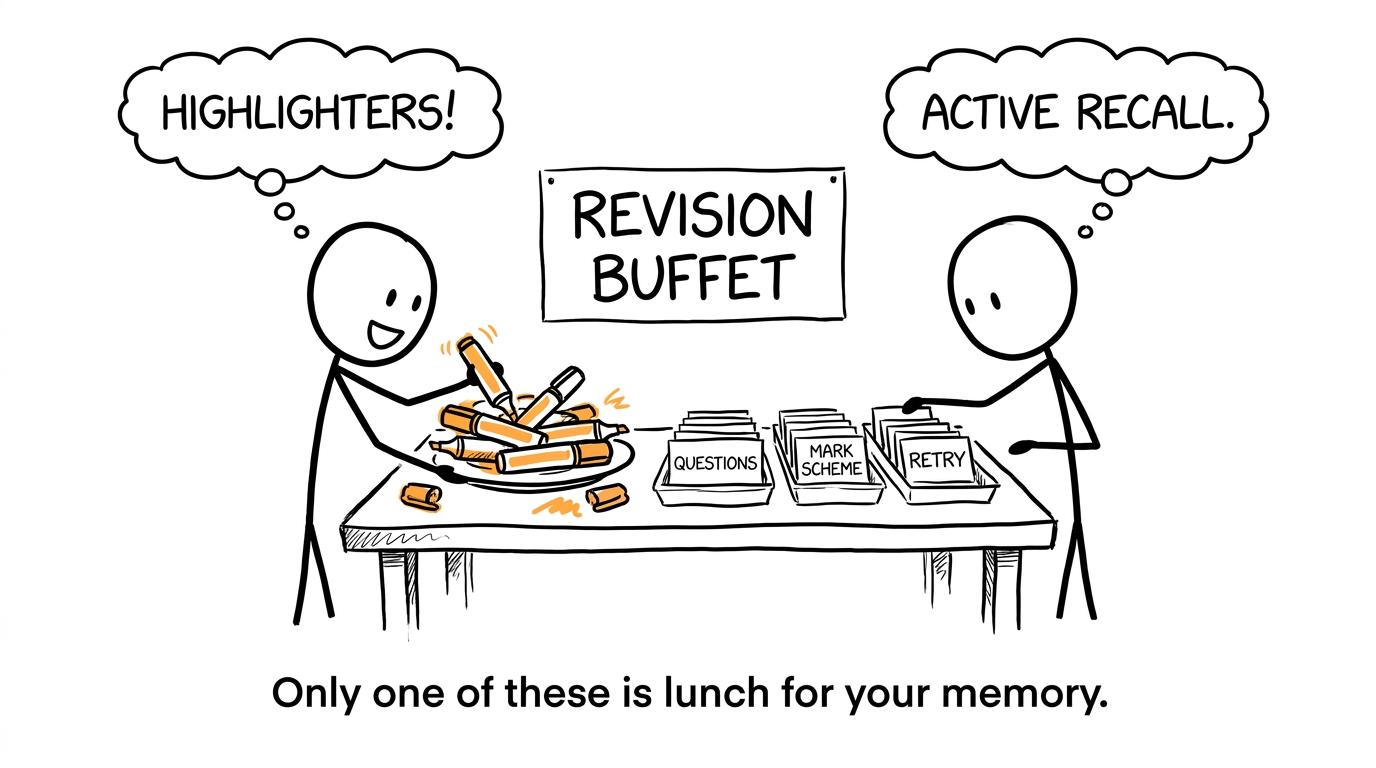 Revision choices at the memory buffet
Common mistakes when interpreting or aiming for grade 7
Treating grade 7 as a fixed percentage
There is no universal mark such as 70%70\%70% that always produces grade 777. Use the official boundary for the exact exam board, qualification and series when interpreting a completed paper.
Assuming grade 7 means perfection
A grade 777 is a strong result, but it does not require full marks. Students at this level can still have weaker topics and make mistakes. The goal is consistent performance across the specification.
Converting old and new grades too precisely
Grade 777 is broadly aligned with the old A. It should not be treated as an exact translation of every result achieved under the previous specification.
Confusing separate and Combined Science
A single grade in GCSE Chemistry and a double grade in Combined Science describe different qualifications. Check which course you are taking before comparing targets or boundaries.
Ignoring the mathematical marks
Calculation skills cannot be postponed until the final week. Ratio, graphs, units, percentages and equation work need repeated practice. MathsGenie’s free maths video lessons and practice questions provide a practical place to build those foundations.
Revising only comfortable topics
Repeating a topic you already know feels productive because progress appears immediate. Grade improvement usually comes from finding the questions that expose uncertainty and returning to them until the method becomes dependable.
A grade is information, not a verdict
A grade 777 in GCSE Chemistry represents strong knowledge, sound application and the ability to reason through many demanding scientific and mathematical questions. It is broadly comparable with the old grade A, but it is not tied to one permanent percentage or one flawless profile of skills.
The most useful question is not simply, “Am I a grade 777 student?” It is, “Which marks am I not yet collecting, and why?” That question leads somewhere.
Use MathsGenie to strengthen the mathematical side of that journey. Start with the GCSE maths revision resources, practise with GCSE past papers, then use predicted papers, video solutions, mini tests and the revision planner to turn weaknesses into specific next steps. A grade is the final summary. The habits that produce it are built one accurate answer at a time.