GCSE Business Paper 1: What to Actually Expect
GCSE Business Paper 1 explained: compare timings, topics and question styles for Edexcel, AQA, OCR and Eduqas, then plan focused revision.

The unsettling thing about an exam is rarely the content alone. It is uncertainty: how long the paper lasts, which topics belong on it, when the case study appears and what an extended question is really asking you to do.
For GCSE Business Paper 1, the useful answer depends on your exam board. Edexcel, AQA, OCR and Eduqas do not use identical structures. Paper 1 may focus on small businesses, operations and human resources, or business activity, marketing and people. Even the timing and number of marks vary.
This guide explains those differences, the questions Paper 1 tends to favour and how to prepare for its mathematical and written demands. Confirm your board with your teacher, timetable or exam-paper code before using any checklist.
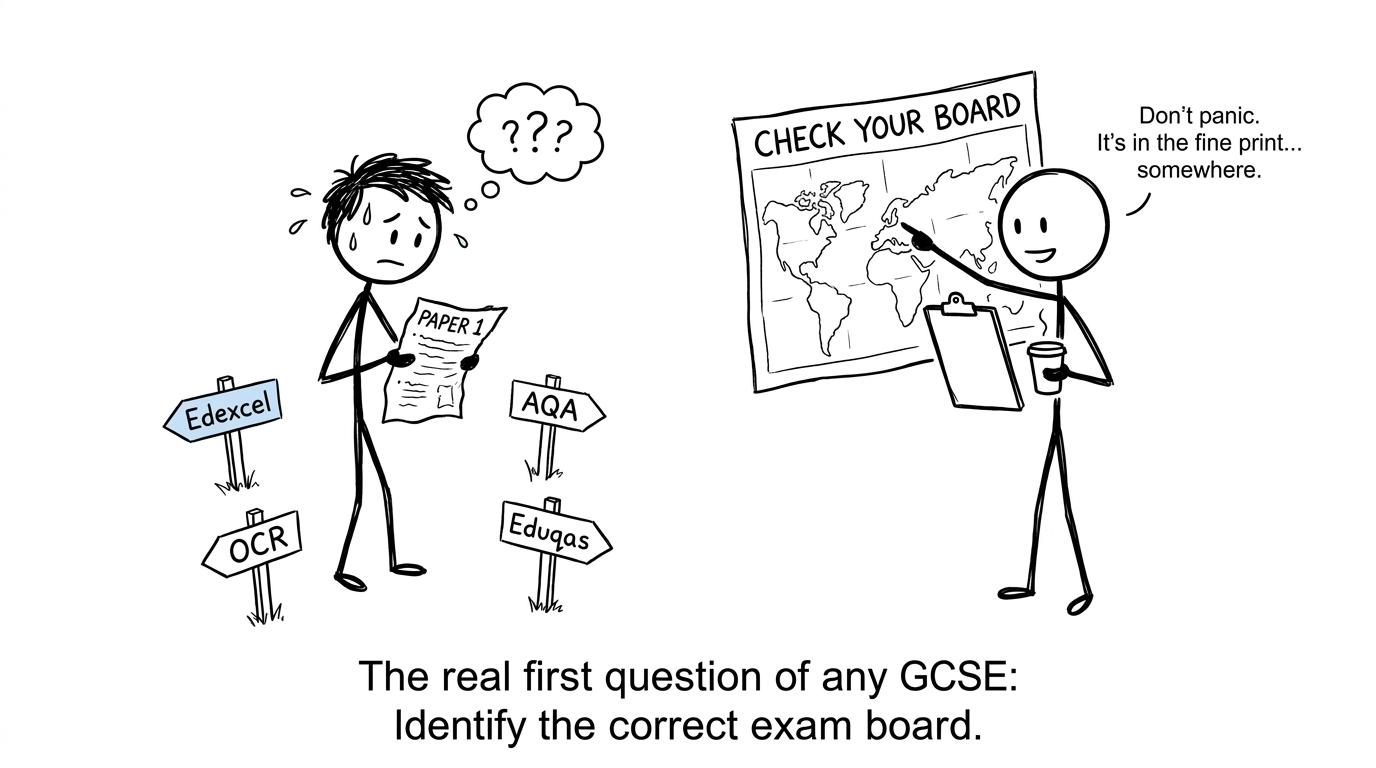 A student discovers why checking the exam board matters before Paper 1
GCSE Business Paper 1 at a glance
Start with this checklist:
- identify your exam board and specification
- learn the content assigned to Paper 1
- check the current time limit and total marks
- understand how the paper is divided into sections
- revise calculations as well as business terminology
- practise applying ideas to unfamiliar businesses
- compare extended responses with official mark schemes
- complete at least one full paper under timed conditions
The most important point is simple: do not revise from a generic Paper 1 list. Use the page matching your board, such as Edexcel GCSE Business revision, AQA GCSE Business revision, OCR GCSE Business past papers or Eduqas GCSE Business revision.
Paper 1 timing and structure by exam board
The current specifications show substantial differences.
| Exam board | Paper or component | Time | Marks | Weighting |
|---|---|---|---|---|
| Edexcel | Paper 1: Investigating small business | 111 hour 454545 minutes | 909090 | 50%50\%50% |
| AQA | Paper 1: Influences of operations and HRM on business activity | 111 hour 454545 minutes | 909090 | 50%50\%50% |
| OCR | Business 1: business activity, marketing and people | 111 hour 303030 minutes | 808080 | 50%50\%50% |
| Eduqas | Component 1: Business Dynamics | 222 hours | 100100100 | 62.5%62.5\%62.5% |
Eduqas calls its first assessment Component 1, rather than Paper 1. It carries more of the overall qualification than Component 2, so Eduqas students should not assume the two assessments have equal weighting.
Edexcel Paper 1
Edexcel Paper 1 assesses Theme 1: Investigating small business. Its five topic areas cover enterprise and entrepreneurship, spotting a business opportunity, putting an idea into practice, making the business effective and understanding external influences.
The paper has three sections:
- Section A: 353535 marks
- Section B: 303030 marks
- Section C: 252525 marks
Expect calculations, multiple-choice questions, short answers and extended writing. Sections B and C use business contexts, so accurate knowledge must be applied to the organisation described rather than repeated generically.
AQA Paper 1
AQA Paper 1 covers business in the real world, influences on business, business operations and human resources. Marketing and finance are principally associated with Paper 2, although ideas across a business can still connect.
The paper contains three sections. Section A is worth 202020 marks and includes multiple-choice and short-answer questions. Sections B and C use separate case-study or data-response material and are worth approximately 343434 and 363636 marks respectively.
AQA introduced a revised approach to its 666-mark GCSE Business questions for summer 2026 onwards, moving away from wording tied to one specified factor. Current practice should therefore come from recent assessment material, not only older question packs.
OCR Business 1
OCR Business 1 assesses business activity, marketing and people. The examination has two sections:
- Section A: 151515 marks of multiple-choice questions
- Section B: 656565 marks of short, medium and extended responses using real business contexts
The shorter overall time does not make OCR easy. Most marks sit in contextual questions, so students must move efficiently from reading the stimulus to selecting evidence and developing an answer.
Eduqas Component 1
Eduqas Business Dynamics covers a broad sample of specification content through multiple-choice, short and structured questions, with a contribution from extended response. Its style differs from Component 2, which is more explicitly organised around data response.
This means Component 1 rewards breadth. A narrow revision plan built around only two or three favourite topics leaves too much of the specification exposed.
What question types does Paper 1 favour?
Across boards, Paper 1 is not merely a memory test. Questions move through four connected demands: knowledge, application, analysis and evaluation.
Multiple-choice and short-answer questions
These reward precision. A one-mark question does not need a paragraph, while a definition cannot survive on vague everyday language. Learn terms accurately, including revenue, variable cost, market segmentation, limited liability, productivity and methods of motivation where they appear on your specification.
Short questions can feel harmless, but together they represent a meaningful share of the paper. They are also where avoidable losses occur through misreading command words such as identify, state, calculate, outline and explain.
Case-study and data-response questions
The case study is not background decoration. It supplies the details that turn a general point into an applied one.
Before answering, identify the business's:
- size and ownership
- product or service
- target market
- objectives
- financial position
- employees and operational constraints
- competitive or economic environment
Application means using those details to explain why an effect matters to this business. Simply repeating its name does not demonstrate meaningful application.
Analysis questions
Analysis explains a chain of consequences. A strong response does not stop at “costs will rise”. It considers what happens next: perhaps prices increase, demand changes, profit margins narrow or an objective becomes harder to achieve.
Every link must be plausible. Longer chains are not automatically better; a short, secure argument is more valuable than an elaborate chain built on an unsupported assumption.
Extended evaluation
Longer questions favour decisions rather than lists. You may need to compare options, consider advantages and disadvantages, or judge how far one factor affects a business.
A defensible judgement should emerge from the evidence already discussed. It may depend on the firm's objective, available finance, timescale, workforce or market conditions. “It depends” is not a conclusion by itself. Explain what it depends on and why that condition changes the decision.
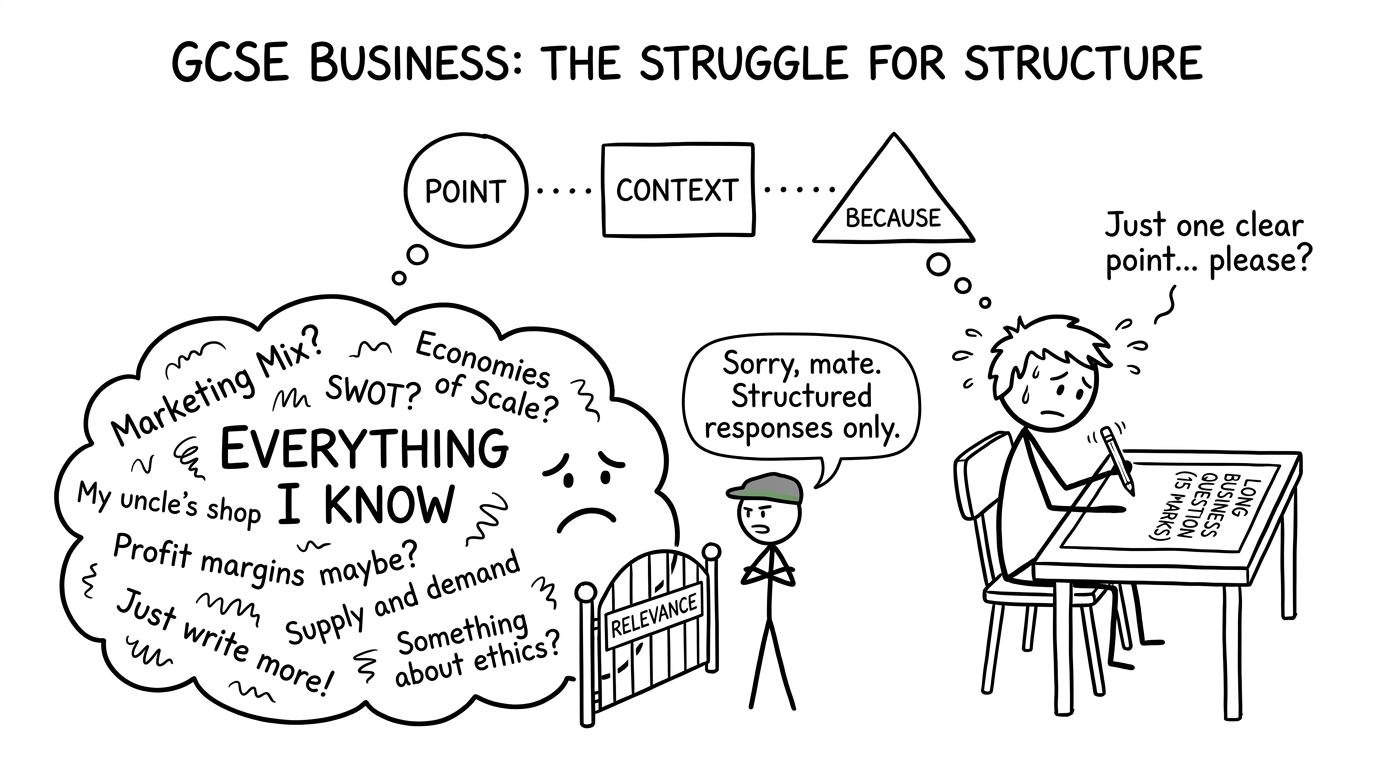 Point, context and reasoning queue up while a vague answer is refused entry
The mathematical side of GCSE Business Paper 1
Business calculations are usually accessible, but they become difficult when several skills arrive together: selecting a formula, reading a table, keeping track of units and interpreting the result.
Depending on your board and Paper 1 content, useful relationships may include:
Revenue=selling price per unit×quantity sold\text{Revenue}=\text{selling price per unit}\times\text{quantity sold}Revenue=selling price per unit×quantity sold Profit=total revenue−total costs\text{Profit}=\text{total revenue}-\text{total costs}Profit=total revenue−total costs Percentage change=new value−original valueoriginal value×100\text{Percentage change}=\frac{\text{new value}-\text{original value}}{\text{original value}}\times 100Percentage change=original valuenew value−original value×100Do not assume every formula will be supplied. Check your own specification, memorise what it requires and practise choosing the correct relationship without a prompt. The AQA calculation revision guide and OCR calculation revision guide provide board-matched coverage.
The calculation is often only the beginning. Interpretation asks what the figure means for decisions, cash flow, competitiveness, staffing or profitability. The AQA interpretation guide shows how to connect numerical evidence to a business consequence.
If percentages remain unreliable, strengthen the underlying skill through fractions, decimals and percentages revision. Business students benefit from the same habits as maths students: show working, retain units, check whether the answer is sensible and avoid rounding too early.
How to manage the time
A useful starting point is to compare available minutes with marks, while remembering that reading and checking also consume time.
For a 105105105-minute, 909090-mark paper, the average is:
10590≈1.17 minutes per mark\frac{105}{90}\approx 1.17\text{ minutes per mark}90105≈1.17 minutes per markFor OCR's 909090-minute, 808080-mark paper, it is:
9080=1.125 minutes per mark\frac{90}{80}=1.125\text{ minutes per mark}8090=1.125 minutes per markThese are planning guides, not rigid laws. Multiple-choice questions may take less time, leaving more for contextual and extended responses.
Use three checkpoints:
- Beginning: read the instructions and locate each section.
- Middle: compare your progress with the marks completed, not merely the page number.
- End: preserve time to finish the final high-mark response and check calculations.
A blank extended response is expensive. If one short question stalls you, mark it, move on and return later.
A focused revision method for Paper 1
Begin with a timed diagnostic paper. Mark it honestly, then sort every lost mark into one of six categories: knowledge, application, analysis, judgement, calculation or timing.
That classification matters. Rereading the whole textbook will not fix a student who knows the content but never uses the case study.
Build revision around this loop:
- revisit one weak area through a short revision lesson
- retrieve definitions and processes without notes
- answer specification-matched practice questions
- check the mark scheme or video solution
- record one precise correction
- retest the same skill within a few days
Move from isolated topics to timed sections, then to complete papers. MathsGenie's GCSE Business resit revision plan contains a useful diagnostic framework even if you are taking the qualification for the first time.
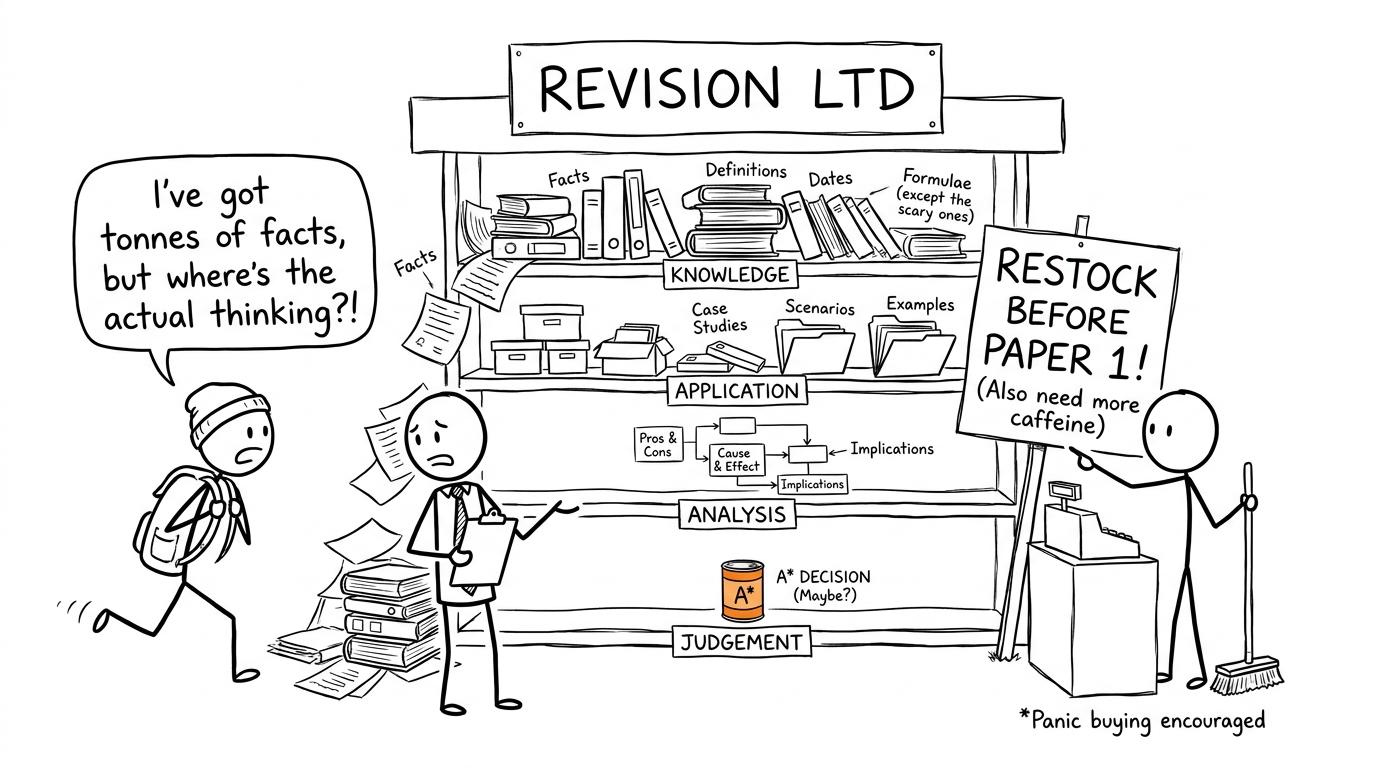 Revision Ltd discovers that its judgement shelf needs restocking
Common mistakes in GCSE Business Paper 1
Revising the wrong board's content
Paper names can sound similar while testing different topic combinations. Confirm the board, paper code and current specification before building a revision list.
Writing generic case-study answers
A response about “any business” wastes the evidence provided. Use specific information and explain why it changes the likely outcome.
Treating every command word alike
Identifying, explaining, analysing and evaluating require different depths. Let the command word and mark allocation determine the answer.
Giving disconnected advantages and disadvantages
A list rarely demonstrates analysis. Develop the consequence of each point and relate it to the business's objective or constraint.
Hiding calculation working
Write the formula, substitute carefully and include the unit. Clear working makes mistakes easier to find and may access method marks where the mark scheme allows them.
Spending too long on early questions
The first section can feel comfortable, making it easy to overinvest time. Protect the later, higher-mark questions by setting section checkpoints in advance.
Go into Paper 1 knowing its shape
Confidence does not come from predicting every question. It comes from removing avoidable surprises.
Know your board. Know the content boundary, timing and section structure. Practise the calculations that belong to your specification, then learn to turn business knowledge into contextual analysis and justified decisions.
MathsGenie gives you a free place to run that process: revision lessons for understanding, practice questions for retrieval, mark schemes and video solutions for feedback, and past papers, predicted papers and mini tests for timed preparation. Choose your board from the GCSE Business revision resources, complete one Paper 1 under the correct conditions and let the lost marks decide what you revise next.