

GCSE Business Grade 7 Meaning: A Clear Guide
GCSE business grade 7 meaning explained: discover the ability it represents, how it compares with an old A grade, and what to do next in revision now.

A results sheet can turn two years of lessons, revision and exams into a single digit. That digit matters, but it rarely explains itself.
Here is the GCSE business grade 7 meaning in plain English: it is a high GCSE grade, and its lower boundary is comparable with the lower boundary of the old grade A. It generally indicates strong knowledge of business concepts and an ability to apply, analyse and evaluate them in unfamiliar contexts. It does not mean that every answer was perfect, nor does it correspond to one fixed percentage across every exam board or year.
For students accustomed to discussing foundation and higher tier maths, one distinction is important: GCSE Business is not usually divided into those tiers. The final grade reflects performance across the complete qualification.
 A student discovers that a grade is useful information rather than a complete identity
Grade 777 at a glance
A GCSE Business grade 777 tells you that:
- you achieved one of the higher grades on the 999 to 111 scale;
- the bottom of grade 777 is comparable with the bottom of the old grade A;
- your total mark reached the grade 777 boundary set for that examination series;
- you probably demonstrated more than factual recall, including application, analysis and judgement;
- the required mark depended on your exam board and the difficulty of that year's papers;
- it is a strong result, although individual sixth forms and colleges set their own entry requirements.
The shortest accurate description is a strong GCSE performance broadly beginning where the old grade A began. The word “broadly” matters because the numerical and letter scales do not match grade for grade.
How does grade 777 compare with the old letter grades?
In England, the numerical GCSE scale runs from grade 999, the highest grade, to grade 111. A result below the standard required for grade 111 is reported as U.
Ofqual's official comparison identifies three anchor points between the present and former systems:
- the bottom of grade 777 is comparable with the bottom of the old grade A;
- the bottom of grade 444 is comparable with the bottom of the old grade C;
- the bottom of grade 111 is comparable with the bottom of the old grade G.
Grades 777, 888 and 999 collectively provide greater differentiation across the performance previously covered by grades A and A*. It is therefore reasonable to describe grade 777 informally as similar to a lower A, but it is misleading to call every grade 777 an exact old-style A.
That distinction sounds small. It is not. The new scale was designed differently, particularly at the top, so there is no perfect conversion table in which each number has one letter partner.
If you are comparing results across subjects, our guide to the meaning of grade 7 in GCSE Maths explains the same grading principle in a mathematical context.
What ability does a grade 777 in GCSE Business represent?
A qualification grade reports performance across the assessment as a whole. It does not certify that a student has mastered every topic, and there is no official grade 777 checklist saying that every student must display precisely the same strengths.
Ofqual's general subject grade descriptors are centred on grades 222, 555 and 888, rather than grade 777. A careful explanation of grade 777 must therefore draw on the Business assessment objectives and the mark boundary actually achieved, rather than inventing a separate official descriptor.
Knowledge and understanding
A grade 777 student is likely to have secure knowledge of much of the specification. Depending on the exam board, this can include business ownership, aims, stakeholders, marketing, operations, finance, human resources and external influences.
But knowing definitions is only the beginning. Strong answers select the relevant concept and use terminology accurately rather than emptying every remembered fact onto the page.
Application to a business context
Application means connecting knowledge to the organisation, market or situation in the question. A generic statement could apply to almost any business. A well-applied point uses the information provided and explains why it matters in that particular context.
This is often where students discover that remembering a definition and earning marks with it are different skills. The first lives in memory. The second requires choice.
Analysis of consequences
Analysis follows an idea through its likely effects. A student might identify how a decision affects costs, demand, productivity, cash flow, employees or competitiveness, then develop the chain rather than stopping after one claim.
The strongest analysis remains grounded in the evidence. It recognises that business decisions have consequences, and that those consequences can interact.
Evaluation and justified judgement
Evaluation is not simply adding “however”. It involves weighing relevant factors, considering limitations and reaching a conclusion supported by the context.
A grade 777 performance will commonly include answers that make sensible judgements, even if they are not consistently as developed or precise as those associated with the very highest grades. Quality also needs to survive across both shorter and extended questions.
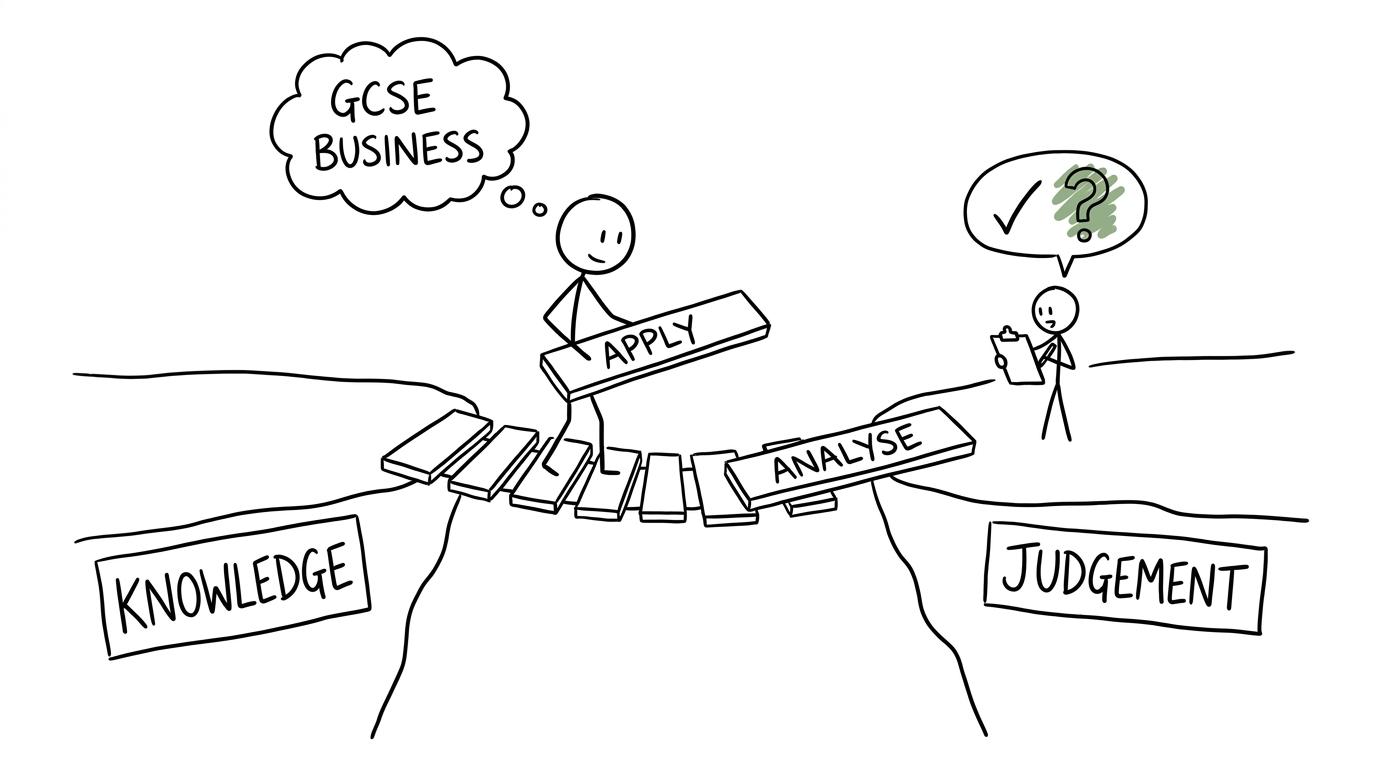 A stick-figure student builds a bridge between business knowledge and judgement
Why grade boundaries do not reveal a universal percentage
A popular shortcut says that a particular percentage must always equal a particular grade. GCSE grading does not work that way.
A grade boundary is the minimum total mark needed for a grade in a particular examination series. Awarding organisations set boundaries after the papers have been taken and marked, using evidence about the assessment's demand and student performance. This allows standards to be maintained when one year's paper is more or less demanding than another.
The latest confirmed boundaries available before the summer 202620262026 results are those from June 202520252025. They differed among AQA, Pearson Edexcel, OCR and Eduqas, partly because the qualifications do not all use the same maximum mark. You can inspect the board-by-board figures in MathsGenie's guide to GCSE Business marks per grade.
The practical lesson is simple: do not turn an old boundary into a promised target. Use it to interpret a completed paper, not to predict the future with certainty. Build a margin above previous boundaries and concentrate on the quality of your answers.
What does grade 777 mean for your next step?
Grade 777 is a strong result that may support progression to A Level Business, Economics or other courses involving extended analysis. It can also sit well alongside subjects such as maths, geography and the sciences.
However, a GCSE grade does not automatically guarantee admission to a particular course. Sixth forms and colleges choose their own entry requirements, which may include a required grade in Business, English Language or Maths. Always check the published conditions for the institution and course you are considering.
Nor should grade 777 be treated as a ceiling. If it is your mock result, ask what produced it. Perhaps your knowledge was secure but conclusions lacked judgement. Perhaps you wrote thoughtful extended answers but lost shorter calculation marks. The total grade is useful; the pattern underneath it is more useful.
Business includes numerical skills such as percentages, revenue, costs, profit, averages and interpretation of data. Students can strengthen that foundation through the free GCSE Maths revision hub, which provides board-specific lessons and questions for AQA, Edexcel, OCR, Eduqas, WJEC and CCEA.
How to move from a grade 777 towards grades 888 and 999
The gap at the top of the scale is rarely closed by writing more words. It is closed by making each paragraph do more work.
Diagnose marks rather than guessing
Complete an appropriate past paper under timed conditions, mark it carefully and classify each lost mark. Was the cause missing knowledge, weak application, incomplete analysis, unsupported judgement, poor timing or an inaccurate calculation?
MathsGenie's guide to using GCSE past papers properly explains the paper, mark, repair and retest cycle. Although its resources focus on maths, the feedback habit transfers directly to Business.
Improve the weakest assessment objective
Do not revise every skill equally when one is costing most of your marks. If recall is weak, use short retrieval sessions. If application is vague, practise identifying details from case studies. If evaluation is thin, compare alternatives and make conclusions conditional on the evidence.
A useful revision session has one narrow purpose. “Improve conclusions on extended questions” is actionable. “Revise Business” is not.
Keep quantitative skills accurate
Business calculations reward a methodical approach. Write the relevant formula, substitute carefully, include appropriate units and check whether the answer is plausible. Secure GCSE maths skills reduce the mental effort required, leaving more attention for interpretation.
Use Edexcel GCSE Maths predicted papers if that is your maths board, or select your board through the main revision hub. Predicted papers are best used as timed practice, not as promises about exactly what will appear.
Build a repeatable revision routine
A sustainable plan alternates learning, question practice, feedback and retesting. The GCSE revision timetable guide can help you organise this around several subjects without turning every evening into an impossible list.
 A student attempts to absorb a textbook while a practice paper waits patiently
Common mistakes when interpreting or targeting grade 777
Treating grade 777 as an exact old A
The bottom of grade 777 aligns with the bottom of the former A grade. That is an anchor point, not a perfect one-to-one conversion across the full grade.
Assuming one percentage always earns it
Boundaries change between examination series and boards. A percentage found online may come from another year, specification or maximum mark.
Looking only at the total mark
Two students with the same total can have different needs. One may need stronger subject knowledge; another may need better application and evaluation. Review question-level performance.
Believing long answers are automatically analytical
Length is not the same as depth. Analysis explains connected consequences, while evaluation uses evidence to reach a justified judgement.
Revising passively
Reading notes can create familiarity without proving recall. Questions, mark schemes and delayed retesting reveal whether knowledge can actually be used. If time is short, the principles in revising GCSE Maths in three days offer a useful model: diagnose first, practise actively and correct errors.
Turn the grade into a useful next action
The clearest GCSE business grade 777 meaning is not merely “good” or “an A”. It represents a high level of overall performance, beginning at a point comparable with the old grade A threshold and usually reflecting secure knowledge alongside effective application, analysis and evaluation.
Still, the number is a summary. Improvement begins when you look beneath it.
Use your marked papers to identify the skills costing marks, then build a short cycle of learning, practice, marking and retesting. For the numerical side of Business and your wider exam preparation, make MathsGenie your free revision base: choose focused revision lessons, complete practice questions and mini tests, then move to past papers and predicted papers with mark schemes and video solutions. Start with the free GCSE Maths resources and give your next revision session one clear job.











