

GCSE Biology Careers: Jobs and Apprenticeships
GCSE biology careers explained: explore jobs and apprenticeships where science grades matter, and the maths skills that strengthen your next application.

Choosing GCSE subjects can feel oddly permanent. One timetable decision appears to be deciding the rest of your working life. Fortunately, careers rarely work like that.
The practical answer about GCSE biology careers is this: Biology can help you progress towards healthcare, laboratory science, animal care, environmental work, pharmacy, sport and scientific research. A good grade is particularly noticeable when a college, apprenticeship or employer asks for GCSE Science at grade 444 or above. However, GCSE Biology is usually a starting signal rather than a complete professional qualification.
Its value also grows when it sits beside strong maths and English grades. Biology may open the door, but employers still need people who can interpret data, calculate accurately and explain evidence clearly.
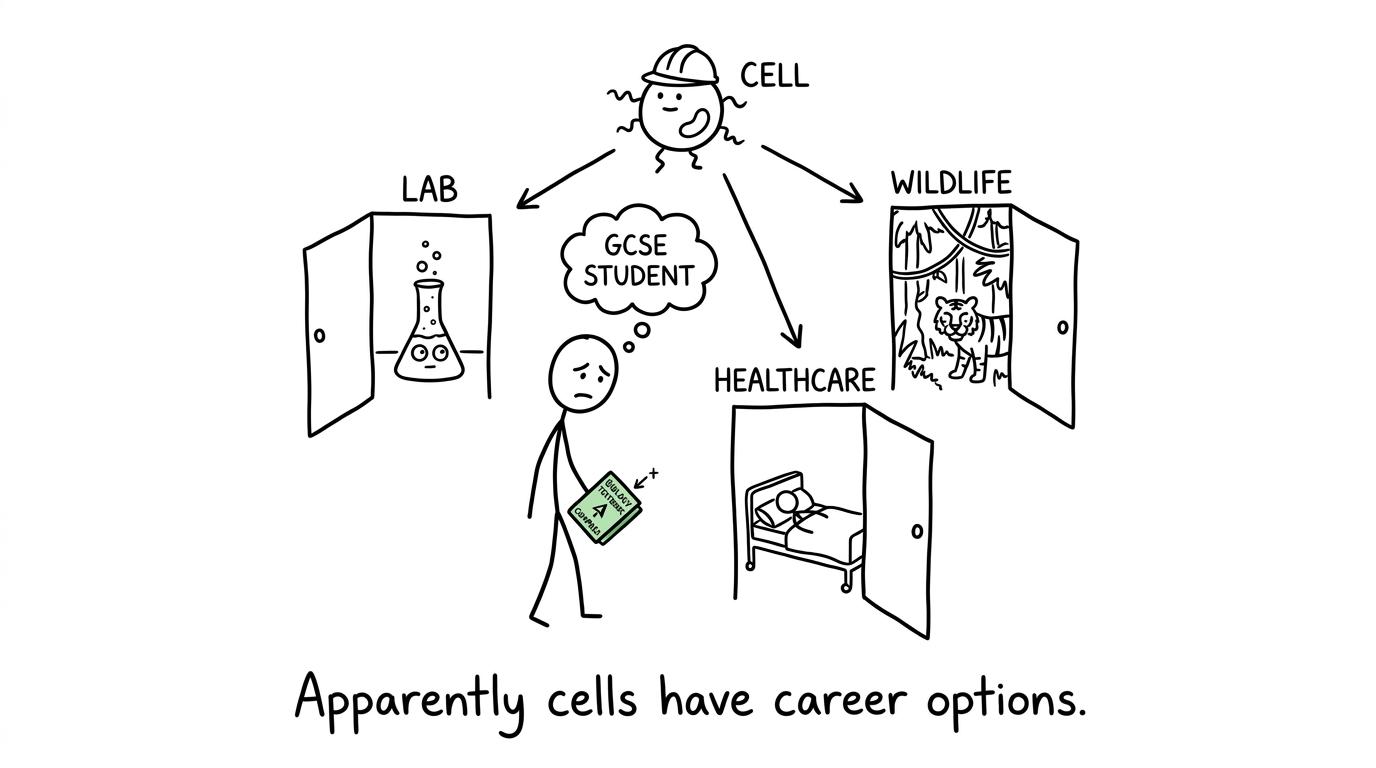 A student discovers that cells have several career options
GCSE biology careers at a glance
Use this checklist before deciding whether a route suits you:
- Laboratories: laboratory technician, healthcare science assistant and research support roles.
- Healthcare: nursing, paramedic science, biomedical science and allied health professions.
- Medicines: pharmacy technician, pharmacist and pharmaceutical manufacturing routes.
- Animals: veterinary nursing, animal care and animal welfare.
- Environment: ecology, conservation, environmental science and countryside work.
- Further science: A Level Biology, Applied Science, a science T Level or a degree apprenticeship.
- Transferable skills: analysing results, using evidence, working safely and handling numerical data.
The important question is not simply, “Which jobs use biology?” It is, “At what stage will my Biology grade be checked?” Often, that stage is your application for sixth form, college, an apprenticeship or initial technical employment.
Where does a good GCSE Biology grade get noticed?
A grade is most likely to matter when the published entry requirements ask for science, Biology or a group of GCSEs including English, maths and science. Current National Careers Service and NHS guidance commonly shows grades 999 to 444 among the usual requirements for relevant training routes, although each employer and provider sets its own criteria.
That distinction matters. An advert requesting GCSE Science may accept Combined Science, separate Biology or an equivalent qualification. Another course may specifically require Biology, particularly when it leads towards a biology degree. Never assume that one rule covers every vacancy.
| Career direction | How GCSE Biology helps | Typical next step |
|---|---|---|
| Laboratory technician | Shows scientific understanding, practical awareness and readiness for technical training | Level 333 laboratory apprenticeship, Applied Science or a T Level |
| Healthcare science | Supports knowledge of cells, disease, body systems and testing | Assistant role, apprenticeship or science-based Level 333 study |
| Veterinary nurse | Provides foundations in organisms, health, infection and biological processes | Level 333 veterinary nurse apprenticeship or approved course |
| Pharmacy technician | Supports understanding of medicines, human biology and safe scientific practice | Level 333 pharmacy technician apprenticeship or trainee position |
| Animal care worker | Demonstrates relevant knowledge of organisms, health and welfare | Level 222 or Level 333 animal care apprenticeship |
| Ecologist or conservation scientist | Builds understanding of ecosystems, sampling and biodiversity | A Level Biology or equivalent, followed by higher study or training |
| Biomedical scientist | Begins the route into cells, infection, genetics and patient-sample analysis | Relevant Level 333 qualifications, then an accredited degree or degree apprenticeship |
Careers that normally require further qualifications
Some careers are closely connected to Biology but cannot be entered with GCSEs alone. Doctors, dentists, pharmacists, biomedical scientists, research biologists, physiotherapists and ecologists usually need substantial further training, professional registration or both.
This does not make the GCSE unimportant. It makes it the first link in a chain:
GCSEs⟶Level 3 study⟶degree or higher training⟶profession\text{GCSEs} \longrightarrow \text{Level 3 study} \longrightarrow \text{degree or higher training} \longrightarrow \text{profession}GCSEs⟶Level 3 study⟶degree or higher training⟶professionFor example, a student considering biological research would commonly need relevant Level 333 qualifications before applying for a degree or degree apprenticeship. Biomedical science has additional professional requirements, so students should check whether a degree is appropriately accredited rather than relying on its title alone.
Think of GCSE Biology as evidence that you can begin the next stage. It is rarely evidence that you have finished training.
Biology apprenticeships and technical routes
Apprenticeships are where GCSE science grades can become immediately visible. A Level 333 apprenticeship is educationally equivalent to A Level study, but combines paid employment with structured training.
Laboratory and healthcare science
Laboratory technician vacancies often ask for several GCSEs at grades 999 to 444, commonly including English, maths and science. The work can involve preparing equipment, recording results, testing samples, following safety procedures and maintaining accurate records.
Healthcare science offers routes at different levels, from assistant and associate positions to degree apprenticeships. Entry requirements rise with the apprenticeship level. A Level 666 route, for instance, will normally require suitable Level 333 qualifications as well as GCSEs.
 A laboratory apprentice learns that careful repetition matters
Veterinary nursing and animal care
Veterinary nursing is a regulated occupation with approved training routes. The Level 333 veterinary nurse apprenticeship normally expects GCSEs including English, maths and science. Animal care apprenticeships may have more flexible entry criteria, particularly at Level 222, but Biology remains relevant evidence of interest and preparation.
These routes are not simply about liking animals. They require reliability, communication, accurate records and the ability to follow welfare and safety procedures.
Pharmacy and medicines
Pharmacy technician apprenticeships and trainee positions frequently ask for grades 999 to 444 in subjects including English, maths and science. Biology supports understanding of the human body and disease, while chemistry often becomes increasingly important when studying medicines.
Requirements vary between employers. Read the essential criteria first, then the desirable criteria. Essential means your application may be screened against it; desirable means it can strengthen an otherwise eligible application.
Apprenticeship systems and eligibility rules differ across England, Scotland, Wales and Northern Ireland. Check the official service for your nation and the individual vacancy rather than relying on a general careers list.
Why maths matters in biology careers
Biology is not a maths-free science. GCSE Biology specifications include percentages, ratios, standard form, averages, sampling, probability, graphs, gradients and simple equations. At least 10%10\%10% of the assessment in GCSE Biology involves mathematical skills in a biological context.
Those same skills appear in real career settings:
- laboratory staff measure quantities and assess results;
- ecologists sample populations and analyse trends;
- healthcare teams interpret numerical observations;
- pharmacy technicians work carefully with quantities and records;
- researchers compare data and evaluate uncertainty.
If these areas feel uncertain, revise fractions, percentages, ratio and other recurring GCSE topics. Scientific notation becomes easier after focused standard form revision, while biological relationships are clearer when you understand scatter graphs and correlation.
You can then test that knowledge using scatter graph exam questions. Correlation does not prove causation, but learning to distinguish the two is useful in exams, scientific investigations and public-health discussions.
 Biology and maths turn out to be working together
How to choose your next step
Start with the work rather than the job title. Would you prefer dealing with patients, handling samples, caring for animals, working outdoors or investigating data? Two careers can use similar biology while feeling completely different from day to day.
Then take these steps:
- Search several real vacancies or course pages.
- Record their essential GCSE requirements.
- Check whether they request Science generally or Biology specifically.
- Identify the Level 333 subjects or qualifications needed later.
- Compare apprenticeship, college, sixth-form and university routes.
- Ask a careers adviser or provider when wording is unclear.
Keep your options open by protecting your English and maths grades alongside science. The full GCSE maths topic guide by exam board and tier can help you identify what Edexcel, AQA, OCR and Eduqas expect without revising randomly.
Common mistakes when planning a biology career
Assuming Biology alone guarantees entry
Employers frequently request a combination of English, maths and science. A strong Biology result may not compensate for missing another essential requirement.
Treating every science requirement as identical
Combined Science, separate sciences and equivalent qualifications are not worded consistently across vacancies. Check directly with the provider if your qualification is not listed clearly.
Choosing a career from its title
Marine biology may sound attractive, but the real route can involve data analysis, fieldwork, laboratory work and years of further training. Investigate daily tasks as well as subjects.
Ignoring maths because the career is biological
Graphs, percentages, units and statistics are part of both Biology examinations and science-related work. Use the MathsGenie GCSE maths revision hub to strengthen weak areas through lessons, questions and solutions.
Reading one old vacancy as a universal rule
Entry requirements change between employers, courses and apprenticeship levels. Use several current examples and confirm the criteria when you apply.
Turn your current revision into future options
A GCSE does not choose your career. It changes which next steps are easier to take. Biology can make laboratory, healthcare, animal, environmental and pharmaceutical routes more accessible, while maths gives you the quantitative confidence those routes increasingly require.
Start with one weakness today. Use MathsGenie’s free revision lessons and practice questions, then check your progress through mark schemes and video solutions. Build stamina with a realistic GCSE maths revision timetable, move on to predicted papers, and use mini tests and past papers to find the marks still escaping.
Your career does not need to be decided now. Your next useful step does.










