

How to Fix a GCSE Biblical Hebrew Weak Topic
GCSE biblical hebrew weak topic? Use a practical diagnose, practise and retest plan to turn repeated errors into reliable exam marks without avoidance or panic.

A topic you repeatedly get wrong can begin to feel like part of your identity. It is not. It is usually a specific gap hidden beneath a broad label such as “grammar”, “translation” or “literature”. If you are dealing with a GCSE Biblical Hebrew weak topic, the practical answer is to diagnose the exact failure, relearn one small skill, practise it without support, mark it carefully and retest it after a gap.
That cycle matters more than another hour of rereading. Avoidance preserves the weakness; focused retrieval exposes it and gives you something precise to repair.
Although MathsGenie specialises in free GCSE and A Level maths revision rather than Biblical Hebrew, the same revision system works in both subjects: identify the marks you lose, study the relevant knowledge, answer exam-style questions and use feedback to decide what happens next.
Your weak-topic repair checklist
Use this sequence rather than simply writing “revise Hebrew” on a timetable:
- Name the weak area precisely.
- Find evidence from marked questions.
- Decide whether the problem is knowledge, recognition, application or exam technique.
- Relearn one manageable part.
- Retrieve it from memory before checking notes.
- Complete relevant questions under light time pressure.
- Mark every response and record the cause of each error.
- Retest after a short gap.
- Return to mixed exam practice once the skill is stable.
The aim is not to make the topic feel comfortable. The aim is to make your answers more accurate and repeatable.
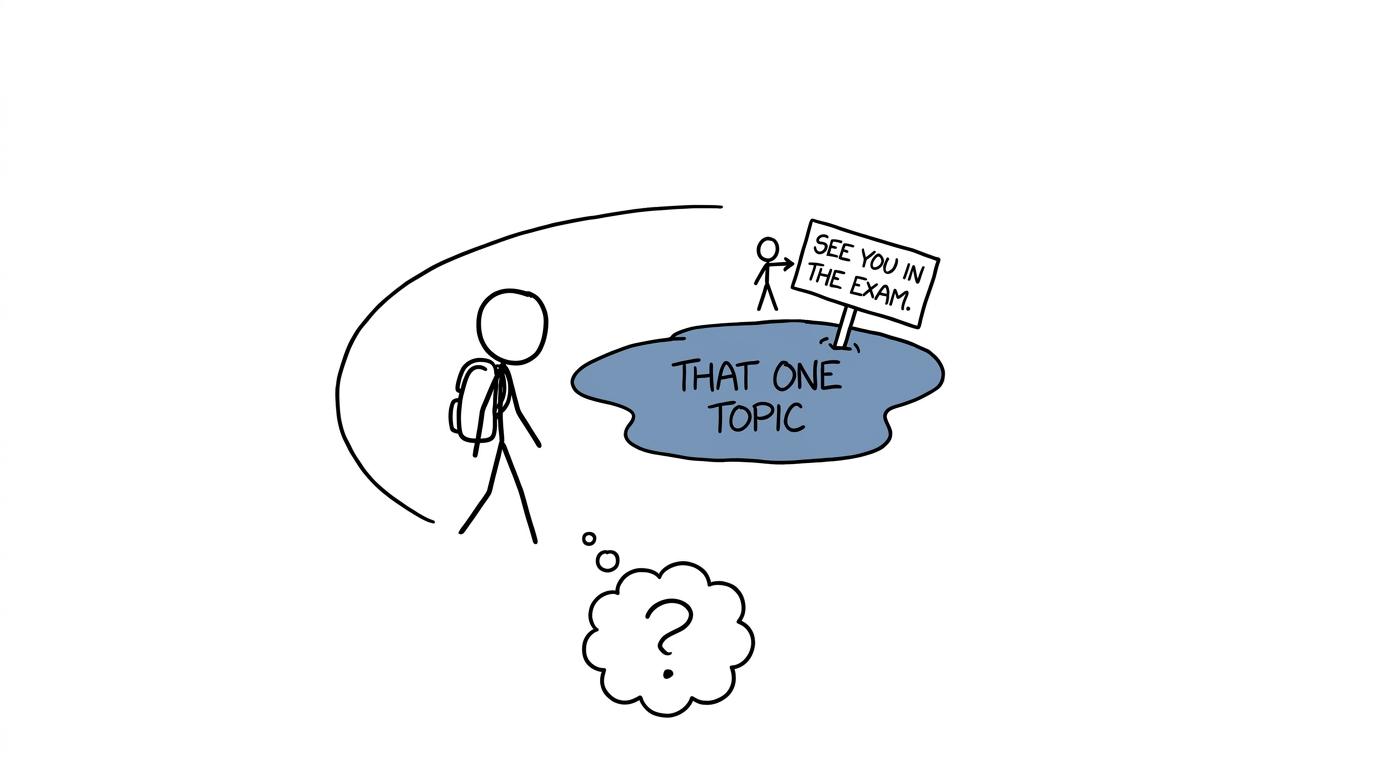 A student discovers that an avoided revision topic plans to appear in the exam
Define the topic before trying to fix it
“Biblical Hebrew” is too large to revise in one session. Even “verbs” or “set texts” may be too broad. A useful diagnosis should describe an observable problem.
For example, your actual difficulty might be:
- recalling vocabulary without seeing the first letter;
- recognising a verb form inside an unseen passage;
- explaining morphology rather than merely identifying it;
- following syntax when English and Biblical Hebrew express an idea differently;
- producing an accurate English translation;
- recalling details from a set text;
- selecting textual evidence for a literature response;
- analysing a literary feature instead of retelling the passage;
- completing translation or comprehension questions quickly enough.
Current Pearson Edexcel GCSE Biblical Hebrew is assessed through two externally examined components: Language and Literature. Each is worth 50%50\%50% of the qualification and each paper is worth 100100100 marks. Language assesses reading, comprehension, translation and the permitted grammar or composition option. Literature assesses knowledge, understanding, analysis and response to the prescribed set texts.
This distinction helps. If your marks disappear in unseen translation, memorising more literature notes will not directly solve the problem. If your literature answers lack analysis, completing extra vocabulary cards alone will not repair them.
Check your current specification, set texts and option with your teacher. Prescribed material can change between examination cycles, so an old revision list should not be treated as automatically current.
Diagnose why you keep getting it wrong
Collect several marked questions involving the topic. One mistake may be a lapse; a repeated pattern is evidence. For every lost mark, assign one main cause.
Knowledge gap
You did not know the vocabulary, form, rule, textual detail or literary feature required. This needs relearning followed by retrieval.
Recognition gap
You knew the fact when looking at notes but did not recognise when it applied. This calls for varied examples and mixed questions, not more copying.
Application gap
You identified the relevant feature but could not use it to translate, explain or analyse the passage. You need question practice and comparison with the mark scheme or an accurate model response.
Exam-technique gap
You knew enough but misread the command word, omitted required evidence, wrote beyond the question or ran out of time. The remedy is timed practice and a clearer answer routine.
A short error log is useful here. Record the question, the mark lost, the reason and one next action. Maths students can use exactly the same approach after working through the GCSE Maths revision hub, where topic resources and exam practice make weaknesses easier to isolate.
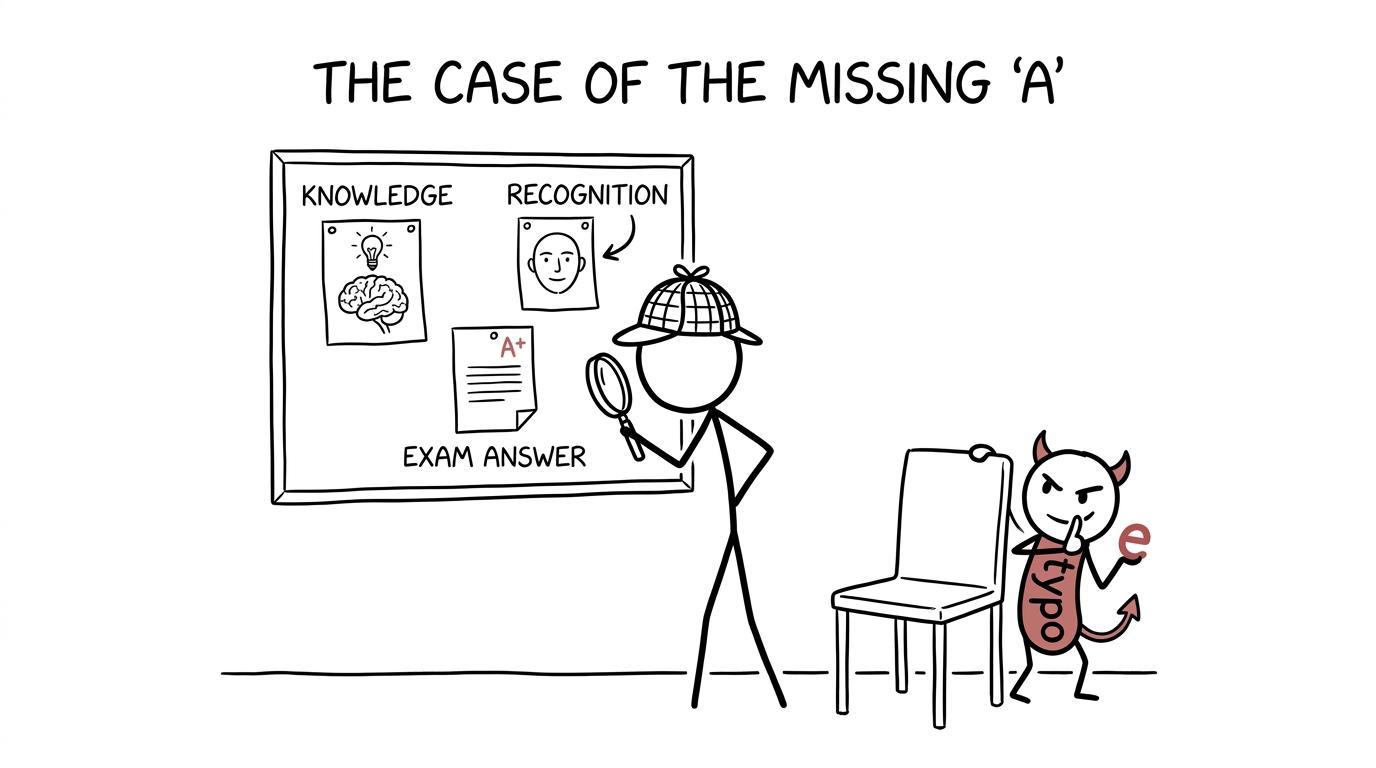 A revision detective investigates knowledge, recognition and exam-answer clues
Rebuild one small skill at a time
Once you know the cause, reduce the topic to a unit you can practise in a short session. Do not attempt to “master translation” on Tuesday evening. Choose one feature that can be recalled, recognised and applied.
A productive session might contain:
- a brief review of the relevant rule, vocabulary group or passage;
- closed-book recall of the key information;
- a small set of questions focused on that feature;
- careful marking;
- one correction written in your own words;
- a final attempt without notes.
Keep the correction specific. “Revise harder” is not an instruction. “Check the subject of the verb before deciding how to translate the clause” is actionable. So is “support every literature point with precise evidence from the set text”.
This resembles the learn, retrieve, space and test cycle described in MathsGenie’s guide to stopping GCSE maths content from being forgotten. The subject knowledge differs, but the principle is the same: looking creates familiarity, while unaided retrieval reveals whether the knowledge is available when you need it.
Use a closed-book ladder
Students often jump from reading notes to attempting a full paper. The distance between those activities is too large. Build a ladder instead.
Supported recall
Review the relevant material, close it and write or explain what you remember. Reopen the source only after making a genuine attempt.
Focused questions
Answer several questions involving the same narrow skill. At this stage, accuracy matters more than speed.
Varied recognition
Mix the feature with similar forms, vocabulary or question types. This tests whether you can recognise it without being told what to look for.
Timed application
Complete a short passage, question group or literature task under a realistic limit. Do not begin with a whole paper if one topic is still unstable.
Mixed retrieval
Return the topic to broader practice. A skill is not secure merely because you can complete five nearly identical questions in a row.
In maths revision, Edexcel GCSE Maths mini tests provide this useful bridge between isolated topic work and full papers. For Biblical Hebrew, create the equivalent from teacher-set tasks, textbook questions and appropriate past-paper sections.
Mark for information, not reassurance
Marking is where practice becomes revision. A tick tells you that an answer worked. A correction tells you what to do next time.
When checking a response, ask:
- Did I understand the command word?
- Which knowledge did the question require?
- Where did my interpretation first go wrong?
- Did I provide enough textual evidence?
- Did I translate the meaning accurately rather than mechanically?
- Did I answer the precise question rather than display everything I knew?
- Could I reproduce the correct approach tomorrow without looking?
Use official mark schemes and advice from your teacher when available. Mark schemes show what is creditworthy, but they do not replace subject teaching. If you cannot explain why an answer earns marks, ask for clarification rather than memorising a sentence blindly.
The same disciplined review turns papers into useful evidence in maths. MathsGenie’s guide to starting GCSE past papers explains why papers work best in phases rather than as an endless series of final scores.
Retest until the improvement survives a gap
A correct answer immediately after reading a correction may be short-term imitation. Retest the skill later without notes.
A simple pattern is:
- first attempt and correction;
- a short retest the following day;
- another check several days later;
- mixed practice the following week.
If the same error returns, do not conclude that you are “bad at Hebrew”. Reopen the diagnosis. Perhaps you memorised a label without learning how to recognise it, or understood the passage but did not practise the exam command.
Keep sessions short enough to repeat. A GCSE revision timetable built around weak topics is more useful than an ambitious plan that disappears after three days. Maths students can also use the GCSE one-month revision plan to organise retrieval, topic practice and timed papers around school commitments.
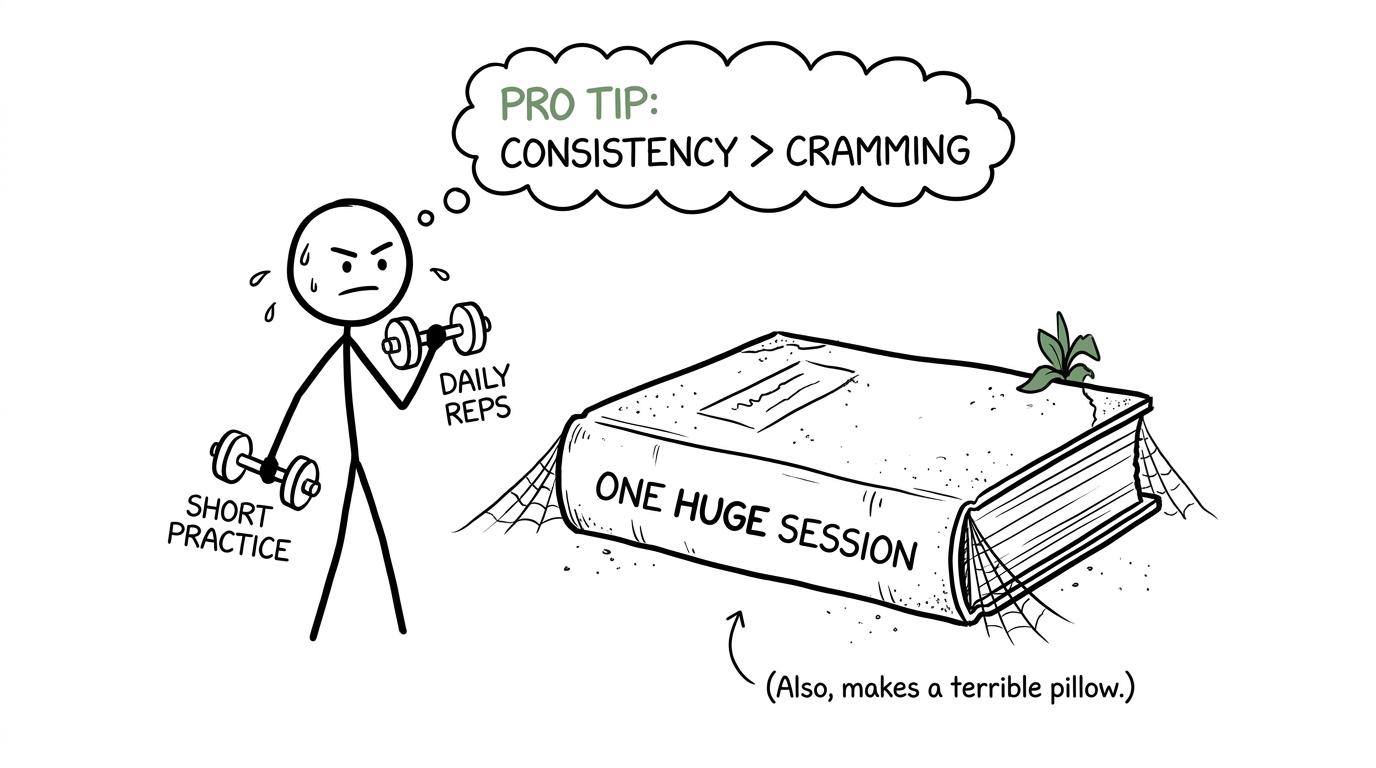 A student trains with short-practice weights beside an unused enormous revision book
Know when the topic is genuinely improving
Confidence is useful, but evidence is better. Move the topic from “weak” to “improving” when you can:
- recall the essential knowledge without prompts;
- recognise the feature in unfamiliar material;
- apply it accurately in an exam-style question;
- explain your reasoning or evidence;
- perform under a sensible time limit;
- repeat the result after a gap.
You do not need perfection before returning to whole papers. You need enough stability that mixed practice tests the skill rather than merely exposing the same untouched gap.
For maths, this is the point at which board-specific practice becomes valuable. Students can use AQA GCSE Maths past papers, the OCR GCSE Maths revision hub or Edexcel predicted papers, depending on their specification and tier. Predicted papers are a test of revision, not a substitute for fixing the underlying topic.
Common mistakes when fixing a weak topic
Revising the label instead of the failure
“Do grammar” is vague. Identify the form, rule or question type that causes the mark loss.
Rereading until the page feels familiar
Recognition while notes are open is not the same as recall in an examination. Close the material and attempt retrieval.
Repeating only one easy question type
This can create an illusion of mastery. Vary the context and mix the skill with similar material.
Correcting answers without recording the cause
Copying a correct answer may fix the page but not the thinking. State why your original response failed.
Attempting full papers too early
A complete paper can diagnose weaknesses, but it is inefficient for repairing one narrow gap. Use short sections first, then rebuild towards full exam conditions.
Ignoring literature because language feels more concrete
The qualification gives substantial weight to literature knowledge, understanding and analysis. Revision should reflect the assessment, not just the areas that are easiest to test with flashcards.
Using outdated set-text information
Check the prescribed texts and examination requirements for your own series with your teacher and current Pearson material.
Turn the recurring error into a routine
The topic that always goes wrong is rarely fixed by one heroic session. It changes when the error becomes specific, visible and repeatedly tested. Diagnose the problem, rebuild one small skill, retrieve it without notes, apply it in questions and return after a gap.
MathsGenie does not teach GCSE Biblical Hebrew, but it can help you apply the same disciplined process to GCSE maths. Start with the free GCSE Maths revision resources, then use revision lessons, practice questions, mini tests, past papers, mark schemes and video solutions to turn weak areas into dependable marks. Finish with predicted papers only after the underlying skills have been repaired.
Do not organise revision around what you already enjoy. Start with the topic that keeps taking marks away, and give it a smaller, clearer problem to become.










