Do You Need a GCSE Biblical Hebrew Tutor?
GCSE Biblical Hebrew tutor advice for deciding whether tuition will help, diagnosing revision gaps and choosing a tutor who understands the Edexcel course.

Revision becomes uncomfortable when effort stops producing progress. You learn vocabulary, reread a set text and attempt another translation, yet the same grammatical forms still catch you out. At that point, searching for a GCSE Biblical Hebrew tutor is reasonable, but hiring one is not automatically the right answer.
A tutor is most likely to help when you have a specific, repeated obstacle that independent revision and teacher feedback have not resolved. If the real problem is inconsistent practice, weak organisation or avoiding timed work, a better revision system may help more than another weekly lesson.
This guide will help you diagnose the difference, understand what the current qualification requires and judge whether a prospective tutor offers genuine exam-focused support.
The quick decision checklist
A tutor may be worthwhile if:
- you repeatedly misidentify roots, verb forms or grammatical structures;
- you understand studied passages but struggle with unseen material;
- your translations lose accuracy through recurring errors;
- you are unsure how to analyse literary features or support conclusions from set texts;
- your school offers limited specialist teaching or feedback;
- you practise consistently but cannot explain why your marks have stopped improving.
Try improving your independent revision first if:
- you rarely complete practice between lessons;
- you have not used the specification to identify what is assessed;
- you reread notes instead of translating, retrieving vocabulary and answering questions;
- you have not attempted timed sections or analysed your errors;
- you mainly want a tutor to make you begin working.
A tutor can explain, diagnose and challenge. They cannot replace regular practice.
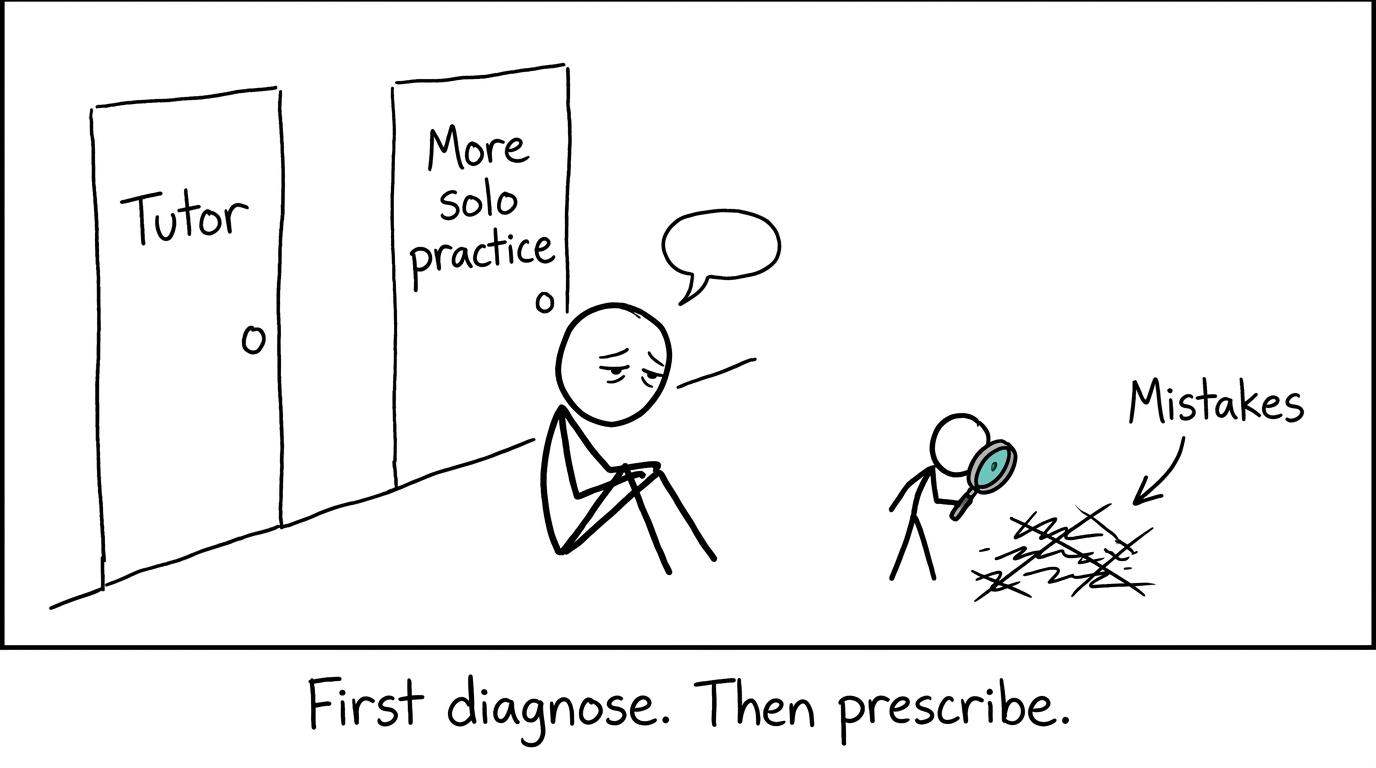 A student and a detective diagnose revision mistakes before choosing between tutoring and solo practice
Understand the GCSE before deciding
GCSE Biblical Hebrew is an ancient-language qualification, not the same course as GCSE Modern Hebrew. The current Pearson Edexcel qualification has two externally examined components, each worth 50%50\%50% of the final result and carrying 100100100 marks.
Component One: Language assesses comprehension and translation of unseen Biblical Hebrew. It also includes an optional route involving either grammatical analysis or translation of short English sentences into pointed Biblical Hebrew.
Component Two: Literature assesses knowledge, translation and analysis of prescribed set texts. Students need to understand content and literary features, use textual evidence and construct reasoned responses.
Unlike GCSE maths, Biblical Hebrew does not have foundation and higher tiers. That distinction matters when planning your wider revision: your Edexcel, AQA, OCR or Eduqas maths entry may be tiered, while your Biblical Hebrew paper is not.
The official ancient-languages framework gives language knowledge half of the assessment weighting, with knowledge of literature and analysis of ancient sources making up the other half. A productive tutor should therefore do more than test vocabulary. They should help you connect vocabulary, morphology and syntax to accurate comprehension while also developing evidence-based responses to literature.
Diagnose whether tuition would fix the problem
Before contacting tutors, collect evidence from two or three recent pieces of work. For each lost mark, use one of four categories.
| Type of difficulty | What it may look like | Best first response |
|---|---|---|
| Knowledge gap | You do not recognise required vocabulary or a grammatical form | Structured retrieval and direct teaching |
| Application gap | You know a rule but cannot use it in an unseen passage | Guided practice followed by independent questions |
| Exam-technique gap | You misunderstand the task, omit evidence or manage time poorly | Timed practice with precise feedback |
| Consistency gap | You improve in lessons but do not practise between them | A realistic timetable and accountability system |
If most errors sit in the first three categories despite steady practice, specialist tuition could be valuable. If the fourth dominates, start with your routine.
This is the same principle that makes maths revision effective. A low paper mark does not simply mean “bad at maths”; it may reveal one weak topic, an accuracy problem or poor timing. MathsGenie’s guide to using GCSE past papers properly explains how to turn marks into a practical error log rather than treating the total as a verdict.
Run a short trial before paying for long-term tuition
For two weeks, use a simple cycle:
- retrieve a manageable set of vocabulary;
- analyse selected forms in context;
- complete a short unseen passage or set-text task;
- mark it using available teacher guidance or a mark scheme;
- record the exact reason for each lost mark;
- revisit the same weakness several days later.
Do not judge the trial by how busy it feels. Judge it by whether repeated mistakes become less frequent. If you remain stuck in the same places, you now have useful information to take to a tutor.
What a good GCSE Biblical Hebrew tutor should offer
The best tutor is not necessarily the person with the most impressive general language background. You need someone who understands the qualification you are actually taking.
Knowledge of the current specification
Ask whether the tutor has taught Pearson Edexcel GCSE Biblical Hebrew specification 1BH01\text{BH}01BH0 or has carefully reviewed its current requirements. They should understand the division between language and literature, the prescribed vocabulary and grammar, the set-text requirements and the choice within the language component.
They should also distinguish Biblical Hebrew from Modern Hebrew immediately. Fluency in Modern Hebrew does not by itself demonstrate expertise in Biblical Hebrew morphology, syntax, pointing, textual analysis or GCSE assessment.
Diagnosis before a teaching plan
A strong tutor asks to see recent assessed work, teacher comments or an attempted specimen or past paper. They should be able to identify a narrow starting point, such as weak parsing, inaccurate handling of suffixed forms, over-literal English or unsupported literature responses.
Be cautious if the proposed plan is simply “work through the textbook”. Tutoring is most valuable when it adapts to evidence.
Active lessons and specific feedback
During tuition, you should spend time thinking, translating, explaining and correcting. A lesson in which the tutor talks for an hour may feel sophisticated while revealing little about what you can do independently.
Useful feedback is precise. “Revise grammar” is too broad. Feedback should identify the form or decision that caused the error, explain how to recognise it and set a short task that tests the same skill again.
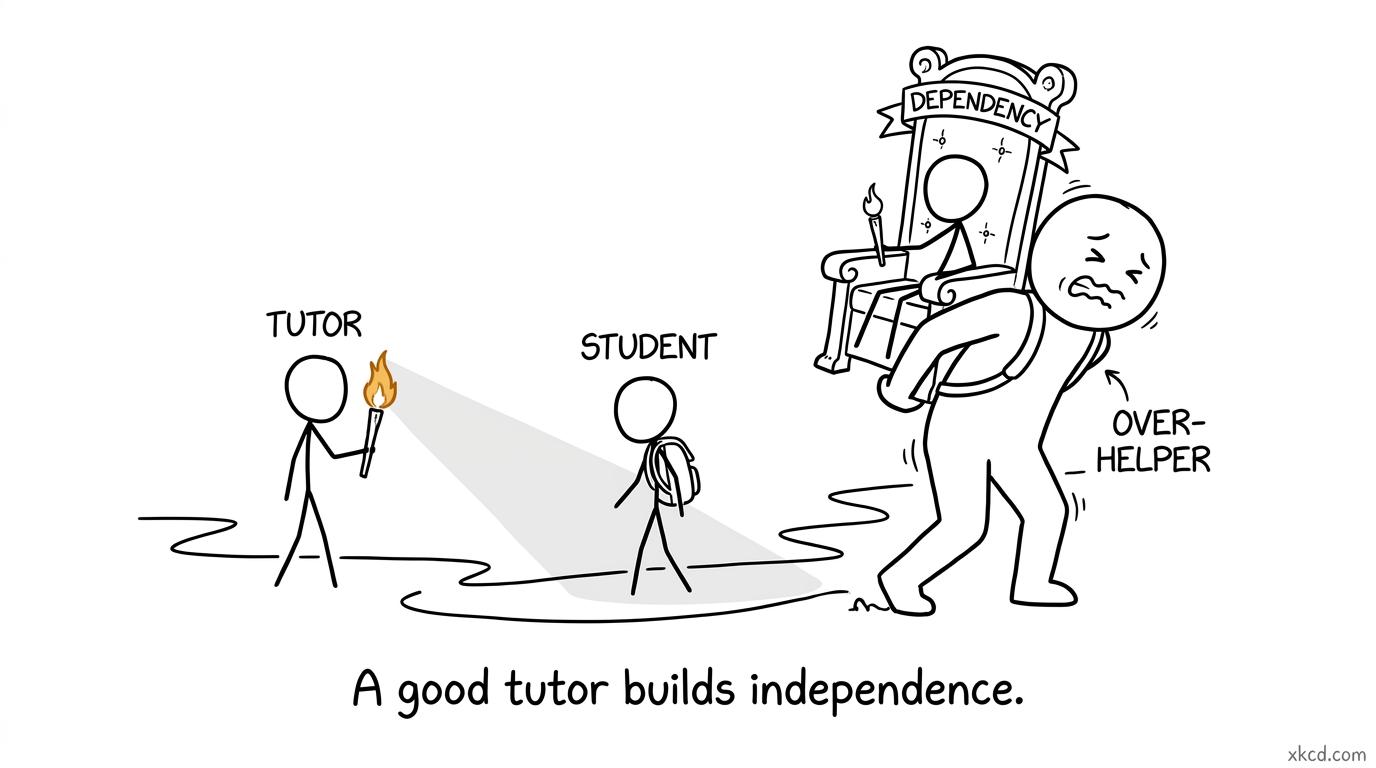 A tutor lights the route while a student walks independently, contrasted with dependency
A plan for independence
Good tutoring should gradually make the tutor less necessary. Ask how progress will be reviewed and what independent work will happen between sessions. There should be a clear link between diagnosis, teaching, practice and retesting.
Promises of a particular grade should make you cautious. No responsible tutor can guarantee an examination result. They can offer knowledgeable teaching, careful feedback and a sensible plan; the final outcome depends on many factors.
Questions to ask before choosing a tutor
Use an initial conversation or trial lesson to ask:
- Which GCSE Biblical Hebrew specification do you teach?
- How do you assess a new student's starting point?
- How do you teach unseen translation rather than only familiar passages?
- How do you cover both language and literature?
- How do you use mark schemes, specimen materials and examiner expectations?
- What work would I complete between sessions?
- How will we know whether tuition is helping after several lessons?
- What happens if your teaching approach does not suit me?
Ask practical questions about availability, lesson length, cancellation arrangements, safeguarding and whether tuition is online or in person. A parent or carer should be involved in checking these arrangements, particularly for online lessons.
A trial lesson should leave you with more than a good impression. You should understand one weakness more clearly and know what to do next.
Balance Hebrew tuition with GCSE maths revision
Tutoring has an opportunity cost. One lesson also creates travel, preparation and follow-up work. If it crowds out sleep, maths practice or other subjects, the total effect may be negative even when the lesson itself is useful.
Build a weekly plan around fixed commitments first. Maths students can use the GCSE maths revision timetable guide or the more focused one-month GCSE revision plan to organise realistic sessions.
Keep the two subjects distinct but use the same learning cycle:
- diagnose the weakness;
- learn or clarify the method;
- practise without support;
- check against reliable feedback;
- record the error;
- retest later.
For maths, the GCSE Maths revision hub provides free revision lessons, exam questions and board-specific resources. Short Edexcel GCSE Maths mini tests can check whether a topic has stuck without consuming an entire evening.
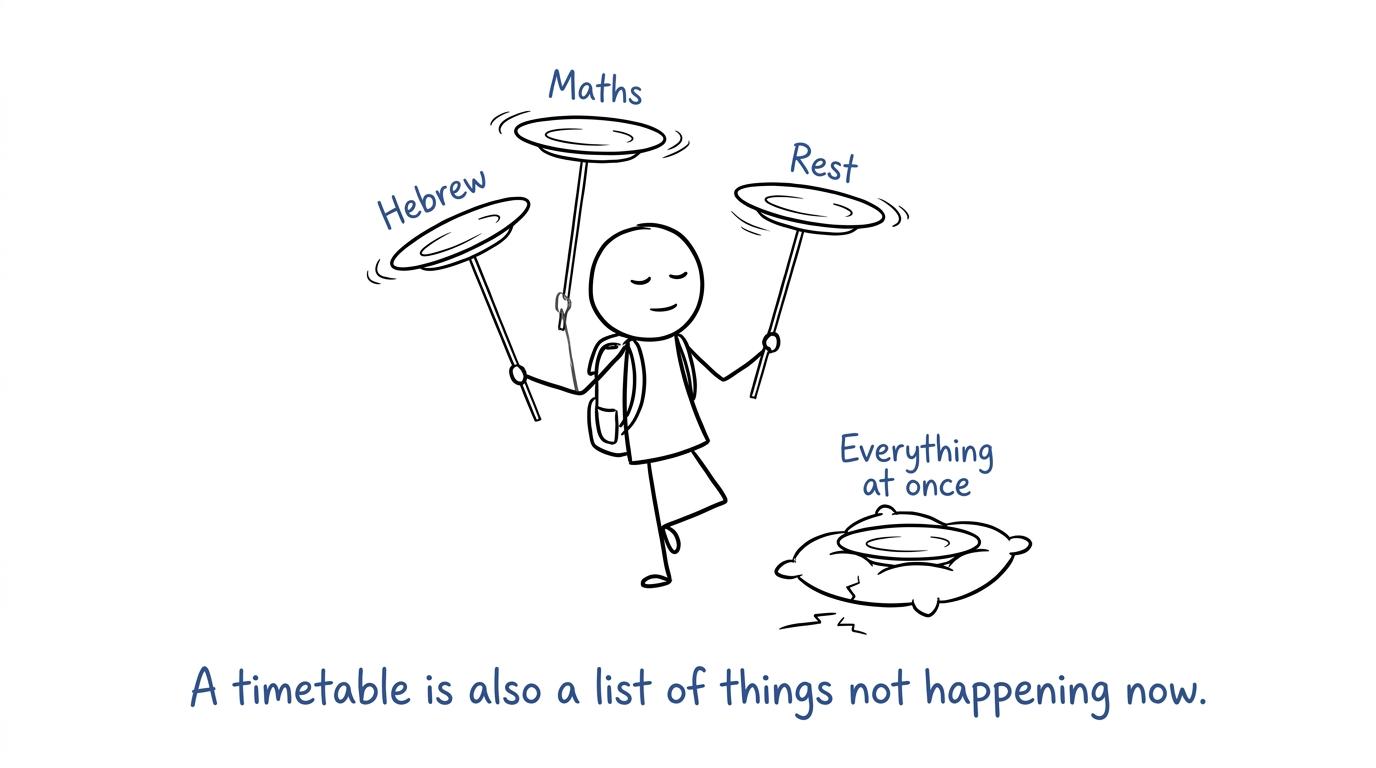 A student balances Hebrew, maths and rest while abandoning the plate labelled everything at once
Common mistakes when looking for tuition
Hiring before identifying the problem
Without a diagnosis, it is difficult to choose the right tutor or measure improvement. Bring marked work and a short error log to the first session.
Confusing subject knowledge with teaching skill
A knowledgeable scholar may not automatically be able to explain GCSE content clearly, pace lessons appropriately or give actionable feedback. Look for both expertise and teaching structure.
Treating lessons as revision completed
Understanding an explanation is not the same as recalling and applying it alone. Independent work between lessons is where fragile knowledge becomes usable.
Practising only familiar material
Repeatedly reading a known set text can create confidence without testing unseen comprehension. Preparation needs both secure set-text knowledge and unfamiliar language work.
Ignoring the literature component
Vocabulary and grammar are essential, but they represent only part of the qualification. Your plan must also cover translation, knowledge and analysis of prescribed literature.
Committing too quickly
Start with a trial or short review period where possible. Agree what progress should look like, then judge the evidence rather than continuing from habit.
Make the decision from evidence
You should consider a GCSE Biblical Hebrew tutor when consistent independent practice still leaves identifiable gaps that require specialist explanation or feedback. You probably do not need one simply because the exam feels difficult. Difficulty is normal; repeated, unexplained difficulty is the stronger signal.
Choose someone who knows the current Edexcel course, diagnoses before teaching, balances language with literature and expects you to become increasingly independent. Then review whether your work is becoming more accurate, better reasoned and more confident under timed conditions.
MathsGenie does not provide Biblical Hebrew tuition, but it can remove much of the pressure from the maths side of your GCSE timetable. Use the free GCSE past-paper library and past-paper tools, then repair weak topics with revision lessons, practice questions, mark schemes, video solutions, mini tests and predicted papers. The aim is not to fill every hour. It is to make each hour reveal what to do next.