GCSE Biblical Hebrew Study Planner: Work Backwards
GCSE Biblical Hebrew study planner: work backwards from exam day, balance maths revision and turn language and literature gaps into weekly tasks.
The hardest part of revision is often not the work. It is deciding what to do next while several subjects compete for the same evening. A GCSE Biblical Hebrew study planner solves that problem by starting with the exam date, placing the final practice sessions first, and working backwards towards today.
For students also preparing for GCSE maths, this matters. Biblical Hebrew needs regular language recall and set-text knowledge, while maths improves through repeated question practice. A backward plan protects time for both instead of allowing the nearest deadline, or the loudest worry, to take over.
Your backward-planning checklist
Before building the timetable, collect five pieces of information:
- your confirmed Biblical Hebrew exam dates
- the current Pearson Edexcel specification and set texts
- recent papers, mark schemes and teacher feedback
- your existing school, homework and maths commitments
- a realistic number of revision blocks each week
For the summer 2027 series, Pearson’s published final timetable places Component 1: Language on Monday 10 May and Component 2: Literature on Wednesday 19 May. Always check your own statement of entry and school timetable because arrangements can change and individual circumstances differ.
The qualification currently has two externally examined written components. Each lasts 222 hours, carries 100100100 marks and contributes 50%50\%50% of the GCSE. Unlike GCSE maths, Biblical Hebrew does not have foundation and higher tiers.
For examinations from 2026 to 2028, the published set texts are Genesis: Joseph’s rise to power, chapters 41 to 43, and Kings: the miracles of Elisha, chapters 4 to 7. Confirm these against the specification for your examination year before scheduling literature revision.
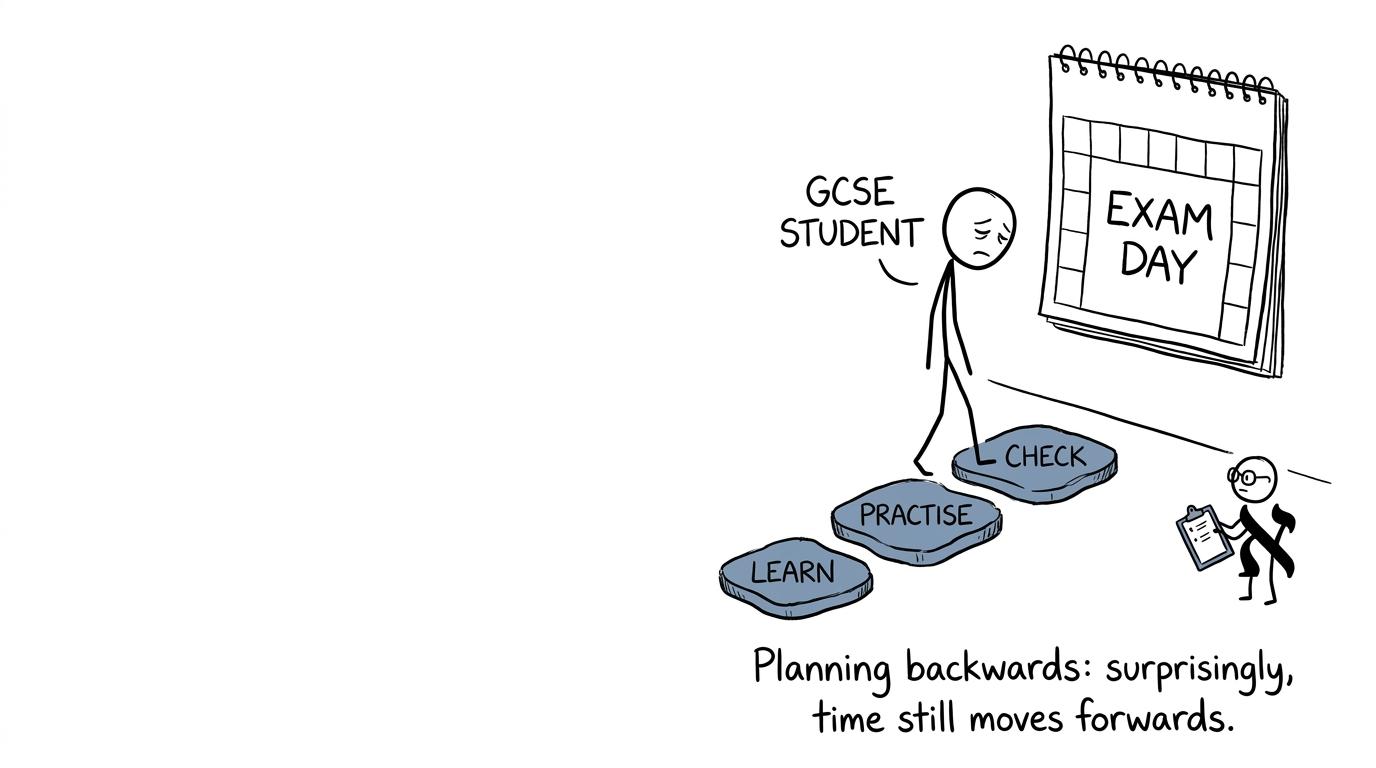 A student builds revision stepping stones backwards from exam day
Start at exam day, not at Monday morning
A normal weekly planner asks, “What could I revise this week?” That sounds sensible, but it leaves too much room for comfortable choices. You may reread a familiar chapter while avoiding unseen translation, or complete easy maths questions while postponing the topic that cost marks in your mock.
Backward planning asks a stricter question:
What must I be able to do on exam day, and what evidence will show that I am ready?
Write an exam-day outcome for each component.
For Language, that might include reading unseen passages, answering comprehension questions, translating accurately into English and preparing for the permitted grammar or composition route taught by your school.
For Literature, it means knowing both set texts well enough to translate selected passages, handle contextual and grammatical questions, discuss language and literary features, and compare themes across the texts where required.
These are destinations rather than revision activities. “Read Genesis” is an activity. “Translate a selected passage accurately without notes and explain its context” is evidence.
Turn the remaining time into phases
Let DDD represent the number of available revision days and let BBB be the number of genuine study blocks you can complete each week. Your usable capacity is approximately
C=B×D7.C = B \times \frac{D}{7}.C=B×7D.This is not a target for filling every free hour. It is a reality check. If the resulting capacity is smaller than your task list, the answer is to prioritise, not to pretend that every task will fit.
Divide the remaining time into four phases.
| Phase | Main purpose | Suitable evidence |
|---|---|---|
| Final days | Recall, confidence and practical preparation | Short translations, quotations, vocabulary checks and error-log review |
| Exam practice | Timing and complete-paper decisions | Timed sections, full papers and strict marking |
| Repair | Correct recurring weaknesses | Targeted grammar, translation and set-text questions |
| Foundation | Build secure knowledge and routines | Vocabulary retrieval, text mapping and untimed practice |
Place these phases on the calendar in reverse order. The final days sit immediately before each relevant paper. Exam practice comes before them. Repair comes before exam practice, and foundational work begins now.
Do not make both papers follow an identical schedule. Language preparation should peak before Component 1. The gap before Component 2 can then be weighted towards literature, although short language practice may still be useful until the first paper is complete.
Audit what the papers actually require
The qualification’s assessment objectives provide a useful allocation rule. Language knowledge and understanding accounts for 50%50\%50% of the GCSE. Knowledge and understanding of literature accounts for 25%25\%25%, while analysis, evaluation and response account for the remaining 25%25\%25%.
That does not mean every week must be split mechanically into those percentages. It does mean a plan made entirely from vocabulary lists is incomplete. Literature analysis cannot be replaced by knowing the narrative, just as unseen translation cannot be replaced by recognising isolated words.
Use one diagnostic task for each major skill, then label it:
- Secure: accurate without help
- Developing: partly accurate or too slow
- Priority: unable to begin, repeatedly inaccurate or poorly understood
The same evidence-led approach works in maths. MathsGenie’s guide to finding your weakest GCSE topics explains how lost marks can become a focused repair list rather than a vague judgement about ability.
Build weekly milestones before daily sessions
Daily plans are fragile. One late journey home can break them. Weekly milestones are more durable because the work can move without disappearing.
Each week should contain outcomes from four categories:
- Language: unseen comprehension, translation, grammar or composition
- Literature: translation, context, language analysis and themes
- Retrieval: vocabulary, forms, passages and quotations recalled without notes
- Assessment: a timed section, marked task or teacher-reviewed response
Write milestones as completed outputs. “Revise Elisha” is too broad. Better milestones include mapping the sequence of one chapter, retrieving key vocabulary from it, translating a chosen passage and answering an analytical question under a time limit.
Then add maths around the fixed Hebrew milestones. Start from the GCSE maths revision hub, choose your board, such as Edexcel, AQA, OCR or Eduqas, and protect separate blocks for your correct foundation or higher tier. Subject plans should share a calendar, but they should not blur into one vague instruction to “revise”.
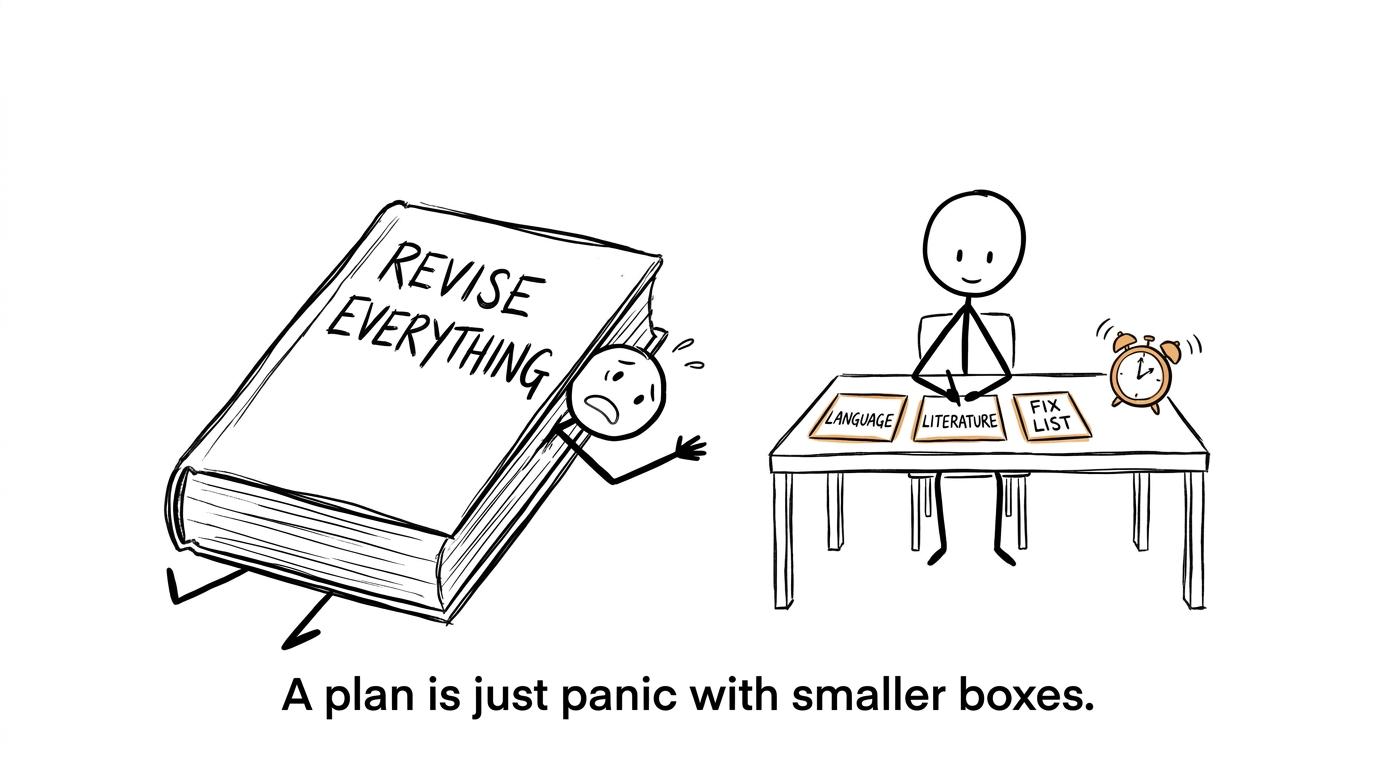 One student tackles an enormous vague task while another uses three small revision cards
Use a repeatable session structure
A revision block should produce feedback. A calm structure is:
- retrieve earlier material without notes
- complete one focused task
- check it against a mark scheme, model or teacher guidance
- record the exact error
- schedule a short retest
For Biblical Hebrew, an error log might distinguish vocabulary gaps, morphology, syntax, omitted translation details, weak textual context and unsupported analysis. Those categories tell you what the next session should contain.
For maths, use the same loop with MathsGenie’s GCSE mini tests, topic questions and video solutions. The article on using past papers properly is especially useful when revision starts becoming more exam-focused.
The important step is the retest. Marking identifies a weakness; returning to it shows whether the weakness has changed.
Schedule full papers carefully
Past papers are limited and valuable. Do not use all of them at the beginning simply to generate totals. Early in the plan, use selected questions and sections to diagnose skills. Reserve complete papers for the exam-practice phase, when timing and concentration have become relevant.
MathsGenie provides Edexcel GCSE Biblical Hebrew past papers with mark schemes and solutions where available. Match every paper to the current specification and remember that older literature papers may use different set texts. Their language questions may still support relevant practice, but old set-text content should not quietly enter your current revision list.
When balancing subjects, alternate demanding tasks. A full Hebrew paper and a full maths paper on the same evening are unlikely to produce useful feedback. A timed Hebrew section followed by a shorter maths topic test is usually easier to mark and repair properly.
Students planning the final month can adapt the rhythm in MathsGenie’s one-month GCSE revision plan. Use the method rather than copying maths-specific content: diagnose, practise, mark, repair and retest.
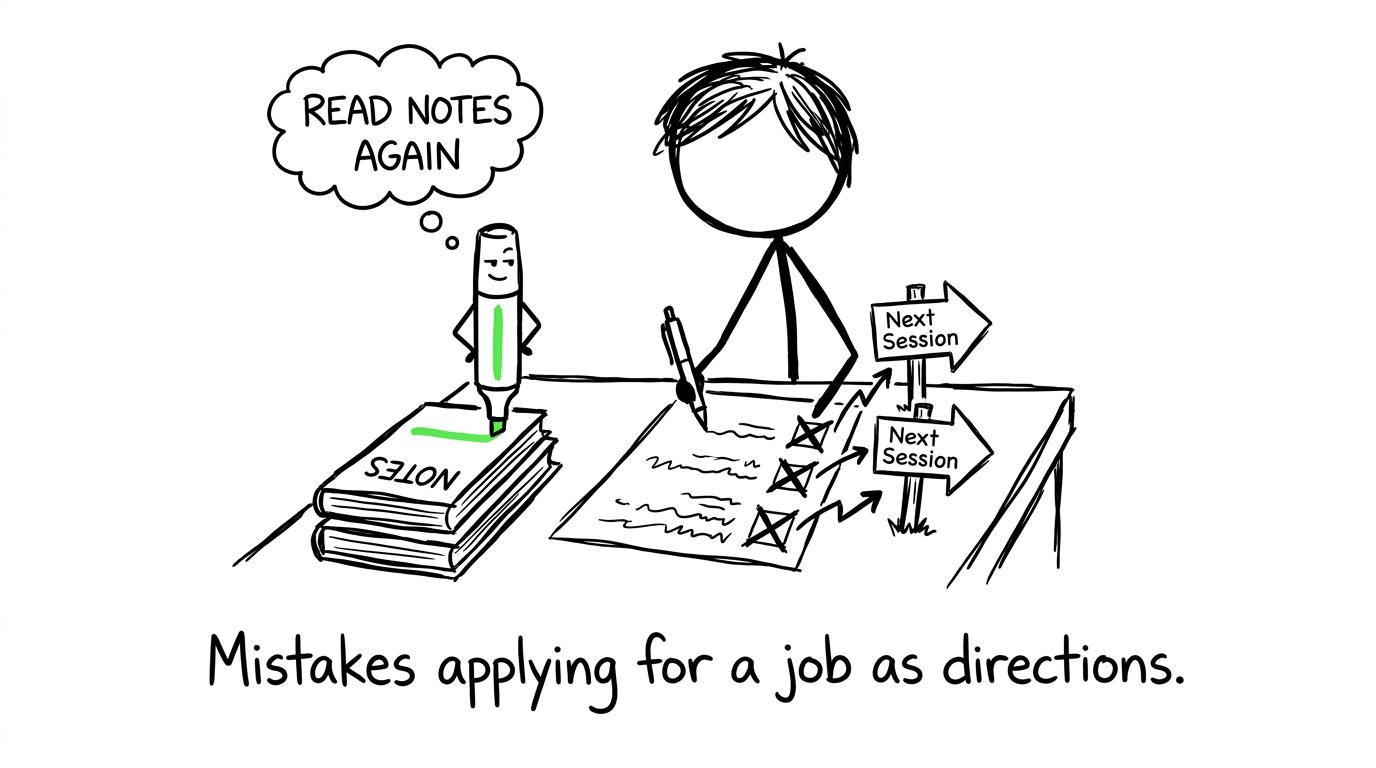 Marked mistakes turn into signposts pointing towards the next revision session
Common mistakes with a GCSE Biblical Hebrew study planner
Planning from topics rather than assessment demands
A list of chapters can create the appearance of coverage without testing translation, analysis or recall. Attach an observable task to every topic.
Giving equal time to unequal weaknesses
Revision does not have to look balanced each evening. Give more time to the skills repeatedly losing marks, while using short retrieval to maintain stronger areas.
Confusing Modern Hebrew with Biblical Hebrew
Check every resource carefully. Modern Hebrew GCSE materials assess different language skills and are not substitutes for the Pearson Edexcel Biblical Hebrew specification.
Ignoring the two separate exam dates
Component 1 and Component 2 need distinct countdowns. Build the Language peak first, then use the interval before Literature deliberately.
Using old literature papers without checking set texts
Past-paper technique can remain helpful, but the prescribed texts change between examination cycles. Keep current set-text practice at the centre of the plan.
Filling every available hour
A timetable without spare capacity fails after one disrupted day. Leave at least one flexible block each week for unfinished work, teacher feedback or rest.
Marking without changing the plan
A score is a measurement, not a correction. Every significant error should lead to a repair task and a dated retest.
Make the plan easier to follow than to avoid
A good plan removes decisions. It tells you which paper matters next, which skill needs evidence and what will be retested. It also accepts that Biblical Hebrew is only one part of a busy GCSE timetable.
Build your backward calendar today. Confirm the dates, define the exam-day outcomes, reserve full-paper practice and turn the nearest weakness into the next small task. Then organise maths with MathsGenie’s free GCSE maths revision resources, Edexcel past papers, revision lessons, practice questions, mini tests, mark schemes, video solutions and predicted papers.
Exam day will keep moving closer. The purpose of the planner is to make sure your preparation moves with it.