

GCSE Biblical Hebrew Study Group That Actually Works
GCSE Biblical Hebrew study group advice: choose the right people, set a weekly agenda, practise exam skills and stop the group chat replacing revision.

A study group often begins with excellent intentions and a new group chat. Then somebody posts a meme, somebody else asks when everyone is free, and silence takes over. Three weeks later, the group has produced many notifications but very little revision.
A GCSE Biblical Hebrew study group works when it is treated as a regular appointment rather than a social possibility. Keep it small, meet at the same time each week, give every session a precise objective and require each member to prepare something beforehand. The chat should support the meeting. It must not become the meeting.
That simple structure matters particularly when you are balancing Biblical Hebrew with GCSE maths and other subjects. A useful group should reduce the number of decisions you face, expose gaps in your knowledge and leave you with clear individual work to complete next.
The quick study group checklist
Before inviting anyone, make sure your plan includes:
- three to five reliable members
- one fixed weekly time and place
- sessions lasting roughly forty-five to seventy-five minutes
- one named organiser for each meeting
- an agenda shared in advance
- active translation, grammar recall and set-text analysis
- an agreed specification and set-text list
- an error log and individual actions at the end
- boundaries for the group chat
- separate time protected for GCSE maths revision
If those pieces are missing, enthusiasm usually has to do all the work. Enthusiasm is useful, but systems survive busy weeks.
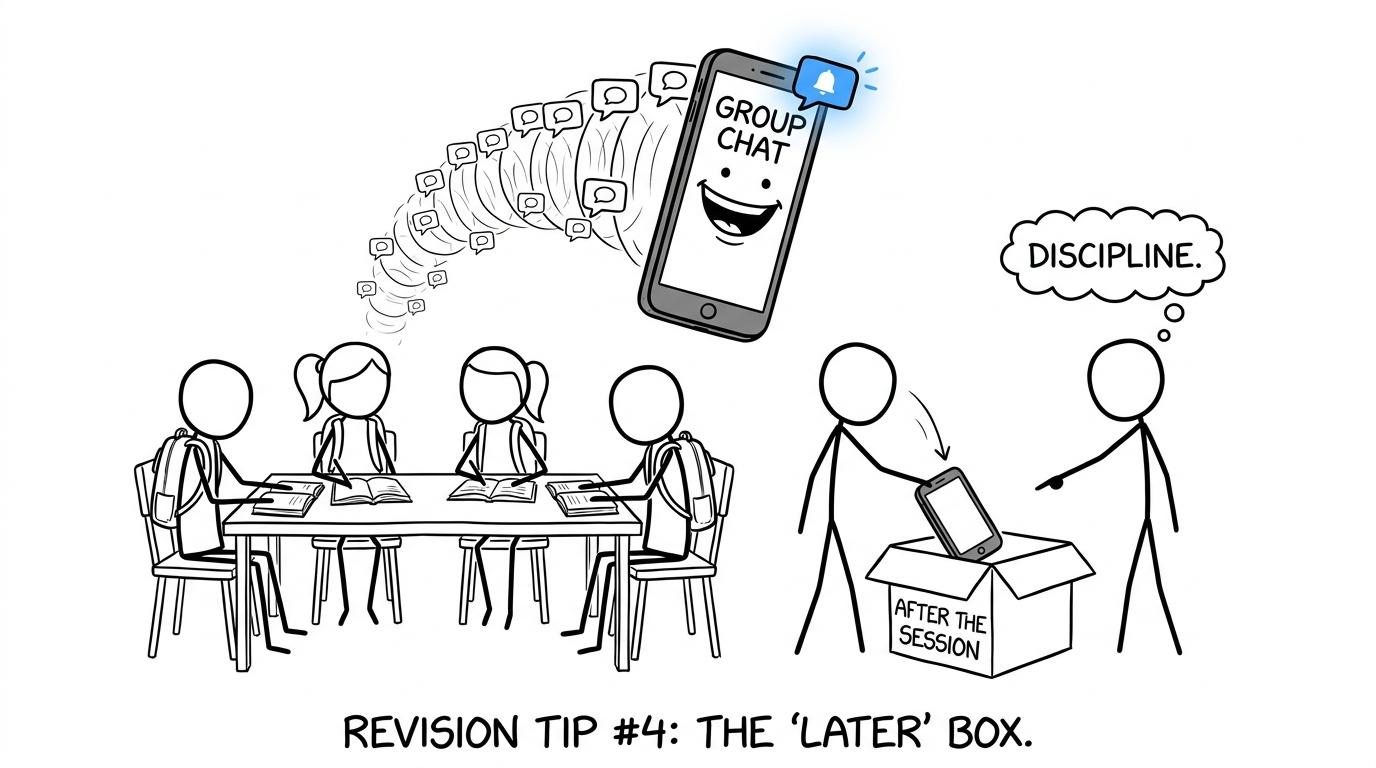 A study group protects its session from the group chat
Start with the examination, not the friendship group
The current Pearson Edexcel GCSE Biblical Hebrew qualification divides assessment equally between language and literature. The language component assesses unseen comprehension and translation, together with either grammatical analysis or translation into pointed Biblical Hebrew. The literature component covers prescribed texts, their language, content, context and literary qualities.
Official assessment objectives give language 50%50\%50% of the qualification, knowledge and understanding of literature 25%25\%25%, and analysis, evaluation and response 25%25\%25%. A group that only memorises vocabulary is therefore incomplete. So is one that spends every meeting discussing the set texts without translating anything.
Check the current Pearson specification with your teacher before planning. Set texts can change between examination cycles. For examinations from 2026 to 2028, the published specification identifies selections concerning Joseph’s rise to power in Genesis and the miracles of Elisha in Kings. Do not assume that an older class, textbook or online folder uses the texts for your examination year.
Your first meeting should answer four questions:
- Which examination series are you preparing for?
- Which prescribed texts apply?
- Which language option has your school selected?
- Which skills does each member most need to improve?
This is the Biblical Hebrew equivalent of checking the board and tier before beginning maths revision. Maths students can use the GCSE maths revision hub to select board-specific material for Edexcel, AQA, OCR, Eduqas and other boards. Biblical Hebrew students should apply the same discipline to their own Pearson specification rather than revising from a vague topic list.
Choose members for reliability, not size
A large group feels impressive until seven timetables need to align. Three to five members is usually enough to create variety without turning organisation into a weekly negotiation.
Look for students who will prepare, admit uncertainty and explain their reasoning. The strongest translator is not automatically the most useful member. Someone who notices an unexplained verb form, asks precise questions and checks the source carefully may improve the whole group.
Agree the non-negotiables before the first proper session:
- Members arrive having attempted the assigned material.
- Absence is communicated early.
- Corrections are about the answer, not the person.
- Nobody pretends to understand to keep the session moving.
- Unresolved questions are recorded for a teacher.
A study group cannot replace subject teaching. When members disagree about morphology, syntax, vocalisation or interpretation, mark the issue as unresolved rather than letting the most confident voice win.
Give each session one measurable purpose
“Revise Hebrew” is not an agenda. It is a category.
A useful objective describes what the group will produce. For example, the session might check an unseen translation, retrieve a defined vocabulary set, identify grammatical features in a passage or plan evidence for a set-text question. These are not worked answers; they are boundaries that stop the meeting wandering.
Use a repeatable session structure
A dependable meeting might contain:
- Opening recall: closed-book vocabulary, forms or textual details
- Main task: one unseen passage or one section of prescribed text
- Comparison: members explain differences between their prepared answers
- Exam focus: check wording against available mark schemes or teacher guidance
- Error review: record recurring weaknesses
- Next action: assign preparation and name the next organiser
Keep the order stable. Familiar routines save time because nobody has to reinvent the meeting each week.
This mirrors the learn, practise, mark, fix and retest cycle used in effective maths revision. If short sessions suit your wider timetable, the twenty-minute GCSE maths revision routine shows how a compact block can still include recall, questions and correction.
Assign roles so everyone contributes
Unstructured groups tend to produce two roles: the person who speaks and the people who listen. Rotate specific jobs instead.
- Chair: keeps the meeting on the agreed objective.
- Timekeeper: prevents one disputed detail consuming the session.
- Question setter: prepares the opening retrieval task.
- Text leader: selects the passage and identifies discussion points.
- Checker: records agreed corrections and unresolved questions.
In a group of three, combine roles. Rotate them every meeting so that responsibility does not quietly settle on the most organised student.
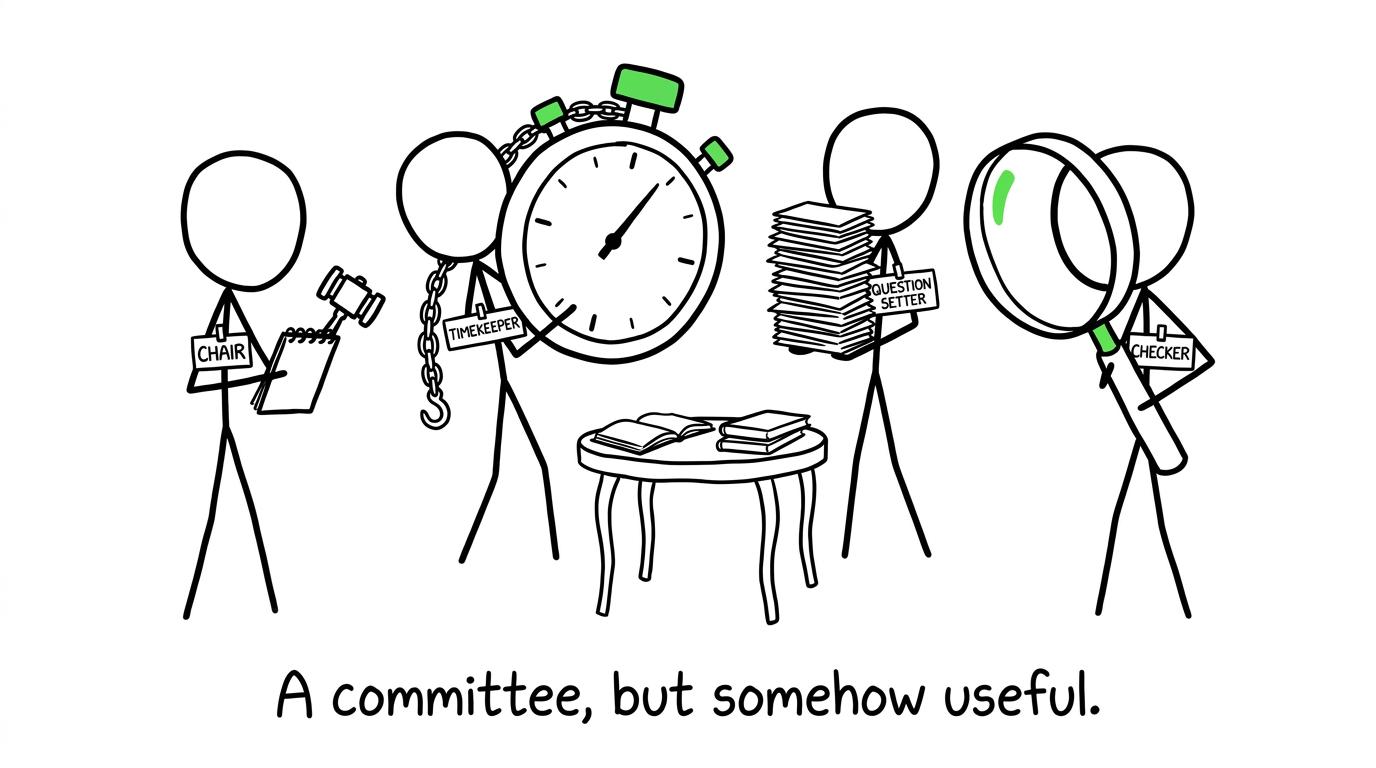 Study group members take deliberately useful roles
Preparation should be visible. The question setter needs to bring questions. The text leader needs to circulate the passage reference. The checker needs to preserve the error log. A title without a task changes nothing.
Make the group chat deliberately boring
The group chat needs only a few functions:
- confirm the next meeting
- share the agenda and assigned passage
- upload permitted resources
- record individual actions
- announce an unavoidable change
Create a rule that academic discussion requiring more than a short reply goes onto the next agenda. Otherwise, complicated questions get fragmented across messages, quieter members miss the reasoning and the in-person meeting loses its purpose.
Send one reminder the day before. Avoid repeated polls about times once the schedule has been agreed. A fixed weekly slot is more effective than reopening the calendar whenever somebody becomes busy.
Practise the skills the papers actually assess
A balanced cycle should cover both language and literature.
For language, members can independently attempt the same unseen passage before meeting. During the session, compare how each person identified forms, resolved syntax and chose accurate English. The goal is not to vote for the translation that sounds nicest. It is to justify choices from the language.
For prescribed literature, alternate between close textual knowledge and analytical response. Members should be able to locate evidence, explain its significance and respond to the precise command word. Merely retelling what happens does not demonstrate analysis.
Mark schemes can help reveal what an assessment rewards, but they should not become scripts to memorise blindly. Compare your response with the scheme, identify what was absent, then answer a fresh question without looking.
The same principle applies to maths. GCSE past papers become valuable when they are completed, marked and used to identify the next topic. The guide to using past papers at the right stage explains why review matters as much as completion.
Keep one shared error log
A good group creates evidence of improvement. Use a simple shared document with four fields:
- passage or task
- error or uncertainty
- corrected principle
- follow-up action
Keep entries specific. “Grammar weak” gives nobody a next step. “Confused the function of a particular form in context” identifies something that can be checked and retested.
Look for repeated errors rather than recording every slip forever. If several members misidentify the same feature, make it the opening recall task at the next meeting. If only one person has the gap, that becomes individual revision.
For maths, this diagnosis-first approach is explained in how to find your weakest GCSE topics. The subject changes, but the useful question remains the same: where, precisely, are marks being lost?
Protect time for maths and other GCSE subjects
A successful Hebrew group should not consume every available revision hour. Group work is memorable and social, which can make it feel more productive than quiet individual practice. Sometimes it is. Sometimes it simply feels easier.
Put the meeting into a complete weekly plan that includes independent Biblical Hebrew work, GCSE maths and your other subjects. The MathsGenie revision planner can help you organise maths alongside the rest of your timetable, while the GCSE maths revision timetable guide explains how to balance topic practice with timed papers.
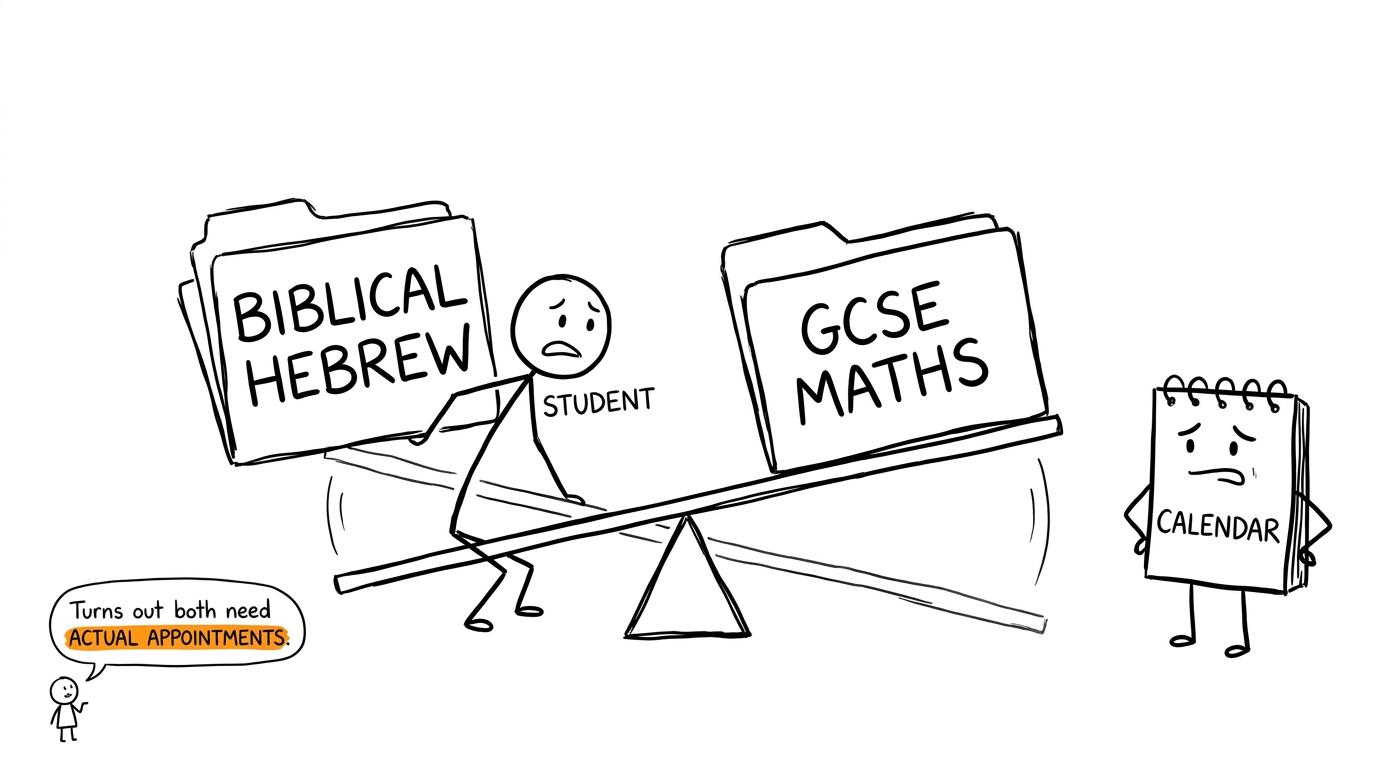 A student balances Biblical Hebrew and GCSE maths revision
The point is not to give every subject identical time. It is to make the trade-offs visible. A fixed Hebrew meeting should create structure, not quietly displace the maths practice you also need.
Common mistakes that stop a study group working
Inviting too many people
More members create more scheduling problems and less individual participation. Start small. You can exchange occasional resources with a wider class without adding everyone to the core meeting.
Meeting without preparation
If nobody attempts the passage beforehand, the session becomes a slow collective first attempt. Assign material in advance and expect members to arrive with questions.
Letting one student teach everything
Explanation can strengthen understanding, but permanent dependence exhausts one person and hides everybody else’s gaps. Rotate roles and require each member to justify decisions.
Trusting confidence instead of checking
An answer delivered quickly is not necessarily correct. Use the specification, source text, teacher guidance and available mark schemes. Record disagreements that need expert clarification.
Revising only comfortable material
Familiar passages and easy vocabulary create reassuring meetings. They do not expose weaknesses. Use the error log to choose future tasks, even when those tasks feel less pleasant.
Turning every meeting into a social event
Friendliness helps a group survive, but conversation needs boundaries. Begin on time, complete the objective and socialise afterwards.
Build a group that leaves evidence behind
A productive GCSE Biblical Hebrew study group is not defined by how often messages appear. It is defined by what changes: translations become more defensible, grammatical gaps become visible, textual evidence becomes easier to select and each member knows what to practise next.
Set one fixed meeting now. Invite a small number of reliable people, circulate a precise first task and create the error log before enthusiasm has time to dissolve into scheduling messages.
Then protect your wider GCSE preparation. Use MathsGenie as your free maths revision base: plan with the revision planner, learn through revision lessons, practise with topic questions and mini tests, and test your progress using past papers, predicted papers, mark schemes and video solutions. A good revision system does not ask you to feel motivated every evening. It tells you what to do when you arrive.










