GCSE Biblical Hebrew Role Play Marking: The Facts
GCSE Biblical Hebrew role play marking explained: why the task is not in the qualification, what students may be confusing it with and how marks work.
A search for GCSE Biblical Hebrew role play marking usually begins with a sensible worry: you want to know what the examiner is listening for, not merely what you are expected to say. But there is an important correction to make before you spend another minute practising.
The current Pearson Edexcel GCSE Biblical Hebrew qualification, specification code 1BH0, does not contain a role-play or speaking assessment. It is an untiered ancient-language GCSE assessed through two written papers. A role-play belongs to qualifications such as AQA GCSE Modern Hebrew, which is a different subject with a different exam structure.
That distinction matters. Revision works only when it is aimed at the examination you will actually sit.
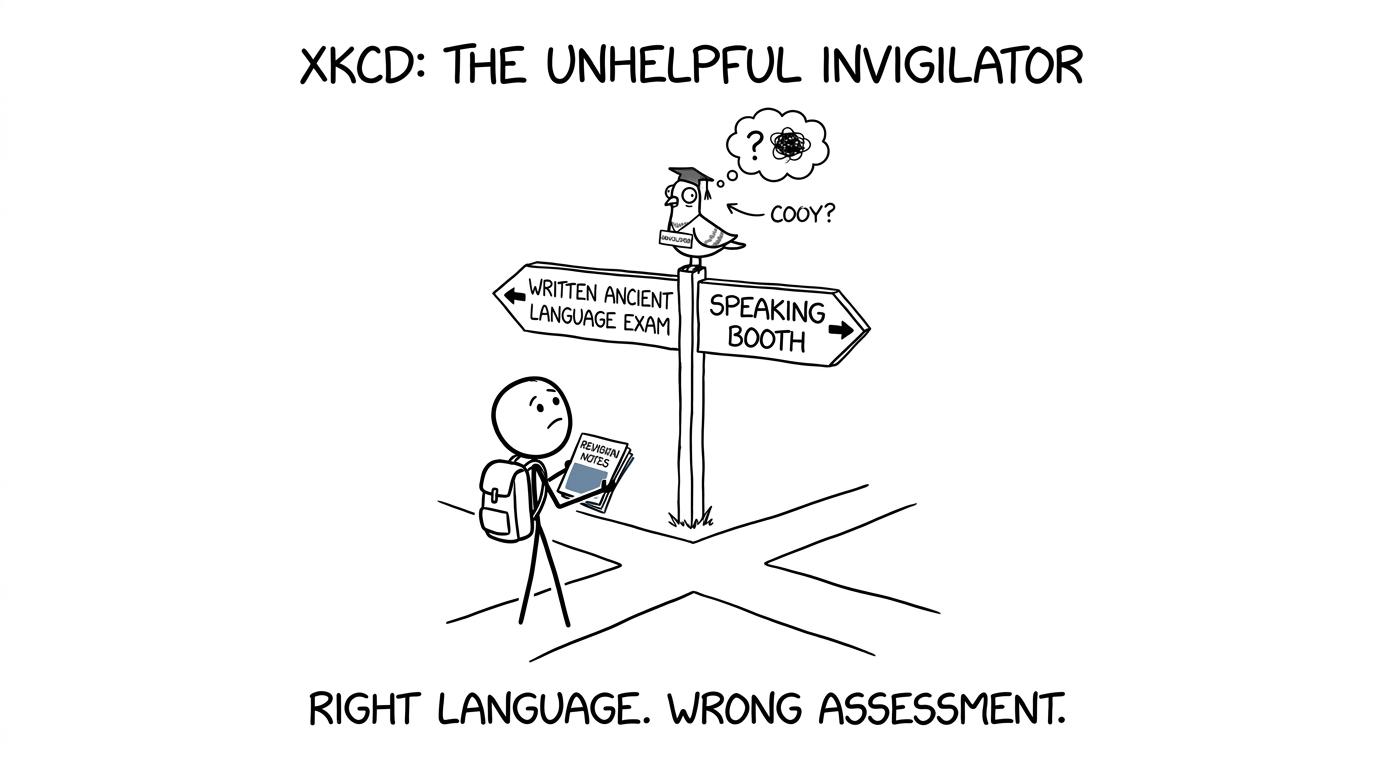 A student choosing between a written ancient-language exam and a speaking booth
The answer at a glance
Before preparing for any Hebrew assessment, check the following:
- Subject: Biblical Hebrew or Modern Hebrew?
- Exam board: Pearson Edexcel, AQA or another awarding organisation?
- Specification code: for example, 1BH0 or 8678?
- Assessment type: written examination or speaking test?
- Current specification: are your resources for the examination series you are taking?
For Pearson Edexcel GCSE Biblical Hebrew 1BH0, the assessment consists of:
- Component 1: Language, a two-hour written examination worth 50%50\%50%.
- Component 2: Literature, a two-hour written examination worth 50%50\%50%.
- No speaking paper.
- No role-play.
- No foundation or higher tier.
If your teacher has given you a role-play card, you may be preparing for Modern Hebrew, an internal school assessment or a different qualification. Ask your teacher to confirm the exact specification rather than relying on the title printed on an unofficial worksheet.
Why Biblical Hebrew and Modern Hebrew get confused
The names look close, but the assessment purposes are different.
GCSE Biblical Hebrew is treated as an ancient language. Students read passages, answer comprehension questions, translate into English, analyse grammar and study prescribed literature. Depending on the option selected in the language paper, students may also answer grammar questions or translate short English sentences into pointed Biblical Hebrew.
Modern Hebrew is assessed as a modern foreign language. Under the current AQA GCSE Modern Hebrew specification, students are assessed in listening, speaking, reading and writing. Its speaking test includes a role-play, a photo card and a general conversation.
The word Hebrew therefore does not tell you enough. The qualification title and specification code determine what is assessed.
This is the same discipline that matters in maths. An AQA paper is not automatically interchangeable with an Edexcel or OCR paper, and foundation material is not identical to higher-tier preparation. The GCSE Maths revision hub begins with the exam board for precisely this reason: the right resource starts with the right specification.
What GCSE Biblical Hebrew actually rewards
Because there is no speaking component, an Edexcel Biblical Hebrew examiner is not listening for pronunciation, fluency or interaction. The examiner is reading what you write.
Language knowledge
Component 1 tests your ability to understand unseen Biblical Hebrew. Marks are available for accurate comprehension, recognition of grammatical structures and translation.
A translation does not gain full credit merely because it sounds elegant in English. It must preserve the sense of the original passage: who performed an action, what happened, to whom it happened and how clauses relate to one another. Errors involving subjects, objects, negatives, verb forms or omitted details can alter that sense.
The useful question during revision is therefore not, “Does this English sentence sound good?” It is, “Have I transferred the meaning accurately and completely?”
Literary understanding and analysis
Component 2 assesses the prescribed set texts. Students need knowledge of content, language and context within the books being studied. They must also analyse literary features, evaluate evidence and support conclusions using relevant material from the texts.
This means that memorising a narrative outline is not enough. You need to recognise how wording creates an effect, select evidence that answers the question and explain why that evidence matters.
Written precision
Examiners can award marks only for the response on the page. Clear references, accurate translations and direct explanations make your knowledge visible. Vague statements leave the examiner to guess what you meant, and examiners do not award marks for knowledge they have to infer.
That principle transfers directly to GCSE maths. A correct method needs to appear in your working. You can develop that habit through AQA GCSE Maths past papers, or the corresponding area for your own board, checking each response against the mark scheme rather than looking only at the final answer.
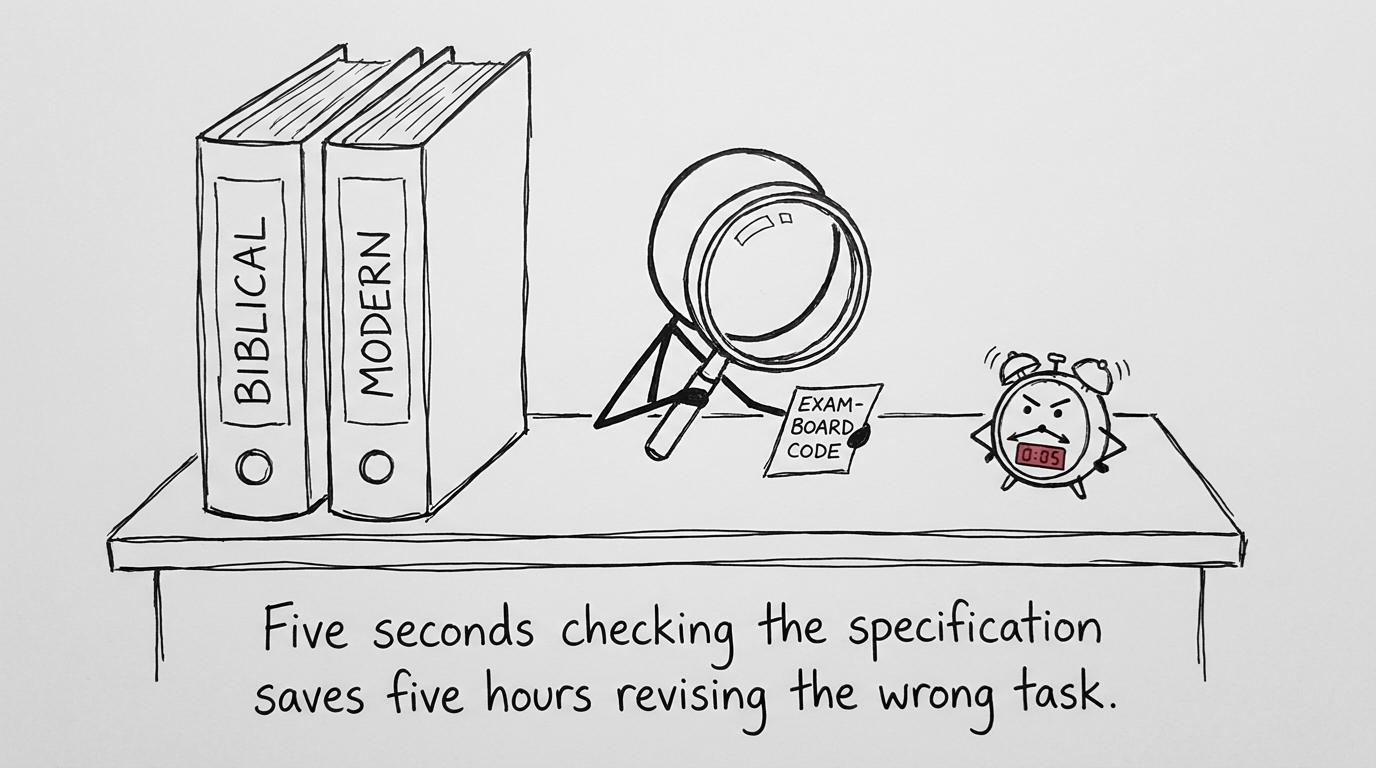 A student checking the exam-board code with an enormous magnifying glass
If you actually mean GCSE Modern Hebrew role-play marking
If your subject is AQA GCSE Modern Hebrew 8678, then the role-play is real. It is worth 151515 marks at both foundation and higher tier.
The total is divided as follows:
5×2=10 communication marks5 \times 2 = 10 \text{ communication marks}5×2=10 communication marksplus up to
5 marks for knowledge and use of language.5 \text{ marks for knowledge and use of language.}5 marks for knowledge and use of language.This structure reveals what the examiner is actually listening for.
Whether each required message is clear
The role-play contains five tasks. Each task receives:
- 222 marks when the message is conveyed without ambiguity;
- 111 mark when it is only partly conveyed or contains some ambiguity;
- 000 marks when none of the required message is conveyed.
The examiner is not simply counting Hebrew words. They are deciding whether the intended information is understandable.
A long response can still be ambiguous. A shorter response can earn full communication marks if it supplies exactly what the task requests. If a prompt requires two details, both need to be communicated clearly for the full 222 marks.
Whether you understood the examiner’s prompt
Role-play is an interaction, not a memorised speech. Your response must fit the question that was asked. A grammatically polished sentence about the wrong subject does not communicate the required message.
Students may use a repair strategy to seek clarification if they do not understand. Under the AQA criteria, a successful answer after appropriate clarification can receive the same communication mark as an answer understood immediately. Calm recovery is therefore more useful than guessing wildly.
Your knowledge and use of Modern Hebrew
Across the role-play as a whole, the examiner awards up to 555 marks for knowledge and use of language. The published descriptors range from poor through limited, reasonable and good to very good knowledge and use.
This overall judgement considers whether you can select and use suitable vocabulary and structures across the task. It is not a separate invitation to produce an unnecessarily complicated speech. Language has to serve the interaction.
What is not separately marked in the role-play
Pronunciation and intonation are not given a separate mark in this AQA role-play. Neither are spontaneity and fluency separate role-play categories. Those features are assessed elsewhere in the speaking examination.
However, pronunciation still has a practical effect: if it makes the message impossible to understand, communication may be lost. The goal is comprehensibility, not a supposedly perfect accent.
A practical preparation routine
Whether you are correcting a subject mix-up or preparing for Modern Hebrew, use a revision process that produces evidence.
Confirm the assessment first
Write the qualification title, board and specification code at the top of your revision plan. Check these against information supplied by your school. Five minutes spent confirming the paper can prevent hours of misplaced practice.
Practise the precise task
For Biblical Hebrew, prioritise unseen comprehension, translation, grammar and set-text analysis. For Modern Hebrew role-play, practise responding to prompts, conveying every requested detail and recovering when you do not initially understand.
Do not merge the two courses into a general folder labelled “Hebrew”. Their assessment demands are too different.
Mark the message, not the performance
When reviewing a Modern Hebrew role-play recording, ask:
- Did I answer the actual prompt?
- Did I include every requested detail?
- Could a listener understand one clear meaning?
- Did I use suitable vocabulary and structures?
- If I hesitated, did I recover and complete the task?
This resembles the honest feedback loop used in effective maths revision: attempt, mark, diagnose, repair and retest. MathsGenie’s guide to finding your weakest GCSE topics shows how to turn lost marks into specific actions rather than vague worries.
Keep sessions small enough to repeat
One focused task reviewed carefully is more valuable than several rushed attempts. If revision time is tight, borrow the structure of the 20-minute GCSE maths revision routine: recall, attempt, mark and record one correction.
For maths itself, shorter Edexcel GCSE Maths mini tests can provide the same quick feedback without requiring a complete paper every evening.
Common mistakes to avoid
Revising the wrong Hebrew qualification
This is the largest error because it makes every later decision ineffective. Confirm whether your course is Biblical or Modern Hebrew before using any role-play advice.
Treating communication as word count
In a Modern Hebrew role-play, more language does not automatically mean more marks. Complete the requested task clearly. Extra language that introduces contradictions can make your message harder to follow.
Ignoring one part of a prompt
When two pieces of information are required, providing only one can limit the communication mark. Train yourself to identify every element before responding.
Believing one error destroys the task
The mark scheme is concerned with whether the message is conveyed. An error may be survivable when the meaning remains unambiguous. Keep going rather than abandoning the response.
Using old or generic resources without checking them
Assessment structures change, and search results can mix together similarly named subjects. Use the specification for your own examination series and ask your teacher when a resource conflicts with it.
The same caution applies to maths predictions. GCSE predicted papers are valuable rehearsal materials, but they should support rather than replace specification-wide revision and official past papers.
Turn accurate information into accurate revision
The central fact is simple: there is no role-play in the current Pearson Edexcel GCSE Biblical Hebrew qualification. If you are studying Biblical Hebrew, focus on the two written components: language and literature. If you are studying AQA GCSE Modern Hebrew, the role-play rewards five clearly communicated task messages plus an overall judgement of knowledge and use of language.
Good revision often begins with a small act of accuracy: checking the subject, board, tier and paper before opening a workbook. Apply that habit across your GCSEs.
For maths, start with the free MathsGenie GCSE revision area, then combine revision lessons and practice questions with mark schemes, video solutions and mini tests. As the exams approach, use the guide to using GCSE past papers properly before moving to predicted papers. The aim is not simply to complete more work. It is to practise the task that will actually be marked.