GCSE Biblical Hebrew Resit Entry: Late Guide
GCSE Biblical Hebrew resit entry explained: summer-only resits, 2027 deadlines, late fees, private candidates and what to do after missing an exam.
Missing an exam creates a particular kind of panic. At first, it feels as though one date has decided everything. In reality, the next step depends on what you missed: the entry deadline, one examination paper, or the entire summer series.
For a GCSE Biblical Hebrew resit entry, the essential answer is this: Pearson Edexcel GCSE Biblical Hebrew is currently available in the May/June series, not the November GCSE resit window. If you missed summer 2026, the next scheduled opportunity is summer 2027. Your school, college or an approved examination centre must enter you, and a full resit requires both components in the same series.
Act quickly even when the next examination is months away. Entry deadlines, centre capacity, access arrangements and fees all have their own clocks.
Your immediate checklist
- Confirm whether you missed an entry deadline or an actual examination.
- Check that your qualification is Pearson Edexcel GCSE Biblical Hebrew, specification 1BH0.
- Contact your school’s examinations officer immediately.
- If your school cannot enter you, start looking for an approved centre accepting private candidates.
- Ask for a complete written quotation, including the awarding-body fee and the centre’s administration or invigilation charges.
- Confirm that the entry covers both Language and Literature.
- Request and check your statement of entry.
- Arrange access arrangements early if you need them.
- Keep preparing for your other GCSEs through the GCSE Maths revision hub rather than allowing one administrative problem to derail every subject.
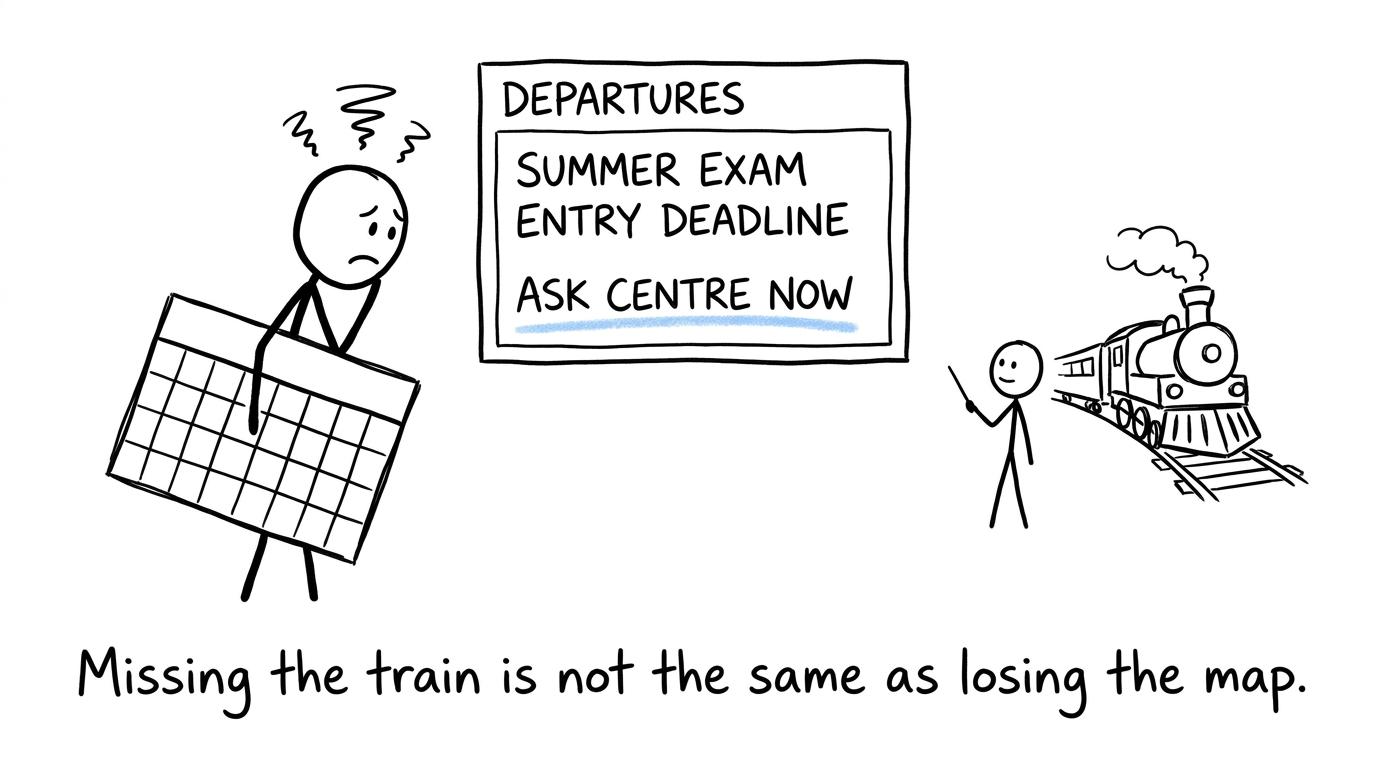 A student consults an exam deadline departures board
How a GCSE Biblical Hebrew resit works
The current Pearson Edexcel qualification has two externally examined components:
- Component 1: Language, code 1BH0/01, lasting 2 hours and worth 50%50\%50% of the qualification.
- Component 2: Literature, code 1BH0/02, lasting 2 hours and worth 50%50\%50% of the qualification.
The specification states that students complete all assessment in May/June in a single year. It is a linear qualification, so a resit is not a chance to repeat only the weaker paper while retaining the other paper’s mark. You must take both components again in the same summer series, and the combined performance produces the new grade.
There is no foundation or higher tier in GCSE Biblical Hebrew. That differs from GCSE Maths, where your centre must also confirm the correct tier. If you are balancing both subjects, check your maths paperwork separately and use MathsGenie’s GCSE resit revision plan to turn your previous result into a focused list of topics.
Pearson’s current information manual confirms that specification 1BH0 is available in June 2027. The published summer 2027 timetable places Component 1 on Monday 10 May in the morning and Component 2 on Wednesday 19 May in the afternoon. Examination timetables can be amended, however, so your centre’s final timetable and statement of entry remain authoritative.
Resit entry and late entry are not the same thing
A resit entry means entering a qualification you have previously taken, or arranging another attempt after missing the previous assessment opportunity. A late entry means the centre submits that entry after the awarding body’s standard deadline.
You can therefore be a resit candidate without being late. This is the best position to be in: it gives the centre time to confirm the specification, order any required materials and deal with access arrangements.
For UK centres in the June 2027 series, Pearson’s published timetable says:
- entry data becomes available on 20 November 2026;
- the standard entry deadline is 21 February 2027;
- late fees begin on 22 February 2027;
- high late fees and amendment fees begin on 22 April 2027.
These are Pearson’s deadlines for centres, not promises that an individual centre will accept your booking until those dates. Schools and private candidate centres frequently set earlier internal deadlines so that they can check identification, collect payment, arrange rooms and process entries safely.
The practical rule is simple: contact a centre during the autumn term if possible. Do not treat February as the day on which your search should begin.
What happens if you miss the standard entry deadline?
Missing the standard deadline does not necessarily make entry impossible. A willing centre may still submit a late entry while Pearson’s late-entry arrangements remain open. You should expect the cost to rise, and the centre may refuse if it lacks space, staff, secure storage or experience with the qualification.
Ask the examinations officer these questions directly:
- Do you accept late entries for Pearson Edexcel GCSE Biblical Hebrew 1BH0?
- What is your own final booking date?
- Does the quotation include both components and every centre charge?
- When will I receive my candidate number and statement of entry?
- Can you process my required access arrangements in time?
- What identification and previous candidate information do you need?
Do not attempt to enter directly with Pearson. GCSE candidates are entered by registered examination centres. The centre is also responsible for receiving papers, conducting the examinations and returning completed scripts.
Entering as a private candidate
If you are no longer enrolled at the school where you first took the qualification, you may need to enter as a private candidate. That means preparing independently but sitting the examinations at an approved school, college or other authorised centre.
Pearson lists GCSE Biblical Hebrew as available in the June series, but availability at qualification level does not mean every centre offers it. Centres choose which private candidates and subjects they can accommodate. A centre familiar with mainstream GCSEs may still decline a less commonly requested language qualification.
Start by giving prospective centres precise information: Pearson Edexcel, GCSE Biblical Hebrew, specification 1BH0, with both externally examined components. Precision saves time. Saying only that you need a “Hebrew resit” could lead to confusion with another qualification.
Once accepted, check every detail on your statement of entry: legal name, date of birth, subject, specification code and component arrangements. Administrative errors become harder to correct as the examination approaches.
If you missed an actual Biblical Hebrew paper
Missing the examination itself is different from missing the entry deadline. Contact your examinations officer on the same day and explain exactly what happened.
If you were absent because of a temporary illness, injury or another circumstance outside your control, the centre may consider an application for special consideration. Under the current JCQ rules, a candidate must have been fully prepared, covered the whole course and completed at least one whole component worth at least 15%15\%15% of the qualification.
Because each Biblical Hebrew component is worth 50%50\%50%, completing one paper may satisfy the assessment-percentage requirement. It does not guarantee an award. The reason for absence must meet the rules, the centre must support the application, and Pearson makes the decision.
Special consideration is not designed to compensate for forgetting the examination, misreading a personal timetable or failing to prepare. If you missed both components, there is no completed component from which an award could normally be calculated. In that situation, the likely route is a fresh entry for the next summer series.
Do not wait for results day before raising an examination-day absence. Evidence and applications are handled within strict post-examination timescales.
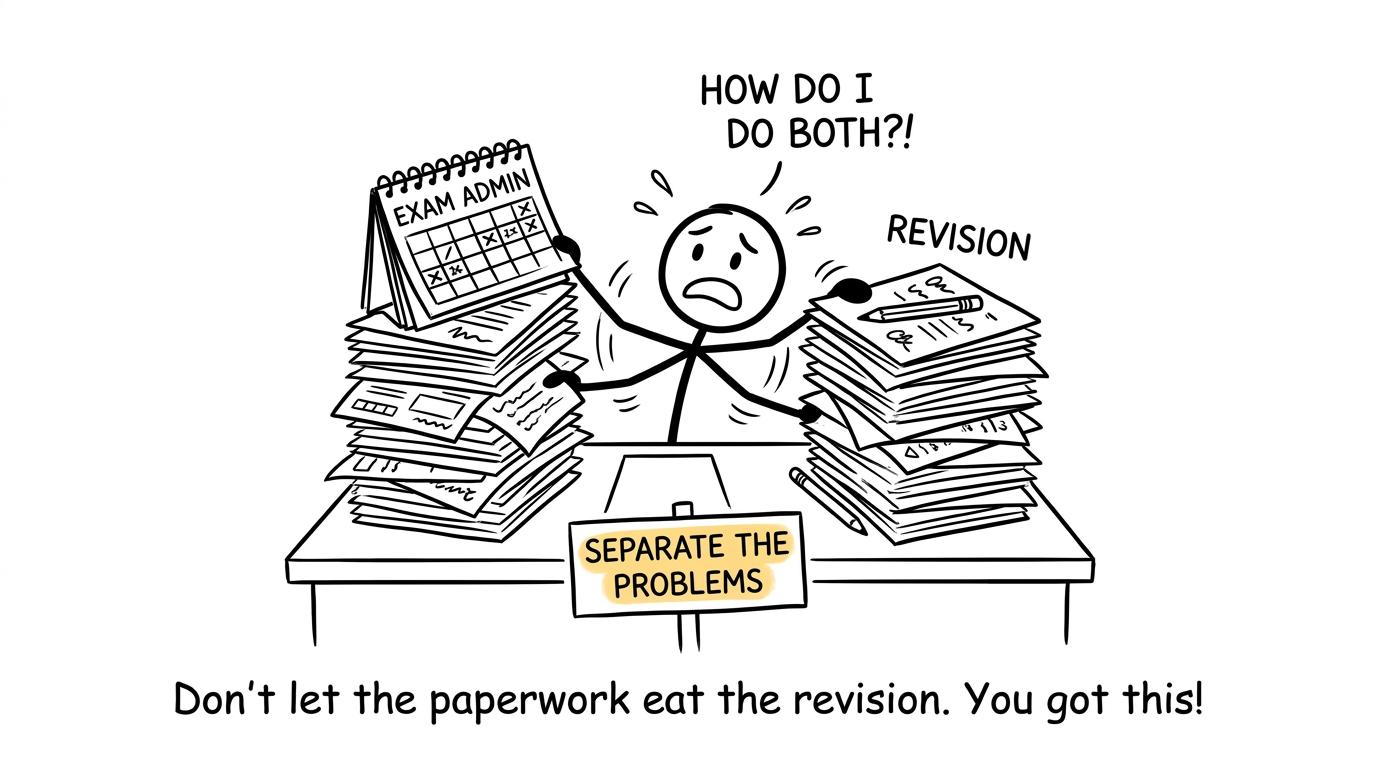 A student separates exam administration from revision
Keep the resit from disrupting maths revision
An unresolved exam entry can occupy far more attention than the form itself deserves. The useful response is to separate administration from preparation.
Give the entry problem a short action list: contact the centre, obtain the quotation, pay, and check the statement of entry. Then return to the work that earns marks.
For maths, begin with one diagnostic paper from the Edexcel GCSE Maths past papers, AQA GCSE Maths past papers or OCR GCSE Maths revision area, depending on your board. Mark it carefully, identify the topics costing you marks, and repair those gaps through revision lessons and practice questions.
If several exams are approaching together, MathsGenie’s one-month GCSE maths revision plan provides a manageable weekly rhythm. The wider MathsGenie resources collection brings together mini tests, practice papers, predicted papers and other revision tools.
The principle is the same in every subject: administration secures your seat, but deliberate practice changes what happens once you sit in it.
Common mistakes with late and resit entries
Assuming Biblical Hebrew has a November resit
The additional November GCSE series is for English Language and Maths, subject to its eligibility rules. Biblical Hebrew candidates normally wait for the next May/June series.
Trying to retain one component mark
The qualification is linear. A new attempt requires Language and Literature in the same examination year rather than carrying forward one externally examined paper.
Confusing Pearson Edexcel with OCR
The current GCSE discussed here is Pearson Edexcel specification 1BH0. Legacy paperwork or an online search can surface old OCR Biblical Hebrew material, but that is not the current Edexcel qualification.
Waiting for the awarding-body deadline
Your chosen centre may close entries weeks earlier. Its internal deadline, capacity and payment rules matter just as much as Pearson’s published dates.
Comparing only the basic entry fee
A private candidate’s total may include centre administration, invigilation, venue and late-entry charges. Request the complete cost before paying.
Leaving access arrangements until spring
Extra time and other arrangements require evidence and centre processing. Tell the centre about your needs when making the first enquiry, not shortly before the paper.
Turn the missed sitting into a clear next step
A missed GCSE sitting feels final because the calendar moves in one direction. But the decision in front of you is smaller: identify the next available series, find a willing centre, enter before its deadline and prepare for both components.
For summer 2027, begin those conversations well before Pearson’s standard deadline of 21 February 2027. Once the entry is confirmed, let the paperwork become boring. That is a good sign. It means your attention can return to preparation.
Keep your other GCSE goals moving with MathsGenie. Use free revision lessons to rebuild weak methods, practice questions and mini tests to make them reliable, then past papers, predicted papers, mark schemes and video solutions to prepare under examination conditions. Secure the entry early; then make the sitting count.