GCSE Biblical Hebrew Note Taking That Works
GCSE Biblical Hebrew note taking made practical: build concise language and set-text notes, then turn them into retrieval prompts for revision that lasts.

A notebook can look busy without being useful. Pages fill with copied vocabulary, highlighted translations and grammar explanations that made sense when the teacher said them. Weeks later, the same pages feel strangely unfamiliar.
Effective GCSE Biblical Hebrew note taking solves that problem by designing every note for a future action. Instead of asking, “What should I write down?”, ask, “How will this help me recall, translate or analyse something later?” Your notes should become questions, short tests and records of mistakes, not a transcript of the lesson.
That principle matters when Biblical Hebrew is one subject among several. If you are also preparing for GCSE maths, your revision system needs to be quick to maintain and easy to return to. The goal is not a perfect notebook. It is reliable recall.
The quick note-taking checklist
A useful Biblical Hebrew note system should:
- follow the current Pearson Edexcel specification and your teacher’s set-text guidance
- separate vocabulary, morphology, syntax, translation and literature
- record roots, prefixes, suffixes and forms precisely
- turn information into questions you can answer with the page covered
- include corrections from assessed work and mark schemes
- schedule difficult material for another attempt
- remain short enough to review regularly
The distinction between Biblical and Modern Hebrew is important. Pearson Edexcel GCSE Biblical Hebrew is an ancient-language qualification, not AQA GCSE Modern Hebrew. It is also not divided into foundation and higher tiers in the way GCSE maths is.
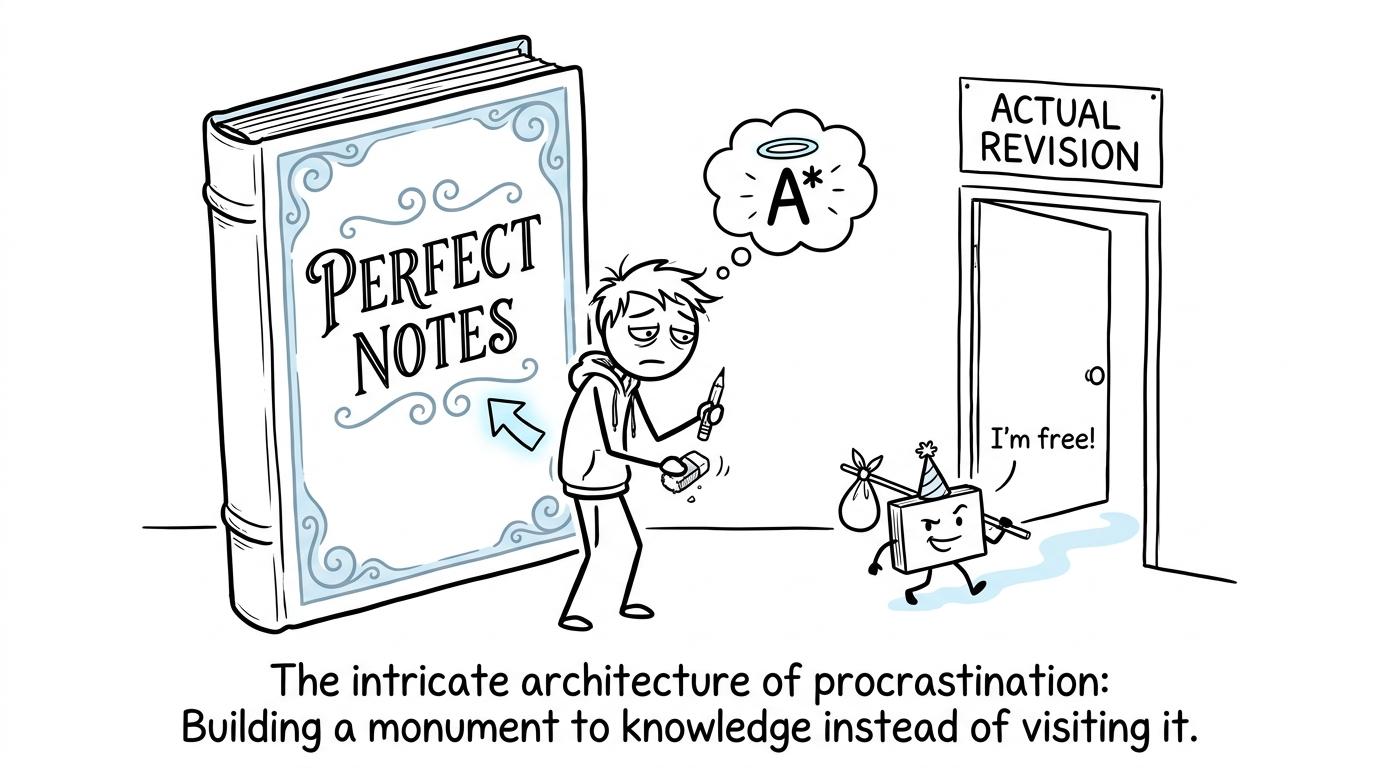 A student protects beautiful notes while useful revision escapes
Build notes around what the examination assesses
Pearson Edexcel GCSE Biblical Hebrew has two externally examined components. Language accounts for half of the qualification and includes understanding and translating unseen passages. Students also answer either grammar questions or questions requiring translation of simple English sentences into pointed Biblical Hebrew. The other half assesses prose literature.
This gives your notebook a clear structure. Create five sections:
- core vocabulary
- verb forms and morphology
- syntax and translation decisions
- set-text language
- literary content and analysis
Keep the core vocabulary list separate from words attached to a prescribed passage. Otherwise, you may spend revision time memorising a set-text word as though it belongs to the general unseen-language list.
For examinations from 2026 to 2028, Pearson’s specification identifies passages concerning Joseph’s rise to power in Genesis, chapters 41 to 43, and the miracles of Elisha in Kings, chapters 4 to 7. Set texts can change between examination cycles, so label literature folders with the relevant years and confirm them against the specification supplied by your teacher.
This specification-first approach transfers well to maths. Before organising maths notes, identify your board and tier through the GCSE Maths revision hub rather than revising from an unfiltered collection of topics.
Use a page that can test you later
A conventional page encourages rereading because all the information is visible. A retrieval page hides the answer until you have tried to remember it.
Divide each page into three areas:
| Area | What belongs there |
|---|---|
| Cue column | Questions, roots, grammatical labels or short translation prompts |
| Main notes | Accurate meanings, forms, rules and teacher explanations |
| Review box | Errors, next review date and confidence rating |
Write cues after the explanation has become clear. Useful cue types include:
- What is the root?
- Which conjugation, person, gender and number are present?
- What does this prefix contribute?
- What function does the suffix perform?
- Which feature of the form could cause a mistranslation?
- What literary effect should be connected to this detail?
When reviewing, cover the main-notes column and respond to the cues. This turns the page into a mini test rather than something to stare at.
Research on learning consistently supports retrieval practice and spacing over repeated passive exposure. That does not mean rereading is forbidden. Rereading is useful for checking and correcting an attempted recall. The order matters: attempt, check, correct, then return after a gap.
Separate vocabulary from grammatical recognition
A translation can fail even when you know every dictionary meaning. Biblical Hebrew words carry information through roots, patterns, prefixes and suffixes, so vocabulary notes must preserve more than an English gloss.
For a verb, record:
- the unpointed root
- the principal meaning or meanings required by the specification
- the usual conjugation where relevant
- forms you have repeatedly misidentified
- a cue that asks you to recognise the form without seeing the answer
For a noun, adjective or preposition, record relevant information such as gender, number, construct forms and possible pronominal suffixes. Copy pointing carefully where it is required. Pearson’s vocabulary appendices distinguish unpointed verb roots from other pointed entries, so your notes should preserve that distinction rather than flattening every entry into transliteration.
Avoid placing six facts on the front of one flashcard. A crowded prompt tests recognition of the page layout rather than recall of a specific fact. Split large entries into smaller prompts, but connect them with the same root label or topic tag.
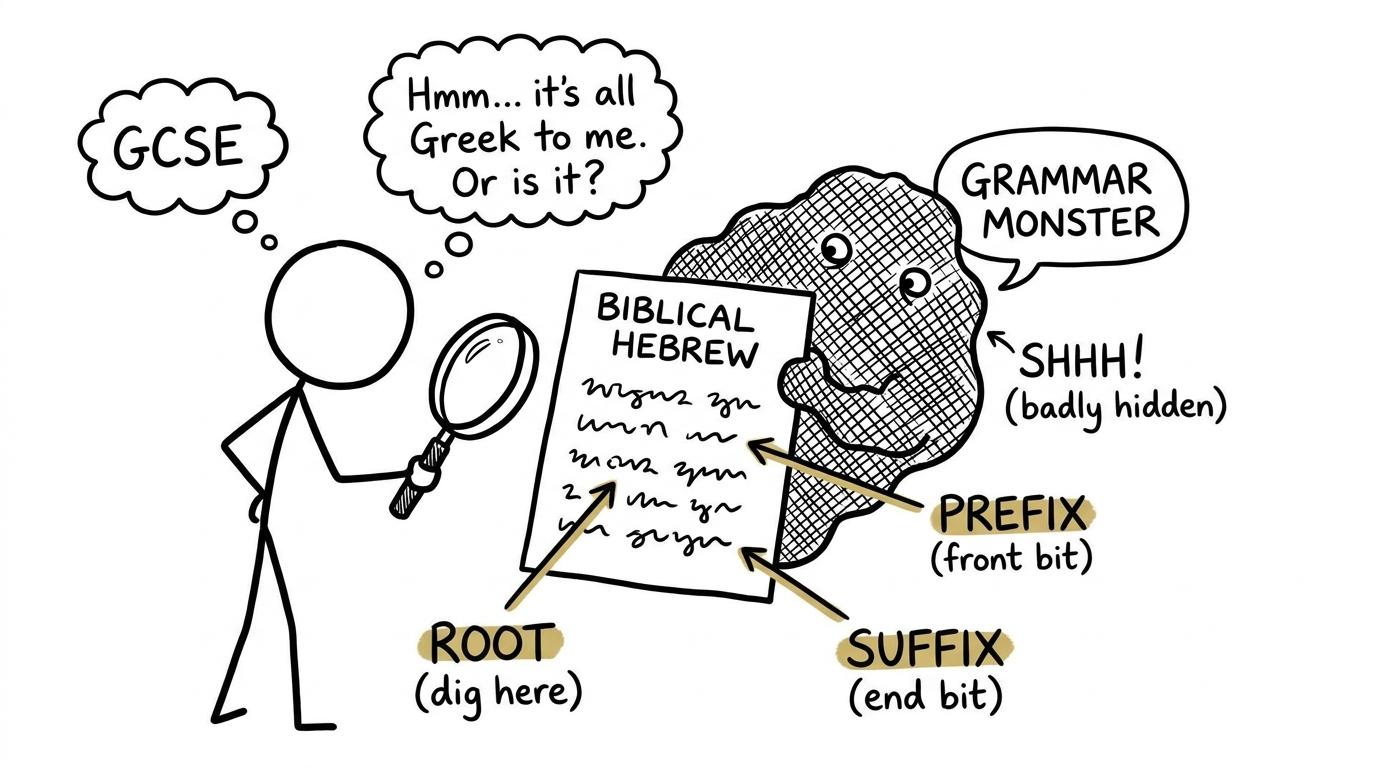 A revision detective follows clues labelled root, prefix and suffix
Record translation decisions, not complete copied translations
Copying a polished English translation feels productive because the result looks finished. Yet the final sentence hides the decisions that created it.
Instead, annotate a passage with brief decision notes:
- the verb form that establishes the subject or time
- the role of a conjunction or prefixed preposition
- an attached pronoun and its likely referent
- an idiom that should not be translated mechanically
- a word whose meaning depends on context
- the reason English word order must differ
Then keep a separate clean translation for checking. During revision, return first to the Hebrew and reconstruct the meaning before opening the polished version.
This mirrors effective maths revision. Reading a completed solution is not the same as producing a method. MathsGenie’s guide to stopping forgotten GCSE maths content uses the same learn, retrieve, check and revisit cycle.
Make literature notes do three different jobs
Set-text notes often become too large because language, content and analysis are mixed together. Give each passage three compact layers.
Language layer
Record vocabulary, forms, syntax and translation choices that are specific to the passage. Link repeated roots or constructions rather than explaining the same feature several times.
Content layer
Summarise who acts, what changes and how the passage develops. Keep this factual. It should help you locate evidence quickly without replacing close knowledge of the text.
Analysis layer
Organise themes, characterisation, narrative technique and significant details as claims supported by precise textual references. A heading such as “Joseph” is too broad. A question such as “How does the passage present authority?” gives your later revision a purpose.
Do not import background material merely because it is interesting. GCSE Biblical Hebrew assessment is tied to the prescribed books and passages. Follow the specification and your teacher’s guidance about the expected literary and contextual scope.
Use a capture, compress and test routine
Good notes are made in stages. Trying to create their final version while listening can make you miss the explanation.
Capture during the lesson
Write the essential rule, textual reference, correction or teacher explanation. Use temporary abbreviations if necessary, but leave space to clarify them.
Compress soon afterwards
Reduce the lesson to a small number of cues. Correct pointing, complete labels and remove duplicated material. If a sentence cannot be shortened without losing its meaning, turn it into two separate prompts.
Test without looking
Close the source and answer your cues. Check immediately, correct inaccuracies in a different colour and mark uncertain items for another attempt. Revisit them across several shorter sessions rather than relying on one long reread.
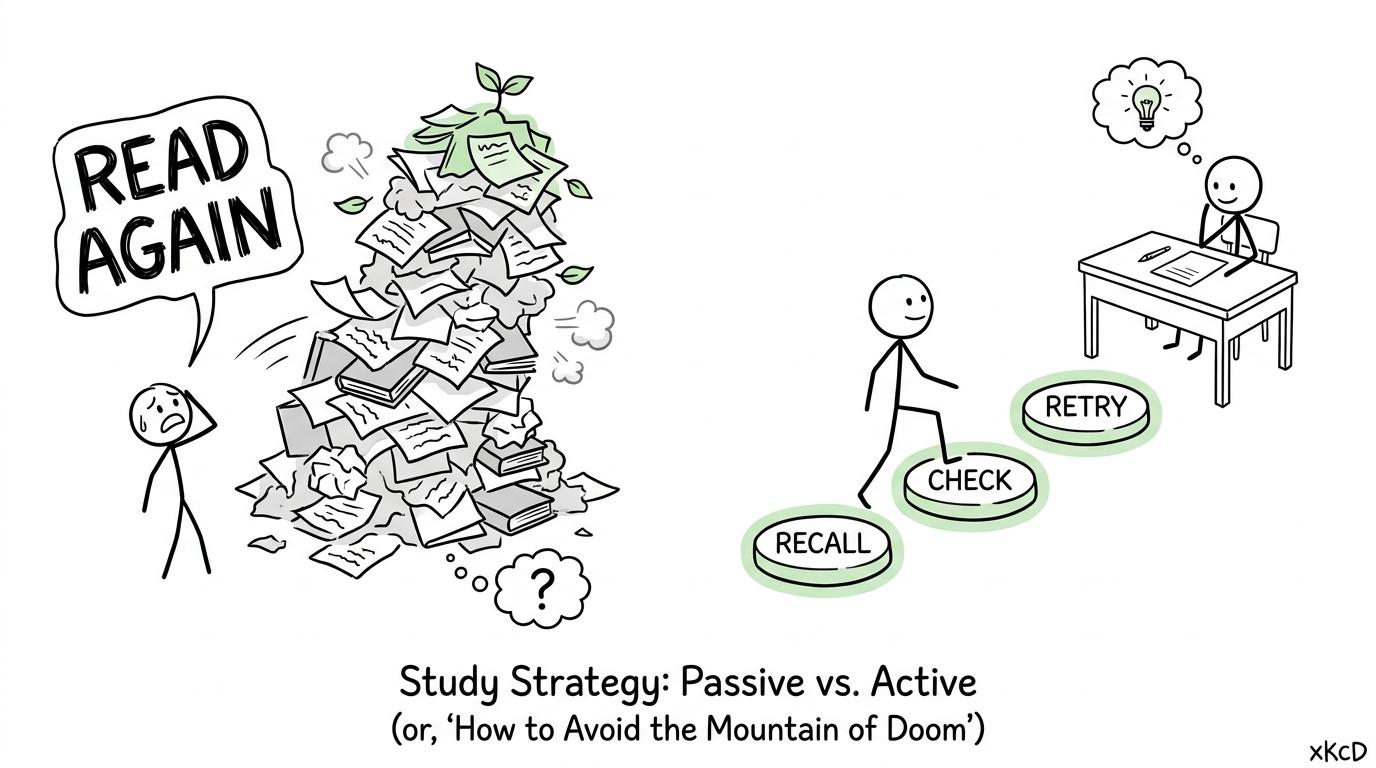 Small recall, check and retry steps lead past a wobbling rereading pile
A revision plan becomes more trustworthy when it is based on evidence. Maths students can apply the same idea through the guide to finding weak GCSE topics, then use Biblical Hebrew errors to decide which forms or passages need the next review slot.
Keep an error log beside your notes
Your most valuable notes may begin with something wrong. Every marked translation, grammar exercise or literature response can reveal a repeatable pattern.
Use four columns:
| Source | Error type | Precise correction | Next action |
|---|---|---|---|
| Translation or test reference | Vocabulary, morphology, syntax, pointing, omission or analysis | One short statement of what should change | A specific recall prompt and re-test date |
Do not write “revise verbs”. Record the exact distinction you missed. Precision makes the next task smaller and therefore more likely to happen.
For maths, the same discipline turns lost marks into focused practice. Use Edexcel GCSE Maths past papers with their mark schemes, or read how to use Edexcel past papers properly. Biblical Hebrew papers should likewise be reviewed against the relevant official mark scheme and your teacher’s feedback.
Paper or digital notes?
Choose the format you will genuinely test yourself with. Paper makes covering answers and annotating forms simple. Digital notes are searchable and easier to reorganise when a root appears in several passages. A hybrid system often works well: a searchable master index, alongside handwritten retrieval and translation practice.
Whatever you choose, keep one source of truth. Three half-maintained vocabulary systems create more searching than learning. Your format should also reproduce examination demands where appropriate, including accurate square script and pointing rather than depending entirely on transliteration.
Common GCSE Biblical Hebrew note-taking mistakes
Copying everything
A transcript records the lesson but does not identify what must be recalled. Capture selectively, then convert important information into cues.
Highlighting without a question
Colour can organise categories, but highlighting alone does not test memory. Every highlighted rule should lead to a prompt or task.
Mixing core vocabulary with set-text words
Use clear labels so you know what is required for unseen language and what belongs to literature preparation.
Recording translations without grammar
Keep the decisions behind a translation visible. Otherwise, you may remember the English sentence while remaining unable to interpret a fresh passage.
Making notes but never scheduling review
Put a next-review date beside uncertain material. The GCSE one-week maths revision plan shows how short, defined tasks can fit alongside paper practice without turning revision into an endless list.
Treating familiarity as mastery
A page can feel familiar because you have seen it often. Test whether you can supply the answer before revealing it. In both languages and maths, a correct independent response is stronger evidence than recognition.
Notes should become something you do
Useful notes are rarely the prettiest notes. They are the pages with covered answers, corrected misunderstandings and dates showing that you returned. They reduce the distance between learning in class and performing alone in an examination.
For Biblical Hebrew, build your system around the current Pearson specification, preserve linguistic detail and turn each page into retrieval. For maths, let MathsGenie’s free GCSE revision resources do the organising: choose your exam board and tier, learn through revision lessons, complete practice questions and mini tests, then move into past papers, predicted papers, mark schemes and video solutions.
Start small. Take one page of existing Biblical Hebrew notes, write five useful cues in the margin and test yourself before looking. That is the moment note taking stops being an activity that looks like revision and becomes revision you can actually use.