

GCSE Biblical Hebrew Half-Term Revision That Gets Done
GCSE Biblical Hebrew half-term revision made realistic: build a focused plan for language, literature, recall and practice without losing your break.
Half-term revision often begins with an ambitious timetable and ends with several beautifully highlighted headings but very little tested knowledge. The problem is rarely laziness. The task simply feels too large to start.
Effective GCSE Biblical Hebrew half-term revision is smaller and more practical: identify a few genuine weaknesses, complete short sessions based on recall and exam questions, mark your work, and return to mistakes later in the week. You do not need to surrender the whole holiday. You need a plan clear enough to begin and light enough to repeat.
This guide is written for students balancing Biblical Hebrew with GCSE maths and other subjects. MathsGenie does not provide Biblical Hebrew teaching materials, but the same revision system that makes maths practice effective, diagnose, practise, mark, repair and retest, transfers remarkably well.
Your half-term revision checklist
Before building a detailed timetable, settle these essentials:
- Confirm your current specification and set texts with your teacher.
- Divide revision into language, literature and exam technique.
- Choose three to five specific weaknesses rather than revising everything.
- Schedule short, protected sessions with clear finishing points.
- Retrieve knowledge before opening your notes.
- Complete written questions and mark them carefully.
- Revisit mistakes after a gap.
- Keep at least one day substantially free from revision.
If maths is competing for space too, put both subjects into the free MathsGenie revision planner. A plan should show what you will do, not merely announce that you will “revise”.
Know what the Biblical Hebrew GCSE assesses
Pearson Edexcel's GCSE in Biblical Hebrew is qualification code 1BH0. According to the current specification, it has two externally examined components. Component 111, Language, is a 222-hour paper worth 100100100 marks and 50%50\%50% of the qualification. Component 222, Literature, is also a 222-hour paper worth 100100100 marks and the remaining 50%50\%50%.
The Language component tests understanding of unseen passages, comprehension and translation into English. It also gives students the specified choice between demonstrating understanding of grammatical structures and translating simple English sentences into pointed Biblical Hebrew.
The Literature component assesses knowledge, understanding, analysis and response to the prescribed texts. The official specification lists Genesis chapters 414141-434343, concerning Joseph's rise to power, and II Kings chapters 444-777, concerning the miracles of Elisha, as the set texts for examinations from 202620262026 to 202820282028.
Set texts can change between examination cycles. Use the material assigned by your school and confirm the correct specification before spending half-term revising a passage. That five-minute check can prevent hours of misplaced effort.
The assessment objectives also reveal how to divide your time. Language knowledge and understanding accounts for 50%50\%50% of the qualification. Knowledge and understanding of literature accounts for 25%25\%25%, while analysis, evaluation and response account for another 25%25\%25%. In other words, knowing the narrative is necessary, but it is not the whole literature paper.
Build a plan that leaves room for a holiday
A half-term plan fails when it assumes that every day will contain unlimited energy. A better approach is to set a modest daily minimum and decide in advance which sessions may be longer.
Try this rhythm:
- First day: complete a short diagnostic task and identify weaknesses.
- Second day: language accuracy and vocabulary retrieval.
- Third day: close revision of one set-text section.
- Fourth day: mostly rest, with optional light recall.
- Fifth day: unseen translation or comprehension under time pressure.
- Sixth day: literature analysis and evidence selection.
- Final day: mixed retest, corrections and planning for the next school week.
A normal session might contain 555 minutes of recall, 252525 minutes of focused written work and 101010 minutes of marking. That is 404040 purposeful minutes rather than an undefined afternoon at a desk.
Students balancing several subjects can borrow the structure in the GCSE one-week maths revision plan. Do not copy its maths topics into your Hebrew timetable. Copy the useful architecture: diagnose first, focus narrowly, practise under controlled conditions and learn from the result.
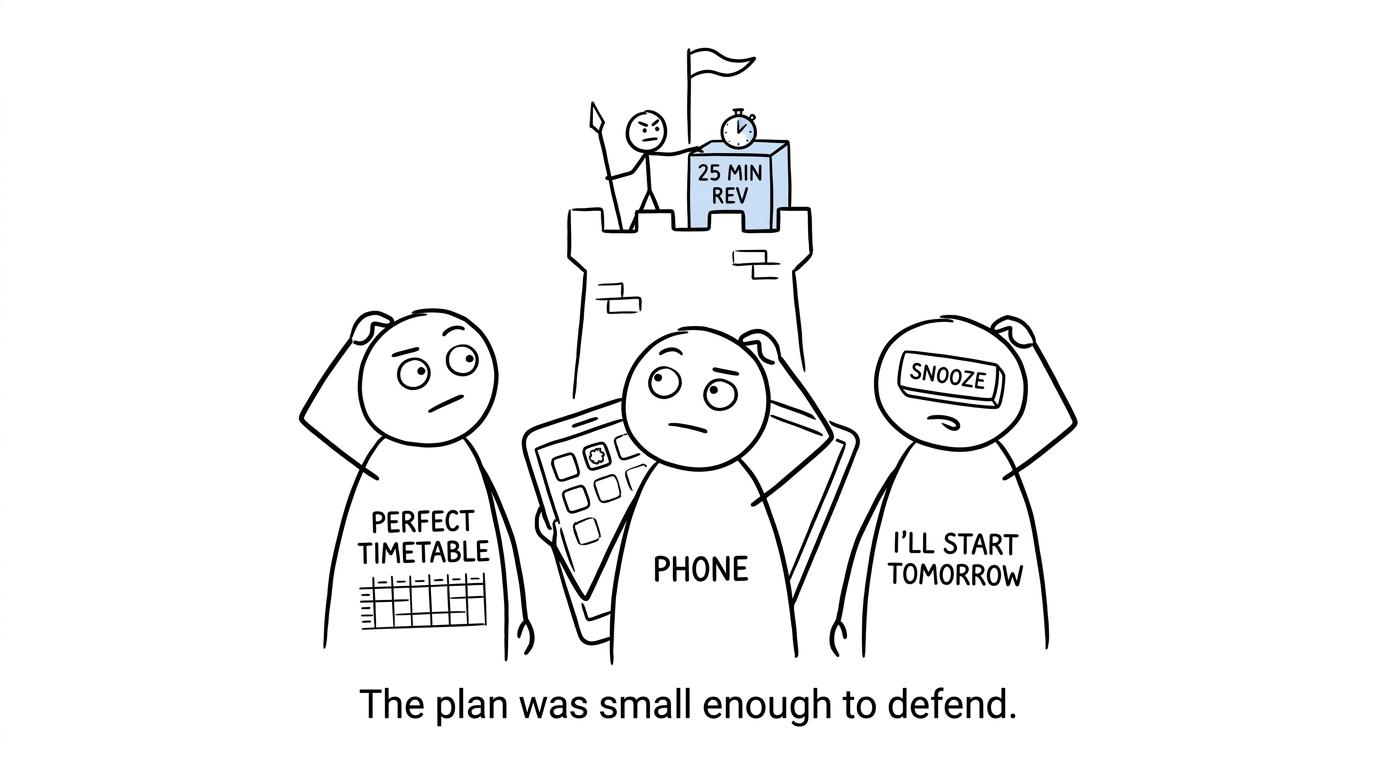 A student protects a small revision block from distractions
Make every session produce evidence
Reading feels fluent because the page supplies the information. Exams do not. A productive session must therefore produce something you can inspect: recalled vocabulary, a translation, responses to comprehension questions, a passage plan or a corrected answer.
Start with retrieval
Close the book and write what you remember about one tightly defined area. That could include vocabulary from a passage, the function of a grammatical form, the order of events in a set text, or evidence supporting a particular literary effect.
Only then consult your notes. The difference between what you recalled and what the source contains is your revision target.
This principle is equally useful in maths. The MathsGenie guide to stopping forgotten GCSE content explains a repeatable pattern of active recall, spaced practice and exam-style questions. For Biblical Hebrew, replace formula recall with vocabulary, morphology, syntax and textual evidence, but preserve the pattern.
Narrow the target
“Revise language” is not an executable task. “Complete one unseen comprehension and check every verb form” is.
Useful session targets include:
- recalling a defined vocabulary group without prompts;
- identifying prescribed grammatical forms in context;
- translating a short unseen passage into clear English;
- checking where an English translation became too loose;
- recalling the sequence and significance of one set-text episode;
- selecting brief textual evidence for a literature question;
- planning a response to one analytical prompt.
The smaller door is usually the one you walk through.
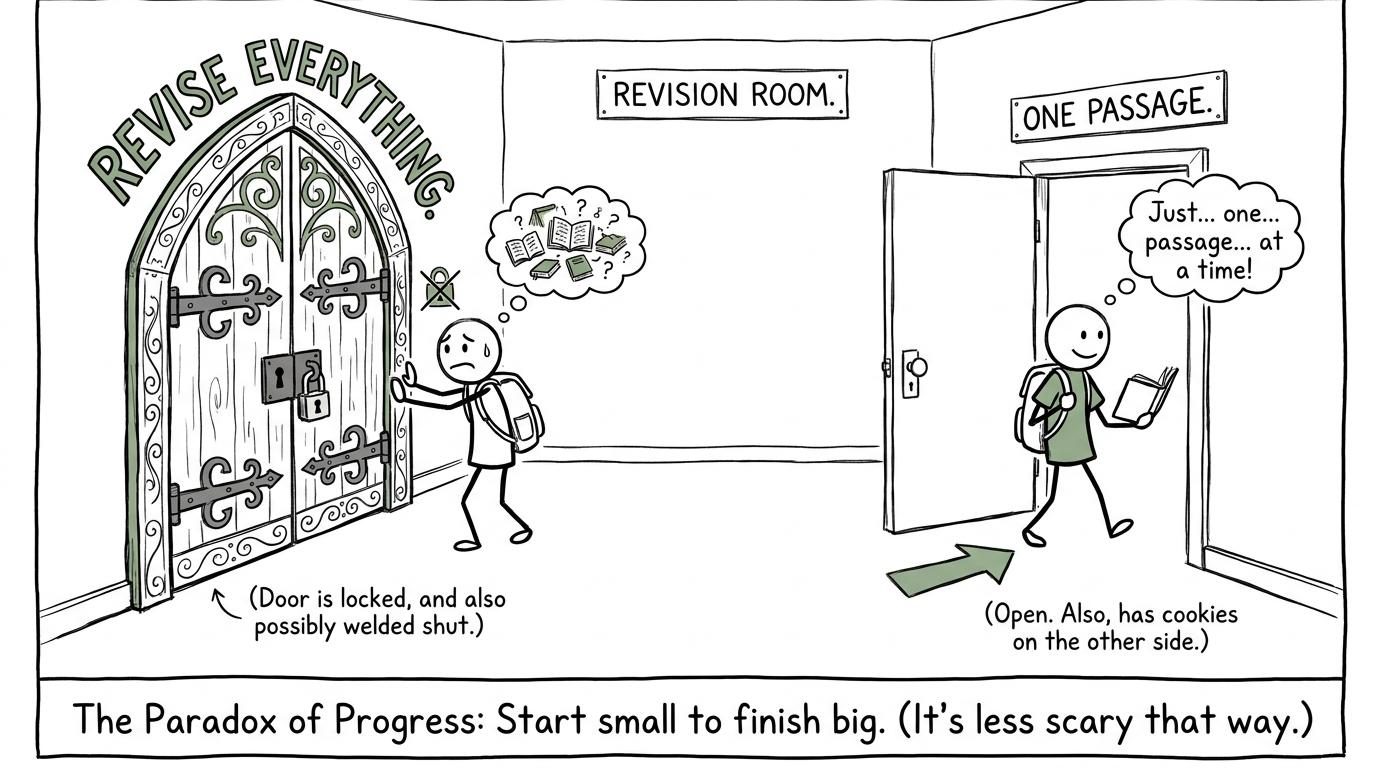 One small revision task is easier to enter than revising everything
Mark while the attempt is still fresh
Marking should happen during the session, not in a vague future moment. Compare your work with a teacher-approved answer, official mark scheme or model response. Then label the cause of each problem:
- vocabulary was unknown;
- morphology was misidentified;
- syntax was understood incorrectly;
- the English expression was unclear;
- set-text knowledge was incomplete;
- evidence was missing;
- analysis described the passage without explaining its effect;
- timing caused an unfinished response.
The label determines the repair. Unknown vocabulary needs retrieval practice. A syntax error needs focused explanation and another sentence containing the same structure. Weak analysis needs a rewritten paragraph, not another hour of rereading the narrative.
Maths students can use exactly this habit with the guide to finding weak GCSE topics. In maths, a lost mark might reveal an algebra gap; in Biblical Hebrew, an inaccurate clause may reveal a parsing or vocabulary gap. Either way, the mistake should choose the next task.
Balance language and literature
Students often spend most of half-term in the area that feels safest. Someone who enjoys narrative may reread the set texts repeatedly while avoiding unseen translation. Another student may learn vocabulary lists but postpone analytical writing.
Because Language and Literature each contribute 50%50\%50%, both need protected time. That does not mean dividing every day perfectly in half. It means reaching the end of the week with written evidence from both components.
For language, prioritise active vocabulary recall, recognition of morphology and syntax, accurate translation, comprehension and the option your class has prepared for the relevant section of the paper. Practise expressing the meaning in natural English without quietly adding ideas that are not present.
For literature, move through three layers:
- Knowledge: what happens, who speaks and what the passage contains.
- Evidence: the precise words, details or features that support your claim.
- Analysis: how the language or literary feature shapes meaning and affects the reader.
A summary can establish knowledge, but analysis explains why a detail matters. Keep returning to the exact demands of the question rather than writing everything you know about the episode.
Protect maths without letting it take over
Half-term is rarely devoted to one qualification. If GCSE maths is another priority, use separate blocks rather than switching between Hebrew and maths every few minutes.
The GCSE maths revision hub organises free revision lessons, practice questions and board-specific resources for Edexcel, AQA, OCR, Eduqas, WJEC and CCEA. Choose the board and tier you actually sit, foundation or higher, and give maths one defined target of its own.
On a busy day, the 20-minute GCSE maths revision routine can preserve momentum without swallowing the afternoon. A short Edexcel GCSE maths mini test can also provide a clear beginning and end.
Save longer paper practice for a day when you have the attention to mark it properly. If you study Edexcel maths, the Edexcel GCSE maths past papers include official mark schemes and worked solutions where available. Biblical Hebrew and maths need different knowledge, but both reward the same honest loop: attempt, mark, repair and retest.
Common half-term revision mistakes
Designing the perfect timetable before doing any work
Planning can become a respectable form of avoidance. Limit set-up time, choose the first small task and begin. Adjust the timetable using evidence from that session.
Rereading instead of retrieving
Familiarity is not recall. Close the text before testing vocabulary, grammar, narrative sequence or evidence. Looking should follow an attempt, not replace it.
Revising only favourite material
Comfortable passages create reassuring sessions but may leave the largest gaps untouched. Use a diagnostic task and teacher feedback to decide what deserves time.
Completing work without correcting it
An unmarked translation preserves uncertainty. Mark promptly, explain each error and redo the relevant part without copying.
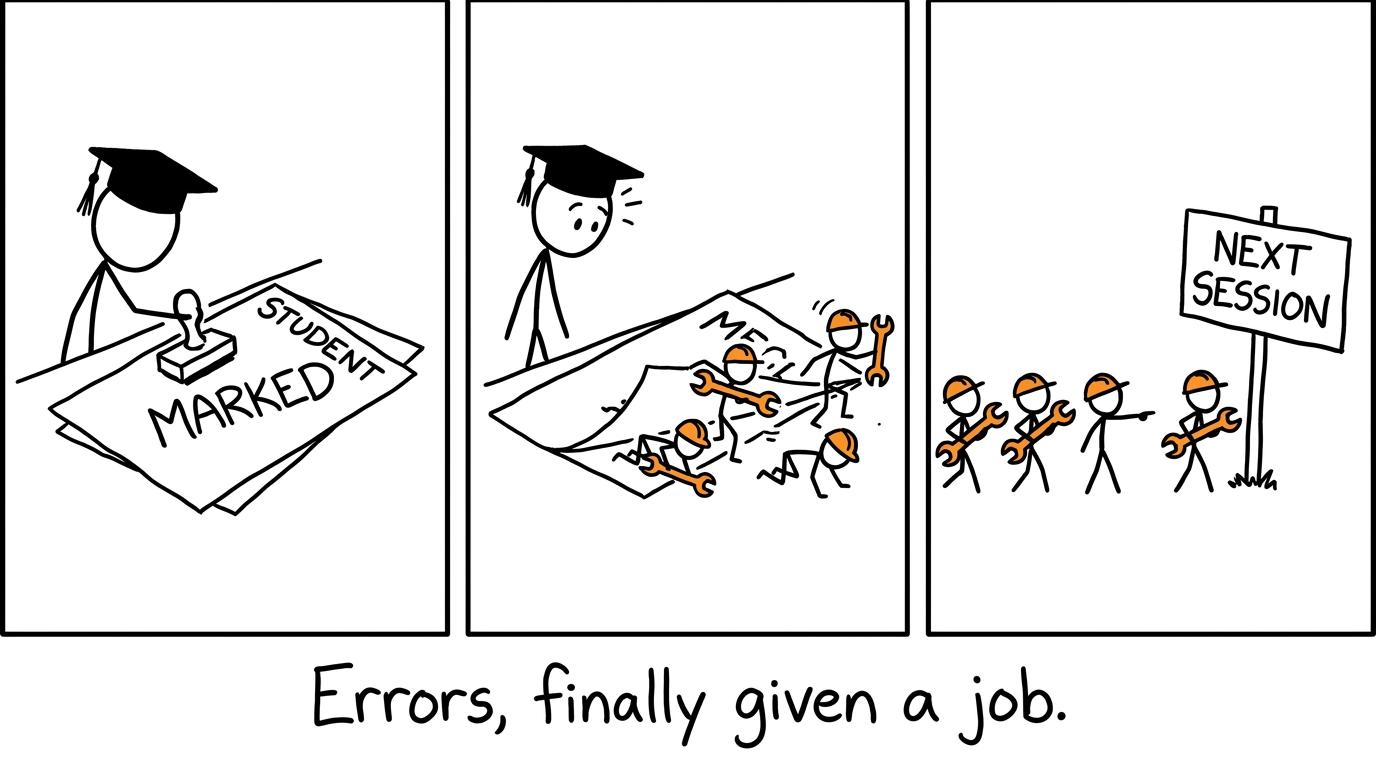 Revision errors become helpful mechanics for the next session
Treating one long session as proof of progress
A heroic first day can make the rest of half-term feel like recovery. Several manageable sessions create more opportunities to retrieve knowledge after a gap.
Sacrificing the whole break
Rest is not evidence of poor commitment. Give revision fixed boundaries, take proper breaks and preserve time away from schoolwork. A plan that you resent is difficult to repeat.
Finish half-term with proof, not promises
By the final evening, do not ask whether you spent enough hours revising. Ask what changed. Can you now recall vocabulary that was missing? Can you parse a form you previously guessed? Is one set-text argument supported with better evidence? Did a timed task reveal improved accuracy?
Write a short carry-forward list containing the two or three issues that still need attention. Those become next week's tasks. Half-term has then done its real job: not completing the entire course, but making the next stage clearer.
For your parallel maths preparation, open the MathsGenie GCSE revision hub and follow the same disciplined cycle. Use revision lessons to rebuild methods, practice questions and mini tests to test them, then past papers and predicted papers for exam conditions. Mark with the available mark schemes and video solutions, record the exact error, and return to it.
Start with one protected session today. Small enough to complete. Specific enough to mark. Useful enough to shape what comes next.










