GCSE Biblical Hebrew Group Chat Study Tips
GCSE Biblical Hebrew group chat study tips that turn messages into active recall, accurate feedback and a calm revision routine alongside GCSE maths.

A class group chat can look productive while achieving almost nothing. One person asks about a verb. Someone replies with a meme. Ten minutes later, nobody remembers the original question.
Effective GCSE Biblical Hebrew group chat study needs a different rhythm: attempt a question independently, post a precise answer, check it against an authoritative source and record the correction. The chat should prompt revision, not replace it.
That matters particularly when Biblical Hebrew must share your week with GCSE maths and other subjects. A useful group chat saves time. A noisy one quietly consumes it.
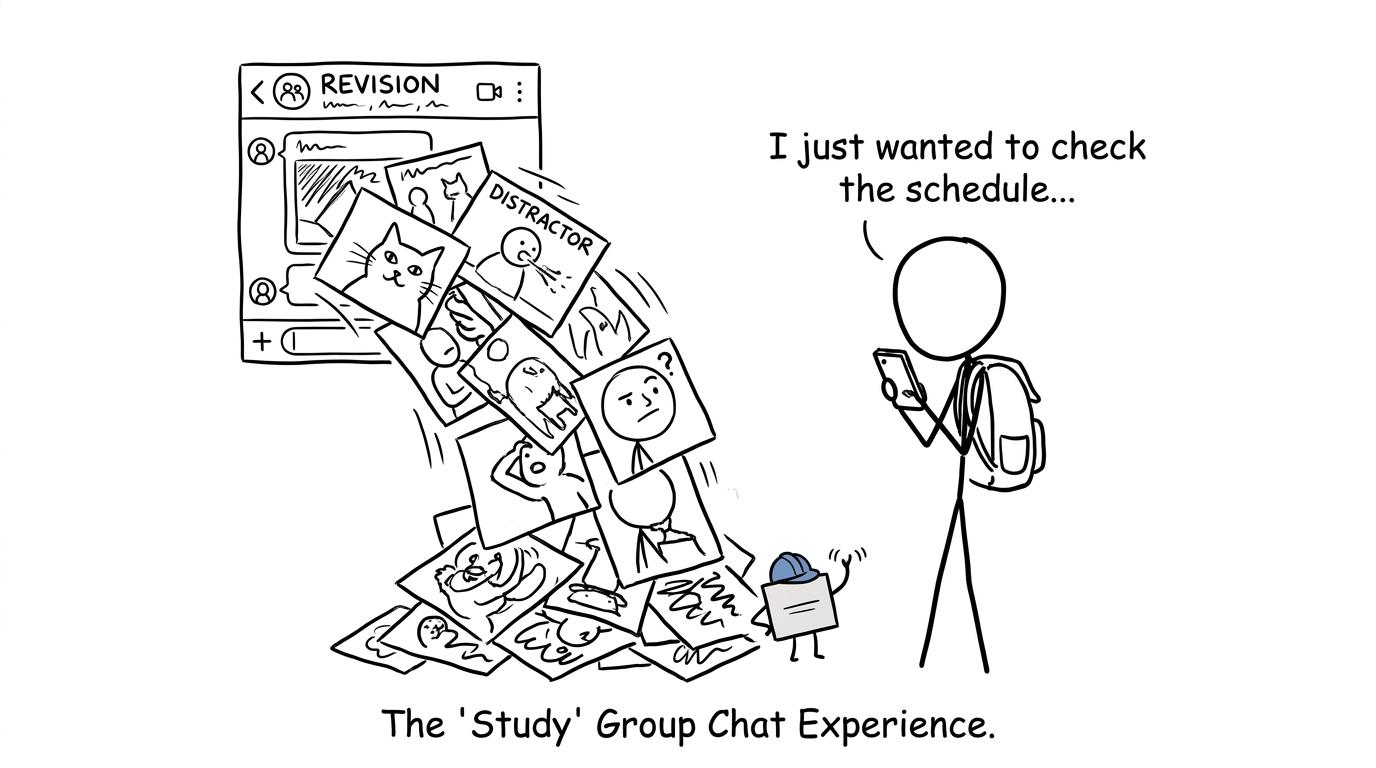 A useful revision flashcard tries to survive an avalanche of group chat memes
The quick group chat checklist
Before changing platforms, making colour-coded channels or appointing twelve administrators, agree on a few simple rules:
- Give each revision session one narrow topic.
- Post questions before answers.
- Let everyone attempt the question independently.
- Label uncertain answers clearly.
- Verify corrections using the specification, teacher materials or mark schemes.
- Keep a shared error log.
- Separate revision messages from general conversation.
- End each session with an individual task.
- Revisit difficult material on another day.
- Protect time for your other GCSE subjects.
The principle is simple: the chat creates prompts and feedback, but each student still has to retrieve, translate, analyse and write for themselves.
Know what GCSE Biblical Hebrew actually assesses
A revision chat becomes more useful when every task connects to the qualification. The current Pearson Edexcel GCSE Biblical Hebrew qualification, code 1BH0, is linear and untiered. Unlike GCSE maths, there is no foundation or higher tier.
The qualification has two externally examined components. Each lasts 222 hours, carries 100100100 marks and contributes 50%50\%50% of the qualification.
Component 1: Language
The Language paper assesses understanding of unseen Biblical Hebrew. Students need to comprehend passages, translate accurately into English and deal with grammatical structures. The specification also provides a choice between answering grammar questions and translating simple English sentences into pointed Biblical Hebrew.
Useful group chat activities therefore include:
- short vocabulary retrieval questions;
- identifying roots, forms and grammatical features;
- explaining why a translation is accurate;
- spotting omitted words or unjustified additions;
- comparing two possible English translations;
- discussing an unseen passage only after everyone has attempted it.
A photograph of completed notes is not active revision. A question that forces each person to retrieve a root or justify a translation is.
Component 2: Literature
The Literature paper assesses knowledge and understanding of the set texts, translation, literary features, analysis and comparison. For examinations from 2026 to 2028, the specified material is based on Joseph’s rise to power in Genesis, chapters 414141 to 434343, and the miracles of Elisha in Kings, chapters 444 to 777.
Confirm the correct examination year and set texts with your teacher. An old resource may still contain valuable language practice, but literature revision must match the texts for your series.
For the group chat, divide literature preparation into distinct tasks:
- narrative and sequence;
- character, ideas and values;
- important language choices;
- grammatical and literary features;
- passage translation;
- evidence for extended responses;
- comparisons across both set texts.
This prevents the common habit of revising only the storyline. Knowing what happens is useful, but the paper also asks you to analyse, evaluate and support ideas with evidence.
Turn the chat into an active-recall room
Reading somebody else’s answer can feel like learning because the answer looks familiar. Recognition, however, is not the same as producing the answer unaided.
Research on retrieval practice supports bringing information to mind rather than relying only on rereading. Spacing those retrieval attempts across different days can also strengthen retention. A group chat can support both ideas, provided everyone thinks before the first answer appears.
Use this sequence:
- One student posts a focused question.
- Everyone works privately for a fixed period.
- Members send answers at an agreed time.
- The group compares the answers.
- One person checks the relevant source.
- Everyone records the correction independently.
- The question returns later in the week.
For vocabulary, ask for meanings in both directions. For grammar, require identification and explanation rather than a one-word guess. For literature, ask members to retrieve a relevant moment or idea before opening the text.
A useful message might say: “No answers until 7.15. Identify the grammatical form, give its root and explain what in the form supports your decision.” That creates thinking time and makes the standard of the response clear.
Give each person a rotating role
Group chats often fail because everybody assumes somebody else will organise them. Four rotating roles are enough:
- Question setter: posts a small, specification-relevant set.
- Timekeeper: starts and ends the independent attempt period.
- Checker: verifies answers against a trusted source.
- Recorder: updates the shared error log and future review list.
Rotate these jobs. Creating a good question demands careful thought, while checking an answer teaches you to notice precision. Nobody should become the permanent expert whose answers everyone copies.
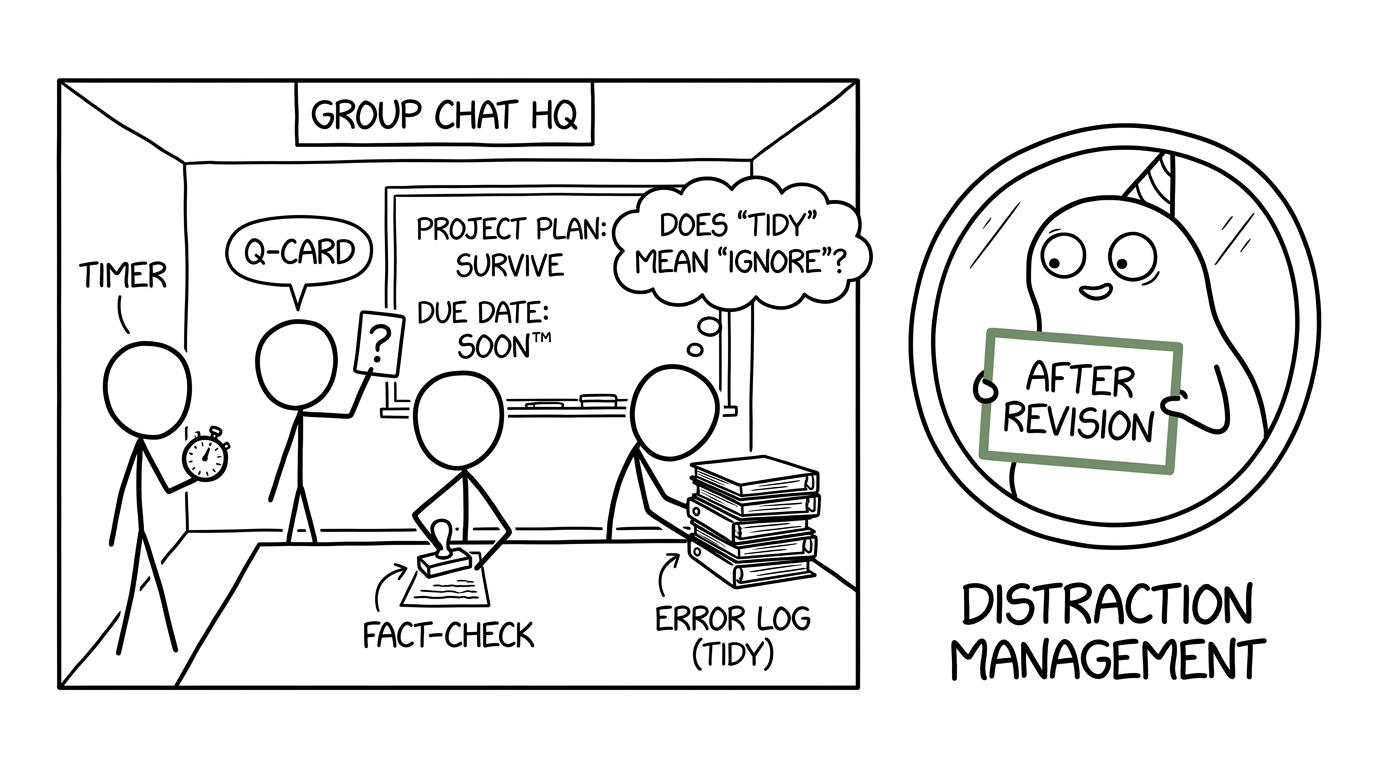 A revision group chat works like a tiny control room with a timer, question card and error log
Use an error log instead of a message graveyard
Chats are organised by time, not by importance. A valuable correction posted on Tuesday can disappear beneath hundreds of later messages by Friday.
Keep a separate shared document with four fields:
- the topic or passage;
- the original misunderstanding;
- the verified correction;
- the date for another attempt.
Use specific labels such as “confused two similar roots”, “lost the subject of the verb”, “translation too free” or “literature claim lacked evidence”. Avoid vague entries such as “grammar bad”. A correction is useful only when it tells you what to do differently.
This is the same principle that makes an error log effective in maths. The MathsGenie guide to finding weak topics explains how to turn mistakes into focused next steps rather than treating a total mark as the whole story.
Keep corrections accurate
A confident message can still be wrong. That is especially risky with grammar, where one mistaken explanation may be repeated by the whole group.
Agree on a hierarchy of evidence:
- the current Pearson specification and official assessment materials;
- school texts, vocabulary lists and teacher guidance;
- official mark schemes or examiner materials where available;
- the group’s interpretation, clearly labelled as discussion rather than fact.
If members disagree, preserve both suggestions temporarily and ask the teacher. Do not settle a technical question by voting. Languages are not corrected by majority opinion.
For extended literature responses, peers can ask whether a claim is relevant, supported and clearly explained. They should not turn one student’s paragraph into a model answer for everyone to memorise. The goal is stronger independent judgement.
Build short sessions that leave time for maths
Biblical Hebrew group chat revision should not expand until it occupies the entire evening. A focused session of roughly 202020 to 303030 minutes can include retrieval, checking and one scheduled follow-up.
A practical structure is:
- 333 minutes to post the topic and rules;
- 888 minutes for independent retrieval;
- 888 minutes to compare and check;
- 555 minutes to update error logs;
- 222 minutes to schedule the next attempt.
Then stop. Muting the chat after the session protects the rest of your timetable.
For maths, the same short-cycle idea appears in the 20-minute GCSE maths revision routine. You can also use the GCSE maths revision timetable guide to balance group commitments with individual work.
Your maths preparation must match your own exam board and tier. The GCSE maths revision hub includes free resources for Edexcel, AQA, OCR and Eduqas, with foundation and higher tier materials where appropriate.
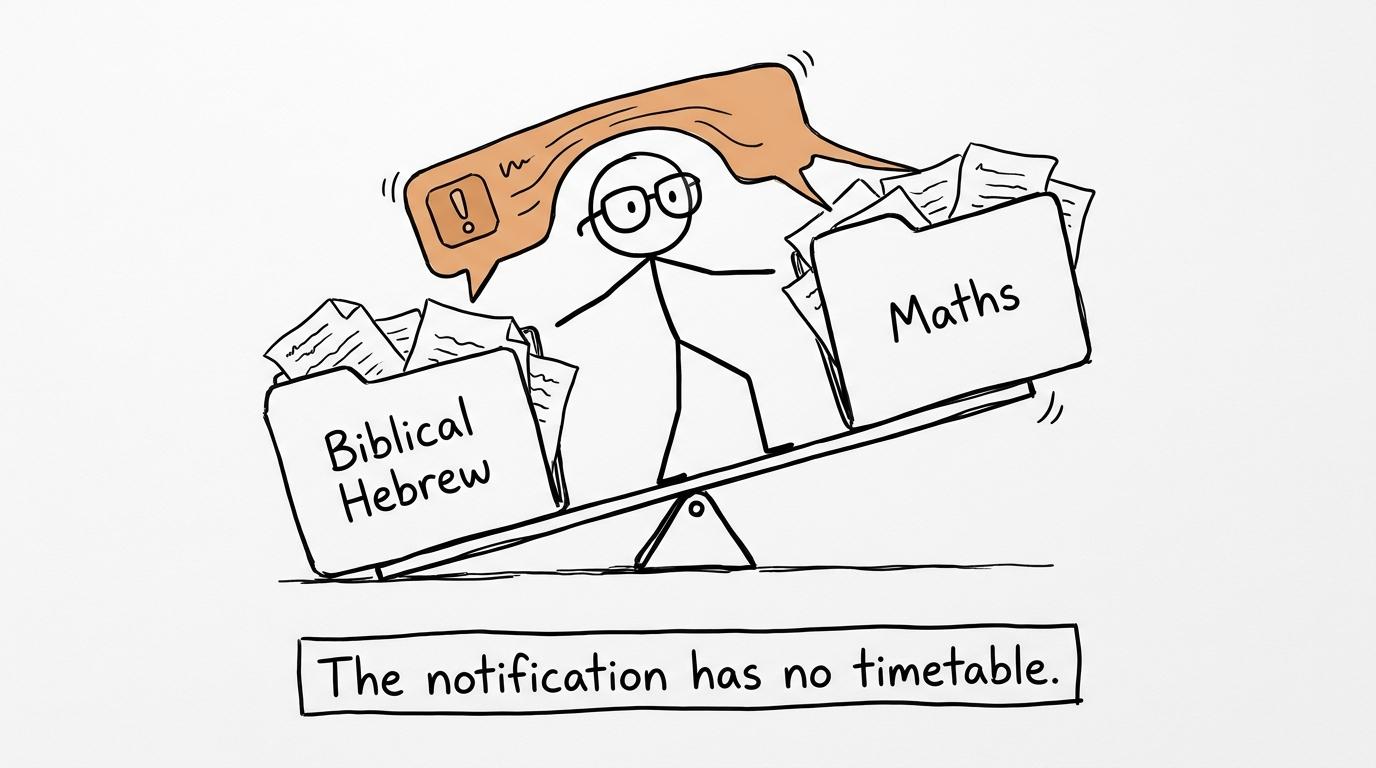 A phone notification tries unsuccessfully to control both Biblical Hebrew and maths revision
Use the chat to support independent exam practice
The final test of a group session is not whether the conversation felt intelligent. It is whether you can complete a similar task alone later.
Finish every group activity with an individual exit task. This might be a fresh vocabulary set, a short unseen passage, a plan for a literature response or a closed-book recall of key events. Attempt it without checking the chat.
Apply the same boundary to maths. Discussing a method may help, but you still need silent question practice. Use Edexcel GCSE maths mini tests for short checks, then progress to Edexcel GCSE maths past papers or the appropriate board section.
Afterwards, mark carefully. The MathsGenie mark scheme guide shows why feedback should identify the missing knowledge, method or communication rather than ending with a tick or cross.
Common group chat study mistakes
Allowing the fastest person to answer immediately
This turns everyone else into an audience. Require private thinking time and release answers together.
Revising whatever appears in the chat
The loudest topic is not necessarily the weakest or most important. Use the specification and personal error logs to choose tasks.
Treating uncertain answers as facts
Label uncertainty and nominate a checker. If the evidence remains unclear, ask your teacher.
Sharing complete answers too early
Post prompts first. A finished translation or essay plan can remove the productive struggle that makes retrieval useful.
Confusing Biblical Hebrew with Modern Hebrew
They are different qualifications with different content and assessment structures. Check that every resource is specifically for Biblical Hebrew and matches Pearson Edexcel 1BH0.
Using old set-text material without checking dates
Older passages can still support language skills, but literature preparation must reflect the set texts for your examination series.
Letting revision become constant notification management
Agree on start and finish times. Use muted periods, keep social conversation separate and follow your school’s expectations for appropriate online communication.
Neglecting individual practice
Group revision should lead back to solo retrieval, timed writing and exam questions. Nobody else can perform those skills for you in the examination.
Make the chat smaller, calmer and more useful
The best revision group chat is not the busiest one. It is the one that produces a few good questions, honest attempts, verified corrections and scheduled re-tests.
Set one topic. Think before replying. Check what is true. Record what went wrong. Then leave the chat and prove that you can do the task alone.
When it is time to switch back to maths, make MathsGenie your free revision base. Use revision lessons and practice questions to repair specific topics, mini tests to check recall, and past papers or predicted papers to develop exam timing. Mark each attempt with the available mark schemes and video solutions, then add the next task to your revision planner.
Start with the MathsGenie GCSE maths revision hub. A good group can help you begin, but consistent individual practice is what carries the learning into the exam hall.