

GCSE Biblical Hebrew Grade Boundaries Explained
GCSE Biblical Hebrew grade boundaries explained clearly: why raw marks change each year, how grades are set and how to interpret past results wisely.
A raw mark can feel wonderfully certain. You add the marks, divide by the total and get a percentage. Surely the grade should follow automatically.
But GCSE grading does not work through a permanent percentage chart. GCSE Biblical Hebrew grade boundaries explained simply means this: your raw marks are compared with boundaries set for that particular exam series after the papers have been marked. Because papers cannot be identical in difficulty every year, the raw mark needed for a grade can move.
For Pearson Edexcel GCSE Biblical Hebrew, the qualification total is 200200200 marks across Papers 010101 and 020202. In June 202520252025, the grade 999 boundary was 149149149; in June 202420242024, it was 162162162. The standard represented by grade 999 was intended to remain comparable. The mark needed to reach it changed.
The essential grade-boundary checklist
Before interpreting a mark, check five things:
- Exam board: these figures refer to Pearson Edexcel GCSE Biblical Hebrew.
- Specification: make sure the paper belongs to the correct qualification and syllabus.
- Exam series: June 202420242024 and June 202520252025 have different boundaries.
- Maximum mark: compare your total with the qualification maximum of 200200200.
- Official boundary: historical boundaries are evidence, not a prediction of the next series.
You can check the published figures on MathsGenie's Edexcel GCSE Biblical Hebrew grade boundaries page.
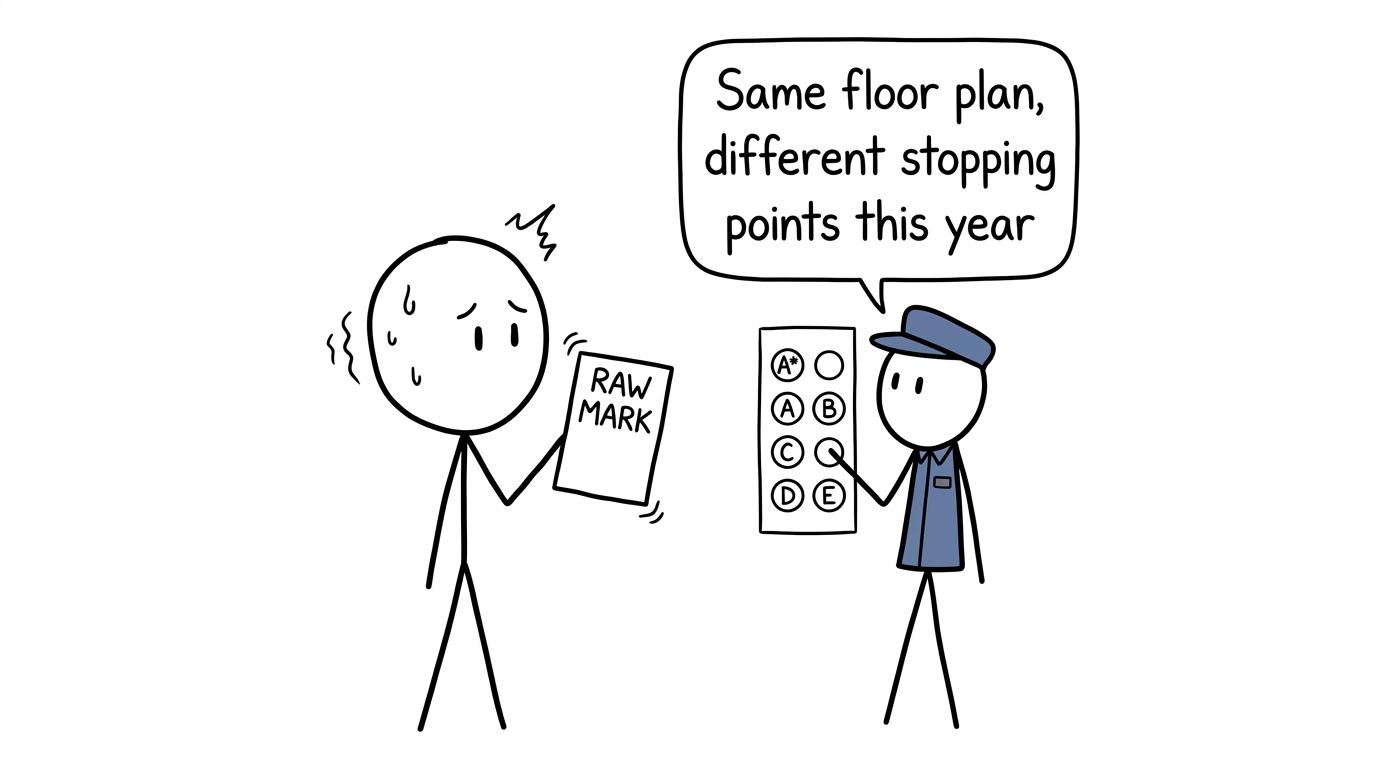 A student discovers that raw marks and grade boundaries do not always stop at the same floor
What a raw mark actually means
A raw mark is the number of marks awarded for your responses. If your marks across the two papers total mmm, your raw qualification mark is simply mmm out of 200200200.
A percentage can describe that performance:
Percentage=m200×100\text{Percentage} = \frac{m}{200} \times 100Percentage=200m×100However, the percentage does not independently determine the grade. The grade boundary is the minimum raw mark required for a particular grade in that exam series.
For example, the published June 202520252025 boundary for grade 999 was 149149149 marks, equivalent to:
149200×100=74.5%\frac{149}{200} \times 100 = 74.5\%200149×100=74.5%In June 202420242024, the corresponding boundary was 162162162 marks:
162200×100=81%\frac{162}{200} \times 100 = 81\%200162×100=81%This does not show that a grade 999 became less valuable in 202520252025. It indicates that the awarding process found a lower raw mark appropriate for maintaining the grade standard on that year's assessments.
The distinction matters in maths too. A mark is what you achieved on a particular set of questions; a grade is an interpretation of that mark against an established standard. MathsGenie's broader guide to how GCSE grade boundaries work explores the same principle across GCSE subjects.
Recent GCSE Biblical Hebrew grade boundaries
The following official Pearson Edexcel figures show how the qualification boundaries moved between the two most recent published summer series.
| Exam series | Maximum mark | Grade 999 | Grade 777 | Grade 555 | Grade 444 |
|---|---|---|---|---|---|
| June 202520252025 | 200200200 | 149149149 | 125125125 | 102102102 | 919191 |
| June 202420242024 | 200200200 | 162162162 | 138138138 | 114114114 | 102102102 |
Every selected boundary was lower in 202520252025. Yet these figures alone do not prove precisely which questions caused the difference. Boundaries reflect the complete awarding evidence, including how demanding the assessments proved in practice, statistical information and expert review of students' work.
Notice another important detail: the June 202420242024 grade 444 boundary and the June 202520252025 grade 555 boundary were both 102102102. The same raw mark could therefore correspond to different grades in different series. That is the clearest reason your mark is not just a percentage.
How GCSE Biblical Hebrew boundaries are set
Grade boundaries are not normally fixed before students sit the examination. The process has two connected stages: marking and awarding.
The papers are marked
Trained examiners apply the mark scheme to students' responses. Quality-assurance checks are used to keep marking consistent. This produces the raw marks on which awarding decisions can be based.
Statistical evidence identifies possible boundaries
Exam boards analyse how the current cohort performed and compare relevant evidence with previous cohorts. Ofqual explains that prior-attainment information is considered at cohort level. It is not used to assign a predetermined grade to an individual student.
The aim is comparability. If two cohorts are broadly similar in prior attainment, their overall outcomes would usually be expected to remain broadly comparable unless the evidence supports a difference.
Senior examiners inspect students' work
Numbers do not tell the whole story. Senior examiners review scripts around possible boundary marks and compare the quality of work with the standard represented by the grade in previous years. They consider the paper, mark scheme, performance data and actual responses before recommending final boundaries.
The boundaries are applied consistently
Once confirmed, a boundary is applied to everyone who took that specification in the same series. There is no separate boundary for one school, and an individual's earlier results do not alter the mark required.
This combination of evidence explains why the system is more careful than attaching grade 777 to one permanent percentage. If a paper proves harder, a lower boundary may be needed. If it proves easier, a higher boundary may be appropriate.
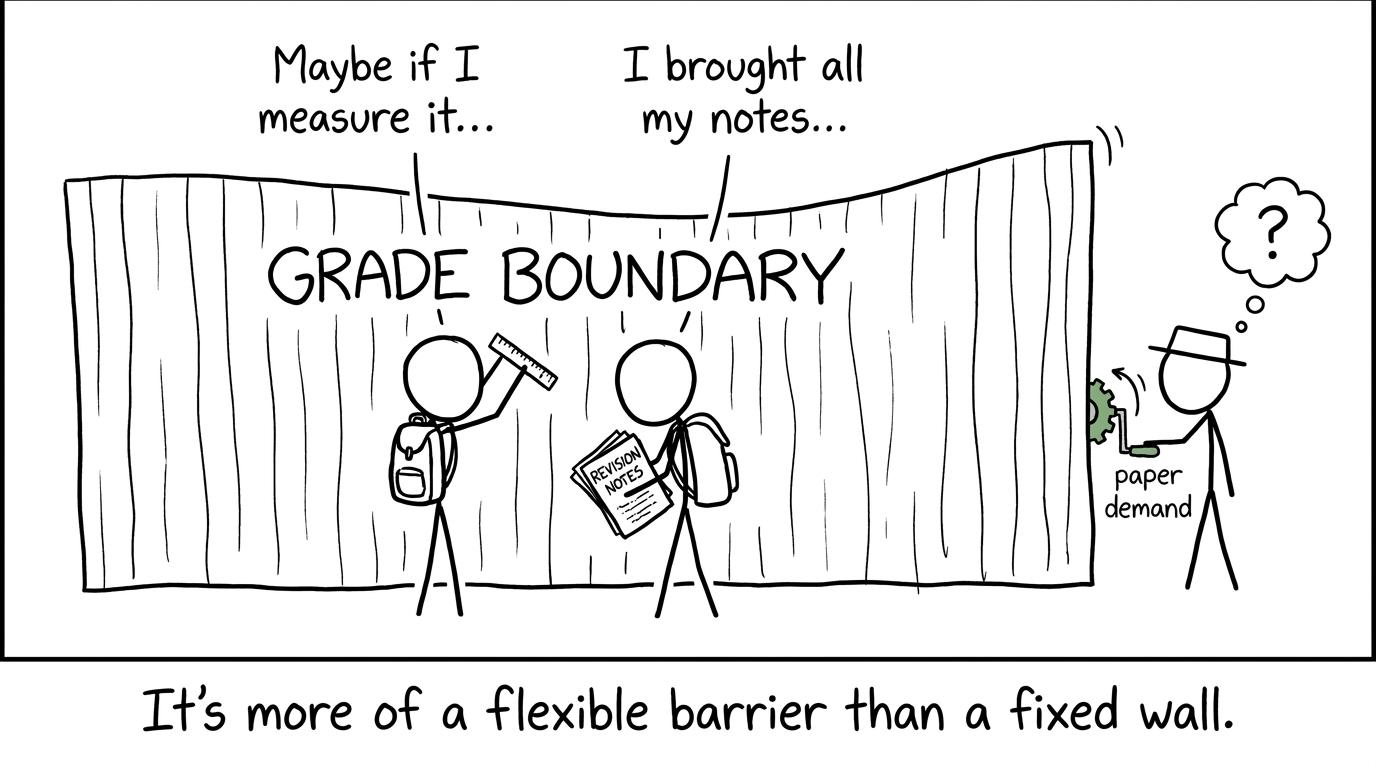 Students encounter a grade boundary that can move with the demand of the paper
Why boundaries move from one year to another
No exam board can produce two papers with perfectly identical demand. One unseen passage may be more accessible than expected. A group of grammar questions may distinguish strongly between students, while another section may produce lower marks across the cohort. Mark schemes and the way questions function in practice also matter.
That is why a changing boundary is not a flaw by itself. Movement is part of the mechanism designed to protect the meaning of the grade.
A useful way to think about it is that the paper measures performance through raw marks, while awarding translates that performance into grades. The translation must account for the particular assessment rather than pretending every paper was identical.
There are also no fixed quotas saying only a particular number of students may receive each grade. Statistical evidence guides the process, but expert judgement about the required standard remains part of awarding.
What past boundaries can and cannot tell you
Past boundaries are useful for interpreting a completed past paper. If you sit the June 202520252025 papers, using the June 202520252025 boundaries gives you a sensible historical grade estimate.
They can also show a range. If your total sits above the same target boundary across several series, that provides more reassurance than testing it against one unusually high or low year.
But historical data cannot reveal the next boundary. Until the new papers have been sat, marked and reviewed, the evidence required to set that boundary does not exist. Any boundary published beforehand is an estimate rather than an official result.
This lesson transfers directly to maths revision. The history of GCSE maths grade boundaries shows movement across series, while the GCSE Maths revision hub helps you improve the marks you can actually control.
A better way to use your marks
Do not revise towards the lowest boundary you can find. That turns a historical safety net into a target and leaves no room for normal variation, marking errors in self-assessment or an unexpectedly awkward paper.
Instead, treat a practice-paper total as diagnostic evidence:
- compare it with boundaries from the matching series;
- record where marks were lost;
- separate knowledge gaps from misreading, timing and incomplete answers;
- revise the weakest specific areas;
- retest under timed conditions;
- aim for a comfortable margin above your target boundary.
For maths, MathsGenie's guide to finding your weakest GCSE topics turns a paper score into a practical revision list. The Edexcel GCSE Maths mini tests then provide shorter checks before you return to a full paper.
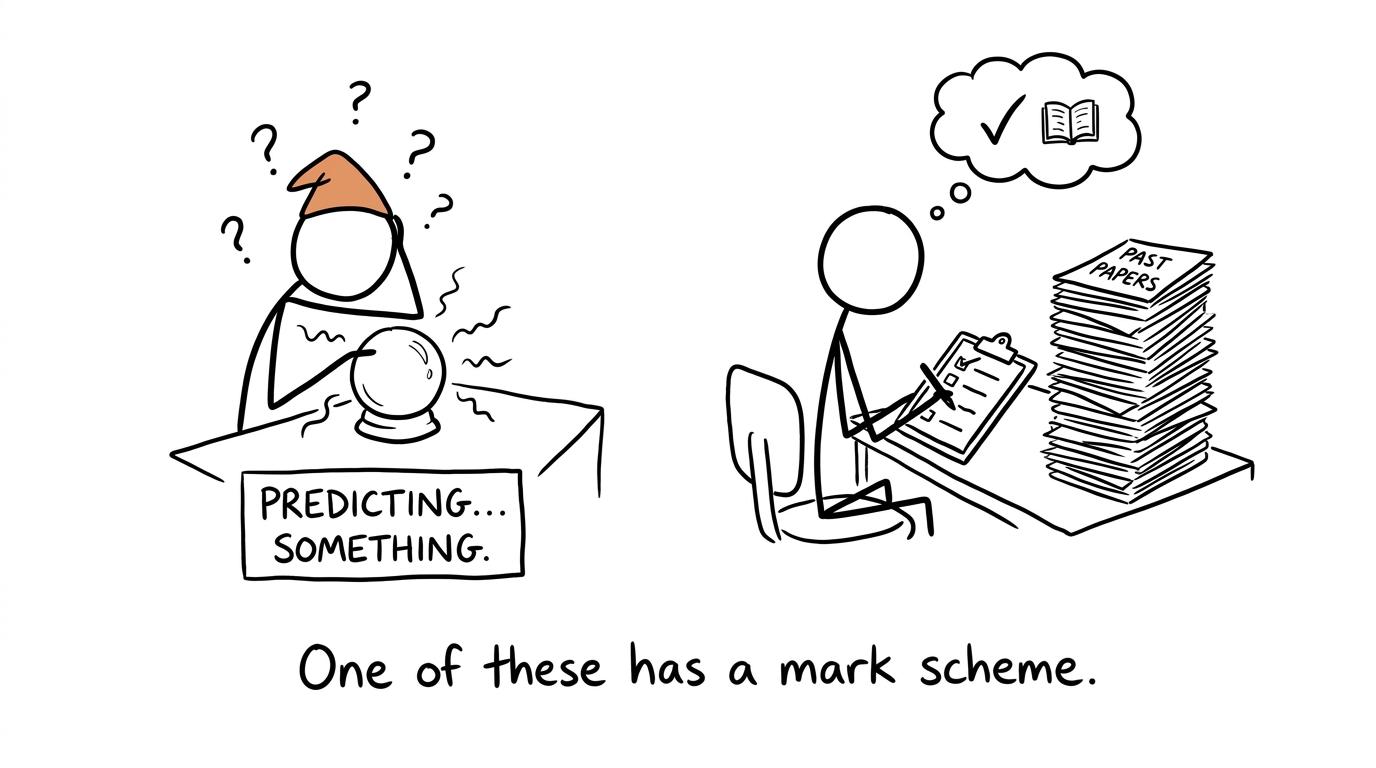 One student uses a crystal ball while another notices that past papers come with mark schemes
Common mistakes when reading grade boundaries
Treating a familiar percentage as permanent
There is no universal rule that a particular percentage always earns a particular GCSE grade. Use the official boundary for the correct board, specification and series.
Comparing boundaries without checking the maximum mark
A boundary of 149149149 out of 200200200 cannot be compared directly with a boundary from a qualification carrying a different total. Convert to a percentage if comparison is useful, but remember that paper demand still differs.
Using component boundaries as a final qualification grade
Where component-level information is published, it may show the notional grade represented by one paper. Your final qualification grade is based on the combined, appropriately weighted result. Paper grades do not simply get averaged.
Assuming a lower boundary means an easier route
A lower boundary commonly reflects a more demanding assessment. It does not mean the exam board has quietly reduced the standard represented by the grade.
Predicting the next boundary from one year
The movement from 162162162 to 149149149 at grade 999 does not establish a trend that must continue. Each series is awarded using its own evidence.
Revising the boundary instead of the subject
Boundary speculation feels productive because it produces precise numbers. Yet it cannot improve a response. Completing questions, checking mark schemes and correcting weaknesses can.
Maths students can apply that principle through MathsGenie's guide to using GCSE past papers properly, rather than merely collecting scores.
Focus on the marks within your control
The calmest conclusion is also the most useful. GCSE Biblical Hebrew grade boundaries move because raw marks come from papers whose difficulty varies, while grades are intended to represent comparable standards over time. Your percentage describes your score. The official boundary determines how that score translates into a grade for the relevant series.
You cannot know the next boundary in advance, but you can build a margin through better preparation. For maths, begin with MathsGenie's free GCSE Maths revision resources, then combine revision lessons and practice questions with past papers, predicted papers, mini tests, mark schemes and video solutions. Use the revision planner to schedule what needs fixing, not to chase an unknowable cut-off.
The boundary is decided later. The marks you give yourself the chance to earn are decided now.










