GCSE Biblical Hebrew Foundation Tier Grade Cap
GCSE Biblical Hebrew foundation tier grade cap explained: the subject is untiered, so grade 9 is available, with clear advice for top-grade aims.
A grade ceiling can change how you think about an exam. If the highest available grade is lower than your target, effort alone cannot remove that structural limit. That is why the GCSE Biblical Hebrew foundation tier grade cap is an important question, and why the answer may be a relief.
The current Pearson Edexcel GCSE Biblical Hebrew qualification is untiered. There is no Foundation tier, so there is no Foundation-tier cap. Students can be awarded any grade from 999 to 111, with 999 as the highest possible grade.
The confusion is understandable. GCSE Maths has Foundation and Higher tiers, as do some science and modern foreign language qualifications. Biblical Hebrew does not follow that model. Everyone taking the current Edexcel qualification, specification code 1BH0, enters the same untiered assessment.
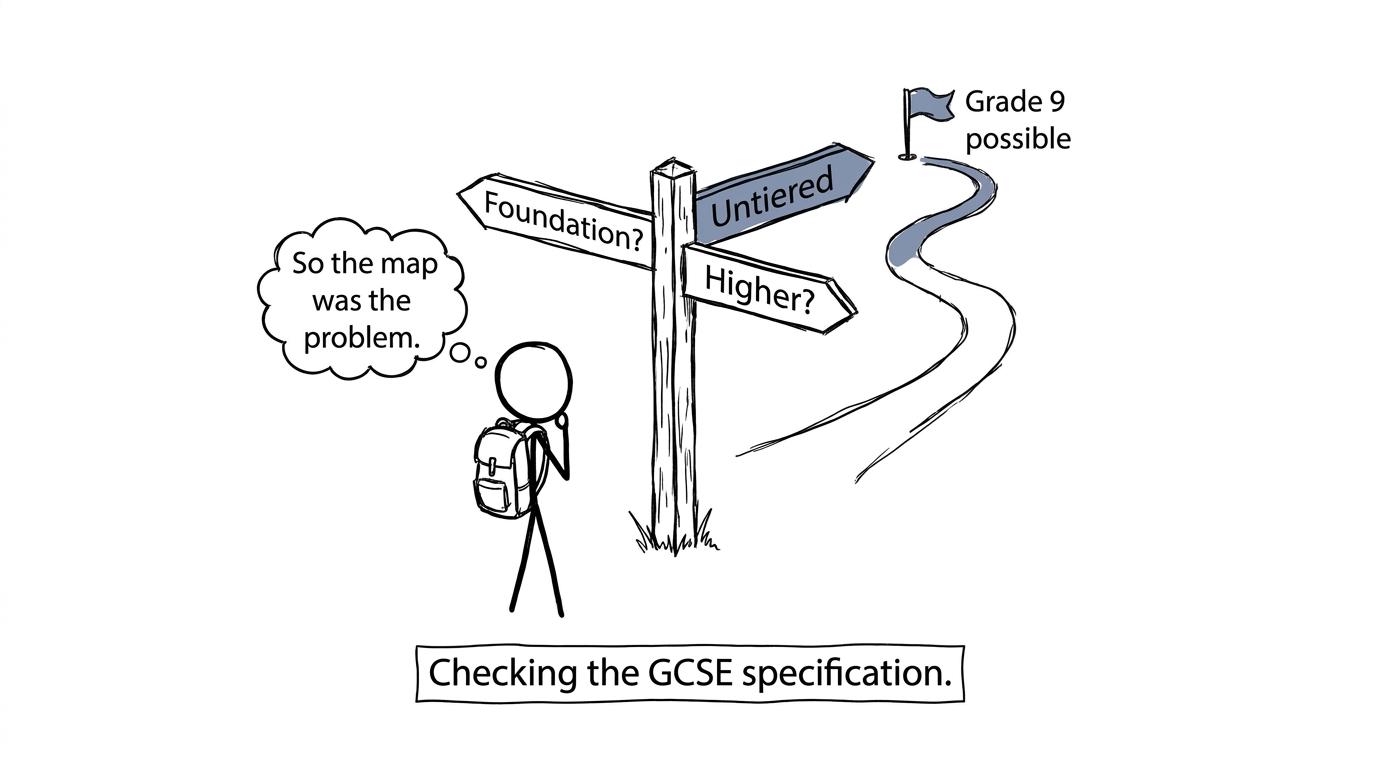 A student discovers that GCSE Biblical Hebrew follows the untiered path
The answer at a glance
Here is the position to remember:
- GCSE Biblical Hebrew is untiered.
- There is no separate Foundation or Higher paper.
- The complete grade scale runs from 999 to 111, followed by U for an unclassified result.
- The highest available grade is 999.
- A student aiming for grades 666, 777, 888 or 999 is not blocked by a tier entry.
- Biblical Hebrew should not be confused with GCSE Modern Hebrew, which has a different specification and tier structure.
- Grade boundaries are set for each exam series, so a past boundary is evidence from that year rather than a guaranteed future target.
Maths students are used to checking their tier before opening a paper. That remains essential for maths, but it is not a rule that transfers automatically to every GCSE.
Is there a GCSE Biblical Hebrew foundation tier grade cap?
No. Strictly speaking, the phrase describes something that does not exist in the current qualification.
Pearson's official guidance identifies GCSE Biblical Hebrew as a fully linear, untiered GCSE. Its two assessments are Paper 1: Language and Paper 2: Literature. Each paper is worth 100100100 marks and contributes 50%50\%50% of the final qualification, producing a total of 200200200 marks.
The qualification is graded using the overall subject mark. Individual papers do not receive separate final GCSE grades. Your result is therefore based on your combined performance across both components:
Overall mark=Language mark+Literature mark\text{Overall mark}=\text{Language mark}+\text{Literature mark}Overall mark=Language mark+Literature markBecause the assessment is untiered, the same qualification can award the full range of grades. There is no need to move from a Foundation entry to a Higher entry before attempting a top grade.
This is different from GCSE Foundation and Higher Maths, where the selected tier controls the grades normally available. In GCSE Maths, Foundation tier offers grades 111 to 555, while Higher tier is the route to grades 666 to 999. Biblical Hebrew has no equivalent decision.
Why students expect a grade cap
Tier language becomes familiar early in GCSE Maths revision. A student may hear that Foundation Maths is capped at grade 555 and reasonably assume that any GCSE described as difficult must offer the same choice.
But tiering is not a general measure of difficulty. It is an assessment design used only in certain subjects. Ofqual permits Foundation and Higher tiers in subjects including maths, statistics, science and modern foreign languages. Biblical Hebrew is regulated as an ancient language, and its current assessment is untiered.
The useful lesson reaches beyond this particular subject: never infer an exam structure from another GCSE. Check the exact subject title, exam board and specification code.
That habit matters in maths too. Before using a paper, confirm whether you are taking Edexcel, AQA, OCR or Eduqas and whether your entry is Foundation or Higher. The GCSE Maths revision hub lets you choose the correct board and resources rather than revising from a paper that only looks familiar.
Biblical Hebrew is not Modern Hebrew
The two names are close enough to create a consequential mistake.
GCSE Biblical Hebrew focuses on the language and literature of set biblical texts. The current Pearson Edexcel qualification is untiered. GCSE Modern Hebrew is a modern foreign language qualification with listening, speaking, reading and writing assessments, and its tier arrangements are different.
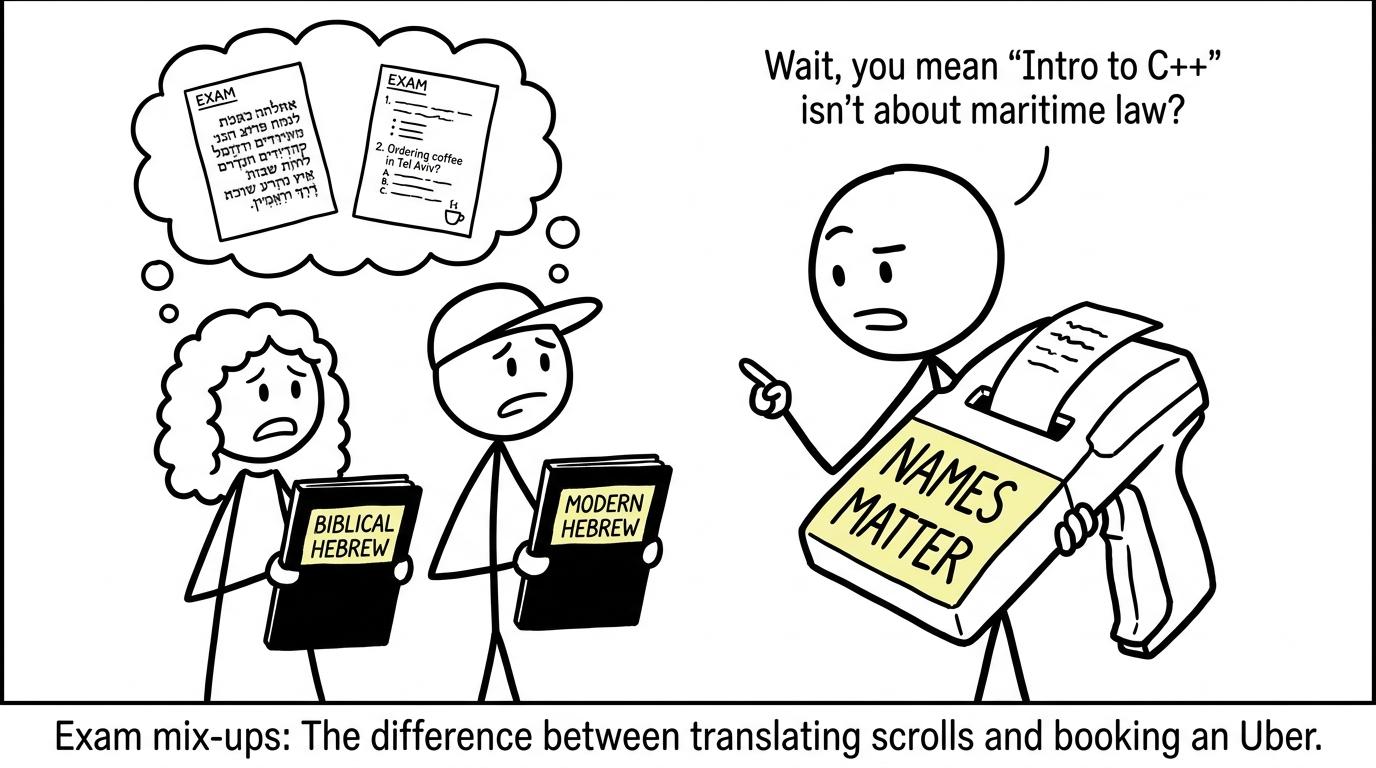 Students accidentally swap Biblical Hebrew and Modern Hebrew folders
If a school document says only “Hebrew”, ask for the full qualification title and specification code. For the Edexcel GCSE discussed here, the code is 1BH0. Do not use information about AQA GCSE Modern Hebrew to decide what grades are available in Edexcel GCSE Biblical Hebrew.
This simple check prevents three errors at once:
- confusing an ancient language with a modern language;
- assuming that a Foundation paper exists;
- planning around a grade 555 ceiling that does not apply.
What being untiered means for top-grade ambitions
An untiered paper removes one administrative ceiling, but it does not make a grade 999 automatic. It means every candidate can access the full assessment and grade range. Their final grade still depends on the marks earned and the grade boundaries set for that exam series.
In June 2025, the official Pearson boundary for grade 999 in GCSE Biblical Hebrew was 149149149 out of 200200200. Grade 888 began at 137137137, while grade 777 began at 125125125. These figures help interpret that completed exam series, but boundaries can move because papers vary in demand and awarding bodies use evidence to maintain standards.
You can see the published figures on MathsGenie's Edexcel GCSE Biblical Hebrew grade boundaries page.
Do not treat 149149149 as a permanent promise or revise to land exactly on it. A safer ambition is to build a margin above previous boundaries while improving both papers. A candidate who concentrates only on Language cannot replace all the marks available in Literature, because the components carry equal weight.
Aim for secure performance, not a boundary guess
A grade boundary is a line drawn after the assessment. Revision happens before it. The practical target should therefore be consistent accuracy across the specification rather than a prediction about where that line will fall.
Use three kinds of evidence:
- performance on full papers under timed conditions;
- marks by section or topic;
- repeated errors revealed by mark schemes.
One strong attempt can be encouraging, but repeated performance is more informative. MathsGenie's guide to using past papers properly explains the useful cycle: complete, mark, diagnose, repair and retest. Although the available MathsGenie papers focus on maths, that revision logic transfers well to any examined subject.
What this means for your GCSE Maths planning
For a student balancing Biblical Hebrew with GCSE Maths, the difference in structure should shape the revision plan.
In Biblical Hebrew, you do not need to spend time deciding between tiers. In maths, the tier is a real strategic decision. If your target requires grade 666 or above, Foundation Maths cannot provide it. Speak to your teacher early if your current maths tier and required grade do not match.
Once your tier is confirmed, keep your resources aligned with it. Use Edexcel GCSE Maths past papers or the appropriate board section, then mark each attempt carefully. MathsGenie's revision lessons, practice questions, mark schemes and video solutions allow you to move directly from a lost mark to the skill behind it.
A calm weekly structure might include:
- short sessions for learning or reviewing content;
- focused practice immediately afterwards;
- a mini test to check recall;
- a timed paper section at the end of the week;
- an error log that determines the next week's priorities.
The best order for learning GCSE Maths topics can help if the subject feels too large to organise. Nearer the exam, Edexcel GCSE Maths predicted papers provide an additional rehearsal alongside official past papers. Predicted papers are practice resources, not forecasts of exact questions.
Common mistakes about the grade ceiling
Assuming every GCSE has Foundation and Higher tiers
Many GCSEs are untiered. Difficulty and tiering are not the same thing. Always read the current specification rather than relying on the structure of GCSE Maths.
Confusing Biblical Hebrew with Modern Hebrew
These are separate qualifications. Advice about the Foundation tier in Modern Hebrew does not establish a grade cap for Biblical Hebrew.
Reading a grade boundary as a fixed pass mark
The June 2025 boundaries apply to that particular series. Future boundaries may be higher or lower. Use historical boundaries to understand past outcomes, not to guarantee your own.
Looking at component boundaries as final grades
Pearson may publish notional boundaries for individual papers, but the final GCSE grade comes from the total subject mark across both components. A notional paper grade does not appear as a separate qualification result.
Letting an imaginary ceiling reduce ambition
If you believe the maximum is grade 555, you may avoid the depth of preparation needed for the highest grades. The official structure says otherwise: grade 999 is available.
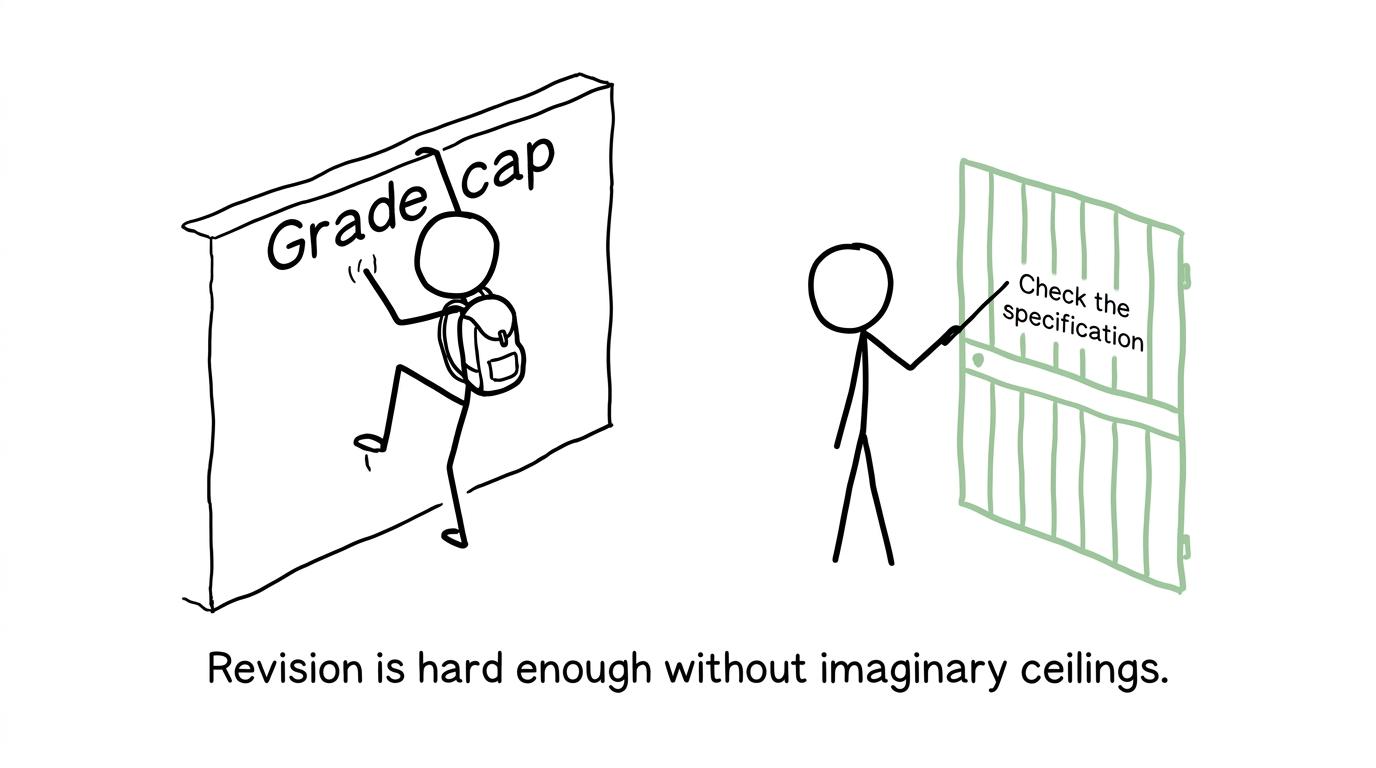 A student finds an open gate beside an imaginary grade-cap wall
The clearest next step
There is no GCSE Biblical Hebrew Foundation tier and therefore no Foundation-tier grade ceiling. The current Edexcel 1BH0 qualification is untiered, and its highest possible result is grade 999.
That answer removes one worry, but it also leaves a useful principle: check the structure first, then build revision around the exam you will actually sit. For maths students, that means confirming the exam board and tier before choosing questions or papers. It also means treating every marked paper as information, not judgement.
Start with MathsGenie's free GCSE Maths resources, use revision lessons and practice questions to close knowledge gaps, and then test the improvement through mini tests, past papers and predicted papers. Mark with the official schemes, use video solutions when a method is unclear, and organise the next steps with the revision planner.
A real grade cap deserves attention. An imaginary one does not. Check the specification, set the right target and let focused practice do the rest.