GCSE Biblical Hebrew Exam Length: Real Timings
GCSE Biblical Hebrew exam length is two hours per paper. See the full four-hour assessment and plan your exam-day energy, timing and focus.
The difficult part of a long exam is rarely the first question. It is the moment, somewhere past halfway, when concentration begins to drift and the clock suddenly feels louder.
The GCSE Biblical Hebrew exam length is straightforward: Pearson Edexcel sets two written papers, and each lasts two hours. Component 1 covers Language and Component 2 covers Literature. Together, that means four hours of examination time, normally split across two different days.
That is the short answer. The useful answer is knowing what those two hours feel like, how long you may actually be in school, and how to protect enough energy for maths and your other GCSE exams.
GCSE Biblical Hebrew exam length at a glance
| Component | Exam time | Marks | Qualification weighting |
|---|---|---|---|
| Component 1: Language | 222 hours | 100100100 marks | 50%50\%50% |
| Component 2: Literature | 222 hours | 100100100 marks | 50%50\%50% |
| Complete qualification | 444 hours | 200200200 marks | 100%100\%100% |
A few details matter:
- Biblical Hebrew is an untiered GCSE, so there are no separate foundation and higher papers.
- Both components are externally examined.
- All assessment is completed in the May and June exam series in a single year.
- Each paper is worth half of the final GCSE.
- The two papers are normally timetabled on separate dates.
- Your personalised school timetable is the final source for your room, arrival time and start time.
Pearson's current specification confirms that each paper lasts two hours and carries 100100100 marks. Its summer 202620262026 timetable, for example, placed Language in a morning session and Literature in an afternoon session on a different date. Future candidates should not copy those dates; always check the timetable issued for their own exam series.
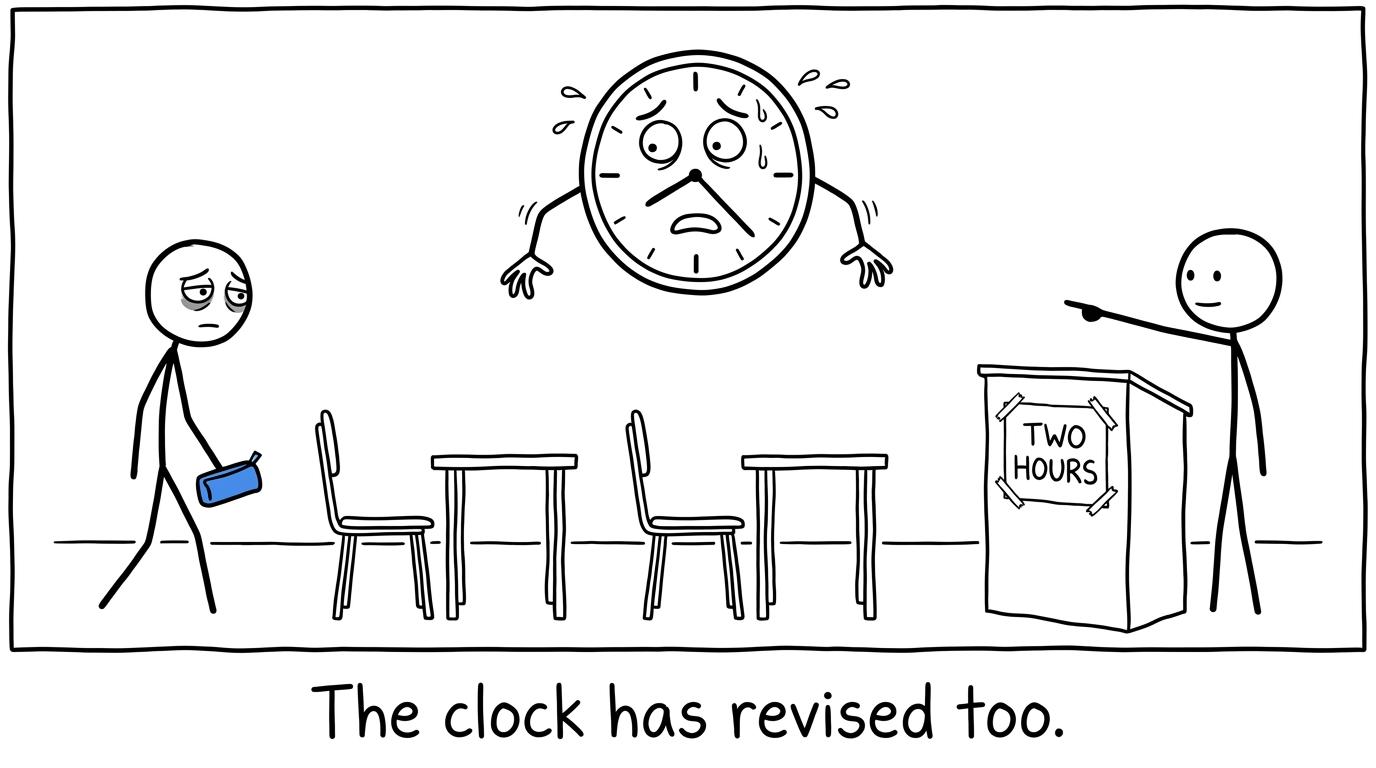 A GCSE student and an equally nervous exam clock
How long are you actually sitting on exam day?
Your writing time is two hours, but your total time at the exam venue will be longer. Schools usually ask candidates to arrive before the published start so that attendance, seating and instructions can be handled calmly.
A realistic sequence looks like this:
- Before the exam: arrive at the time specified by your school, find the correct room and place permitted equipment on your desk.
- Entry and administration: sit in your assigned seat, listen to instructions and complete the candidate details required on the paper.
- The examination: work for the official two-hour duration.
- Collection and dismissal: remain silent while scripts and source booklets are collected and counted, then leave when the invigilator permits it.
Do not assume that a morning paper means you can arrive at the nominal start time, or that an afternoon paper will finish exactly two hours after you enter the room. Your school controls the practical arrangements within the examination regulations.
For planning purposes, treat Biblical Hebrew as a substantial half-day commitment. Avoid scheduling demanding revision immediately before it. If you have another examination that day, your school will explain the arrangements, including any required supervision between papers.
What happens during the two Language hours?
Component 1: Language assesses your understanding of unseen Biblical Hebrew and your ability to translate into English. The specification divides its 100100100 marks equally between comprehension and translation:
- Section A: Comprehension, worth 505050 marks
- Section B: Translation, worth 505050 marks
The examination does not prescribe a compulsory minute-by-minute schedule. However, the equal mark weighting gives you a sensible starting point. If you spent roughly one hour on each half, your effort would reflect the available marks.
Across the full paper, the raw average is:
120/100=1.2120/100=1.2120/100=1.2That is 1.21.21.2 minutes per mark. It is a guide, not a command. Reading an unseen passage may take longer before the marks begin to arrive, while some shorter questions can be completed quickly.
A practical plan is to reserve about ten minutes across the paper for checking, then divide most of the remaining time between the two sections. Your checks should focus on omitted questions, mistranslated negatives, names, verb forms and whether your English communicates the complete meaning.
What happens during the two Literature hours?
Component 2: Literature is also worth 100100100 marks and lasts two hours. It contains three sections:
- Section A: Set text 1, worth 444444 marks
- Section B: Set text 2, worth 444444 marks
- Section C: Synoptic question, worth 121212 marks
Students answer all questions and receive a source booklet containing passages from the set texts. For examinations from 202620262026 to 202820282028, Pearson identifies the prescribed selections as Joseph's rise to power in Genesis and the miracles of Elisha in Kings. Confirm the correct set texts with your teacher if you are sitting the qualification in a later series.
Because the first two sections carry equal marks, they deserve broadly equal time. The synoptic section is smaller, but it should not be left to whatever time survives at the end.
One possible personal checkpoint plan is:
| Stage | Approximate working time |
|---|---|
| Section A | About 484848 minutes |
| Section B | About 484848 minutes |
| Section C | About 141414 minutes |
| Final review | About 101010 minutes |
This is not an official Pearson timetable. It is a rehearsal framework. Adjust it during timed practice according to your reading speed and the kinds of questions that cost you time.
Plan your concentration, not just the clock
A two-hour paper is an endurance task disguised as a desk task. You are physically still, but your attention is repeatedly translating, recalling, selecting evidence and checking meaning.
The best preparation is not to force every revision session to last two hours. Build stamina gradually:
- Begin with a focused section under timed conditions.
- Progress to a longer combination of sections.
- Complete full papers when you can review them properly afterwards.
- Record where concentration falls, not only where marks are lost.
- Practise returning to a difficult question without carrying frustration into the next one.
This principle transfers directly to maths. The MathsGenie guide to using GCSE past papers properly explains how to sit, mark, repair and retest rather than simply accumulating completed papers.
If your timetable already feels crowded, use the GCSE maths revision timetable to place demanding sessions away from long examination days. A plan should protect attention, not merely fill every empty box.
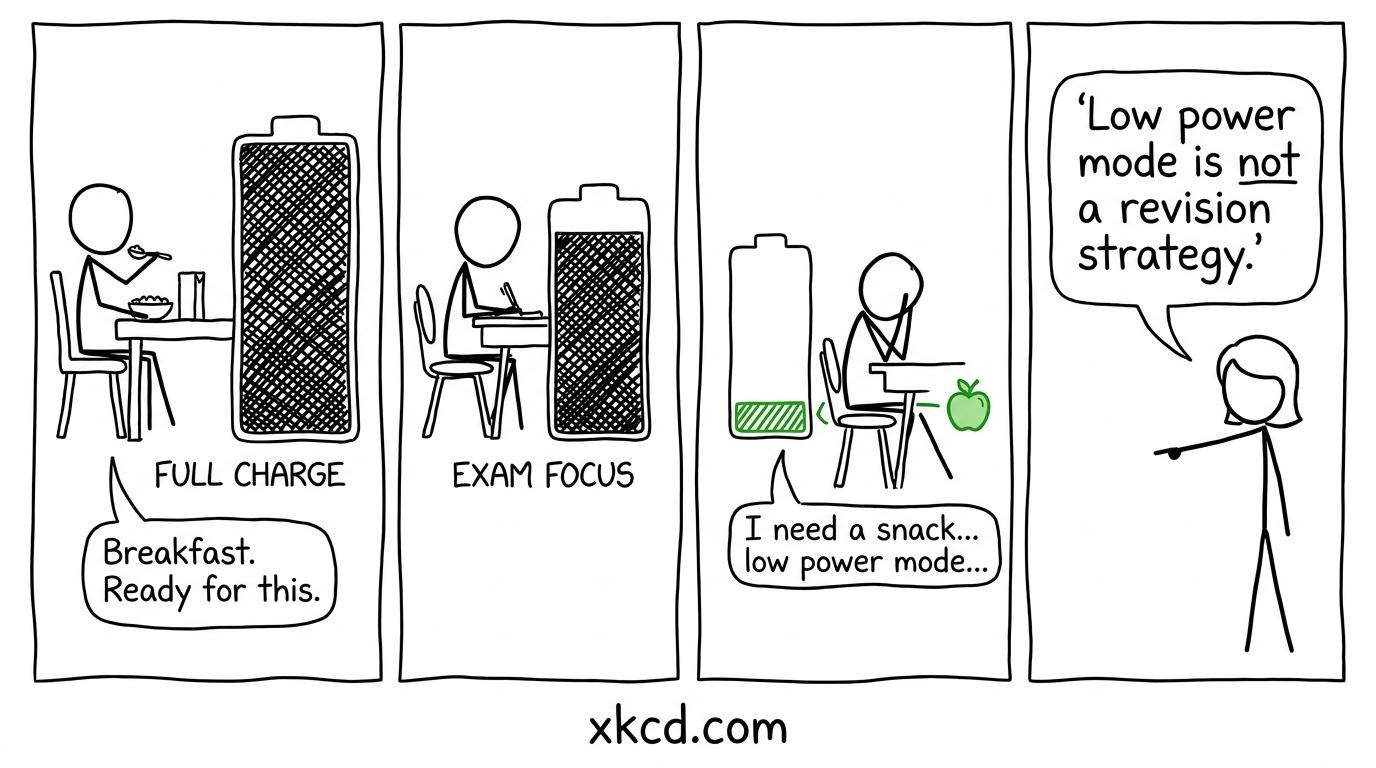 A student monitoring exam energy like a phone battery
A real exam-day energy plan
The evening before
Stop heavy revision early enough to sleep properly. Check your school timetable, candidate details, permitted equipment and travel arrangements. Pack what your centre has told you to bring rather than relying on memory in the morning.
If maths is also approaching, keep the final session short. An Edexcel GCSE maths mini test provides controlled practice without turning the evening into another full mock.
Before entering the room
Eat and drink as you normally would. Avoid experimenting with an unfamiliar breakfast or relying on a sudden burst of caffeine. Visit the toilet before reporting to the exam room and arrive at the time stated by your school.
Do not use the final minutes to learn an entire passage. A short review of familiar prompts may settle you; frantic new material usually competes with what you already know.
During the paper
Read the front-page instructions carefully. Identify optional questions where relevant, follow every instruction about the source booklet and use the marks beside questions to guide your effort.
Set a few quiet checkpoints rather than watching the clock after every sentence. If a question stalls you, leave a clear indication that you need to return. Protecting the remaining paper is often more valuable than spending another ten minutes pursuing one uncertain mark.
After the paper
Once you leave, avoid conducting a detailed unofficial mark scheme with friends. You cannot alter the script, and remembered answers are often incomplete. Eat, drink and allow your attention to reset before revising for the next subject.
The GCSE maths exam week checklist can help you decide what to do between papers without exhausting yourself.
Extra time and supervised rest breaks
If you have an approved access arrangement, your wall-clock experience may differ from the standard two hours.
For example, an approved allowance of 25%25\%25% extra time adds thirty minutes to a two-hour examination, making the working time two hours and thirty minutes. This is not automatically available because an exam feels long. Access arrangements must reflect an evidenced need and your normal way of working, with the school or college SENCo managing the process.
Supervised rest breaks are different from extra working time. Under current JCQ rules, candidates cannot access the question paper or answer booklet during a rest break, and the break must not become thinking time. The pause can extend how long you remain at the venue even though it does not increase the paper's assessed working time.
Speak to your SENCo or examinations officer well before the exam series if you are uncertain. Do not wait until the morning of the paper to ask whether an arrangement applies.
Balancing Biblical Hebrew with GCSE maths
A long Biblical Hebrew paper can affect the revision you do for maths later that day. Plan around that reality.
On a Hebrew exam day, choose light maths maintenance: revisit an error log, watch one short revision lesson or complete a few familiar questions. Save full papers for a day with more mental space. The GCSE maths revision hub lets you choose your exam board and move directly to the right level of practice.
On non-exam days, use timed materials to develop stamina. Depending on your board, you can practise with Edexcel GCSE maths past papers or AQA GCSE maths past papers, then review the relevant mark schemes and solutions.
Closer to the maths papers, Edexcel GCSE predicted papers can provide a fresh rehearsal after you have repaired your topic gaps. If you have several weeks available, the one-month GCSE maths revision plan offers a calmer structure than reacting to whichever exam happens to be next.
Common mistakes when planning for the exam length
Thinking there is only one paper
There are two components, each lasting two hours. Revising Language thoroughly does not replace preparation for Literature, and each contributes half of the qualification.
Confusing Biblical Hebrew with tiered GCSEs
Unlike GCSE maths, Biblical Hebrew is untiered. You do not choose between foundation and higher papers.
Dividing time equally between every question
Questions carry different marks and demand different amounts of reading, translation or analysis. Use the marks as a guide and create checkpoints by section.
Using old dates or set texts
Past timetables are useful for understanding the format, not predicting your appointment. Set texts can also change between examination cycles. Check the current specification and your school's official timetable.
Rehearsing knowledge without rehearsing duration
Knowing the content and sustaining performance for two hours are separate skills. Complete at least some full timed practice before the real examination.
Planning intense maths revision straight afterwards
Four productive hours on paper are not the same as four hours sitting at a desk. After a demanding examination, a short targeted maths session may produce more than a tired full paper.
Turn the time limit into something familiar
The GCSE Biblical Hebrew exam length is two hours for Language and two hours for Literature: four assessed hours in total, usually spread across separate days. Once you know that, the clock stops being a surprise and becomes part of your preparation.
Rehearse sensible checkpoints. Protect your energy before the paper. Check the timetable issued by your school. If access arrangements apply, confirm them early with the relevant staff.
Then give your maths revision the same calm structure. Use MathsGenie's free revision lessons and practice questions to repair individual topics, mini tests to check progress, and past papers, predicted papers, mark schemes and video solutions to practise under pressure. Start with the MathsGenie GCSE maths revision hub, choose your board and turn the next available revision session into one clear step forward.