GCSE Biblical Hebrew Early Entry: Is It Worth It?
GCSE Biblical Hebrew early entry explained: weigh readiness, workload, set texts and exam timing before deciding whether sitting a year early is wise.
A year can look like a simple gap on a calendar. In revision terms, it can represent hundreds of lessons, practice questions and chances to become more fluent. That is why GCSE Biblical Hebrew early entry should not be treated as an automatic reward for being ahead.
The short answer is that sitting early can make sense if you have completed the full specification, can already perform securely under timed conditions and will not weaken your preparation for maths, English or other GCSEs. If early entry mainly means learning the final parts of the course in a rush, waiting is usually the wiser decision.
The goal is not to finish first. It is to sit the qualification when your knowledge, exam technique and wider workload are ready at the same time.
The early-entry decision checklist
Before agreeing to an early entry, ask:
- Have you covered the complete language and literature specification?
- Do you know the set texts prescribed for your examination year?
- Can you translate unseen material without heavy prompting?
- Have you completed full papers under the correct time limit?
- Are your results consistently close to your target grade?
- Is an experienced teacher able to assess your readiness?
- Will the extra preparation reduce time for GCSE maths or other priority subjects?
- Has your school or exam centre confirmed the entry arrangements?
- Do you understand what would happen if you later chose to resit?
A confident “yes” to one question cannot compensate for several uncertain answers. Early entry works best when the evidence forms a complete picture.
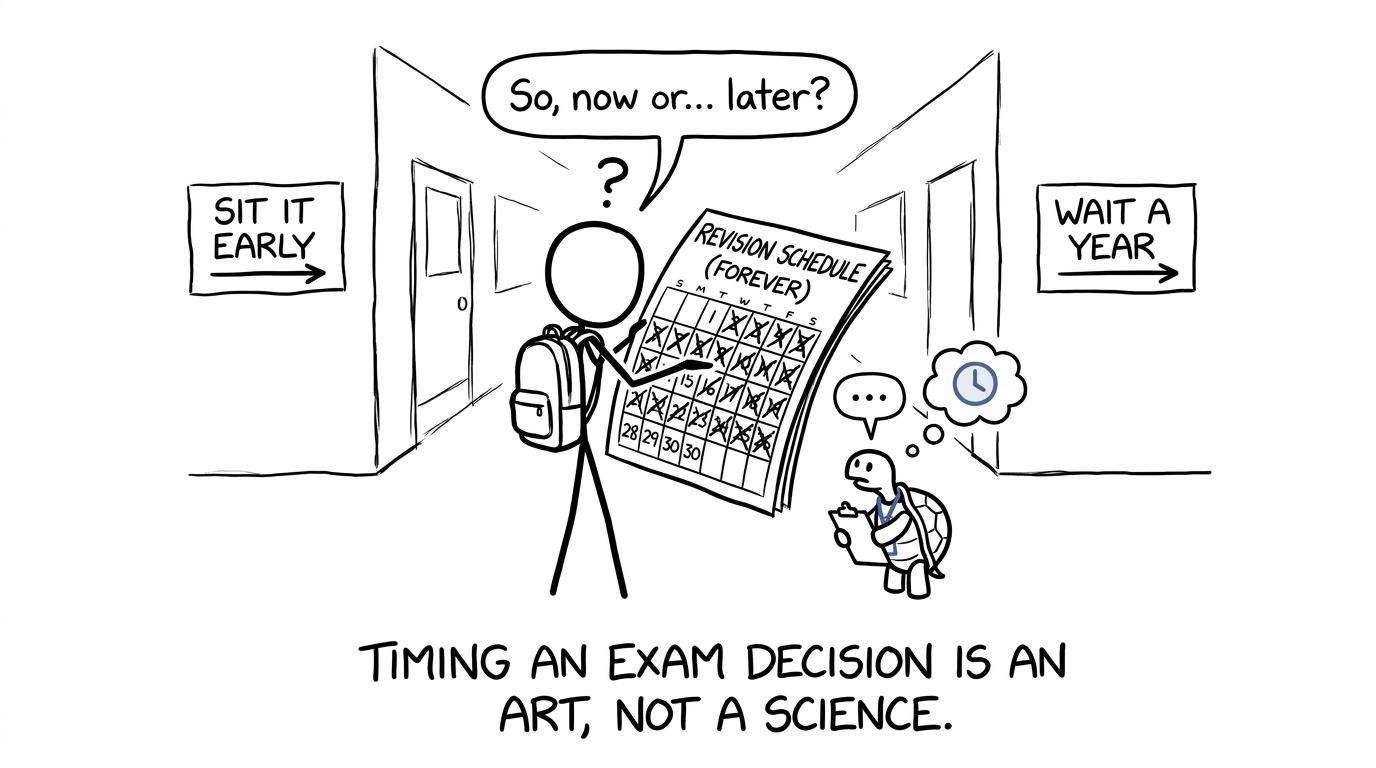 A student choosing between sitting an examination early and waiting
What GCSE Biblical Hebrew currently involves
The current regulated qualification is the Pearson Edexcel GCSE in Biblical Hebrew. You should still confirm the specification and entry code with your school or examination centre before making plans.
The qualification has two externally examined components:
- Paper 1: Language: a written examination lasting 222 hours, worth 100100100 marks and 50%50\%50% of the qualification.
- Paper 2: Literature: a written examination lasting 222 hours, worth 100100100 marks and 50%50\%50% of the qualification.
Students complete both components in the same May or June examination series. Paper 1 assesses skills including comprehension and translation from unseen Biblical Hebrew. It also contains an optional route involving either grammar questions or translation into pointed Biblical Hebrew. Paper 2 examines prescribed texts through short responses, translation and extended writing.
For examinations from 202620262026 to 202820282028, the prescribed material includes Genesis chapters 414141 to 434343, concerning Joseph’s rise to power, and II Kings chapters 444 to 777, concerning the miracles of Elisha. Set texts can change between examination cycles. An early-entry decision must therefore use the material prescribed for the actual year in which you will sit the papers, not an older textbook or inherited revision plan.
This is not a tiered qualification like GCSE maths. There is no foundation or higher paper to choose between, so entering early does not come with the option of reducing the breadth or difficulty through a different tier.
When sitting a year early may be sensible
You have finished the course rather than merely read it
Seeing every topic once is not the same as being examination-ready. A strong candidate should be able to retrieve vocabulary, recognise grammatical forms, translate unseen passages and discuss the prescribed literature without depending on notes.
The distinction matters. Familiarity often feels like mastery until the source booklet opens and the clock starts.
Timed evidence supports the decision
Teacher judgement should be supported by completed papers or specification-matched assessments. One unusually high mark is less useful than a pattern of secure performances across language and literature.
Ask whether your marks remain stable when:
- the passage is unfamiliar;
- the paper is completed in one sitting;
- notes and prompts are removed;
- extended responses are marked strictly;
- both components are tested close together.
That is the same principle that makes GCSE maths past-paper practice useful. A topic can feel comfortable in a revision lesson but behave very differently inside a timed paper.
Early entry creates genuine space later
Completing Biblical Hebrew early may leave more time in Year 111111 for core subjects, A Level preparation or other commitments. But that benefit only exists if preparation now is manageable. Moving work from next year into an already crowded term does not remove the work. It changes when the pressure arrives.
You have appropriate teaching and marking
Biblical Hebrew is a specialist subject. Reliable feedback on translation, grammar and literary responses is particularly valuable. Early entry is more defensible when a knowledgeable teacher has reviewed your work against the current specification and mark scheme, rather than relying on general confidence or informal fluency.
When waiting is probably the better choice
Waiting is sensible if unseen translation remains unpredictable, important grammar has not become automatic or the prescribed texts are only partly covered. The same applies if you have not yet completed full assessments under timed conditions.
You should also pause if the entry is driven mainly by comparison. Another student may have started earlier, receive different tuition or carry a lighter GCSE timetable. Their calendar says little about your best examination date.
A further year can improve more than content knowledge. It can develop writing precision, judgement about command words, stamina and the ability to recover when a passage initially looks difficult. Those quieter skills often decide marks.
Nor does waiting signal a lack of ambition. Sometimes patience is the more ambitious choice because it protects the grade you are capable of achieving.
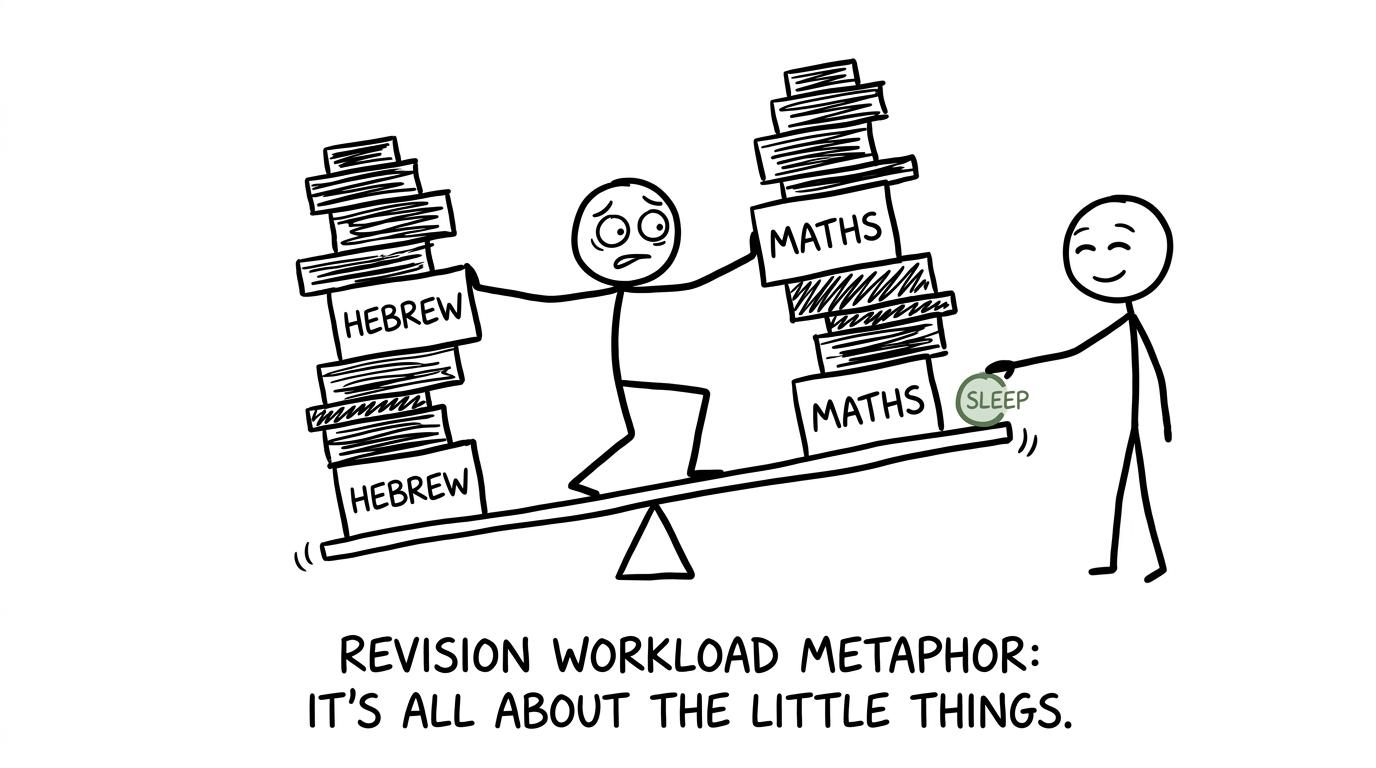 A student balancing Biblical Hebrew, maths and sleep
How early entry could affect GCSE maths revision
For a student preparing for maths examinations, the central issue is opportunity cost. Every additional Hebrew session occupies time and attention that could have been used to secure algebra, ratio, geometry or statistics.
Review a realistic week rather than an ideal one. Start with the time genuinely available after school, travel, meals, sleep and existing commitments. Your plan is sustainable only if
planned revision time≤realistically available time.\text{planned revision time} \leq \text{realistically available time}.planned revision time≤realistically available time.Do not build the decision on a timetable that requires perfect concentration every evening. Leave room for homework, illness, family events and ordinary tiredness.
If maths is becoming squeezed, use the MathsGenie GCSE maths revision hub to identify what still needs attention. Students taking AQA can organise lessons and questions through the AQA GCSE Maths revision page, while Edexcel students can test their performance with Edexcel GCSE Maths past papers.
Short assessments can reveal whether your timetable is still working. The Edexcel GCSE Maths mini tests are useful when a full paper would take too much time. The purpose is not to cram another task into the week. It is to check whether an early entry in one subject is quietly creating gaps in another.
Build an evidence-based readiness review
A useful review should happen before the examination entry is finalised. Include the student, parent or carer, subject teacher and the person responsible for examination entries where possible.
Bring specific evidence:
- recent timed marks for both components;
- a list of specification content not yet secure;
- feedback on unseen translation and extended responses;
- a calendar covering mock examinations and other GCSE deadlines;
- the examination centre’s entry arrangements;
- the current specification and prescribed texts;
- a plan for maintaining maths and English revision.
Then choose a review date. If the evidence is not strong enough by that point, waiting should remain a normal and acceptable option.
For maths, follow a compact cycle: learn a method, answer questions, mark them and return to mistakes. MathsGenie’s guide to revising GCSE maths without wasting time explains how to turn each session into a clear next action. When full papers become appropriate, the advice on when to start GCSE past papers can help you phase them sensibly.
 An exam paper waiting for the right time
Understand entries, resits and school accountability
In England, government early-entry rules affect which result counts in a school’s key stage 444 performance measures. Broadly, where a pupil takes more than one qualification in the same subject, the first entry normally determines the result used for those measures, subject to the detailed current rules and limited exceptions.
That is not identical to saying that a later result has no value to the student. Nevertheless, resit and accountability arrangements are technical and can change. Ask the school’s examinations officer how the rules apply to your exact circumstances before entering.
Students entering independently must arrange the examination through an approved centre that accepts private candidates. The centre makes the entry, sets its own administrative deadlines and fees, and confirms whether it can provide any approved access arrangements. Finding a centre late may be difficult, especially for a specialist subject, so practical arrangements should be checked before revision plans are built around a particular series.
Common mistakes when deciding on early entry
Treating age as proof of readiness
Being young for the examination can be impressive, but age earns no marks. Translation accuracy, textual knowledge and clear responses do.
Using untimed work as the main evidence
Homework completed with notes cannot show how securely you will perform across two 222-hour papers. Include timed, closed-book assessment before deciding.
Checking the wrong set texts
Prescribed literature depends on the examination cycle. Confirm the exact texts for your intended sitting directly with your teacher or centre.
Ignoring the whole GCSE timetable
A decision can be right for Biblical Hebrew and wrong for your overall results. Protect time for maths, English and subjects in which you still have substantial gaps.
Assuming a resit makes the first attempt risk-free
A later attempt requires more preparation, another entry and another examination period. School accountability rules may also treat entries differently. Understand the implications first.
Revising everything equally
Equal time is rarely efficient. Use assessment evidence to find the areas most likely to cost marks. In maths, using Edexcel past papers properly means converting errors into targeted practice rather than simply collecting paper scores.
The better question is whether you are ready
GCSE Biblical Hebrew early entry can be a good idea, but only when it is the result of readiness rather than hurry. Look for complete specification coverage, secure performance across both papers, current set-text knowledge, experienced teacher support and a weekly timetable that still protects your other GCSEs.
If those conditions are absent, another year is not wasted time. It is time available for fluency, judgement and a stronger final performance.
Keep the wider plan steady with MathsGenie’s free GCSE maths resources: use revision lessons to rebuild weak topics, practice questions and mini tests to check recall, then move to past papers, mark schemes, video solutions and predicted papers when you are ready for examination-style practice. Start with an honest assessment of your current workload, speak to your teachers and choose the date that gives you the best chance to show what you know.