

Is a GCSE Biblical Hebrew Discord Server Worth It?
GCSE Biblical Hebrew Discord server guide: weigh useful peer support, unreliable advice, online safety and the risk of replacing focused revision.
Revision can feel strangely lonely when your subject is small. A difficult grammar point appears, your textbook explanation is brief, and few people around you are taking the same qualification. At that moment, finding a GCSE Biblical Hebrew Discord server can seem like discovering a room full of people who finally understand the problem.
Is it worth joining? Potentially, yes, if the community is well moderated, relevant to your specification and used as a supplement to proper revision. It may provide encouragement, resource recommendations and discussion with other students. But anonymous messages are not authoritative teaching, and constant chat can quietly replace the practice you actually need.
For students balancing Biblical Hebrew with GCSE maths and other subjects, the best question is not simply whether a server is good. It is whether joining improves what you do when the screen is closed.
The quick checklist
Before joining or relying on any subject community, ask:
- Is it clearly focused on Pearson Edexcel GCSE Biblical Hebrew, rather than Modern Hebrew or an unrelated course?
- Are the moderators active and are the rules visible?
- Does advice refer back to the current specification, set texts and official assessment materials?
- Can you participate without revealing your school, location, full name or exam timetable?
- Are questions answered with explanations and evidence rather than confidence alone?
- Can you mute notifications and leave without losing an essential revision resource?
- Does the server lead you towards independent practice?
Several weak answers do not automatically prove that a community is unsafe or useless. They do suggest that you should keep looking.
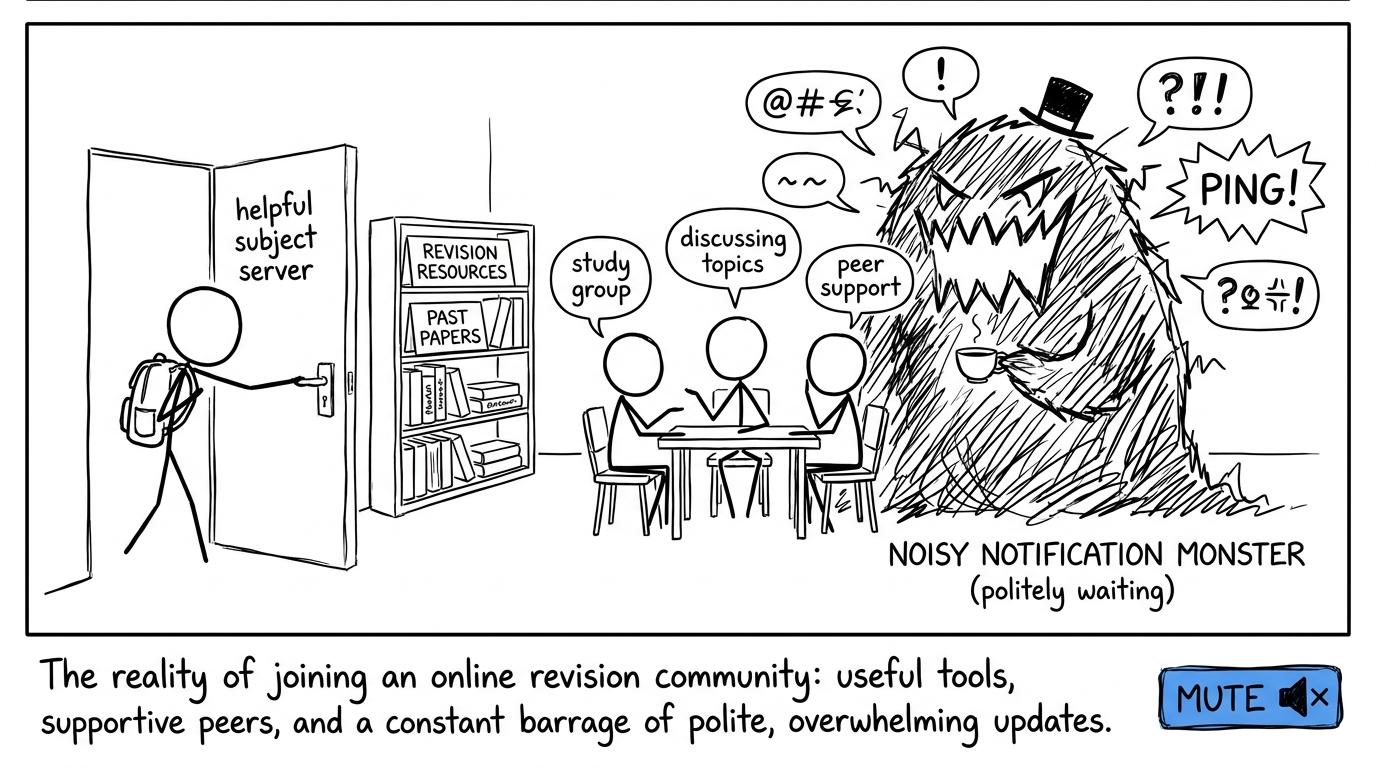 A student discovers that a helpful online study room also contains a notification monster
What a GCSE Biblical Hebrew Discord server can offer
The strongest benefit is connection. Biblical Hebrew is a comparatively specialised GCSE, so students may have fewer classmates, tutors or school resources than they would for a large-entry subject. A focused online community can reduce the friction involved in finding someone who recognises the same terminology and assessment structure.
Clarification and discussion
A good server may give you somewhere to discuss vocabulary, grammar, translation choices, prescribed passages and revision organisation. Another student might point you towards the relevant part of the specification or notice that you have confused two grammatical forms.
That can be useful, but treat the conversation as a starting point for checking, not as the final answer. Pearson Edexcel currently awards the GCSE in Biblical Hebrew. It is distinct from AQA GCSE Modern Hebrew, so advice for one qualification should not be assumed to fit the other.
Set texts can also change between examination periods. For example, Pearson's current specification identifies particular passages for the 202620262026 to 202820282028 examinations. A beautiful set of notes based on an older prescribed text may still teach language, but it may not address the passages you will be assessed on. Always check the current specification and information supplied by your teacher or exam centre.
Resource discovery
Students often share vocabulary systems, revision prompts, public lectures, textbook suggestions and ways to organise quotations or grammatical rules. The community's value is not necessarily that it owns unique material. It may simply help you find useful material sooner.
Pause before downloading files or following unfamiliar links. You do not know whether an anonymous upload is accurate, secure or legally shared. Prefer resources recommended by your teacher, examination centre or the awarding body, and ask a trusted adult if something seems unusual.
Motivation and accountability
A quiet revision channel can make it easier to begin. Posting a realistic intention, working offline and returning later to report completion may provide helpful accountability.
Yet there is a thin boundary between accountability and performance. Writing about a revision plan feels satisfyingly organised, but the examination rewards recall, interpretation and accurate responses, not the number of messages sent about intending to revise.
What an online community cannot replace
A server cannot know your precise teaching context, diagnose every misconception or guarantee that its advice matches the current mark scheme. It should not replace your teacher, tutor, examination centre or official course documents.
Nor can discussion replace retrieval. Reading someone else's translation explanation may create familiarity without proving that you can produce the reasoning independently. Useful revision eventually has to become an individual act: close the chat, retrieve the knowledge, answer the question and check the result.
The same principle applies to maths. Watching other people debate algebra is not the same as completing questions yourself. MathsGenie's GCSE Maths revision hub is organised around lessons, questions and papers because understanding becomes dependable through practice.
A simple rule works across both subjects:
- use discussion to identify or clarify a gap;
- verify the explanation through a trusted source;
- practise without help;
- check your work;
- revisit the weakness later.
The online community belongs near the beginning of that loop, not at its centre.
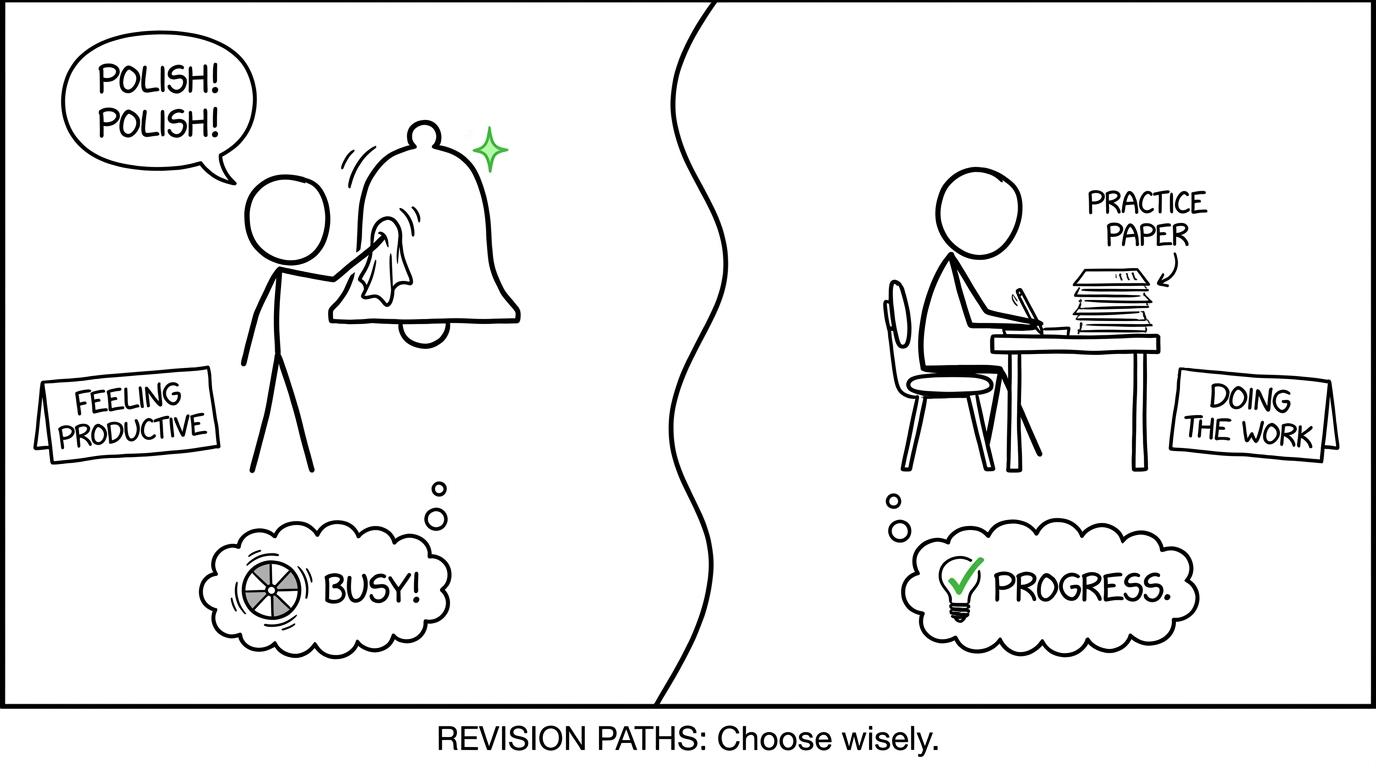 One student polishes a notification bell while another completes real revision
How to judge the quality of a subject server
Look for specification awareness
Strong contributors distinguish Biblical Hebrew from Modern Hebrew and identify the qualification they are discussing. They recognise that current set texts, command words and assessment arrangements matter. Be cautious if answers rely entirely on what somebody vaguely remembers from a previous year.
Notice how uncertainty is handled
Reliable communities allow people to say, “I am not sure.” Members provide reasons, point towards authoritative material and correct errors calmly. A confident answer without supporting evidence is still an unverified answer.
Where two people disagree, do not choose the person with the more impressive username. Check the specification, ask your teacher or consult official assessment material.
Examine the moderation
Visible rules are only the first layer. Look for evidence that moderators remove spam, challenge harassment, discourage cheating and respond to inappropriate contact. Public subject discussion is generally easier to evaluate than unsolicited private tutoring in direct messages.
Be particularly wary of anyone who promises leaked examination content, guaranteed grades or access to restricted papers. Apart from obvious integrity concerns, such claims can be used to persuade students to download files, send money or reveal personal information.
Run a short trial
Join only if you meet the platform's age requirements and have appropriate permission at home. Mute the server, observe it for several days and use it for one defined purpose. Afterwards, ask whether it helped you complete more accurate revision or merely generated more notifications.
This trial mindset is useful in maths too. Try one routine, measure what it reveals and keep it only if it improves your work. The GCSE maths revision timetable guide explains how to build revision around weak topics rather than whichever activity feels busiest.
Staying safe on Discord
Discord does not permit children under 131313 to hold an account, and local requirements may be stricter. In the UK, Discord has introduced teen-appropriate default settings, sensitive-content filtering and restrictions around age-gated features. These protections help, but no setting makes every stranger or claim trustworthy.
Use a non-identifying display name and do not share your full name, school, home area, daily routine, examination centre, photographs, contact details or live location. Turn off or restrict direct messages from server members, review friend-request settings and keep sensitive-media filters enabled.
If somebody pressures you to move to a private chat, send a photograph, share personal information, pay privately or keep a conversation secret, stop responding. Save evidence if it is safe to do so, block and report the account, and tell a parent, carer, teacher or another trusted adult. Leave any community that makes you uncomfortable. Revision help is never worth trading away your safety.
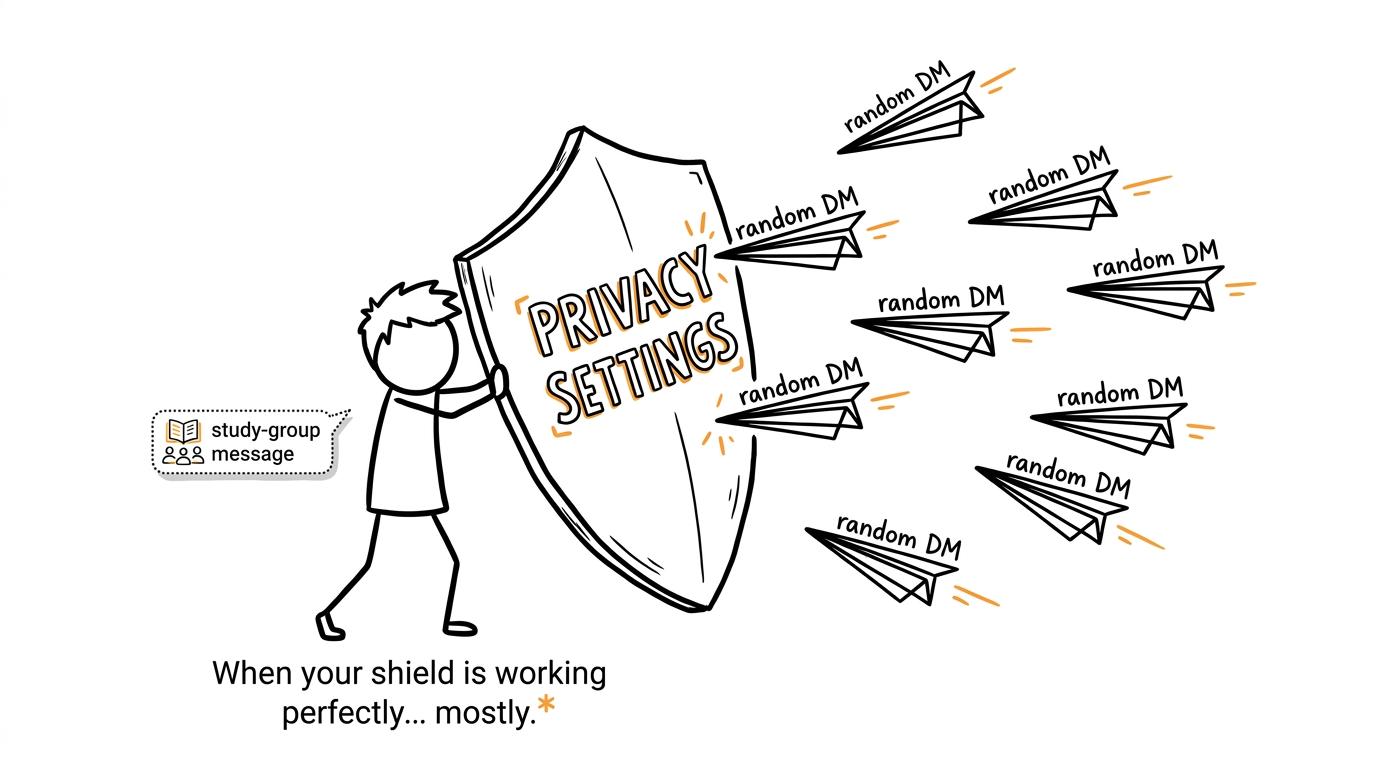 A student uses privacy settings to block random direct messages
Preventing Discord from taking over revision
Notifications are good at turning a small doubt into an hour of fragmented attention. The solution is not heroic self-control. It is structure.
Choose a narrow purpose before opening the app: clarify one specification point, locate one recommended resource or ask one well-formed question. Set a short time limit, mute the server afterwards and complete the main revision task offline.
A balanced session might contain:
- a short check of unanswered questions;
- focused independent revision;
- recall or exam-style practice;
- careful checking against trusted materials;
- one written note identifying the next action.
When several GCSE subjects compete for time, schedule them rather than letting the loudest notification choose. MathsGenie's one-month GCSE revision plan offers a practical structure for diagnosis, targeted sessions and timed practice.
For maths, use short Edexcel GCSE mini tests to expose gaps quickly. Then move to the relevant lesson and practice questions. A subject server can encourage you to begin, but a marked test tells you what you can actually do.
Common mistakes when using revision communities
Treating popularity as proof
A frequently repeated answer can still be wrong. Check important claims against the current specification, official assessment materials or your teacher.
Revising the wrong qualification
Biblical Hebrew and Modern Hebrew are not interchangeable course titles. Confirm the exam board, qualification and current set texts before investing time in shared notes.
The same check matters in maths: Edexcel, AQA, OCR and Eduqas specifications have substantial common ground, but paper structures and resources are board-specific. Use MathsGenie's guide to GCSE maths topics by exam board and tier to keep your preparation aligned.
Collecting resources instead of using them
A folder containing hundreds of documents is not a revision system. Keep only materials that serve a defined weakness, then practise retrieval or exam questions.
Letting chat replace marked work
Discussion can explain confusion, but only completed work exposes hesitation and errors. For maths, follow the proper past-paper revision process: complete, mark, diagnose, repair and retest. Students taking Edexcel can use the GCSE maths past-paper collection with mark schemes and worked solutions where available.
Sharing too much personal information
Even a friendly-looking academic group may contain people you do not know. Keep discussion public and subject-focused, and involve a trusted adult if contact becomes personal, secretive or uncomfortable.
The verdict: useful room, poor foundation
A well-run GCSE Biblical Hebrew community can be worth joining when it solves a real problem: finding peers, clarifying a question or discovering legitimate resources for a specialised subject. Its best role is modest but meaningful. It reminds you that you are not the only person working through the material.
Do not build your preparation on anonymous advice. Build it on the current specification, trusted teaching, accurate resources and repeated independent practice. Keep Discord muted until you need it, verify what you learn and leave if the environment is distracting or unsafe.
Then give every subject the same disciplined treatment. For GCSE maths, start with MathsGenie's free revision lessons and practice questions, use mini tests to uncover weak areas, and build towards past papers, predicted papers, mark schemes and video solutions. Open the MathsGenie GCSE revision hub, choose your exam board and tier, and turn the next revision session into work that produces evidence, not merely activity.











