

GCSE Biblical Hebrew Busy Schedule: Survival Guide
GCSE Biblical Hebrew busy schedule? Build a realistic plan for vocabulary, grammar, set texts and exam practice while protecting your maths revision.
Some evenings disappear before revision begins. Training runs late, a work shift stretches on, maths homework is waiting, and Biblical Hebrew becomes the subject you promise to tackle tomorrow. If GCSE Biblical Hebrew and a busy schedule are colliding, the answer is not to create hours you do not have. It is to make short sessions active, specific and repeatable.
Your survival plan is simple: protect a small daily minimum, divide the course into language and literature, retrieve knowledge rather than rereading it, and use longer sessions only for timed exam practice. You may not control how crowded your week becomes. You can control what happens in the next fifteen minutes.
Your busy-schedule checklist
Keep these principles visible when the week becomes crowded:
- Confirm the current Pearson Edexcel specification and prescribed texts with your teacher.
- Give vocabulary frequent, short retrieval sessions.
- Rotate grammar, unseen translation and literature rather than neglecting one paper.
- Turn travel, lunch or waiting time into low-friction recall practice.
- Use one protected weekly block for exam questions.
- Mark every substantial attempt and record the exact reason marks were lost.
- Keep maths moving through short, focused MathsGenie sessions.
- Protect sleep rather than relying on late-night cramming.
This is not an idealised timetable. It is a minimum viable system designed to survive sport, employment, homework and difficult weeks.
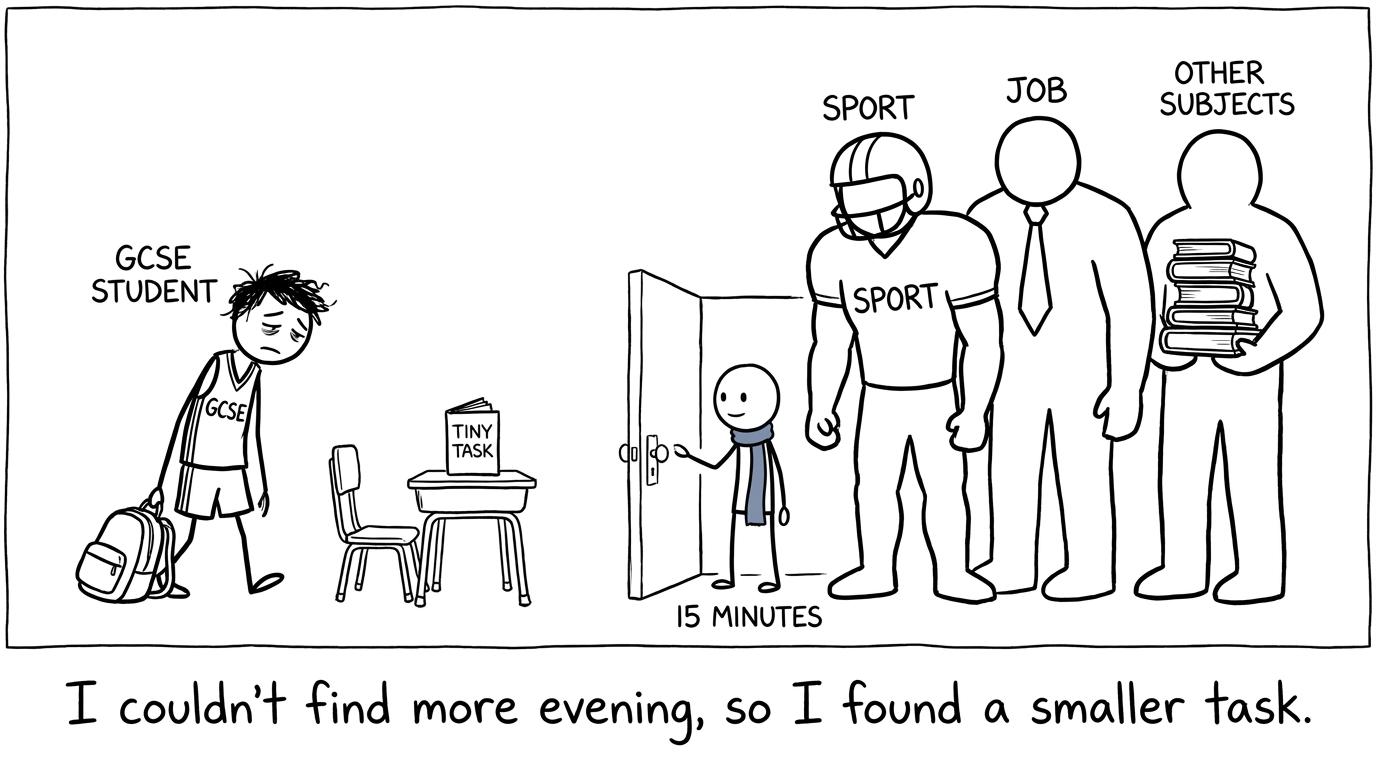 A busy student discovers that a smaller task can fit into a crowded evening
Know what the GCSE Biblical Hebrew exam requires
GCSE Biblical Hebrew is currently offered by Pearson Edexcel under specification 1BH01\mathrm{BH}01BH0. It is an untiered qualification, so there is no foundation or higher paper. That differs from GCSE maths, where your board and tier determine the material and papers you should use.
The qualification has two externally examined components, each lasting 222 hours and worth 100100100 marks:
- Component 1: Language contributes 50%50\%50%. It assesses comprehension and translation of unseen Biblical Hebrew. Students also meet questions involving grammatical understanding or the permitted alternative of translating simple English sentences into pointed Biblical Hebrew.
- Component 2: Literature contributes 50%50\%50%. It assesses knowledge, understanding, analysis and evaluation of the prescribed texts, including a comparative extended response.
Across the qualification, language is weighted at 50%50\%50%, knowledge and understanding of literature at 25%25\%25%, and literary analysis and evaluation at 25%25\%25%.
For examinations from 2026 to 2028, Pearson’s published prescribed texts are Genesis chapters 414141-434343, covering Joseph’s rise to power, and 222 Kings chapters 444-777, covering the miracles of Elisha. Always check your entry year and materials with your teacher rather than revising from an old text list.
This structure gives a time-poor student an important clue: revising only vocabulary is not enough, but neither is knowing the stories without being able to handle the language. Your plan must preserve both halves.
Build a minimum revision routine that survives real life
A fragile timetable assumes every evening will go well. A useful timetable expects disruption.
Create three versions of your routine:
The minimum day
On a training, work or heavy-homework day, complete one short retrieval task. Test vocabulary, identify verb forms, recall a section of a prescribed text or plan the evidence for one literature theme.
The purpose is continuity. A small completed session keeps the subject mentally available and makes tomorrow’s restart easier.
The normal day
Use a focused block containing three actions:
- retrieve something from memory;
- attempt a small amount of unseen language or literature analysis;
- check and record one correction.
Do not spend the entire block arranging stationery, copying notes or deciding what to revise. Choose the task before the session begins.
The weekly anchor
Protect one longer period for a timed section, substantial translation or literature response. Place it where your week is usually quietest, not where an imaginary perfect student would put it.
If Saturdays are dominated by fixtures, Sunday morning may be your anchor. If weekend work is unpredictable, a school study period may be safer. Reliability matters more than appearances.
The same principle can keep maths from swallowing every free evening. The MathsGenie GCSE maths revision hub lets you choose your exam board and move directly to relevant lessons and questions. If your overall week needs rebuilding, use the GCSE maths revision timetable guide to create a plan that leaves room for other subjects.
Prioritise Biblical Hebrew by marks and weakness
When time is limited, “revise Biblical Hebrew” is too vague. Decide which of these four lanes needs attention:
- core vocabulary;
- morphology, syntax and grammatical recognition;
- unseen comprehension and translation;
- prescribed literature, evidence and analysis.
Begin with a brief diagnostic. Without notes, attempt a small task from each lane and classify the result:
- secure: you can do it accurately without prompts;
- shaky: you can begin but make recurring errors;
- blocked: you cannot recall the knowledge or start the task.
Spend most of your available time on shaky material. Secure material needs maintenance, while blocked material may require direct teaching from your teacher before independent practice becomes productive.
Do not let the easiest activity become the default. Vocabulary cards can feel satisfying because they are quick, but a student can recognise isolated words and still struggle to translate a connected passage. The reverse problem also exists: repeatedly reading an English translation creates familiarity with the story without preparing you to analyse the Biblical Hebrew source.
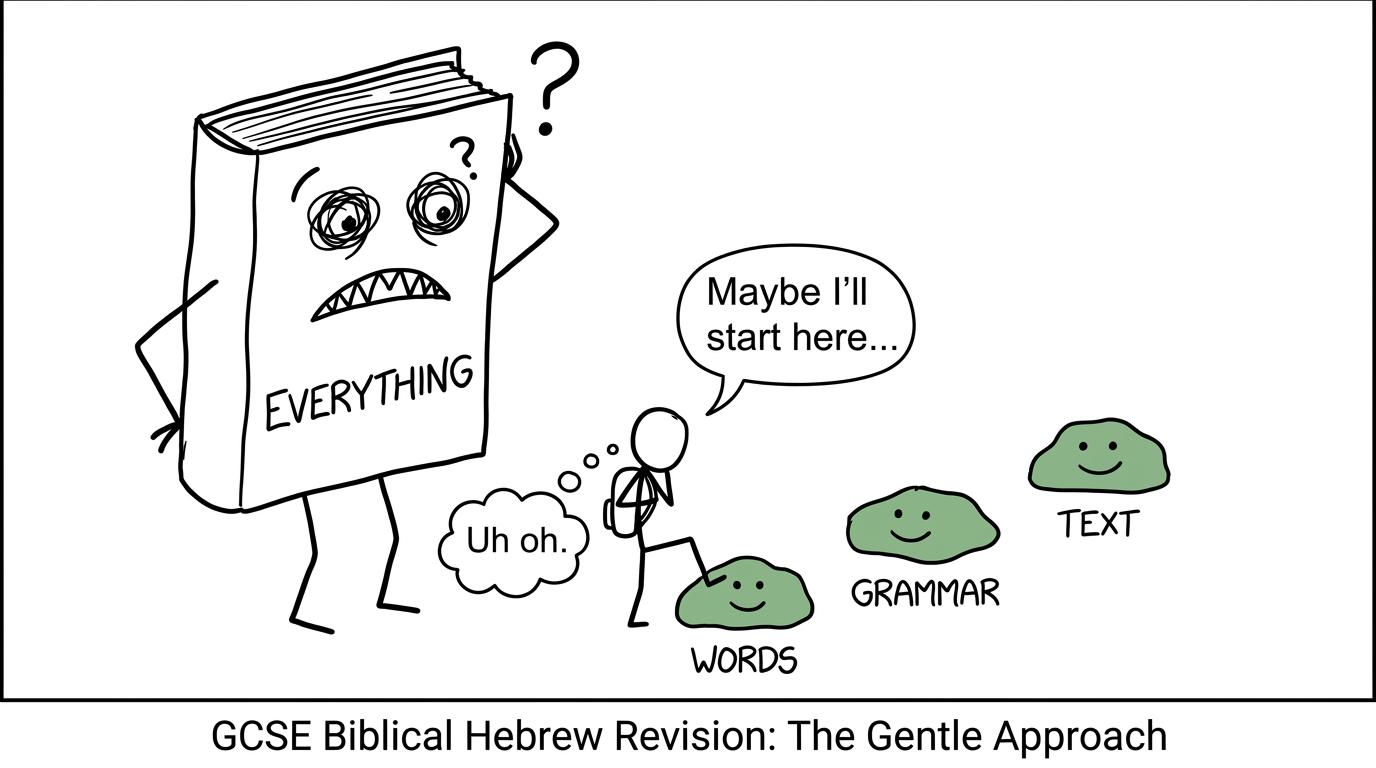 A student breaks an intimidating revision monster into vocabulary, grammar and text tasks
Use active recall in the gaps between commitments
Busy students often have fragments of time rather than open evenings. Those fragments are well suited to retrieval.
For vocabulary, look at the Biblical Hebrew form and produce a meaning before checking. Reverse the direction occasionally. Sort repeatedly missed words into a short weak list rather than reviewing the entire list at equal frequency.
For grammar, retrieve identifying features and meanings without opening your notes first. For literature, recall the sequence, speaker, context, significant language and relevance of a passage. Then check the prescribed text and correct omissions.
A sensible revisit pattern is soon, later in the same week, and again the following week. The precise gap matters less than returning before the knowledge disappears completely.
This approach also protects your maths revision. A short Edexcel GCSE maths mini test can reveal a weak skill without consuming a whole evening. The broader one-month GCSE maths revision plan offers a similar rhythm of diagnosis, focused practice and review.
Make unseen translation a regular habit
Unseen translation is difficult to rescue through passive reading because it requires several decisions at once: recognising vocabulary, parsing forms, understanding syntax and producing clear English.
Use short passages regularly rather than saving every unseen for a long weekend session. During review, separate errors into categories:
- vocabulary was not known;
- the correct meaning was not selected for the context;
- a verb form or tense relationship was misread;
- syntax was overlooked;
- the English translation was awkward or unclear;
- an idiomatic expression was translated too literally.
Pearson examiner guidance has specifically highlighted contextual vocabulary choice, verb structures, connected English, idiomatic expressions and practice with unseen texts. That makes an error log far more valuable than simply writing a total mark.
If you choose the composition route within the permitted language questions, make sure your practice matches that choice. Accurate forms, pointing and block script need deliberate attention. Confirm your intended option and required conventions with your teacher.
Revise literature as evidence, not plot summary
Knowing what happens in Genesis or Kings is the beginning, not the finished task. Literature questions also reward understanding of character, ideas, values, social practices, context and literary effects. The comparative section requires connections across both prescribed texts.
Build compact passage records containing:
- where the passage occurs;
- what changes during it;
- the central characters and motives;
- important language or literary features;
- what the passage reveals about ideas or values;
- one connection to another part of the prescribed material.
Retrieve these records from memory. Then practise selecting only the evidence relevant to a question. A crowded schedule leaves little room for writing long essays that are never checked, so alternate between concise plans and occasional timed responses reviewed against teacher feedback or an official mark scheme.
Keep maths revision efficient alongside Hebrew
The goal is not to make Biblical Hebrew compete with maths every night. Give each subject a clear type of session.
Use MathsGenie revision lessons and practice questions for individual weaknesses, then move into papers when you have enough uninterrupted time. The guide to revising Edexcel GCSE maths without wasting time explains the learn, practise, mark, fix and retest cycle.
Full papers should be purposeful rather than automatic. Read when to start GCSE maths past papers before filling every weekend with them. Near the exams, Edexcel GCSE maths predicted papers can provide fresh exam-style practice, but they should follow topic repair rather than replace it.
Biblical Hebrew requires a different resource base, so use the current Pearson specification, official papers, mark schemes and your teacher’s guidance for that subject. The transferable habit is the same: attempt, mark, diagnose, repair and return.
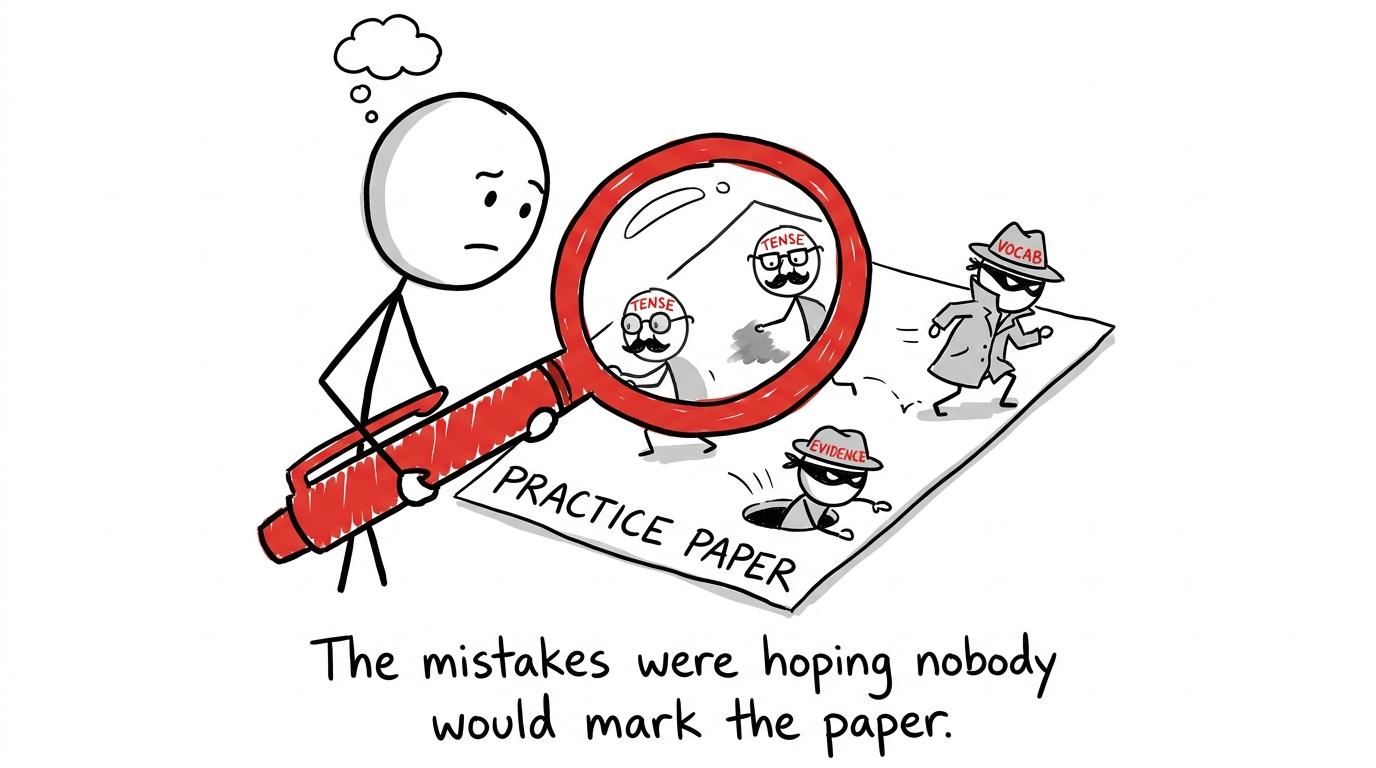 A student catches disguised vocabulary, tense and evidence mistakes while marking
Common mistakes when revision time is scarce
Waiting for a completely free evening
A free evening may never arrive. Define a minimum task that can be completed on an ordinary difficult day.
Revising language but postponing literature
The two components are equally weighted. Rotate them through the week so neither becomes an emergency near the exam.
Rereading instead of retrieving
Familiar pages can create false confidence. Close the book, produce the answer, then check it.
Treating every weakness as equally urgent
Use diagnostics and marked work. Concentrate on recurring errors that affect comprehension, translation or evidence-based analysis.
Completing papers without reviewing them
A paper only becomes revision when its mistakes shape the next session. Record whether each loss came from knowledge, interpretation, expression or timing.
Borrowing an old prescribed-text list
Set texts change between examination cycles. Use the list for your entry year and confirm it with your teacher.
Cutting sleep to create revision time
Late-night work can produce more minutes but poorer attention. Stop at a planned time and restart with a small, defined task the next day.
Small sessions can still build exam readiness
A crowded timetable does not require a heroic rescue. It requires a system that survives tired evenings: a small daily minimum, active vocabulary and grammar recall, regular unseen translation, evidence-led literature revision and one protected weekly exam block.
Let official Pearson materials and your teacher guide the Biblical Hebrew content. Then use MathsGenie to make the maths side of your week easier to manage. Start from the free GCSE maths revision hub, choose your board and tier, and combine revision lessons with practice questions, mini tests, past papers, predicted papers, mark schemes and video solutions.
Do not ask whether you can revise everything tonight. Ask which small task will make tomorrow’s paper less difficult, and begin there.










