GCSE Biblical Hebrew and GCSE Modern Hebrew Together?
GCSE Biblical Hebrew and GCSE Modern Hebrew together: learn whether you can take both, how much they overlap and how to manage the revision load.
Choosing GCSE subjects can feel like choosing which doors to leave open. Taking GCSE Biblical Hebrew and GCSE Modern Hebrew together is generally possible because they are separate qualifications with different subject content and assessments. But possible does not automatically mean practical. Your school or exam centre must offer both, accept the entries and confirm that the final examination timetable is workable.
The overlap is real but limited. Both languages share historical roots and a writing system, yet GCSE Biblical Hebrew is an ancient-language qualification built around scriptural texts, translation, grammar and literature. GCSE Modern Hebrew assesses communication through listening, speaking, reading and writing. Familiarity with one can help with the other, but neither course replaces the work required for its neighbour.
For a student also protecting time for GCSE maths, the deciding question is not simply, “Can I take both?” It is, “Can I prepare properly for both without weakening my wider revision?”
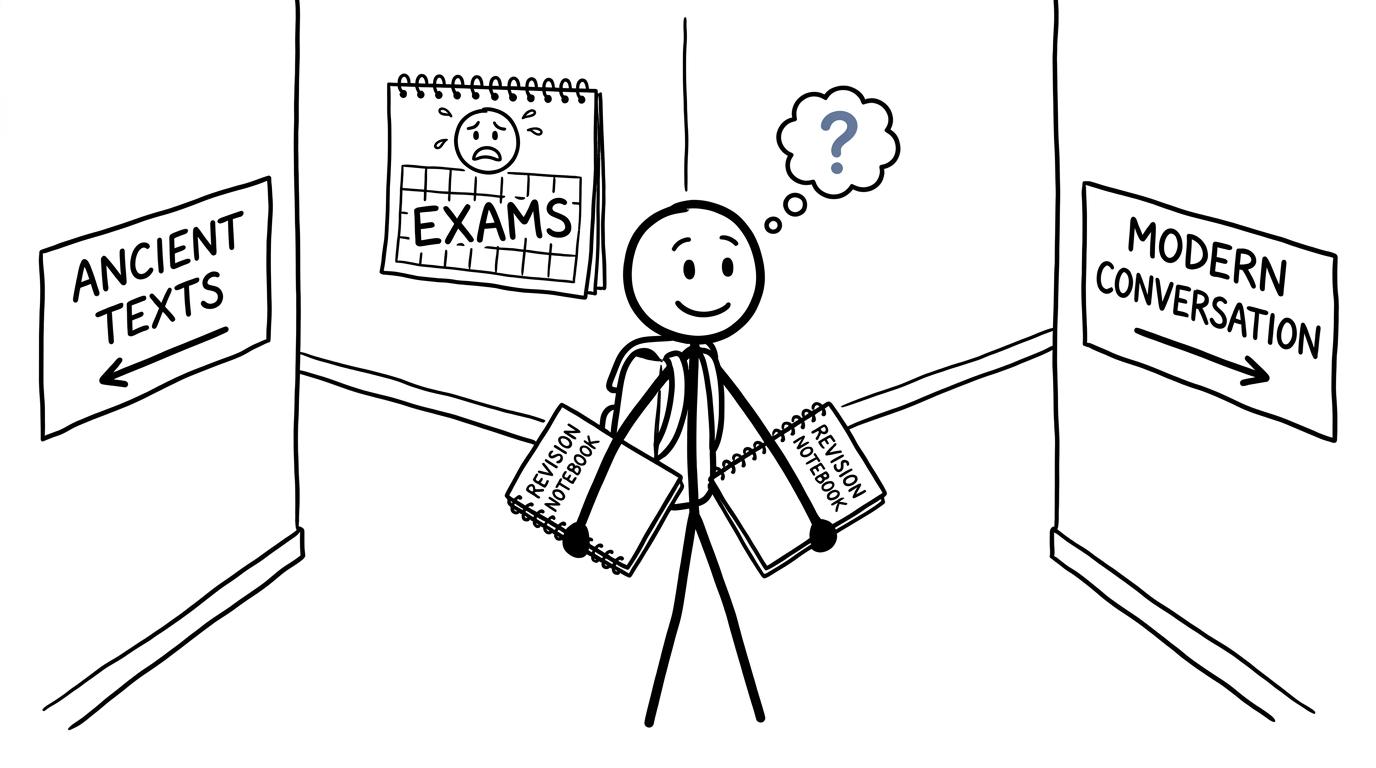 A student choosing both ancient texts and modern conversation
The short answer and your decision checklist
Before committing to both GCSEs, confirm the following:
- Availability: your school or an approved examination centre will enter you for both qualifications.
- Current specifications: you know which exam boards and specification codes apply to your examination year.
- Teaching: you have appropriate tuition for each distinct course.
- Assessment dates: your examinations and any speaking assessment arrangements can be accommodated.
- Prior knowledge: you can read Hebrew script confidently enough to begin the required courses.
- Workload: you have separate time for Biblical grammar and texts, Modern Hebrew vocabulary and communication, and your other GCSEs.
- Purpose: you have a clear reason for taking both rather than assuming they amount to one subject with two titles.
At the time of writing, the approved reformed GCSE in Biblical Hebrew is offered by Pearson Edexcel. Modern Hebrew GCSE is associated with AQA. Specifications and administrative arrangements can change, so use the documents for your examination year and ask your exams officer to verify the entry before building your revision plan.
Why the qualifications are genuinely different
The word “Hebrew” can make the courses appear more similar than they are. A useful comparison is English today and the language of a much older literary text: there may be recognisable connections, but vocabulary, grammar, meaning and the skills being examined are not identical.
GCSE Biblical Hebrew
Biblical Hebrew is regulated as an ancient-language GCSE. Its focus includes understanding the language found in prescribed biblical material, translating and comprehending passages, recognising grammatical forms and engaging with set literature.
This is primarily a text-based course. Success depends on precise analysis: noticing how a word has been formed, identifying its role in a sentence and interpreting it in context. The literary component also requires knowledge of the prescribed material specified for the relevant examination series.
It is not a GCSE in speaking Biblical Hebrew, nor does the specification require comparison between ancient and modern life. That distinction matters because conversational confidence in Modern Hebrew does not automatically prepare a student for detailed analysis of an ancient passage.
GCSE Modern Hebrew
Modern Hebrew is a modern foreign-language qualification. Its assessments are designed around the four familiar language skills:
- listening;
- speaking;
- reading;
- writing.
The course therefore asks whether a student can understand and communicate contemporary meanings across different contexts. Pronunciation, spontaneous responses, listening under time pressure and extended written communication all matter in ways that have no direct equivalent in the Biblical Hebrew qualification.
Modern Hebrew may be familiar from home, school or community life, but familiarity alone is not complete examination preparation. A student still needs command of specification vocabulary, accurate grammar, suitable register and the techniques required by each paper.
How much overlap is there really?
There is enough overlap to provide a useful head start, but not enough to treat the second qualification as a small extension.
Where knowledge can transfer
Students may benefit from familiarity with:
- reading from right to left;
- many letter forms and features of the writing system;
- some related vocabulary and word roots;
- the idea that words can be built around roots and patterns;
- grammatical concepts such as gender, number and verb formation;
- careful attention to small written details.
This shared foundation can reduce the initial sense of unfamiliarity. A student who already reads Hebrew script fluently is not beginning either course from the same position as a complete beginner.
Where the overlap stops
The two courses diverge in important ways:
- Vocabulary: ancient scriptural language and contemporary everyday vocabulary serve different purposes.
- Grammar: Biblical Hebrew preserves forms, structures and conventions that do not map neatly onto modern usage.
- Meaning: familiar-looking words can change meaning or carry a different range of meanings in an ancient context.
- Unpointed and pointed text: students may encounter different conventions and must follow the demands of each specification.
- Assessed skills: translation and textual analysis are not substitutes for listening and spontaneous speaking.
- Revision material: Biblical set texts require their own preparation, while Modern Hebrew needs broad thematic vocabulary and active communication practice.
The safest conclusion is that the relationship provides transfer, not duplication. Shared knowledge may make some learning quicker, but each qualification retains a substantial independent workload.
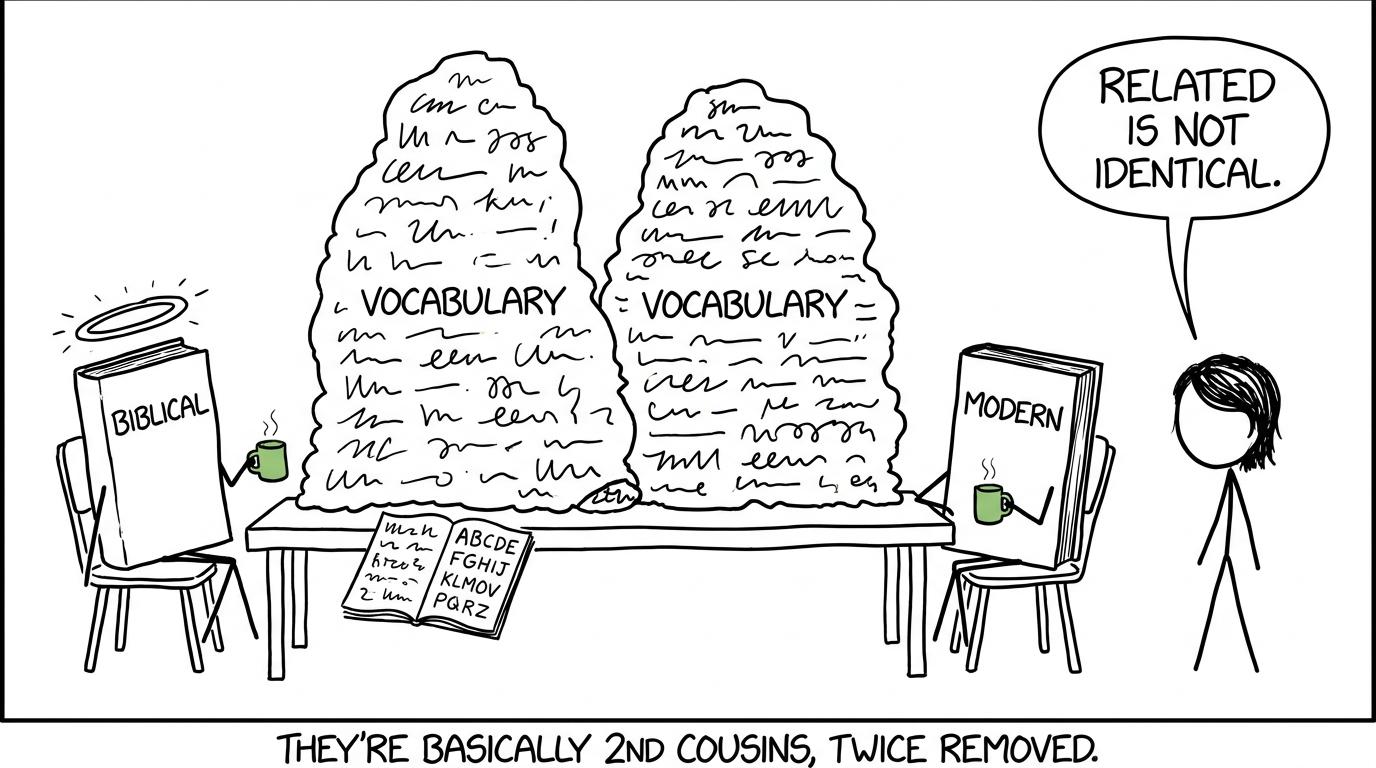 Two related dictionaries discovering that their vocabulary piles differ
Is taking both realistic?
For the right student, yes. It is most realistic when Hebrew is already a strong subject, tuition is available and the rest of the GCSE programme leaves enough space for deliberate practice.
A strong candidate might already read the script fluently, have experience of one form of Hebrew and be willing to learn where the languages differ. Even then, two qualifications mean two specifications, separate bodies of vocabulary and different examination techniques.
Taking both becomes less realistic when a student is learning the script from scratch, has no specialist support for Biblical texts, or is already struggling to maintain core subjects. GCSE maths, English and science cannot simply be placed on hold while language deadlines approach.
The qualification entry is also an administrative matter. A school is not obliged to offer every GCSE, and an independent entry may involve finding a centre willing to handle the papers and Modern Hebrew speaking arrangements. Ask early about teaching, entry deadlines, fees, approved access arrangements and possible timetable clashes. Do not assume that being permitted in principle guarantees a convenient local entry.
Protecting your GCSE maths revision
The hidden cost of an extra GCSE is not only lesson time. It is the attention consumed by vocabulary reviews, set-text preparation, speaking practice and mock examinations. That time has to come from somewhere.
Start by listing every recurring commitment, then give each subject a minimum weekly allocation. For maths, include three different activities:
- learning or refreshing a method;
- answering exam-style questions;
- reviewing errors with solutions or a mark scheme.
The GCSE Maths Revision hub keeps free lessons, questions and examination resources together for foundation and higher tier students. Use it to make maths sessions specific. “Revise maths” is vague; “complete a ratio lesson, answer the practice questions and correct every error” is actionable.
If the week already feels crowded, the GCSE maths revision timetable guide can help you prioritise weak topics rather than dividing time equally without thought. Equal time is not always fair time. A secure subject may need maintenance, while an uncertain algebra topic needs focused repair.
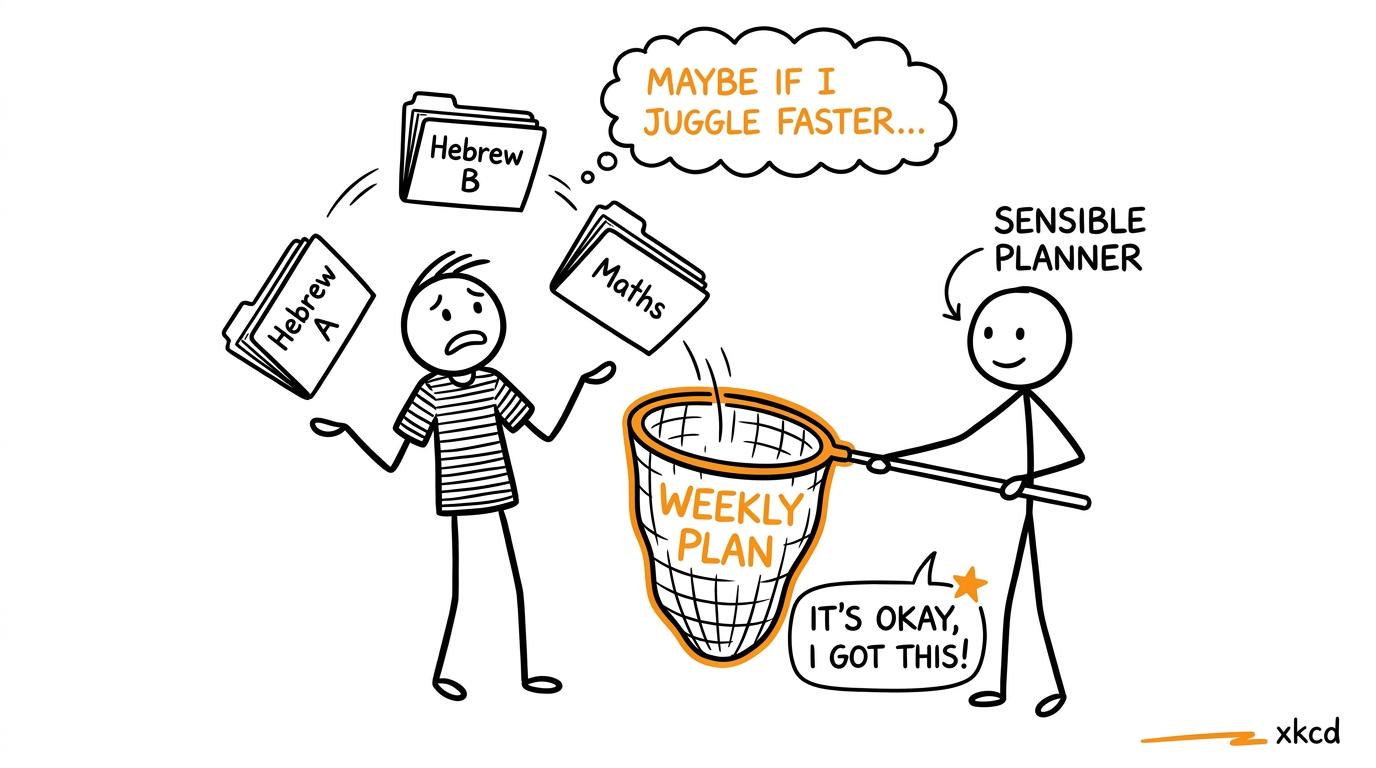 A revision planner rescuing three airborne subject folders
A sustainable way to organise three demanding subjects
Keep the two Hebrew courses separate in your planner. A combined label such as “Hebrew revision” hides what has actually been practised.
Use distinct sessions for:
- Biblical Hebrew grammar and translation;
- Biblical Hebrew prescribed literature;
- Modern Hebrew listening and reading;
- Modern Hebrew speaking and writing;
- GCSE maths topic practice;
- timed maths papers and correction.
Short, repeated sessions are often more manageable than allowing every subject to become a weekend marathon. Keep a record of errors as well: mistranslated forms, vocabulary gaps, weak speaking responses and lost maths marks all need different remedies.
As examinations approach, use maths papers strategically. The guide to when to start GCSE past papers explains how to move from shorter diagnostic work towards timed papers. If you follow Edexcel maths, the guide to using Edexcel past papers properly shows why marking, diagnosing and reattempting matter more than merely finishing another paper.
Near the examination period, resist the temptation to compensate for an overloaded timetable with late-night cramming. MathsGenie’s GCSE night-before revision plan offers a calmer structure based on selected practice, correcting mistakes and preparing properly for the paper.
Common mistakes when considering both GCSEs
Assuming the courses substantially duplicate each other
A shared writing system and related roots do not make the specifications interchangeable. Compare the assessment objectives, content and prescribed material line by line.
Treating spoken Modern Hebrew as complete preparation
Fluent speakers can still lose marks through inaccurate writing, weak examination technique or gaps in formal vocabulary. Biblical translation and textual analysis remain separate skills.
Waiting too long to confirm entry arrangements
A student may prepare independently only to discover that a centre cannot offer the required speaking assessment or accept the entry. Confirm arrangements with the exams officer early and in writing.
Revising both subjects in one undifferentiated block
Label sessions by outcome. “Practise Biblical verb forms” or “record Modern Hebrew speaking responses” gives clearer evidence of progress than “do Hebrew”.
Allowing the extra GCSE to displace maths
Maths improves through regular contact. Long gaps make methods less fluent and errors harder to diagnose. Keep using MathsGenie’s free GCSE resources even during language-heavy weeks, whether that means a revision lesson, mini test or short set of practice questions.
Make the decision from evidence, not optimism
Taking GCSE Biblical Hebrew and GCSE Modern Hebrew together can be a rewarding and coherent choice, particularly for a student with prior knowledge, specialist teaching and a genuine interest in both ancient texts and modern communication. But the overlap should not be exaggerated. They are separate qualifications testing substantially different skills.
Before entering, read both current specifications, ask teachers to assess your starting point, secure an examination centre and map the workload beside maths, English, science and your other subjects. If the plan still looks sustainable during mock season, taking both may be realistic. If it depends on sacrificing core revision or learning one course almost entirely at the last minute, reconsider the timing.
MathsGenie can keep the maths side of that plan clear and free. Begin with the GCSE Maths Revision hub, follow the lessons and practice questions, then build towards mini tests, past papers, predicted papers, mark schemes and video solutions. A full timetable does not need to become a chaotic one; it needs each session to have a purpose.