GCSE Biblical Hebrew 4 to 6: A Practical Plan
GCSE Biblical Hebrew 4 to 6: learn the language, literature and exam-technique changes that turn a secure pass into a stronger exam result now.
A grade 4 often feels close to a grade 6 and far away at the same time. You recognise much of the vocabulary. You understand the broad story of the set texts. Yet small uncertainties keep taking marks: a verb is parsed incorrectly, a translation becomes too loose, or a literature point lacks precise support.
The route from GCSE Biblical Hebrew 4 to 6 is not simply to revise for longer. It is to make four changes: retrieve vocabulary more accurately, analyse grammar in context, translate complete meaning rather than isolated words, and support literature arguments with specific textual evidence.
There is no single permanent mark target. Grade boundaries change after each exam series. However, recent Edexcel boundaries show that the move is achievable through several small gains across both papers, rather than one dramatic improvement.
Your grade 4 to grade 6 checklist
Use this as a quick diagnosis:
- Can you recall common vocabulary without relying on the surrounding story?
- Can you identify the form, person, number and function of verbs accurately?
- Does your English translation preserve the relationships between clauses?
- Can you distinguish knowledge of a set text from analysis of its significance?
- Do your extended responses make a point, support it and explain it?
- Have you completed timed questions from the correct specification?
- Do you record why marks were lost and then retest the same weakness?
If several answers are “not consistently”, you have found the work that matters. MathsGenie’s Edexcel GCSE Biblical Hebrew past papers provide the right starting evidence.
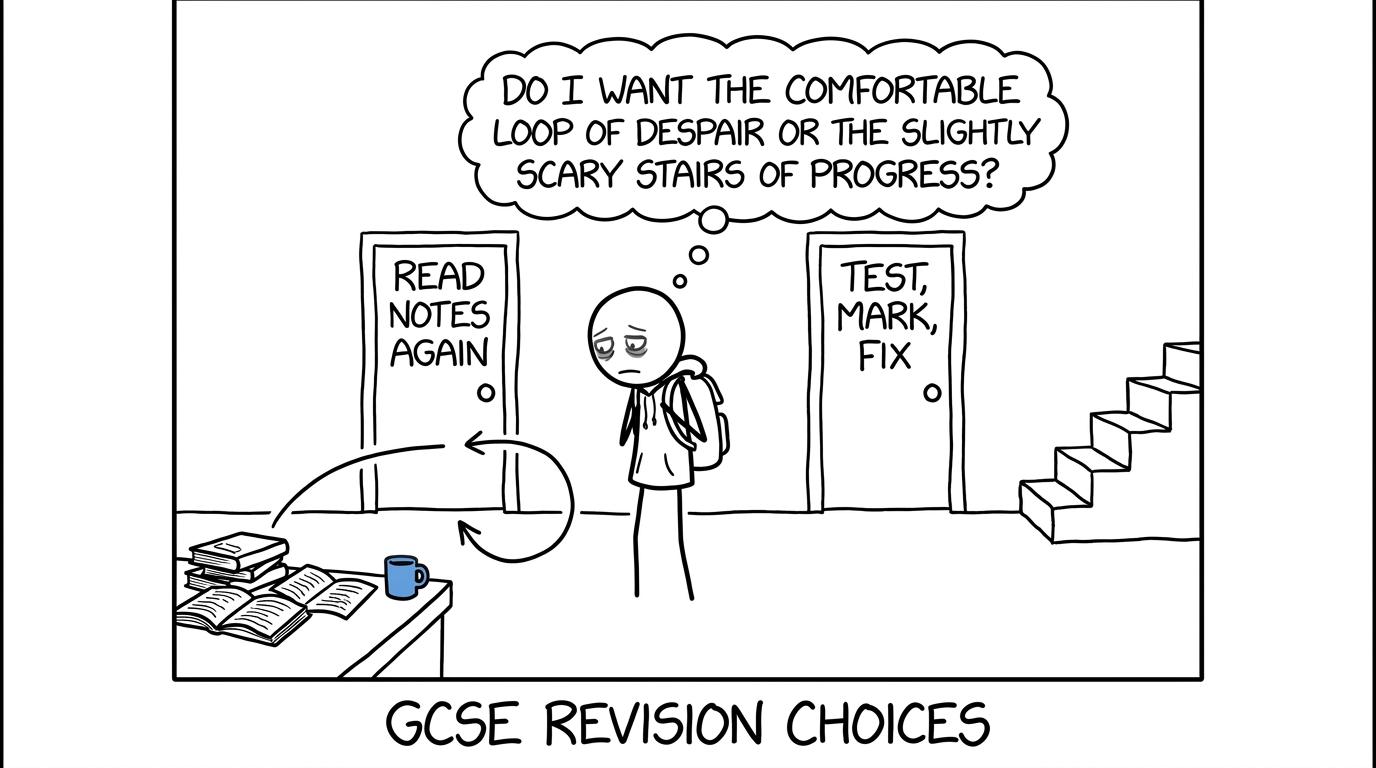 A student chooses between rereading notes and a test-mark-fix revision staircase
What separates a grade 4 from a grade 6?
A grade 4 candidate usually has enough knowledge to understand accessible passages and make relevant comments about the literature. The difficulty is consistency. Knowledge may disappear when a passage is unfamiliar, while longer answers may describe events without examining how the text presents them.
A grade 6 performance is more controlled. It tends to show:
- broader and faster vocabulary recall;
- more reliable recognition of morphology and syntax;
- coherent English translations that preserve detail;
- developed literature points rather than narrative summaries;
- evidence selected from across the prescribed material;
- conclusions connected to the evidence already discussed;
- better decisions under timed conditions.
These are tendencies, not official grade descriptors for individual answers. A final grade comes from the total mark across the qualification.
Recent boundaries help put the gap in perspective. In 2025, the Edexcel grade 4 boundary was 919191 out of 200200200, while grade 6 was 113113113, a difference of 222222 marks. The gaps were 242424 marks in 2024 and 252525 marks in 2023. You can explore these figures on the MathsGenie Biblical Hebrew grade boundaries page.
Those figures must not be treated as predictions. Boundaries are set for each series and are not known in advance. Their useful message is simpler: the difference has recently been around a dozen extra marks per component, which can come from many modest corrections.
Understand where the marks come from
The current Pearson Edexcel GCSE has two externally examined components, each worth 100100100 marks and 50%50\%50% of the qualification. Unlike GCSE maths, it is not divided into foundation and higher tiers.
The assessment objectives are:
- AO1: language, worth 50%50\%50%;
- AO2: knowledge and understanding of literature, worth 25%25\%25%;
- AO3: analysis, evaluation and response to literature, worth 25%25\%25%.
This balance matters. Half of the qualification is language, but half is literature. A student who revises vocabulary while avoiding extended analysis is leaving too many marks exposed. Equally, memorising polished literature notes cannot compensate for insecure unseen translation.
For examinations from 2026 to 2028, the prescribed selections are Genesis: Joseph’s rise to power, chapters 41 to 43, and Kings: the miracles of Elisha, chapters 4 to 7. Always confirm the examination year and prescribed texts with your teacher and the current Pearson specification before planning revision.
Strengthen language accuracy first
Language improvement rarely comes from reading a vocabulary list repeatedly. Recognition can feel fluent because the answer is visible. The examination asks for retrieval when it is not.
Build recall in both directions
Test Biblical Hebrew to English for comprehension and English to Biblical Hebrew for precise recall. Keep sessions short enough to remain demanding. Words answered instantly can be reviewed less often; hesitant or incorrect words should return sooner.
Organise errors by type:
- the word was unknown;
- the root was recognised but the form was not;
- two similar meanings were confused;
- the context caused an unjustified guess;
- the meaning was known but the English was too vague.
That classification turns “my vocabulary is weak” into a practical next step.
Parse before translating
A grade 4 translation may rush towards an English sentence as soon as familiar words appear. A stronger response pauses to establish grammatical structure first.
Before writing, identify the main verb, subject, object, attached pronouns, conjunctions and relationships between clauses. Pay particular attention to person, number, gender, verbal stem and aspect where relevant. The purpose is not to display terminology for its own sake. It is to prevent one incorrect assumption from distorting an entire sentence.
Translate meaning, then check detail
A successful translation should be natural enough to make sense in English but close enough to preserve the source. Avoid both extremes: a wooden sequence of glosses and an imaginative paraphrase based on knowing the story.
Use three checks:
- Completeness: has every significant word or phrase been represented?
- Relationship: are cause, sequence, contrast and direct speech clear?
- English: does the result communicate coherent meaning without inventing detail?
Move literature answers beyond retelling
The grade-band shift is often most visible in literature. Knowing what happens is essential, but AO3 rewards what you do with that knowledge.
A developed paragraph should contain:
- a direct answer to the question;
- precise support from the relevant passage or wider set text;
- explanation of what the evidence reveals;
- analysis of a literary feature, idea, value or social practice where relevant;
- a link back to the focus of the question.
Do not memorise one essay and hope the wording fits. Build flexible evidence banks instead. For each important theme or character, record several moments from different parts of the prescribed text, the literary features involved and the conclusions those moments could support.
Comparison requires the same discipline. Pair related evidence from both texts, identify a meaningful similarity or difference, and explain its significance. Two separate summaries placed beside each other are not yet a comparison.
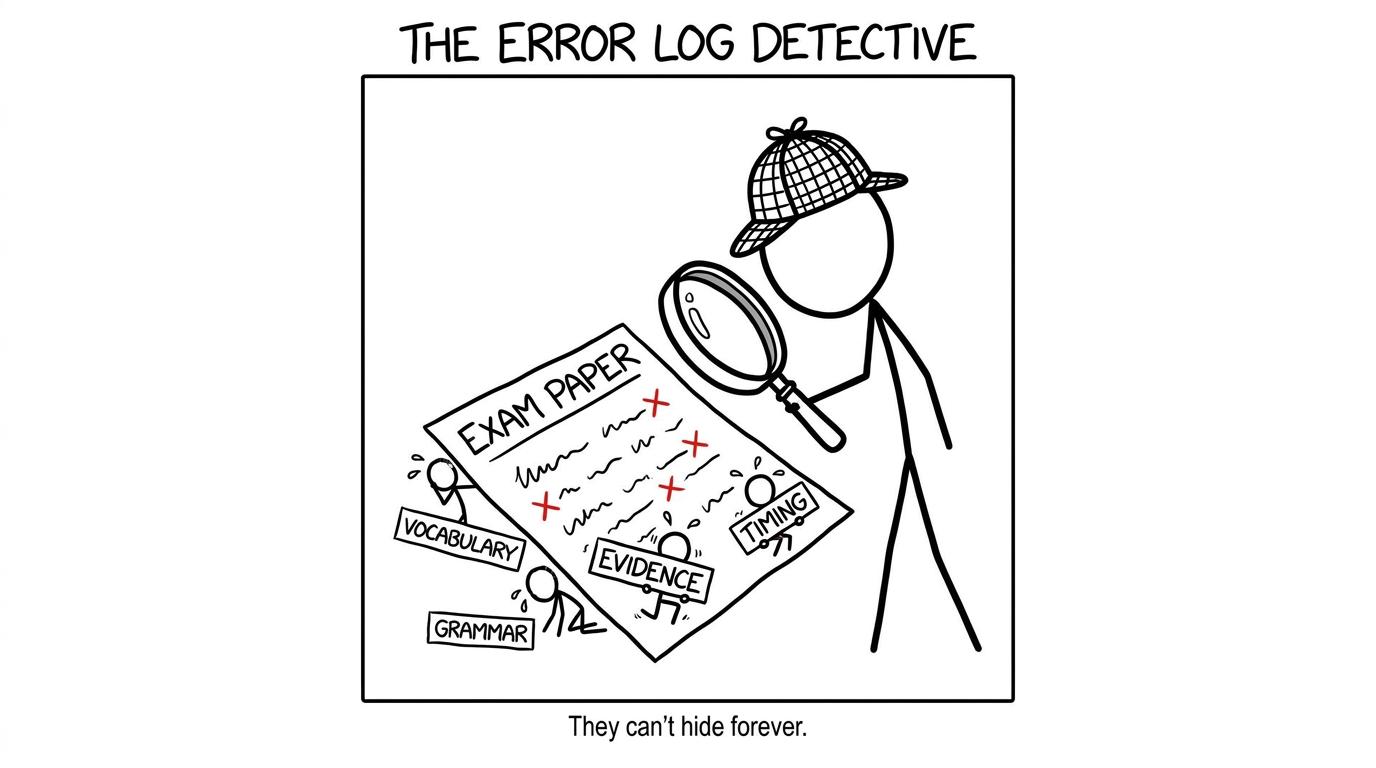 A student detective tracks lost marks hiding behind vocabulary, grammar, evidence and timing
Use past papers as diagnosis, not decoration
Completing papers is useful only when the result changes what you do next. The MathsGenie past-paper library is designed around papers, mark schemes and review, while the specific Biblical Hebrew collection keeps your practice relevant to the qualification.
Follow this cycle:
- complete a section without notes;
- mark it strictly using the available mark scheme;
- record every lost mark by skill;
- revise the smallest skill that would correct the error;
- answer a fresh question testing that skill;
- return to the original question later without notes.
For a more detailed approach, adapt MathsGenie’s guide to finding your weakest GCSE topics. Its central principle transfers well: revision should follow evidence, not preference.
Start with individual sections if knowledge is still fragile. Move towards complete timed papers once you can sustain accuracy. The guidance on when to begin GCSE past papers explains why papers work best as part of a progression rather than a last-minute ritual.
A weekly revision structure that targets grade 6
A balanced week should touch both components several times rather than reserving one day for “all language” and another for “all literature”. A practical pattern is:
- two short vocabulary retrieval sessions;
- two grammar and parsing sessions using unseen material;
- one timed translation section;
- two set-text retrieval sessions;
- one literature paragraph or comparison plan;
- one marking and correction session;
- one delayed retest of the week’s weakest skill.
The sequence matters more than the precise timetable. Learn, retrieve, apply, mark, correct and return. MathsGenie’s GCSE revision timetable guidance was written for maths, but its approach to short, repeatable sessions and honest marking can be adapted to Biblical Hebrew.
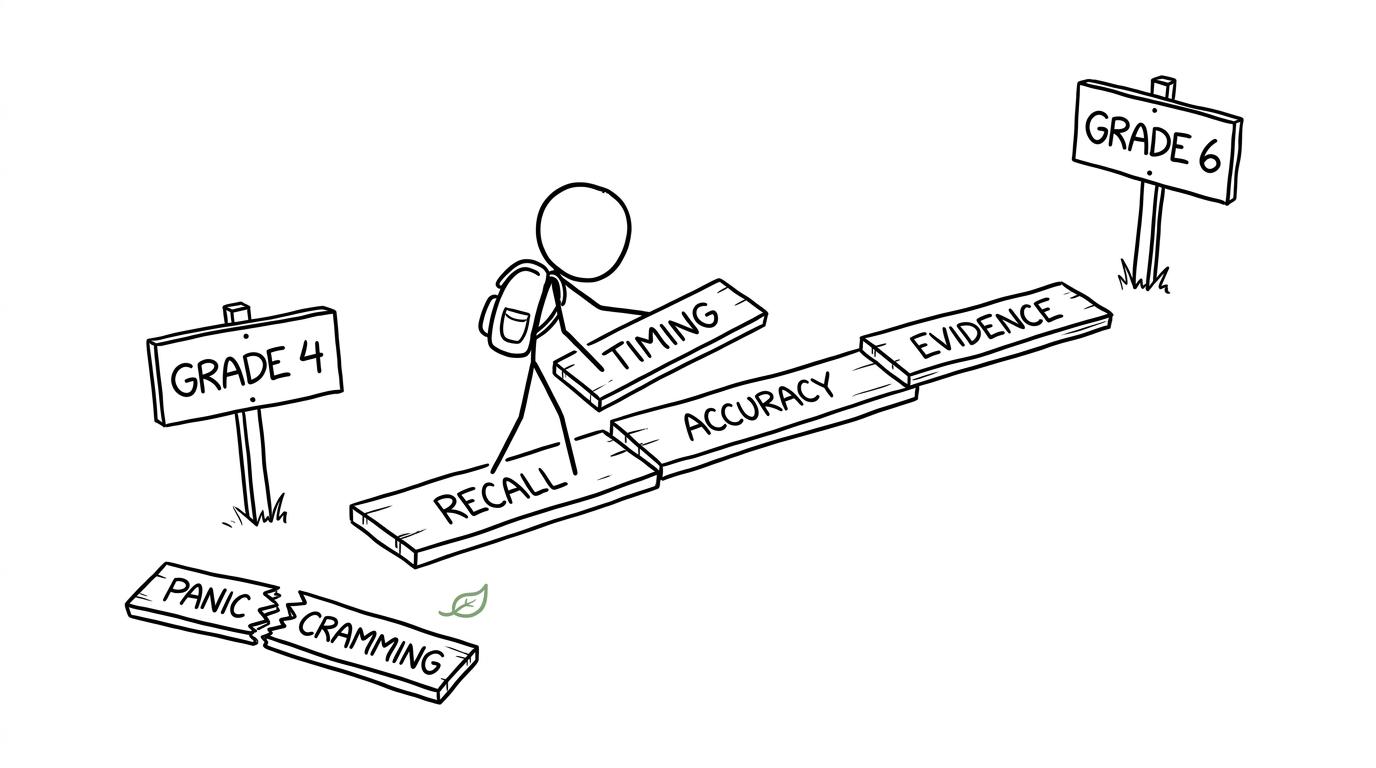 A calm student builds a bridge from grade 4 to grade 6 using recall, accuracy, evidence and timing
Common mistakes that keep students at grade 4
Revising familiar passages only
Familiarity creates confidence but does not always create transferable language skill. Include unseen material so that roots, forms and syntax must genuinely be recognised.
Guessing from the known story
Background knowledge can support comprehension, but it must not replace translation. Award yourself credit only for meaning justified by the words and grammar on the page.
Treating grammar as a list of labels
Identifying a form is useful when it explains meaning. Practise connecting every grammatical observation to its effect on the translation.
Retelling instead of analysing
A summary answers “what happened?” AO3 usually requires more: how the text presents an idea, why a feature matters, or what conclusion the evidence supports.
Using vague evidence
References such as “this happens several times” rarely develop an argument. Select a precise incident, phrase, contrast, repetition or structural feature and explain its relevance.
Counting papers rather than corrections
Five papers completed without reviewing errors may produce less improvement than one paper analysed carefully. The MathsGenie resources hub brings together different practice formats, but no resource can replace the correction stage.
Build the next grade one mark at a time
The journey from grade 4 to grade 6 is not about becoming flawless. It is about becoming less fragile. Vocabulary survives an unfamiliar passage. Grammar guides the translation instead of being guessed afterwards. Literature evidence becomes precise, and timed decisions become calmer.
Begin with the GCSE Biblical Hebrew past papers and mark schemes. Complete one section, identify three recurring mark leaks and build your next week around them. Then retest.
For students balancing Biblical Hebrew with GCSE maths, MathsGenie can also organise the rest of your revision through free GCSE maths revision lessons and practice questions, past papers, predicted papers, mini tests, mark schemes and video solutions. The subjects differ, but the improvement cycle remains the same: practise honestly, learn from the marks and return stronger.