

GCSE Bengali Paper 3: What to Actually Expect
GCSE Bengali Paper 3 explained: timings, sections, question styles, translation, common traps and revision advice for Foundation and Higher tier.
The unsettling thing about a reading exam is that everything looks familiar until one sentence changes the meaning. You recognise the topic, spot a few comfortable words and begin writing. Then, halfway through, you realise the question asked what changed, not what happened.
For AQA students, GCSE Bengali Paper 3 is the reading paper. It lasts 454545 minutes at Foundation tier or 111 hour at Higher tier, carries 606060 marks and contributes 25%25\%25% of the qualification. You will answer questions in English and Bengali before translating a passage from Bengali into English. There is no dictionary.
That is the short answer. The more useful answer is that Paper 3 rewards controlled reading: finding precise details, recognising opinions, handling unfamiliar vocabulary and resisting answers based on one convenient keyword.
GCSE Bengali Paper 3 at a glance
This guide covers AQA GCSE Bengali specification 8638. Check the front of your school materials before revising because Pearson Edexcel International GCSE Bangla has a different assessment structure and should not be treated as the same examination.
| Feature | Foundation tier | Higher tier |
|---|---|---|
| Paper | Paper 3: Reading | Paper 3: Reading |
| Time allowed | 454545 minutes | 111 hour |
| Total marks | 606060 | 606060 |
| Qualification weighting | 25%25\%25% | 25%25\%25% |
| Section A | Questions in English, answered in English or non-verbally | Questions in English, answered in English or non-verbally |
| Section B | Questions in Bengali, answered in Bengali or non-verbally | Questions in Bengali, answered in Bengali or non-verbally |
| Section C | Bengali-to-English translation of at least 353535 words | Bengali-to-English translation of at least 505050 words |
| Dictionary | Not permitted | Not permitted |
The paper uses short and longer pieces of writing. These can include personal messages, public information, advertisements, instructions, letters, emails, websites, brochures, newspaper or magazine material and literary extracts. Some questions are common to both tiers, while more complex language generally appears later in the paper.
Your essential checklist is simple:
- confirm whether you are sitting Foundation or Higher;
- remember which language each section requires;
- practise without a dictionary;
- read the question before hunting through the text;
- use the number of marks to judge how much information is needed;
- leave enough time for the translation;
- check that every required detail has actually reached your answer.
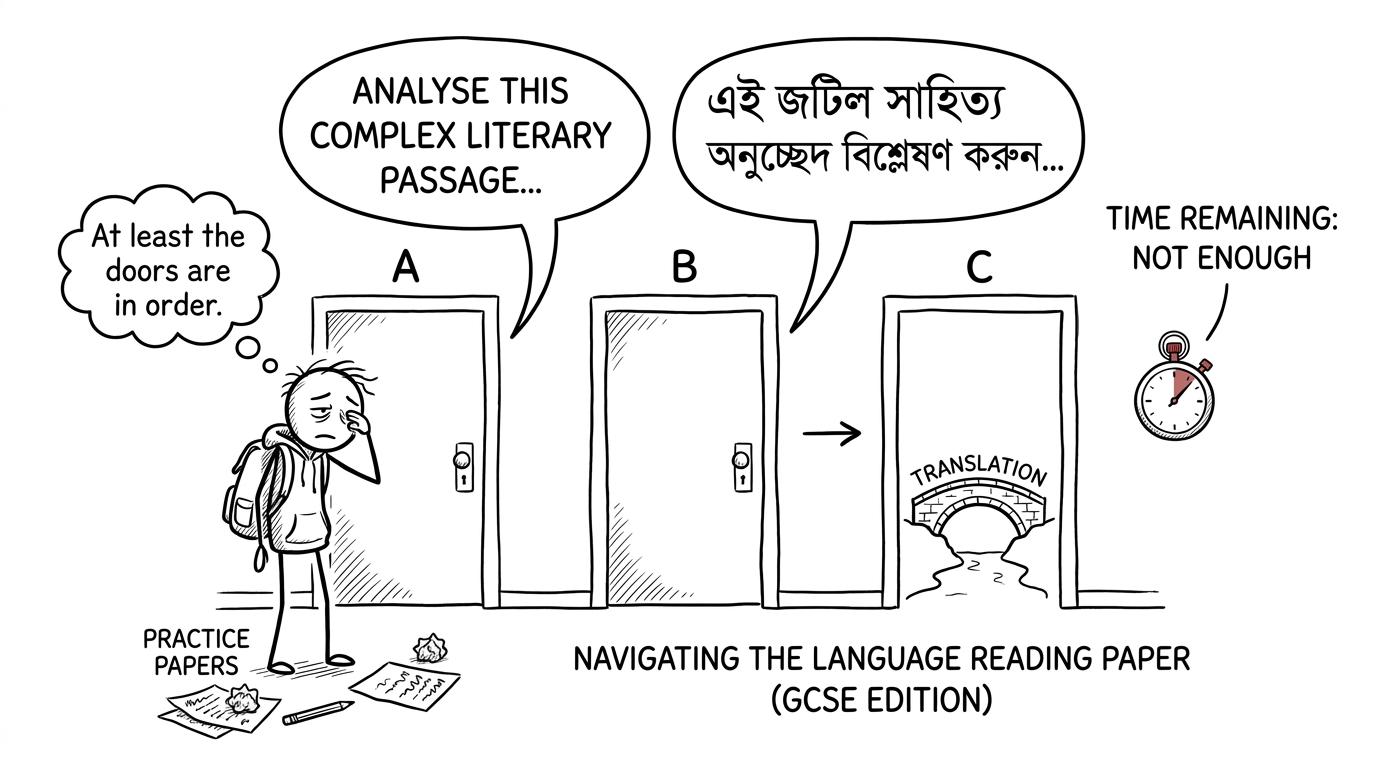 A student navigating the three sections of a language paper
What is actually different about Paper 3?
Paper 3 is not a test of how much Bengali you can produce from scratch. That is closer to the job of the writing paper. Here, the source text already contains the meaning. Your task is to locate, interpret and communicate it accurately.
That creates four important differences.
You must switch response language
Section A gives its questions in English and requires English or non-verbal answers. Section B moves to Bengali questions and Bengali or non-verbal answers. Section C then asks you to transfer meaning from Bengali into natural English.
This sounds administrative, but it changes the mental task. A student can understand a Bengali passage and still lose marks by answering Section B in English. Write a brief reminder beside each section heading when the exam begins: English, Bengali, translate.
Recognition is not enough
The paper tests the overall message, key points, details and opinions. It can also require deduction, inference and recognition of implicit meaning. In other words, the correct answer may not repeat an obvious phrase from the passage.
A familiar word is only a clue. You still need to inspect negatives, time references, comparisons, connectives and the person being discussed. One small word can reverse the direction of an entire sentence.
The texts vary in purpose and style
A public notice usually communicates differently from a personal email. A factual article may state information directly, while a literary extract can imply feelings through behaviour or description.
Before answering, ask two quiet questions:
- What kind of text is this?
- What is its purpose?
That brief classification makes tone and implied meaning easier to recognise.
Paper 3 ends with translation
Translation is not an optional final challenge. Section C is worth 999 marks, so abandoning it because earlier questions consumed your time is costly.
The minimum source length is 353535 words at Foundation and 505050 words at Higher. Your aim is not to create stylish English. It is to transfer the complete meaning accurately, preserving details such as tense, negatives, quantities, opinions and relationships between ideas.
The three sections and the questions they favour
Section A: understanding Bengali through English
Section A is worth 333333 marks. Questions are written in English and responses are given in English or non-verbally.
You may encounter selection tasks, short answers, identification of details and questions asking you to distinguish viewpoints or reasons. Read the English question first. It tells you what evidence to scan for and prevents you from translating an entire passage unnecessarily.
Keep answers focused. If a question asks for two reasons, give two distinct reasons. Copying everything you understood can introduce an incorrect detail and make your intended answer less clear.
Section B: processing both question and answer in Bengali
Section B is worth 181818 marks. The passage, question and written response may all require Bengali, although some responses can be non-verbal.
This section adds an extra layer: you must understand what the question itself is asking. Revise recurring instruction language and question words rather than relying only on topic vocabulary.
AQA’s assessment guidance makes an important distinction: comprehension answers can receive the appropriate marks when understanding has been satisfactorily communicated, even if there are some language-quality errors. That does not make accuracy irrelevant. It means your first priority is an unambiguous answer that addresses the question.
Section C: translation into English
Treat the translation as a sequence of meaning units rather than one intimidating block. First establish who is doing what. Then identify time, negatives, descriptions, opinions and connecting ideas.
If one word is unfamiliar, do not allow it to erase the rest of the sentence. Use context, grammar and surrounding details to produce the most defensible meaning you can. A blank communicates nothing; a careful contextual attempt may preserve other information.
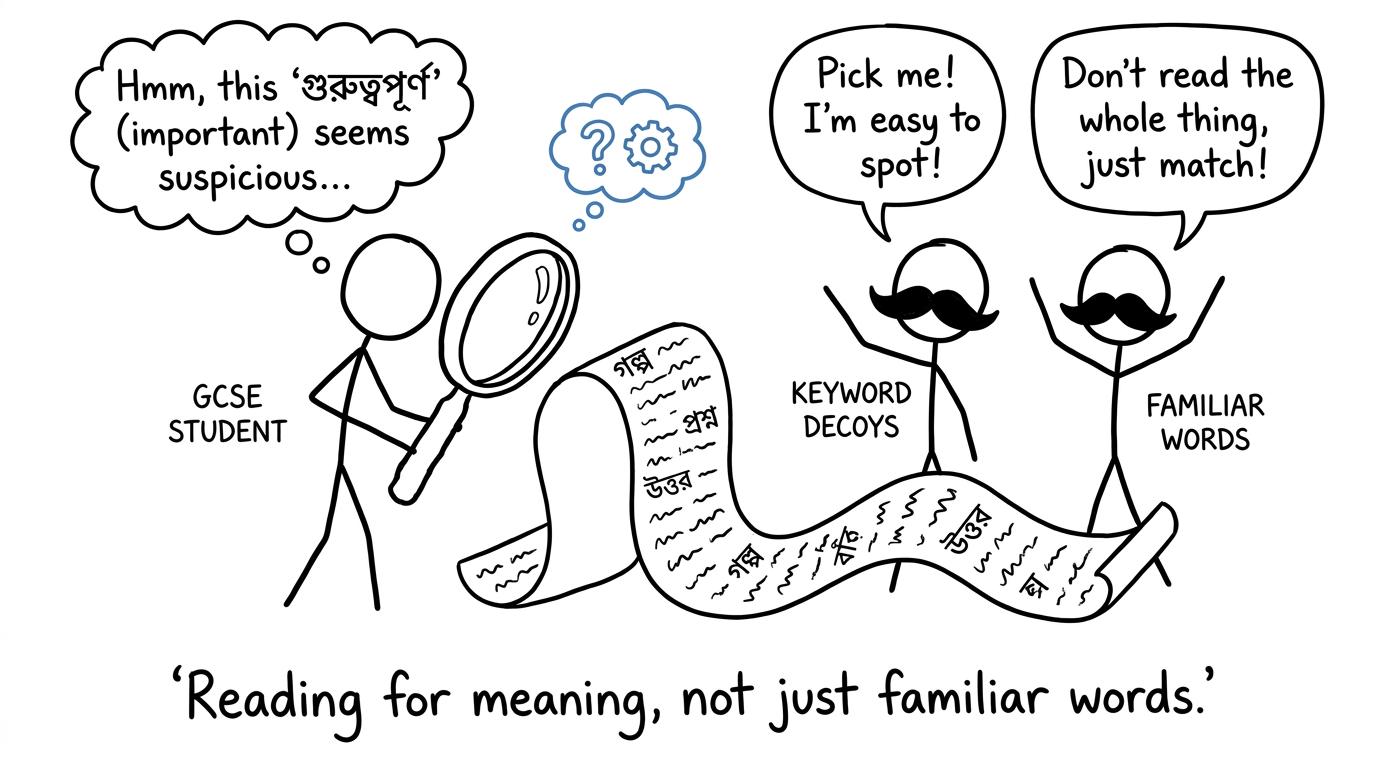 A student looking past keyword decoys to find the real meaning
A practical timing strategy
AQA sets the overall duration but does not require one fixed timing split. Your best plan should come from timed practice, because reading speed and confidence vary.
A sensible starting framework is:
| Stage | Foundation tier | Higher tier |
|---|---|---|
| Sections A and B | About 323232 to 343434 minutes | About 444444 to 474747 minutes |
| Section C | About 888 to 101010 minutes | About 111111 to 131313 minutes |
| Final check | About 222 to 333 minutes | About 222 to 333 minutes |
This is revision advice, not an AQA rule. Adjust it after completing genuine timed papers.
Use two passes. On the first, answer questions you can resolve confidently and mark anything that needs more thought. On the second, return to difficult inferences and uncertain vocabulary. This stops one stubborn sentence from consuming time that belongs to several accessible marks.
The same principle works in maths. MathsGenie’s guide to using past papers properly explains how timed practice becomes useful only when you diagnose and repair mistakes afterwards.
How to revise for the reading paper
Paper 3 preparation should train the exact decisions the exam demands.
Build vocabulary in context
Organise vocabulary around the specification’s themes, but learn words inside short sentences and contrasting pairs. Include connectives, negatives, opinion phrases and time markers. These modest words often control the meaning more strongly than the headline noun.
Practise inferring an unfamiliar word before checking it. Ask whether it appears to be a person, action, description or object, and whether the surrounding tone is positive or negative.
Use papers as evidence
Complete a section under timed, closed-book conditions. Mark it using the official mark scheme, then classify every lost mark:
- vocabulary gap;
- question misunderstood;
- relevant detail missed;
- answer language wrong;
- inference unsupported;
- translation meaning omitted;
- time pressure.
Your total mark tells you where you are. The categories tell you what to do next.
If you are also preparing for GCSE maths, the MathsGenie GCSE revision hub provides board-specific lessons, practice questions and papers. You can use the same attempt-mark-fix routine with AQA GCSE Maths past papers or Edexcel GCSE Maths past papers.
Revisit errors rather than rereading them
After marking, rewrite only the part that failed. Then cover the correction and attempt it again later without help. A mistake becomes useful when it changes your next response.
Use the free MathsGenie revision planner to protect short Bengali reading sessions alongside maths revision. For maths maintenance during a language-heavy week, GCSE mini tests provide compact practice without taking over your timetable.
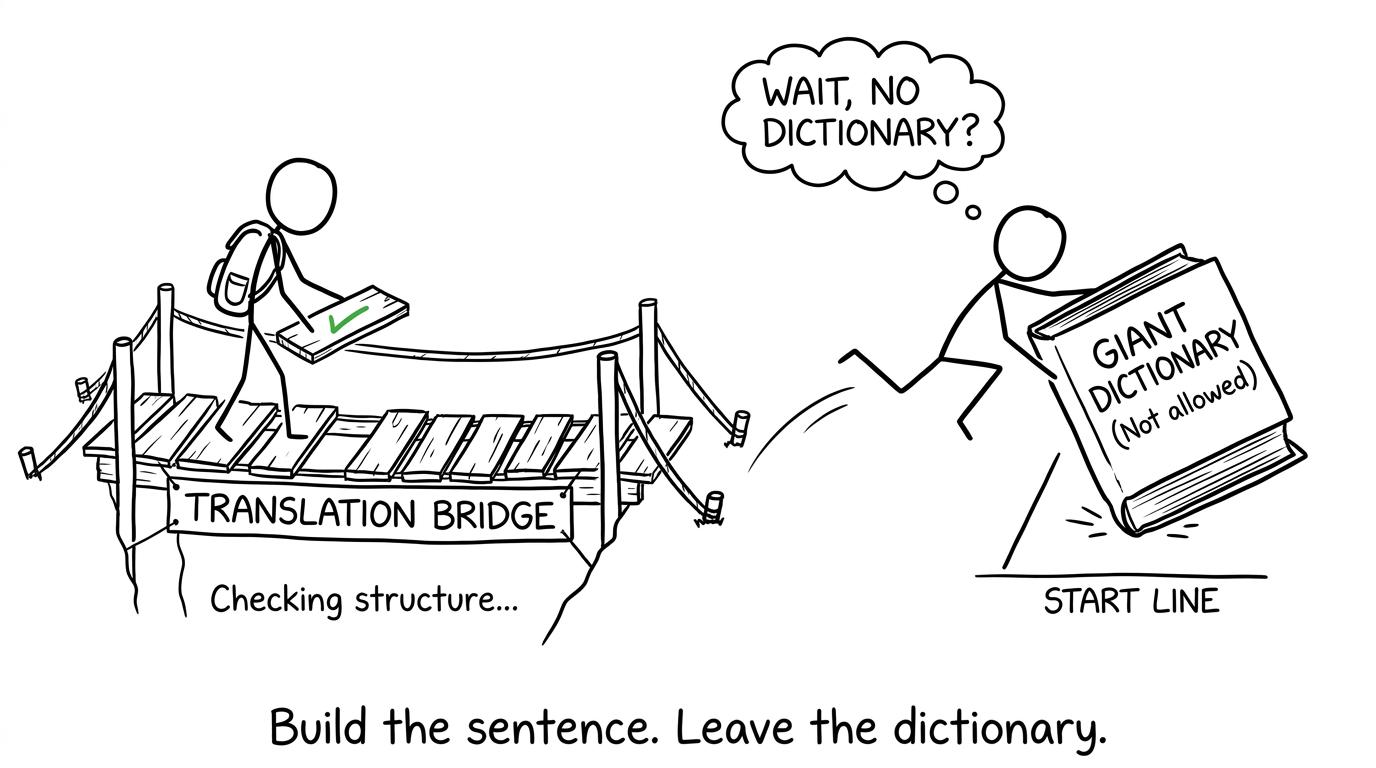 A careful translation bridge being built while the dictionary stays outside
Common mistakes in GCSE Bengali Paper 3
Answering in the wrong language. Section A requires English responses, while Section B requires Bengali responses unless the task is non-verbal. Check the instruction every time the section changes.
Matching one keyword and stopping. Examiners can place familiar vocabulary near a negative, contrast or different person. Read the complete sentence and enough surrounding text to establish meaning.
Ignoring the number of marks. A multi-mark question usually needs multiple distinct pieces of information. Count what you have supplied, not merely how many lines you have written.
Translating word by word. Bengali and English do not always organise meaning identically. Preserve the message, tense and relationships, then make the English natural enough to be clear.
Leaving Section C until there is no time. The translation is worth 999 marks. Establish a latest starting time during practice and follow it in the examination.
Using vague pronouns. If several people appear in a passage, an answer such as “he did not like it” may be unclear. Name the relevant person or idea where necessary.
Turning one unknown word into a crisis. Paper 3 deliberately includes some unfamiliar language. Use context and continue collecting the meaning you can establish.
Doing practice without reviewing it. Repeated papers can rehearse repeated errors. The stronger loop is attempt, mark, classify, repair and retest. Maths students can reinforce that habit with GCSE predicted papers, mark schemes and video solutions.
Go into Paper 3 knowing its shape
GCSE Bengali Paper 3 becomes less mysterious once its structure is fixed in your mind: English responses in Section A, Bengali responses in Section B and translation into English in Section C. The real challenge is not reading every word perfectly. It is identifying exactly what each question requires and transferring the relevant meaning without distortion.
Practise the right tier, without a dictionary and under the correct time limit. Mark carefully. Keep a short error log. Then revisit the weakness rather than simply sitting another paper.
And when Bengali shares your week with maths, let MathsGenie keep the other half of your revision organised. Start with the free GCSE Maths revision area, use revision lessons and practice questions to repair weak topics, then build confidence through mini tests, past papers, predicted papers, mark schemes and video solutions. Calm preparation is rarely dramatic. It is simply a collection of small decisions made before the clock starts.










