

GCSE Bengali Paper 1: What to Actually Expect
GCSE Bengali Paper 1 explained: timings, tiers, listening question types, common mistakes and a practical revision plan for confident preparation.
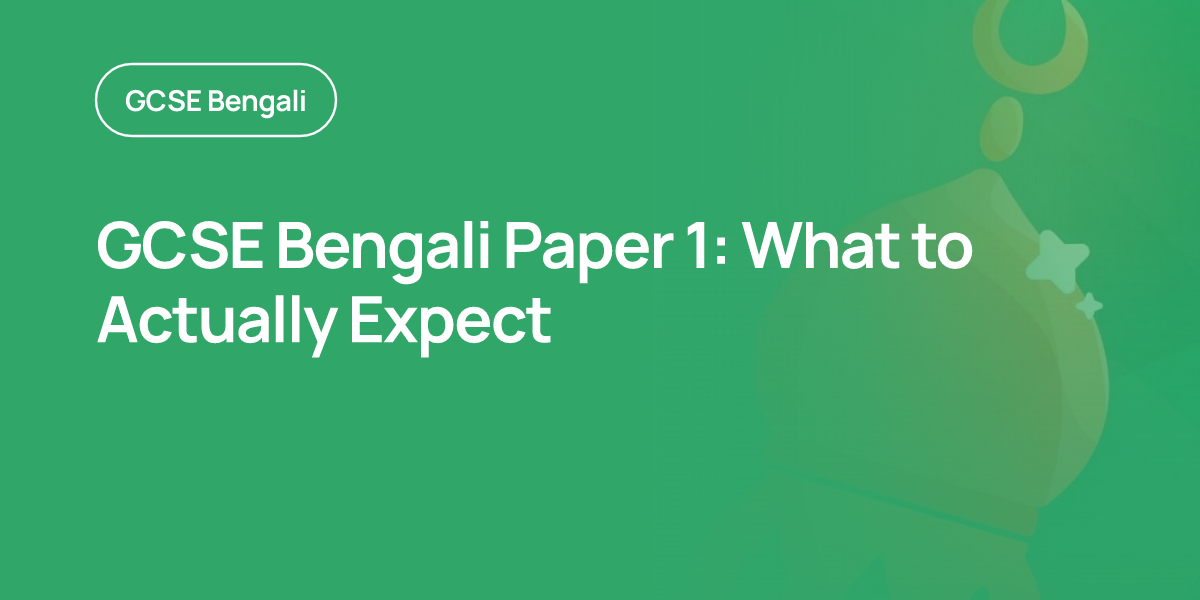
The unsettling thing about a listening exam is that the words disappear. On a reading paper, a difficult sentence waits for you. In GCSE Bengali Paper 1, the recording moves on whether you understood it or not.
Here is the useful answer first: for AQA GCSE Bengali (specification 8638), Paper 1 is the listening examination. It lasts approximately 353535 minutes at Foundation tier or 454545 minutes at Higher tier, including 555 minutes of reading time. Every item is played twice, pauses are built into the recording, and the paper tests whether you can identify information, opinions and meaning in spoken Bengali.
It is not a writing essay, speaking assessment or translation paper. It rewards careful listening, efficient notes and precise answers.
GCSE Bengali Paper 1 at a glance
Use this checklist before you begin revising:
- Exam board covered here: AQA GCSE Bengali, specification 8638.
- Skill assessed: listening and responding to spoken Bengali.
- Weighting: 25%25\%25% of the qualification.
- Foundation tier: 404040 marks in approximately 353535 minutes, including reading time.
- Higher tier: 505050 marks in approximately 454545 minutes, including reading time.
- Reading time: 555 minutes at the beginning.
- Recordings: clearly articulated standard speech at near-normal speed.
- Repetition: each item is heard twice.
- Sections: Section A uses questions and answers in English or non-verbal responses; Section B uses Bengali or non-verbal responses.
- Dictionary: not permitted.
- Notes: you may make notes during the test.
AQA Bengali is linear, so all four papers are taken in the same exam series. Foundation covers grades 111 to 555, while Higher covers grades 444 to 999. You must take listening, speaking, reading and writing at the same tier.
Check the front of your own past paper or ask your teacher to confirm your specification. Pearson Edexcel International GCSE Bangla is a different qualification with a different Paper 1 format, so its materials should not be used as a substitute for AQA 8638 practice.
What is actually different about Paper 1?
Paper numbers can create false familiarity. In GCSE maths, Paper 1 often signals a non-calculator examination. In AQA GCSE Bengali, Paper 1 means listening. The challenge is not completing a calculation without a calculator; it is processing language while the clock and recording control the pace.
That difference changes how you should prepare.
You cannot revise effectively by memorising vocabulary lists alone. Vocabulary matters, but Paper 1 also demands that you distinguish speakers, follow changes of opinion, recognise time references and select only the detail requested.
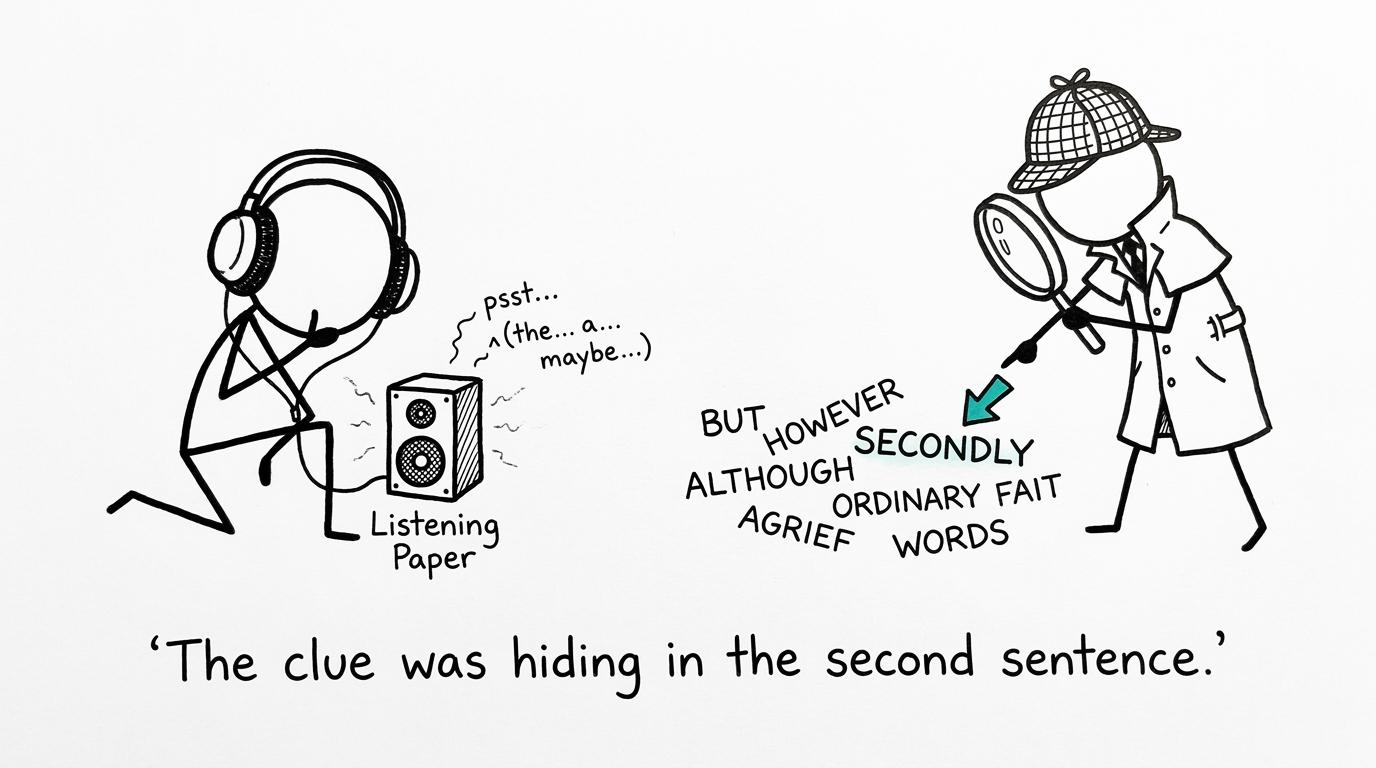 A student detective searches for the clue in a listening paper
The recording controls the timing
The opening 555 minutes are silent reading time within the examination. Use them to inspect the questions, possible answers and mark allocations. The audio then runs with pre-recorded pauses and should not be stopped by the centre.
This is different from practising at home, where it is tempting to pause after every sentence. Constant pausing can improve vocabulary knowledge, but it does not prepare you for the rhythm of the real assessment.
Complete some untimed learning first, then move towards full recordings played without interruption. The principle is the same one described in MathsGenie's guide to starting GCSE past papers at the right time: practise in manageable pieces before expecting yourself to perform confidently under complete exam conditions.
Paper 1 favours retrieval, inference and discrimination
Many questions require you to retrieve a stated fact, such as a destination, activity, reason or future plan. Others are less direct. You may need to recognise whether a speaker is positive or negative, connect a reason to the correct person, or distinguish what used to happen from what happens now.
The strongest listeners do not try to translate every word. They listen selectively. AQA's published communication guidance explicitly supports using context, recognising familiar language patterns and ignoring words that are not needed for the task.
That is an important shift. Missing one unfamiliar word does not mean you have missed the answer.
The two sections require different response languages
In Section A, the questions are in English and answers are given in English or through a non-verbal response such as selecting an option. At Foundation tier, this section carries 323232 marks; at Higher tier, it carries 404040 marks.
Section B tests comprehension through Bengali questions. Responses are in Bengali or non-verbal. It carries 888 marks at Foundation and 101010 marks at Higher.
The listening skill remains central in both sections, but Section B adds a reading demand: you must understand what the Bengali question is asking before the audio begins. That makes the initial reading time particularly valuable.
What topics can appear?
Paper 1 can draw on all three AQA specification themes:
- identity and culture;
- local, national, international and global areas of interest;
- current and future study and employment.
These include family and relationships, technology, free time, customs and festivals, home and neighbourhood, healthy living, environmental issues, travel, school, post-16 education and careers.
Do not treat this list as a prediction of the next paper. Its value is organisational. Group vocabulary by theme, but also group it by purpose: opinions, reasons, comparisons, past events, future plans, frequency and quantity. Those language functions help you understand unfamiliar contexts.
How to use the five-minute reading time
Reading time can feel too quiet. That is exactly why it matters: it is your only opportunity to prepare the shape of your attention before the recording begins.
Read for the required detail
Underline or mentally identify what each question wants. Is it asking for a person, place, reason, activity, advantage or opinion? If two details are required, make that visible so that you do not stop after hearing one.
Look at the answer space and mark allocation. These often indicate how much information is expected, although you should always follow the exact instruction.
Predict categories, not exact answers
If a question asks where somebody is going, expect a place. If it asks why, listen for a reason. If it asks for an attitude, prepare to distinguish approval, disappointment, preference or uncertainty.
Prediction is not guessing what the recording will say. It is deciding what kind of information deserves your attention.
Prepare for Section B
Use part of the reading time to make sure you understand the Bengali wording in Section B. Identify the key question words and any instruction about how many details to give. Waiting until the recording reaches that section may leave you processing the question and audio simultaneously.
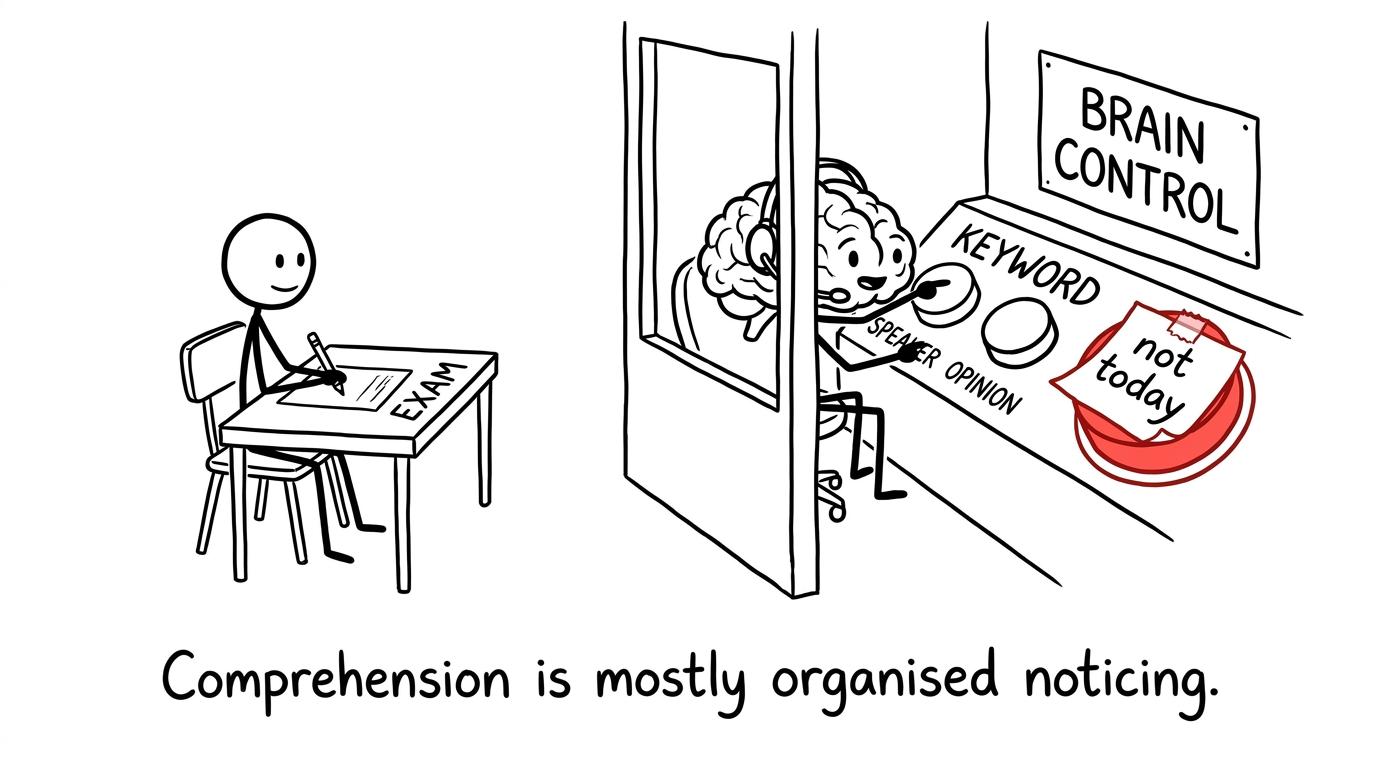 A brain organises keywords while keeping the panic button covered
A better way to use the two listenings
The two playings are not identical opportunities. Give each one a different job.
On the first listening, establish the overall meaning and record the clearest answer. Track who is speaking and notice whether the speaker changes direction through words equivalent to “but”, “however” or “although”.
On the second listening, verify the exact detail. Check negatives, numbers, time references, reasons and contrasts. If your first answer was based on a single familiar word, test whether the surrounding sentence supports it.
Keep notes brief. A note is a temporary memory aid, not the final response. Long notes can cause you to miss the next sentence.
How Foundation and Higher differ
Both tiers use multiple-response and short open-response questions, include the same reading period and play each item twice. Some items are common to both tiers.
Higher tier is longer and carries more raw marks. Its listening demands may involve more extended language, a wider range of vocabulary and less immediately obvious meaning. Students should be ready to follow connected ideas rather than waiting for an isolated keyword.
Foundation is not simply “easy listening”. Accuracy still matters. Familiar topics can contain distractors, negatives and changes of opinion. Your tier should therefore shape the material you practise, but not the seriousness with which you review mistakes.
A practical revision routine
The best preparation is repetitive in a useful way. Listen, answer, mark, diagnose and repeat.
Begin with a short extract. Read the questions under a timer, play the audio twice without pausing, then mark your responses. Classify each error:
- unknown vocabulary;
- recognised word but misunderstood meaning;
- missed negative or contrast;
- confused speakers;
- answered in the wrong language;
- gave too little or irrelevant information;
- lost concentration under timing.
This turns “I am bad at listening” into a specific problem you can address.
A weekly plan might include two short vocabulary-and-audio sessions, one timed section and one correction session. Add these commitments to the free MathsGenie revision planner, especially if Bengali preparation must fit around maths and other GCSE subjects.
The rhythm used in MathsGenie's one-month GCSE revision plan transfers well: diagnose first, practise actively, use feedback and revisit errors after a gap. For shorter sessions, the GCSE revision guide for reluctant revisers explains how a small repeatable routine can be more useful than an ambitious plan you abandon.
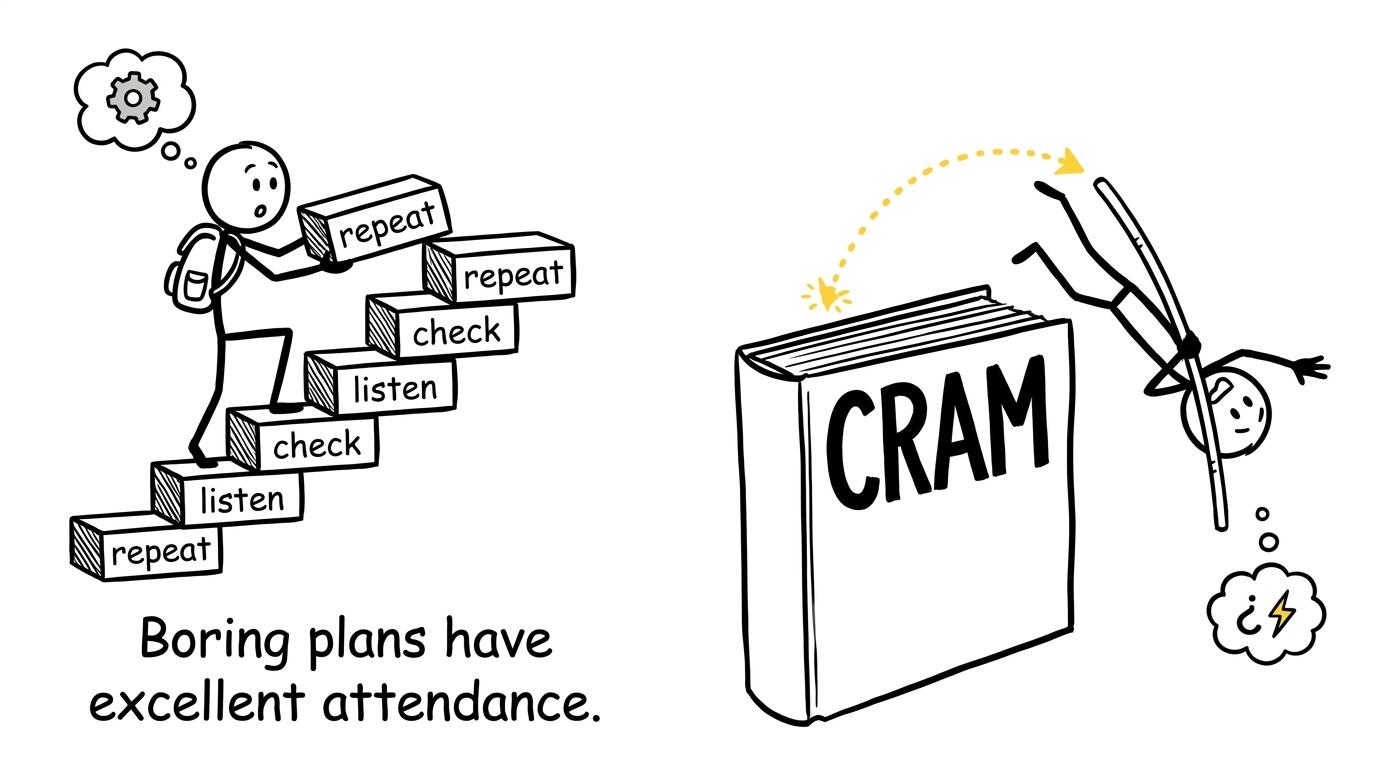 One student builds a calm revision staircase while another attempts to vault over cramming
Common mistakes on GCSE Bengali Paper 1
Trying to translate everything
Word-by-word translation overloads attention. Read the question first and listen for the information needed to answer it.
Choosing an answer after one keyword
Recordings may mention several activities, people or places. A familiar word is evidence, not automatically the answer. Use the second listening to confirm its context.
Missing negatives and changes of mind
A speaker may introduce one idea and then reject it. The final opinion or decision is often what matters, so keep listening after the first plausible detail.
Writing too much
Extra material wastes time and may make an otherwise clear answer ambiguous. Give the requested detail precisely, in the response language required by the section.
Treating the second playing as a rescue attempt
Do not leave every question blank until the repeat. Record your best answer on the first playing, then use the second to check and refine it.
Revising with the wrong qualification
AQA GCSE Bengali and Edexcel International GCSE Bangla do not share the same Paper 1 structure. Confirm your board, specification and tier before downloading resources.
Completing papers without reviewing them
A total mark cannot tell you whether vocabulary, concentration or question interpretation caused the loss. MathsGenie's advice on using mark schemes properly offers a transferable approach: classify errors, rewrite weak responses and retest them rather than merely recording a score.
What to do on the day
Arrive knowing that the pauses and two playings are built into the recording. During reading time, identify the information each question needs and inspect Section B carefully. When the audio starts, keep moving with it. If one item goes badly, make a brief note and reset for the next.
Use any remaining time after the recording to check unanswered items, response language and questions requiring more than one detail. The night before, avoid turning tiredness into a revision strategy. The calm checklist in MathsGenie's GCSE night-before plan is designed for maths, but its central lesson applies here too: choose a small amount of focused practice, prepare what you need and stop at a sensible time.
Make the paper familiar before it matters
GCSE Bengali Paper 1 becomes less mysterious once you understand its machinery: 555 minutes to read, two playings of each item, English responses in Section A, Bengali responses in Section B, and a premium on relevant detail rather than complete translation.
Prepare for that machinery, not just the vocabulary list.
Then keep the rest of your exam preparation equally structured. Use MathsGenie's free GCSE maths revision hub for board-specific revision lessons, practice questions, mini tests, past papers, mark schemes and video solutions. Nearer the maths exams, add fresh Edexcel GCSE predicted papers where relevant to your board.
Start with one timed listening section for Bengali and one diagnosed weak topic for maths. Mark both honestly. Fix one mistake from each. Confidence usually arrives after the routine, not before it.










