GCSE Bengali Group Chat Study Tips That Work
GCSE Bengali group chat study tips that turn messages into focused maths revision through clear rules, short challenges, marking and retesting at exam time.

A class group chat can become strangely busy when nobody wants to revise. One person posts an exam meme, another asks what topics are coming up, and ten minutes later everyone is discussing lunch. Effective gcse bengali group chat study needs a different rhythm: agree a short revision slot, choose one maths topic, attempt questions independently, compare methods, mark the work and schedule a retest.
That is the short answer. The chat should not replace individual practice. It should make individual practice easier to start, harder to avoid and more useful to review.
Whether your chat is called “GCSE Bengali”, includes Bengali-speaking classmates or simply grew from a Bengali friendship group, the same principle applies. You can explain an idea in the language that helps it make sense, while still practising the English command words and notation used in your maths paper.
The quick group chat revision checklist
Before the next session, agree these rules:
- Choose one specific topic rather than “all of algebra”.
- Set a start time and a clear finishing time.
- Ask everyone to attempt questions before requesting answers.
- Share hints and methods, not unexplained final answers.
- Check work against a mark scheme or trusted solution.
- Record mistakes in a shared topic list without naming or embarrassing anyone.
- Retest the same skill on another day.
- Keep memes for the break or the end of the session.
- Never request, buy or circulate secure exam material.
Start by choosing the correct exam board and tier from the GCSE Maths revision hub. Edexcel, AQA, OCR and Eduqas specifications overlap substantially, but paper structures and wording can differ. Foundation and higher tier groups also need appropriately demanding questions.
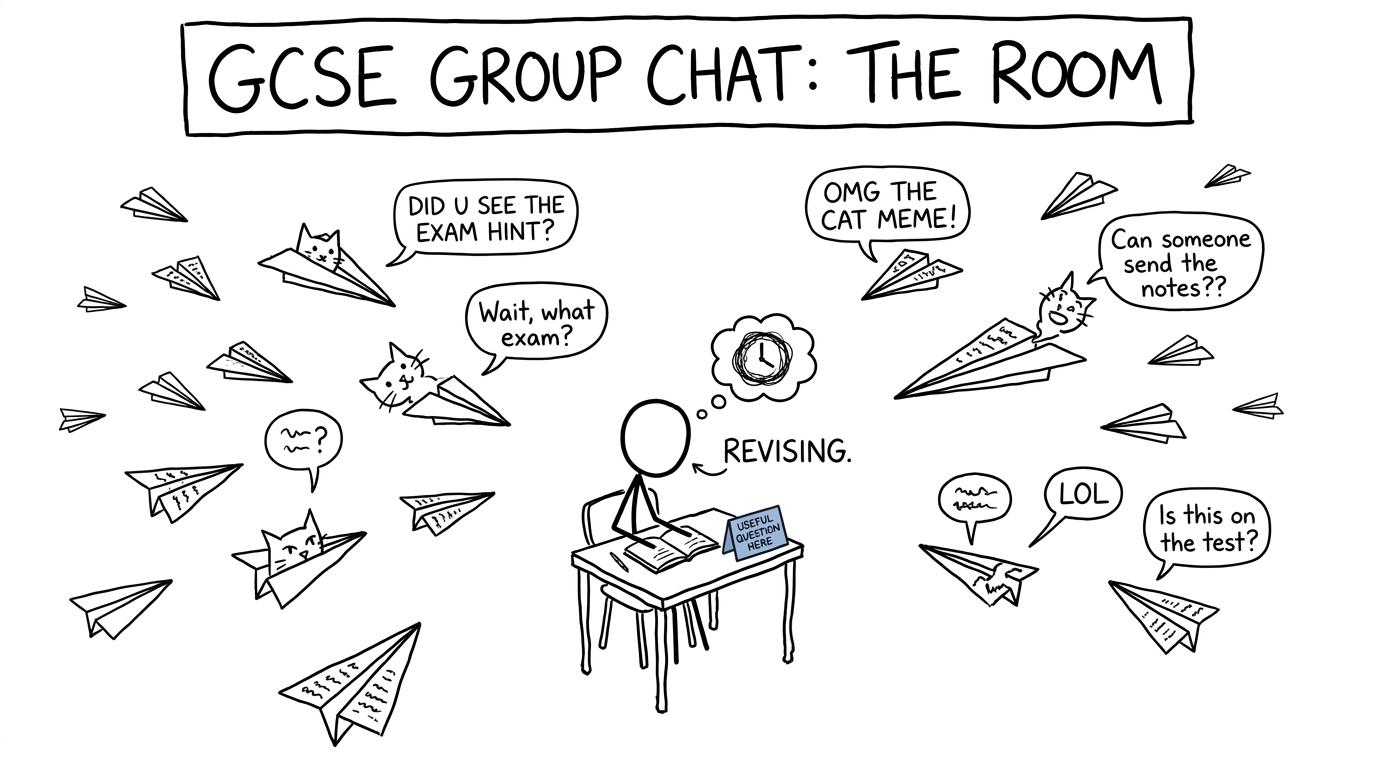 A student searches for a useful revision question in a storm of group chat memes
Give the chat one job at a time
Most unproductive chats do not fail because students are lazy. They fail because the instruction is vague. “Let’s revise maths tonight” leaves everyone with too many decisions: which topic, which resource, how long and what counts as finished?
A useful chat message removes those decisions. It names the topic, resource, duration and expected response. For example, the organiser might ask everyone to complete the same mini test independently, then post only the question numbers they found difficult.
For short, shared tasks, Edexcel GCSE Maths mini tests provide a natural structure. Students from other boards can use the relevant resources in the main GCSE hub. The important part is that everyone opens the task before the conversation drifts elsewhere.
Assigning light roles can also help:
- Host: chooses the task and starts the timer.
- Checker: opens the mark scheme after attempts are complete.
- Explainer: summarises one difficult method clearly.
- Recorder: adds weak topics to the group’s revision list.
Rotate the roles. The strongest student should not become an unpaid answer service, and the quietest student should not disappear behind reaction emojis.
Build each session around attempt, discuss and retest
A group chat feels productive when messages are arriving quickly. But activity is not the same as learning. Reading somebody else’s method can create familiarity without proving that you could reproduce it alone in an exam.
Use this sequence instead.
Attempt independently
Everyone works without chat hints for a short, agreed period. Phones can remain on silent until the attempt is complete. If a student is stuck, they should still write down what they know: the topic, a relevant rule, a diagram or the first possible step.
The twenty-minute GCSE maths revision routine is useful when the group needs a manageable format rather than a heroic evening session.
Discuss the obstacle
Ask precise questions such as:
- Which line stopped making sense?
- Is the problem choosing a method or carrying it out?
- Which command word matters here?
- Did the error come from algebra, arithmetic, units or rounding?
A good reply gives the smallest helpful hint first. It might identify the topic or suggest what to inspect, but it should leave the original student with some thinking to do.
Mark from an authoritative source
Popularity does not make an answer correct. Once everyone has attempted the task, use the official mark scheme or the MathsGenie solution rather than voting on which chat answer looks convincing.
The guide to using GCSE past papers properly explains how to move from a total mark to a useful error log. Method marks matter, so do not check only the final answer.
Retest later
Recent evidence reviews suggest that spacing practice across separate sessions can improve mathematics learning compared with concentrating the same practice into one sitting. Retrieval can also be helpful, although evidence for complex mathematical tasks is more nuanced than it is for simple factual recall.
The practical lesson is modest: revisit the topic and complete a different question without scrolling back to the explanation. The retest reveals whether the method became usable knowledge or remained a message you briefly understood.
Use Bengali to clarify, not to avoid exam language
For bilingual students, moving between Bengali and English can be genuinely useful. A classmate may explain an unfamiliar idea more clearly in Bengali, particularly when the barrier is the wording rather than the mathematics.
However, your final revision stage should match the language and presentation of the paper you will sit. Practise recognising command words such as “estimate”, “show that”, “prove”, “hence” and “give a reason”. Keep standard mathematical notation unchanged and learn the English names of important methods and shapes.
One practical approach is to allow explanations in either language but require the final summary to use exam-ready terminology. This protects the advantage of bilingual discussion while preparing everyone to interpret questions independently.
The chat should also remain welcoming. Avoid mocking spelling, accents, confidence or different levels of Bengali. The purpose is shared revision, not a test of who sounds most fluent.
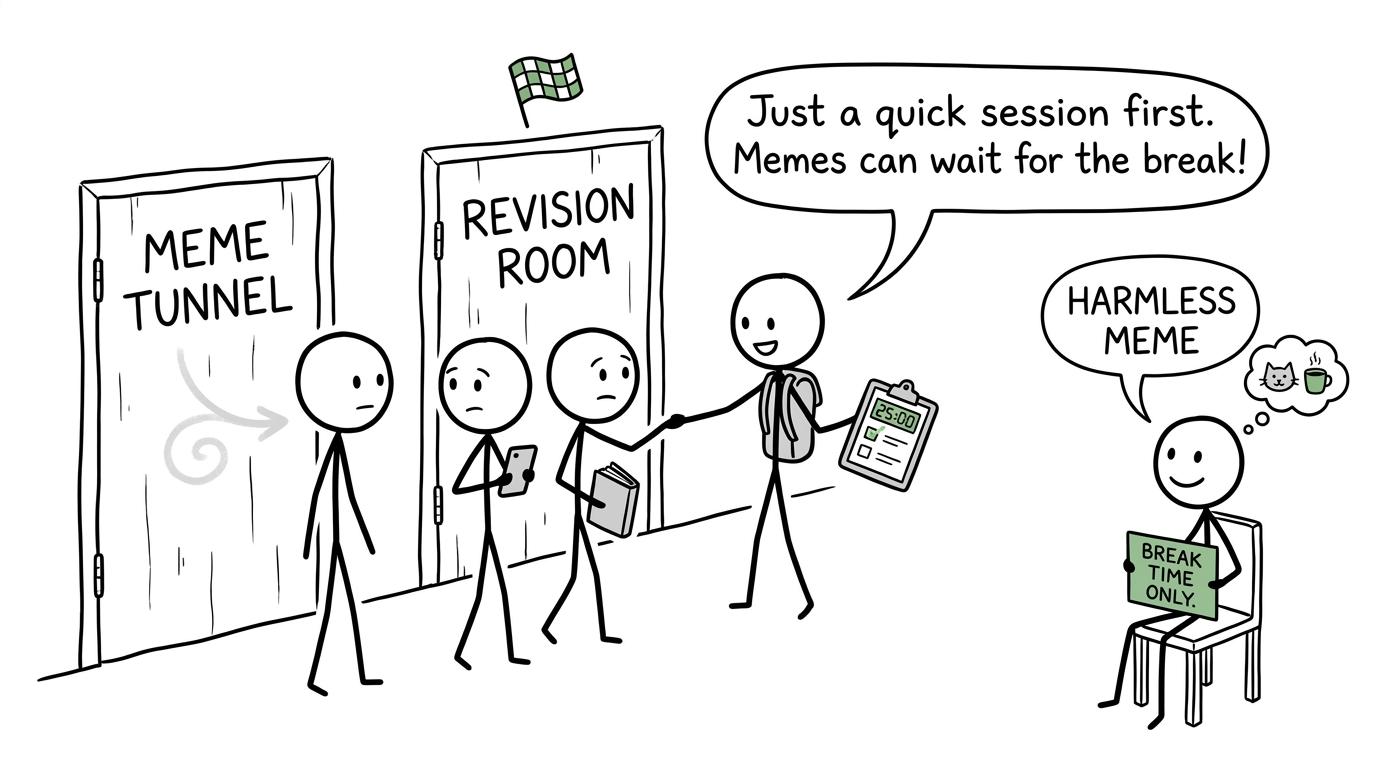 Students redirect their group chat from a meme tunnel into a revision room
Turn messages into a weekly maths plan
A good group chat should produce evidence outside the chat. At the end of each session, record three things:
- the topic practised;
- the mistake pattern discovered;
- the date or session when it will be tested again.
Keep the list short. If the group identifies fifteen weak topics in one evening, choose the two or three causing the most repeated lost marks. MathsGenie’s guide to finding your weakest GCSE topics shows how to diagnose gaps from papers and mini tests rather than relying on feelings.
Fit group sessions around a personal plan. The GCSE maths revision timetable guide can help students balance topic lessons, practice questions and timed papers. Nobody should wait for the chat before revising; the group is a checkpoint, not the engine of the entire timetable.
A balanced week might include:
- one group topic session;
- one individual retest of that topic;
- one timed mini test or paper section;
- one review of errors and mark schemes.
This is deliberately ordinary. Improvement usually comes from a repeatable process rather than a dramatic late-night session.
Use past and predicted papers responsibly
Past papers are valuable because they reveal how topics are assessed under exam conditions. They should usually be attempted individually and timed before the group discusses difficult questions. If everyone collaborates during the first attempt, the resulting mark tells you very little about individual readiness.
Students taking AQA can use the AQA GCSE Maths revision collection, which brings together foundation and higher tier lessons, questions and papers. Edexcel students approaching exam season can add Edexcel GCSE Maths predicted papers after building their topic knowledge.
Predicted papers are practice resources, not leaked papers and not promises about what will appear. Treat them as fresh material for timing and diagnosis. Official past papers should remain central because they show the established assessment style.
Current JCQ social media guidance is especially important in any class chat. Do not buy, ask for or share secure exam or assessment content, and do not circulate rumours about what is supposedly in an exam. If unexpected exam content appears in the chat, do not forward it. Tell a teacher or another appropriate member of school staff immediately. When uncertain, ask your school before posting.
Keep the chat calm enough to be useful
Notifications can make a twenty-minute task feel like an evening-long commitment. Protect attention by creating boundaries:
- Use one revision thread or agreed message label.
- Mute unrelated conversation during the session.
- Post resources before the start time.
- Finish when the timer ends.
- Move social conversation to a separate period.
- Let students opt out of late-night notifications.
Memes do not need to be banned. A group chat is social because it contains friends, not revision robots. The better rule is sequencing: useful work first, jokes afterwards. That turns humour into a break rather than an escape route.
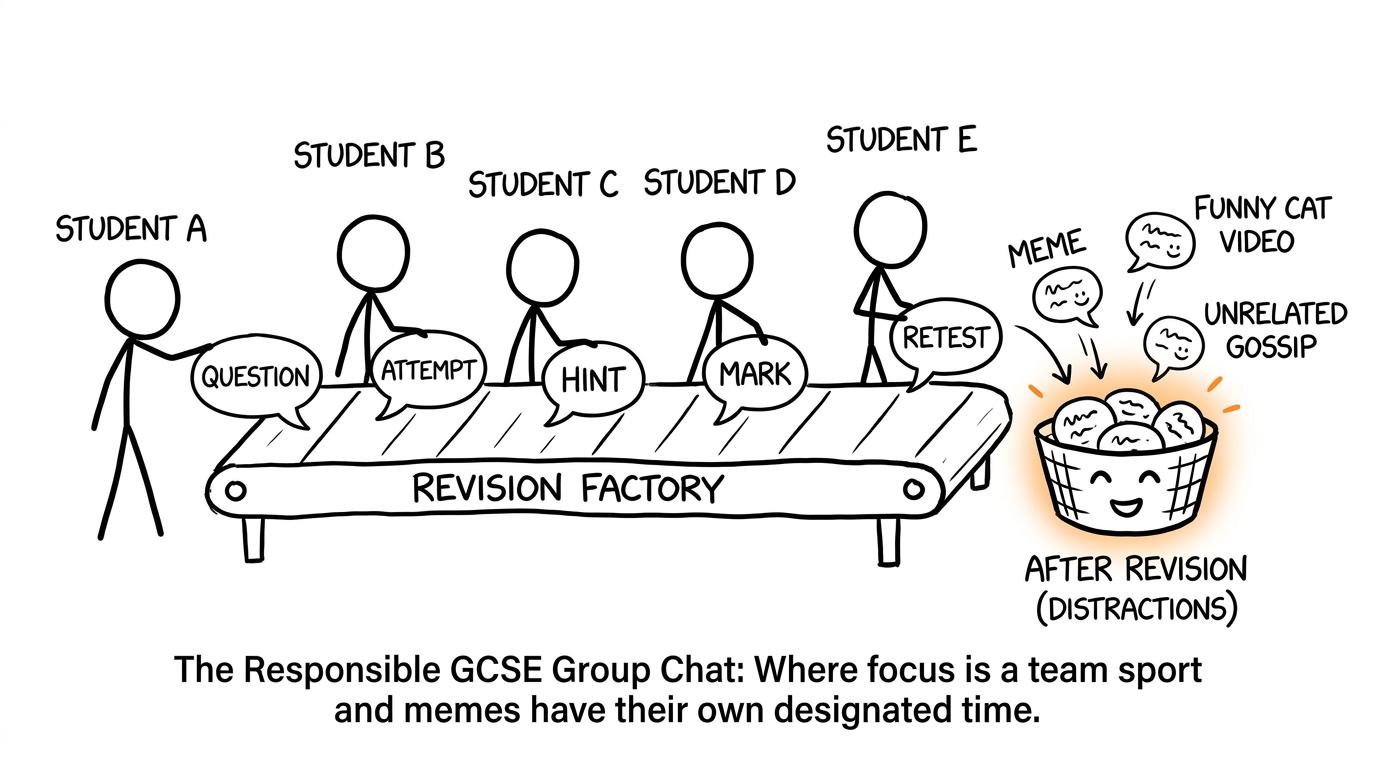 A group chat revision factory moves from question to attempt, hint, mark and retest
Common group chat revision mistakes
Posting answers before others have attempted
This removes the thinking that makes practice worthwhile. Ask for a thumbs-up when attempts are complete, then open discussion.
Revising topics because they are popular
A long conversation about quadratics is not useful to someone repeatedly losing marks on fractions. Choose topics from mini-test and past-paper evidence.
Trusting confident explanations
A polished message can still contain an error. Verify methods with mark schemes, revision lessons or video solutions.
Turning the chat into comparison
Scores can help diagnose progress, but public rankings often distract from the actual mistakes. Share strategies and weak topics rather than creating a league table.
Mixing boards and tiers carelessly
Check whether a resource matches Edexcel, AQA, OCR or Eduqas and whether it is foundation or higher tier. Some skills overlap, but your timed paper practice should reflect the examination you will take.
Never returning to the topic
An explanation that makes sense tonight may be gone next week. Schedule an independent retest while the mistake is still visible.
Make the next message useful
The most valuable group chat message is rarely the longest. It is the one that turns uncertainty into a clear next action: open this topic, attempt these questions, mark them honestly and return to the mistake later.
Choose one weak area today from the MathsGenie GCSE Maths revision hub. Use a free revision lesson to rebuild the method, practise with exam questions or a mini test, and check your work with mark schemes and video solutions. As the exams approach, add past papers and predicted papers under timed conditions.
Then take one useful link back to the chat. Not twenty resources. Not a rumour about the exam. One task everyone can start, and one plan to prove later that it helped.