GCSE Bengali Grade 5 Meaning: A Clear Guide
GCSE Bengali grade 5 meaning explained: understand the ability it represents, its old letter-grade comparison and what your result means for next steps.
Opening a results slip can turn a familiar number into a surprisingly difficult question. Is a grade 555 good? Is it a pass? Does it mean the same as an old grade B or C? And what does it say about your actual Bengali?
The GCSE Bengali grade 5 meaning is straightforward at its core: it is a recognised Level 2 GCSE grade, above the grade 444 threshold commonly described as a standard pass. It indicates a sound performance across the language skills assessed, but it is not an exact measure of fluency. Compared with the old letter system, grade 555 sits broadly between grades B and C, often described informally as a high C or low B.
That is the short answer. The more useful answer is about what the grade represents, what it does not prove and how to use it when planning your next step.
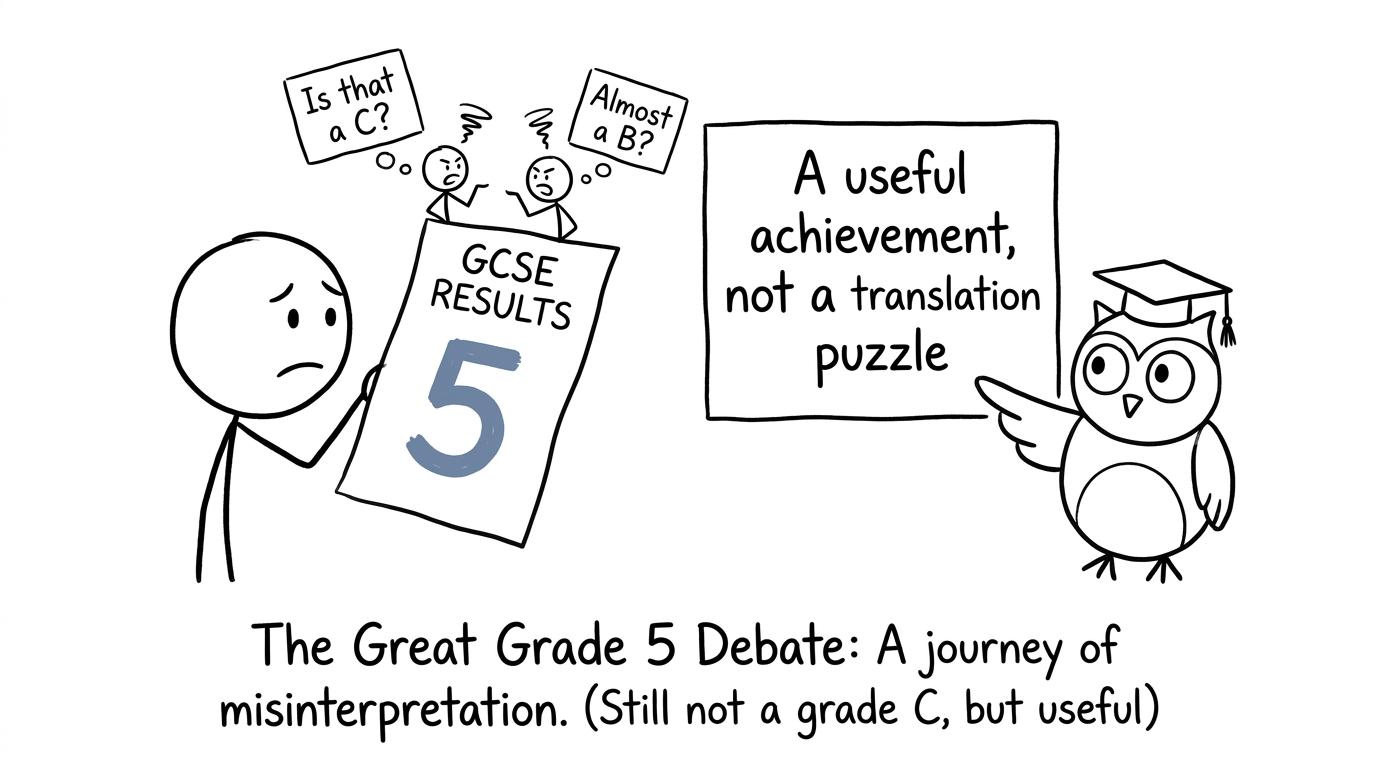 A student tries to translate a numbered GCSE grade into the old letter system
Grade 5 in GCSE Bengali at a glance
A grade 555 normally means that you have:
- achieved a numbered GCSE grade above the grade 444 standard-pass threshold;
- earned a Level 2 result;
- demonstrated competent performance across listening, speaking, reading and writing;
- shown that you can understand and communicate Bengali in familiar contexts, with some success when the language becomes less predictable;
- achieved a result broadly between the former grades B and C;
- met a meaningful academic standard, although individual sixth forms, colleges and employers can set their own entry requirements.
It does not automatically mean that you are fluent, that every skill is equally strong or that you received a fixed percentage of the available marks.
What does a grade 5 actually represent?
The current GCSE scale in England runs from grade 999, the highest grade, to grade 111. A result of U means ungraded. The numbered system replaced the former A* to G scale, but the two scales do not match grade by grade.
Grade 555 is one grade above grade 444. Government guidance identifies grade 444 as the standard-pass benchmark across GCSE subjects. The phrase “strong pass” has historically been used particularly within school performance measures for English and maths, so it should not be treated as a separate qualification category for Bengali.
For a Bengali student, the most accurate interpretation is this: grade 555 is a solid Level 2 result showing that your overall assessed performance was securely above the grade 444 boundary in that exam series.
A grade is an overall judgement, not a personality label. It records how successfully you met the assessment requirements on particular papers under particular conditions. It cannot capture every conversation you can hold, every cultural reference you understand or every reason you chose the subject.
What ability does grade 5 suggest in Bengali?
Pearson Edexcel's GCSE Bengali qualification assesses four broad language skills:
- listening and understanding;
- speaking;
- reading and understanding;
- writing.
Each component contributes 25%25\%25% of the qualification. Students must therefore do more than memorise vocabulary or speak confidently at home. They need to respond to the formats, timings and assessment objectives of a formal GCSE examination.
At around grade 555, a student would generally be expected to show a reasonably developed ability to understand and communicate information, ideas and opinions. In practical terms, this may include:
- following the main message and relevant details in spoken Bengali;
- understanding written passages on familiar themes;
- expressing opinions and supporting them with reasons;
- using more than isolated words or basic sentences;
- communicating across different time frames where a task requires it;
- translating meaning with reasonable accuracy;
- coping with some unfamiliar vocabulary by using context;
- producing responses that remain understandable despite errors.
These are broad indications rather than a second mark scheme. Ofqual's GCSE grade descriptors describe likely performance around selected grades, but they are not used to award an individual result. Your final grade comes from your marks and the grade boundaries set for that examination series.
Does grade 5 mean conversational fluency?
Not necessarily. GCSE Bengali tests curriculum-based performance, while fluency is a broader and less sharply defined idea.
One student may speak Bengali naturally with relatives but find formal reading and writing difficult. Another may write accurately and understand examination recordings but feel less spontaneous in conversation. Both could receive the same overall grade because different strengths can contribute to the final total.
A GCSE grade should therefore be read as evidence of assessed language ability, not as a universal fluency certificate. There is also no simple official conversion from grade 555 to a particular CEFR language level.
 A student balances the four language skills during revision
How grade 5 compares with the old letter grades
The safest comparison begins with the official alignment points:
- the lower boundary of grade 777 aligns with the lower boundary of the former grade A;
- the lower boundary of grade 444 aligns with the lower boundary of the former grade C;
- the lower boundary of grade 111 aligns with the lower boundary of the former grade G.
Grade 555 sits between the grade 444 and grade 777 reference points. It is therefore commonly described as being broadly equivalent to a high C or low B.
The word broadly matters. The old and new systems were designed differently. There is no official one-to-one rule saying that every grade 555 is precisely a B or precisely a C. If an application asks for your result, write the grade actually awarded rather than converting it yourself.
A useful summary is:
- grade 444 begins at the comparable old grade C threshold;
- grade 555 represents stronger performance within the former B-to-C region;
- grade 666 is generally associated with a stronger old grade B standard;
- grade 777 begins at the comparable old grade A threshold.
Why a grade 5 is not a fixed percentage
It is tempting to ask whether grade 555 means achieving 50%50\%50%, 60%60\%60% or another fixed proportion. GCSE grades do not work that way.
Exam boards set grade boundaries after the papers have been taken and marked. Boundaries can move between exam series because papers vary slightly in difficulty. The aim is to maintain a comparable standard rather than demand the same raw mark every year.
GCSE Bengali also combines marks from four equally weighted components. Your overall result reflects the combined outcome, so a stronger performance in one skill may partly offset a weaker performance elsewhere. The relevant boundary is the published boundary for your qualification, tier and examination series.
For that reason, an unofficial online boundary from another year is only a rough revision reference. It cannot predict a future result with certainty.
Foundation and higher tier matter
Pearson Edexcel GCSE Bengali uses foundation and higher tiers. Students take the same tier across the assessed components.
Foundation tier targets grades 111 to 555, making grade 555 the highest available foundation result. Higher tier targets grades 444 to 999, with a limited grade 333 safety outcome available in specified circumstances when the grade 444 standard is narrowly missed.
This creates two different contexts for the same grade:
- on foundation tier, grade 555 is the top available grade;
- on higher tier, grade 555 is within the lower part of the available higher-tier range, but it remains the same awarded GCSE grade.
A foundation grade 555 is not worth less than a higher grade 555. The certificate records the grade, not a discounted version of it. Tier choice affects which grades are available and the demand of the questions, not the value of an identical final grade.
Is grade 5 good enough for sixth form or college?
Grade 555 is a respectable GCSE result, but “good enough” depends on the course and institution.
A sixth form might accept grade 555 as part of its general entry profile while requiring grade 666 or above for a particular A Level. Another college may consider a wider combination of grades. Bengali can also contribute to a student's overall GCSE profile even when it is unrelated to the subject they want to take next.
Check the published entry requirements of the institution and course you are considering. Do not assume that a requirement applying to GCSE English language or maths automatically applies to Bengali.
For students primarily preparing for maths exams, the result can sit alongside progress made through free GCSE Maths revision. Maths entry requirements deserve separate attention because post-161616 rules and course expectations often refer specifically to GCSE maths.
What students can learn from this result
A grade is most useful when it becomes information rather than judgement. The question is not only “What did I get?” but “Where did the marks go?”
If you can access component marks, compare your performance across listening, speaking, reading and writing. Then decide whether the next step is to celebrate the qualification, request your script through your school, discuss a review of marking or continue developing Bengali beyond GCSE.
The same diagnostic habit improves maths revision. Instead of repeatedly completing random questions, identify the specific skills losing marks. MathsGenie's GCSE Maths revision hub organises lessons and questions by topic, while the past-paper library lets you compare your work with official mark schemes and available solutions.
You can also use GCSE predicted papers for exam-style practice once your topic knowledge is secure. The principle is the same in any subject: practise, mark, diagnose and return to the weakness.
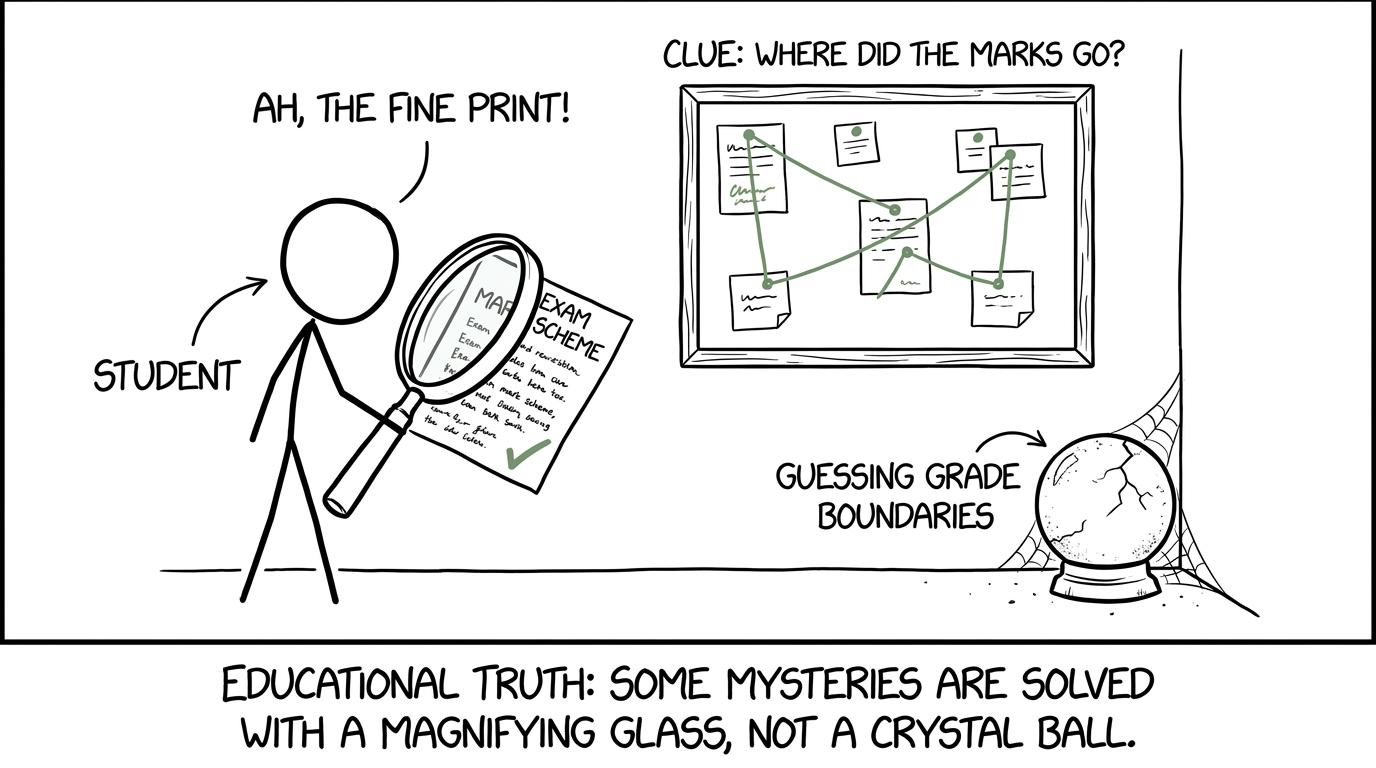 A student investigates lost marks while ignoring a grade-boundary crystal ball
Common mistakes when interpreting a Bengali grade 5
Calling it an exact old grade B
Grade 555 lies broadly between the former B and C grades. The official scales have alignment points, not a complete one-to-one conversion.
Assuming it proves complete fluency
The result reflects performance in GCSE assessments. Real-world language ability is wider and may be uneven across speaking, listening, reading and writing.
Treating grade 5 as a fixed percentage
Boundaries vary by examination series. Always use the official grade-boundary document for the correct year, qualification and tier.
Thinking foundation grade 5 has less value
Grade 555 is grade 555 whichever permitted tier produced it. Foundation tier simply caps the available outcome at grade 555.
Applying English and maths rules to Bengali
Post-161616 resit requirements and many headline measures refer specifically to English and maths. They should not automatically be transferred to GCSE Bengali.
Revising without examining mistakes
Completing more papers is not enough if the same errors return. This is especially important in maths. Read when to start GCSE past papers, then use the advice on working through Edexcel papers properly to turn each mark scheme into a revision plan.
Turn the grade into a sensible next step
The gcse bengali grade 5 meaning is neither mysterious nor absolute. It is a solid Level 2 result, above the grade 444 benchmark and broadly located between the former grades B and C. It suggests competent assessed ability across Bengali language skills, but it does not provide a perfect measure of fluency or guarantee entry to every course.
The calmest response is to keep the grade in proportion. Recognise what it records, check any course-specific requirements and use component marks if you need to understand your strengths.
Then bring that same evidence-led approach to your maths preparation. Begin with MathsGenie's free revision lessons and practice questions, use board-aware GCSE revision guidance, and progress to past papers, mark schemes, video solutions, mini tests and predicted papers. A result tells you where you were on one day. Good revision gives you somewhere useful to go next.