GCSE Bengali Grade 4 Meaning: A Clear Guide
GCSE Bengali grade 4 meaning explained: ability, old grade C comparison, changing grade boundaries and clear next steps for confident GCSE revision.
Results slips have a strange ability to turn years of learning into one small number. If that number is Grade 4, the immediate questions are usually simple: have I passed, what can I actually do, and is it the same as the old Grade C?
The short answer to the GCSE Bengali grade 4 meaning is this: Grade 4 is a recognised standard pass in England. It is broadly comparable with the bottom of the old Grade C, although the two grading scales are not exact translations. In AQA GCSE Bengali, it represents combined achievement across listening, speaking, reading and writing rather than perfect fluency in every skill.
Grade 4 in GCSE Bengali at a glance
- Grade 4 is a standard pass on England's Grade 9-1 scale.
- The bottom of Grade 4 is broadly comparable with the bottom of the old Grade C.
- It is available on both Foundation and Higher tier in AQA GCSE Bengali.
- It reflects performance across listening, speaking, reading and writing.
- It suggests a practical foundation in Bengali, but it does not certify complete fluency.
- There is no permanent percentage needed because grade boundaries can change between exam series.
- Entry requirements vary, so students should check directly with their chosen school, college or course provider.
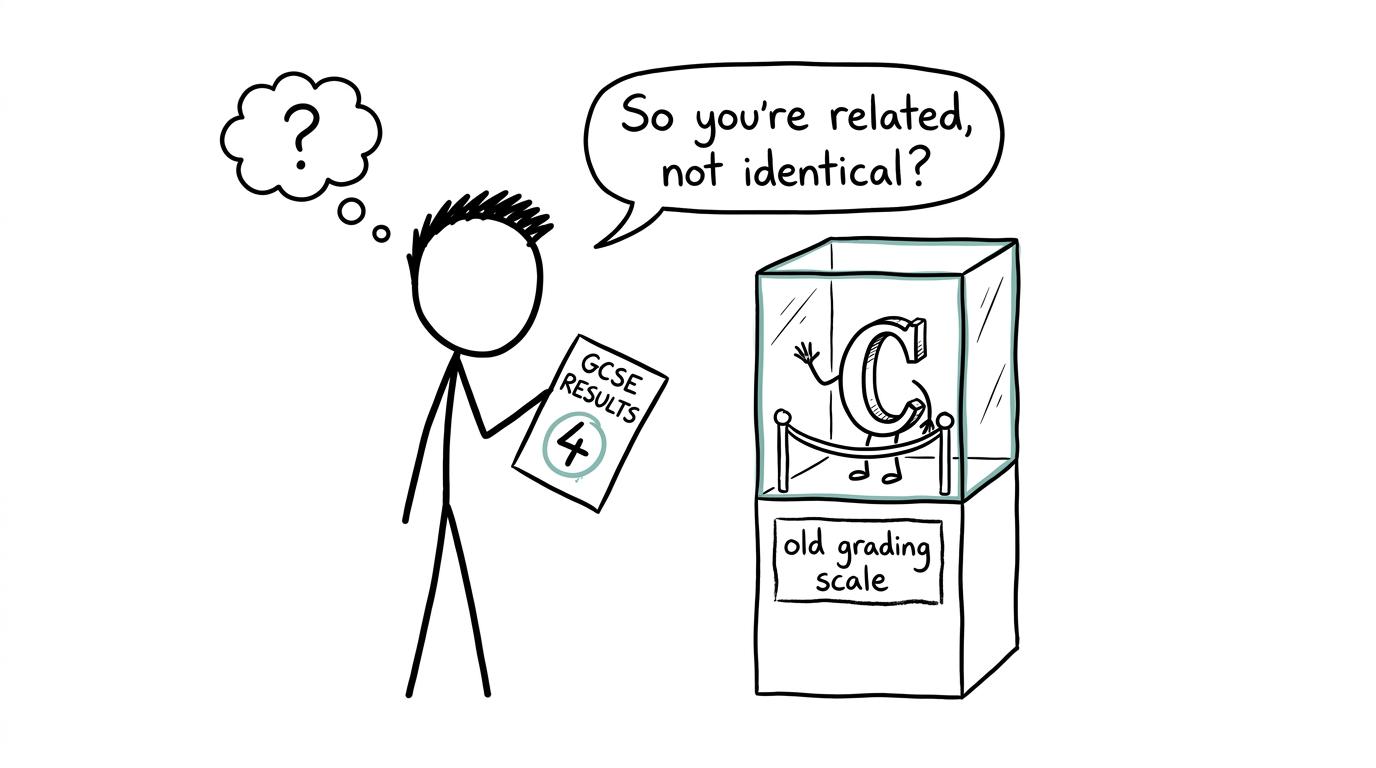 A student discovers that Grade 4 and the old Grade C are related but not identical
What does a Grade 4 in GCSE Bengali actually represent?
A grade is not a label for everything you know. It is a summary of how successfully you met the assessment requirements across a particular set of papers.
For the current AQA GCSE Bengali specification, students are assessed through four components:
| Component | What it assesses | Qualification weighting |
|---|---|---|
| Listening | Understanding and responding to spoken Bengali | 25%25\%25% |
| Speaking | Communicating and interacting in speech | 25%25\%25% |
| Reading | Understanding and responding to written Bengali | 25%25\%25% |
| Writing | Communicating effectively in writing | 25%25\%25% |
A Grade 4 therefore indicates that the student's scaled marks across these components reached the Grade 4 boundary for that examination series. It does not mean every component was performed at precisely the same level. A student might be stronger in speaking and listening than in writing, for example, while still earning Grade 4 overall.
The practical ability behind the grade
At this level, a student will generally have demonstrated enough knowledge and control to communicate about familiar topics and understand accessible spoken and written material. The specification covers themes including identity and culture, home and community, travel, social and global issues, education and employment.
In practical terms, Grade 4 achievement may include the ability to:
- understand the main message in familiar spoken passages;
- identify relevant details in accessible written Bengali;
- take part in structured conversations and respond to questions;
- express information, opinions and simple reasons;
- write connected responses using familiar vocabulary;
- communicate across different time frames, with some successful use of past, present and future language;
- translate key messages between Bengali and English.
This should not be read as a promise that every Grade 4 student can do all of these things equally well in every situation. The grade describes overall examination performance. It is not a separate certificate of conversational fluency, literacy or a particular CEFR language level.
Is Grade 4 the same as the old Grade C?
Broadly, yes, but not exactly.
Ofqual's official comparison uses several anchor points between the old A* to G scale and the newer 9-1 scale. The bottom of Grade 4 is comparable with the bottom of the old Grade C. Similarly, the bottom of Grade 7 aligns broadly with the bottom of the old Grade A, while the bottom of Grade 1 aligns with the bottom of the old Grade G.
That means an organisation which previously requested at least Grade C would normally express the corresponding requirement as at least Grade 4. However, it would be misleading to create an exact letter equivalent for every numbered grade. Grades 4, 5 and 6 provide more differentiation across the part of the old scale associated broadly with Grades B and C.
| Current GCSE description | Broad comparison with the old scale |
|---|---|
| Grade 4 | Bottom broadly comparable with the bottom of Grade C |
| Grade 5 | Above the standard-pass benchmark; commonly called a strong pass |
| Grade 7 | Bottom broadly comparable with the bottom of Grade A |
The careful wording matters. Grade 4 is not a renamed Grade C with identical papers, content and boundaries. It is the standard-pass anchor within a different grading system.
How AQA GCSE Bengali is assessed
AQA GCSE Bengali is a linear qualification. Students complete all four assessments at the end of the course, in the same examination series and at the same tier.
Foundation tier targets Grades 1-5. Higher tier targets Grades 4-9, although examination-board rules may allow a limited Grade 3 safety-net award just below the Grade 4 boundary. Students take every component at the same tier rather than mixing Foundation listening with Higher writing, for example.
The raw marks from the papers are scaled so that each of the four language skills contributes equally to the qualification. The total scaled mark is:
240240240This balance is important. Strong everyday conversation alone cannot guarantee Grade 4 if reading and writing marks are weak. Equally, a student who writes accurately must still prepare for spontaneous speaking and listening under examination conditions.
Students should also distinguish AQA GCSE Bengali from Pearson Edexcel International GCSE Bangla. These are different qualifications with different assessment arrangements. Before interpreting a result or downloading practice material, check the qualification title, exam board and specification code shown by your school or examination centre.
Why there is no fixed Grade 4 percentage
Students often search for one percentage that will always equal Grade 4. GCSE grading does not work that way.
A grade boundary is the minimum mark required for a grade in a particular examination series. Exam boards set boundaries after the papers have been sat and marked, taking account of the demand of the assessments and evidence about expected standards. Consequently, the boundary may move when one year's papers are more or less demanding than another year's.
For illustration, the confirmed AQA June 2025 boundaries for GCSE Bengali were different by tier. Grade 4 required 104104104 scaled marks out of 240240240 on Foundation and 787878 out of 240240240 on Higher. These figures describe that series only. They should not be treated as predictions for a future paper, nor do they mean Higher tier is automatically the easier route. Higher papers contain more demanding language and tasks.
Past boundaries are useful for interpreting old practice papers. Your teacher's judgement and performance across several papers are more reliable than chasing one historical threshold.
What Grade 4 does and does not tell you
Grade 4 tells a school, college or employer that you achieved the recognised standard-pass benchmark in GCSE Bengali. It can contribute to the collection of GCSE results used for applications and demonstrate assessed language knowledge.
It does not automatically tell them:
- that Bengali is your first or strongest language;
- that you are equally confident in every dialect or context;
- that you can interpret specialist, academic or professional material;
- that you met a particular provider's entry requirements;
- that you achieved Grade 4 in English language or maths.
The final point is especially important. GCSE subjects are awarded separately. Passing Bengali cannot substitute automatically for a required grade in GCSE English language or GCSE maths. Course providers set their own subject requirements, so check the exact wording rather than assuming that any GCSE pass will satisfy it.
Turning the result into a useful revision decision
A grade becomes valuable when it changes what you do next. If Grade 4 is your target, identify which language component is holding back the overall result. Use specification-matched Bengali materials supplied by your school or exam board, complete timed tasks and compare your responses carefully with the assessment criteria.
The same evidence-led process is powerful in maths. Start at the free GCSE Maths revision hub, select your board and tier, and use a paper to identify the topics costing you marks. MathsGenie covers Edexcel, AQA, OCR and Eduqas alongside other UK boards.
A dependable cycle is:
- attempt an appropriate task under timed conditions;
- mark it honestly;
- classify each mistake by skill;
- practise the weakest skill;
- retest it with a fresh question.
For Edexcel maths students, short GCSE maths mini tests can make that first diagnosis manageable. When you are ready for full-paper practice, use the Edexcel GCSE Maths past papers with their mark schemes and available solutions.
The guide to finding your weakest GCSE topics explains how to turn lost marks into a focused revision list. If you are unsure when complete papers should enter your timetable, read when to start GCSE past papers.
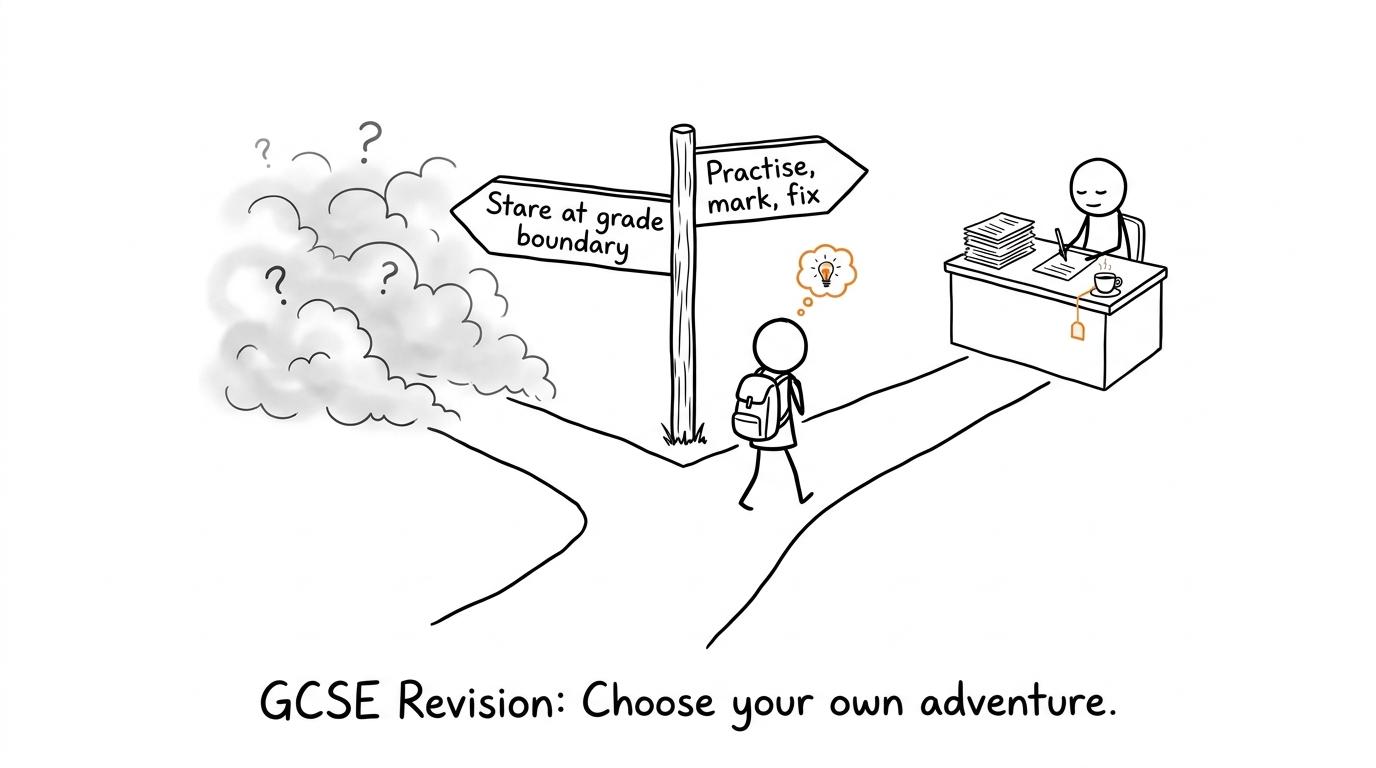 A student chooses useful practice instead of staring into the fog of a grade boundary
Common mistakes when interpreting GCSE Bengali Grade 4
Treating Grade 4 as an exact old Grade C
The bottom of Grade 4 is broadly comparable with the bottom of the old Grade C. That is an anchor-point comparison, not a complete conversion of every mark or ability statement.
Assuming Grade 4 means fluency
The result records performance against GCSE assessment objectives. Fluency is broader and depends on context, vocabulary, literacy, spontaneity and continued language use.
Using one past boundary as a prediction
Boundaries change between examination series. Use old boundaries to understand completed papers, not to calculate a guaranteed future grade.
Looking only at the overall mark
The overall grade can hide an uneven skill profile. Review listening, speaking, reading and writing separately so that revision addresses the real weakness.
Confusing GCSE Bengali with International GCSE Bangla
Check the full qualification and board. Different specifications may use different components, paper structures and grade boundaries.
Assuming the result satisfies every entry requirement
A standard pass is meaningful, but schools, colleges, apprenticeships and employers can set course-specific requirements. Confirm these directly, particularly where English language and maths are named subjects.
Make Grade 4 a starting point, not a verdict
A Grade 4 in GCSE Bengali means you have reached the recognised standard-pass benchmark through assessed language performance. It is broadly aligned with the bottom of the old Grade C and shows a useful foundation across the skills tested. It does not claim perfection, and it does not place a ceiling on what comes next.
That is also a helpful way to view a Grade 4 in maths. It is evidence of what is secure today, not a prediction of where you must finish. Use MathsGenie's GCSE one-month revision plan to organise your time, then combine revision lessons and practice questions with mark schemes, video solutions and past papers. Nearer the examination, add Edexcel GCSE predicted papers as fresh practice rather than a promise about exact topics.
Begin with one honest test. Find one weakness. Repair it. Then test it again. Grades often improve through a process that feels smaller and calmer than the number on the results slip suggests.