

Is GCSE Bengali Foundation Tier Actually Easier?
GCSE Bengali Foundation Tier easier or simply different? Compare grades, paper demands, skills and revision needs to discuss the right tier confidently.
You can know exactly what someone has said in Bengali and still hesitate when the exam asks you to write the answer. You can speak confidently at home, then discover that accurate spelling, formal vocabulary and translation feel quite different under timed conditions.
That is why students type “GCSE Bengali Foundation Tier easier” into a search bar. The short answer is: Foundation is less demanding in its targeted language, task length and grammatical range, but it is not an effortless version of the qualification. It assesses the same four language skills and the same broad themes. Grades 444 and 555 must also represent comparable standards on Foundation and Higher.
So Foundation is partly easier and partly different. The useful question is not which label sounds safer. It is which paper allows you to demonstrate your current ability most reliably.
The quick Foundation tier checklist
Before comparing the tiers, keep these facts in view:
- AQA GCSE Bengali has Foundation and Higher tiers.
- Foundation targets grades 111 to 555; Higher targets grades 444 to 999.
- You must take listening, speaking, reading and writing at the same tier.
- Each skill contributes 25%25\%25% of the qualification.
- Both tiers cover the same three broad themes.
- Foundation uses shorter assessments and a narrower expected range of language.
- A Foundation grade 444 or 555 is not worth less than the same grade achieved on Higher.
That final point matters. A tier changes the route and the available grade range, not the meaning of the grade printed on your certificate.
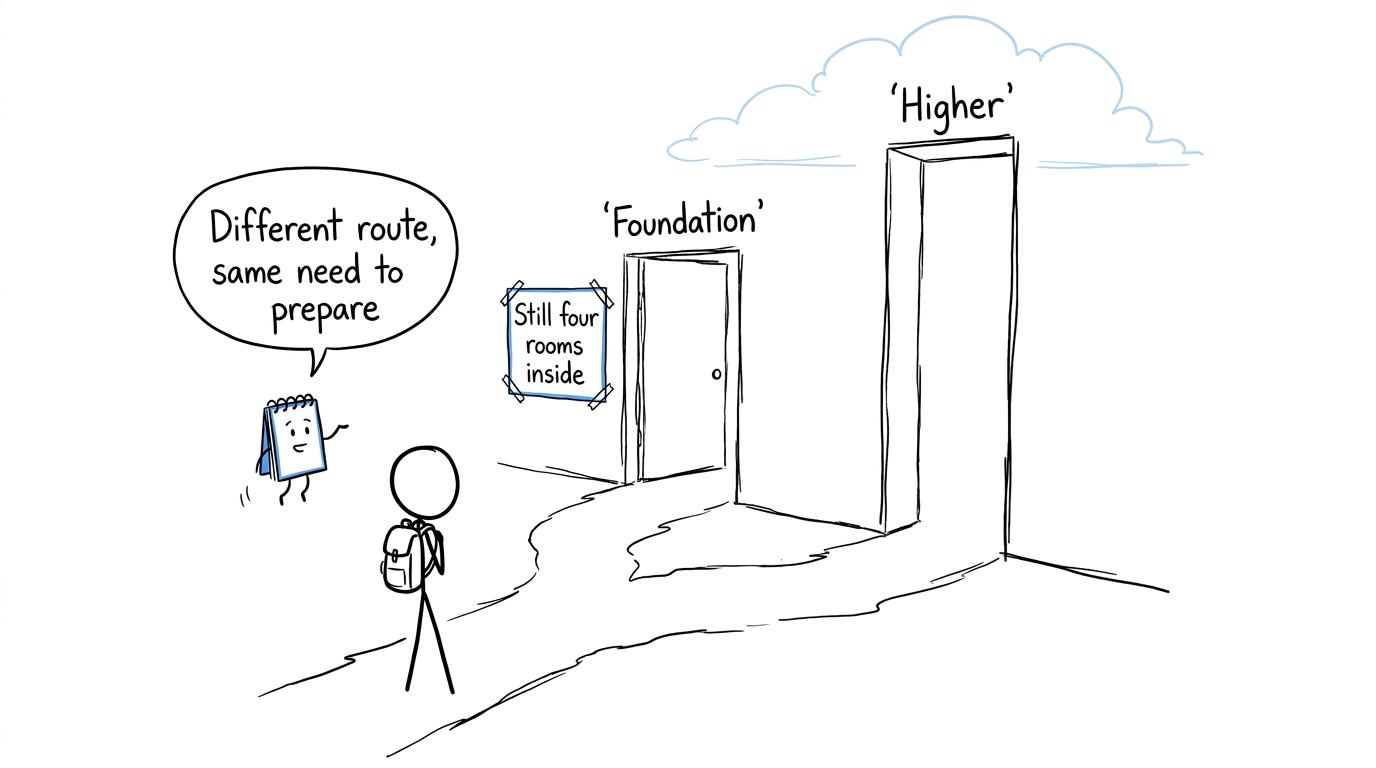 A student choosing between Foundation and Higher exam routes
What GCSE Bengali Foundation Tier actually assesses
The current AQA GCSE Bengali specification, code 863886388638, assesses four separate abilities: understanding spoken Bengali, communicating through speech, understanding written Bengali and communicating in writing.
The papers draw on three themes:
- identity and culture;
- local, national, international and global areas of interest;
- current and future study and employment.
Those themes apply at both tiers. Foundation candidates are not given an entirely separate course about simpler subjects. They may still meet material involving relationships, technology, festivals, health, the environment, travel, education and careers.
The difference lies mainly in how far the exam expects you to go. Higher questions can demand more complex language, less familiar vocabulary, longer responses and greater independence. Higher grammar includes the Foundation requirements plus additional structures.
This resembles GCSE maths tiering. The broad subject remains recognisable, but Higher extends the depth, complexity and grade range. Maths students can see that distinction in the GCSE Maths topics by exam board and tier.
Foundation and Higher compared
The current AQA assessment structure makes the practical differences clear.
| Feature | Foundation tier | Higher tier |
|---|---|---|
| Grades normally available | 111 to 555 | 444 to 999, with a narrow allowed grade 333 for candidates just below grade 444 |
| Listening | 353535 minutes, including reading time | 454545 minutes, including reading time |
| Speaking | Approximately 777 to 999 minutes | Approximately 101010 to 121212 minutes |
| Reading | 454545 minutes | 111 hour |
| Writing | 111 hour | 111 hour 151515 minutes |
| Grammar demand | Defined Foundation structures | Foundation structures plus additional Higher structures |
| Maximum grade | Grade 555 | Grade 999 |
Shorter papers do not automatically feel easy. Listening still moves forward whether or not you understood the previous phrase. Speaking still requires a response in real time. Reading still tests meaning rather than word spotting, while writing still rewards relevant communication and control of language.
Foundation therefore reduces the ceiling of demand, but it does not remove the need for accuracy, vocabulary, grammar or exam technique.
In what sense is Foundation genuinely easier?
Foundation is genuinely less demanding in several specific ways.
The language demand is more controlled
Questions and tasks are targeted at grades 111 to 555. Students are not expected to command the same breadth of vocabulary and grammar required for grades 666 to 999. The Foundation grammar list is correspondingly narrower.
Some tasks are shorter
The listening, speaking, reading and writing assessments take less time than their Higher equivalents. Foundation writing includes shorter forms of communication, although students must still address the required content and communicate clearly.
The grade range starts lower
Foundation papers contain tasks designed to let students working towards grades 111, 222 and 333 demonstrate what they know. A Higher paper is targeted from grade 444 upwards, so its starting demand can feel less forgiving.
There is less exposure to Higher-only complexity
Higher candidates must cope with more ambitious structures, extended responses and material designed to separate performance across grades 444 to 999. Foundation candidates do not face that full stretch.
That is a meaningful reduction in demand. Calling the tiers identical would be misleading.
Why “easier” can still be the wrong description
The word easier often suggests that less preparation is needed. That is where students get caught.
Imagine a student who speaks Bengali naturally with relatives but rarely reads extended Bengali or writes it accurately. Foundation may reduce the linguistic ceiling, yet reading and writing can remain the hardest parts of the qualification. Familiarity with spoken conversation does not automatically produce secure spelling, translation or formal written responses.
The reverse can happen too. A student may read carefully and know grammar rules but become hesitant during spontaneous speaking. Tier choice does not remove that imbalance because all four skills must be taken at one tier.
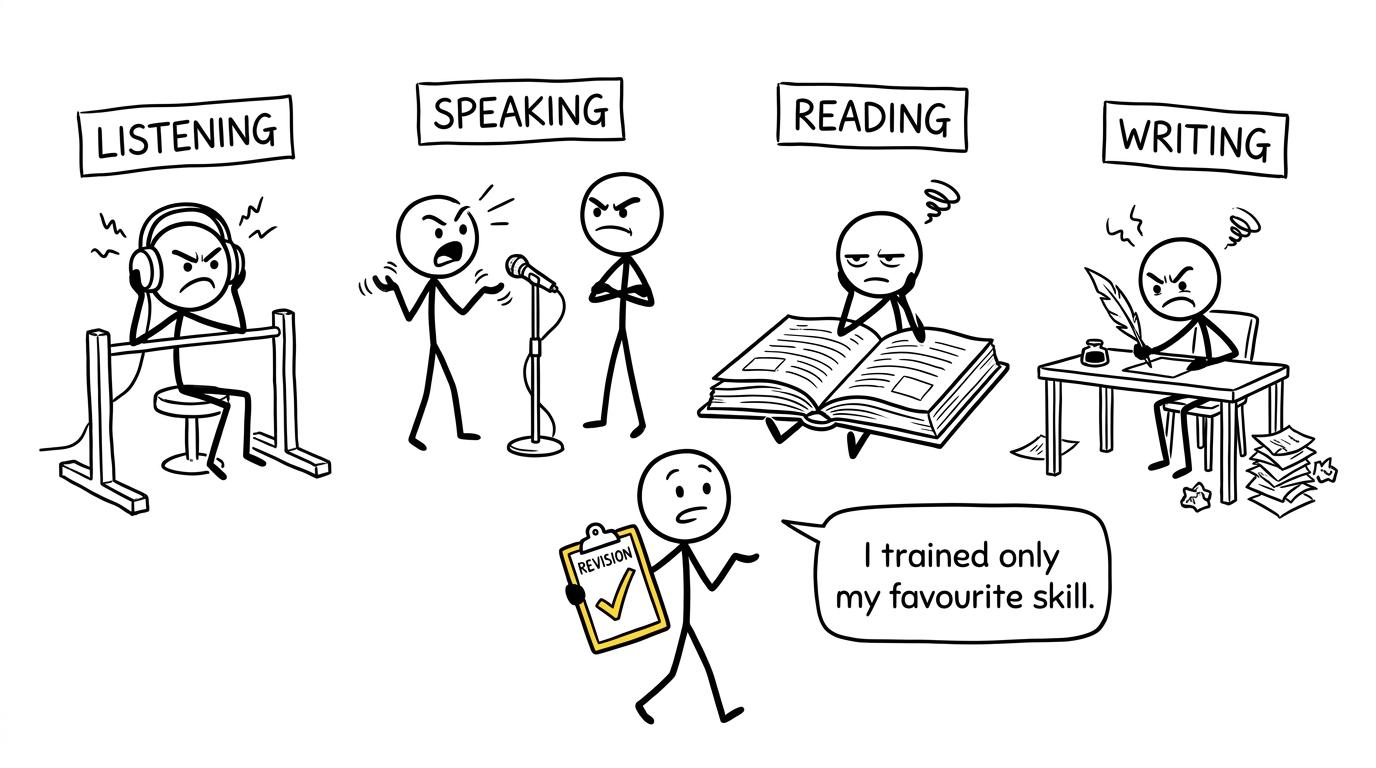 Four language skills waiting to be revised equally
There is another important qualification rule: grades 444 and 555 must be comparable across tiers. Foundation may present more accessible questions overall, but it is not supposed to make the same grade cheaper. To achieve a strong Foundation result, you still need evidence of performance at that standard.
This is familiar to maths students. Foundation GCSE maths also offers grades 111 to 555, and Higher is needed for grades 666 to 999. The MathsGenie guide to moving from Foundation to Higher explains why the decision should be based on consistent evidence rather than the belief that Higher is automatically more impressive.
Is Foundation different rather than easier?
“Different” is accurate when discussing the experience of the paper.
Foundation gives greater space to accessible communication and core language. Higher places more pressure on range, complexity, inference and sustained control. Students may therefore need different revision priorities even where the broad themes overlap.
But “just different” goes too far. The tiers are deliberately set at different levels of demand. The most precise conclusion is:
Foundation covers the same broad GCSE Bengali skills and themes, but assesses them within a lower grade range and with less linguistic complexity.
It is a different paper with a lower ceiling, not a different subject and not an easy certificate.
One warning is especially important when searching for resources: Pearson Edexcel International GCSE Bangla is a different qualification from AQA GCSE Bengali. Do not assume that its assessment structure, papers or grading arrangements match AQA Foundation tier. Always check the qualification title, specification and paper code supplied by your school.
How to decide which tier fits you
Your teacher or exams officer makes the formal entry, but your performance can inform the conversation. Use evidence from all four skills rather than choosing according to one comfortable lesson.
Ask:
- Can I understand the main points and relevant details in Foundation listening tasks?
- Can I respond without relying on a memorised paragraph that does not fit the question?
- Can I read Bengali accurately enough to distinguish similar-looking words and details?
- Can I write relevant responses while controlling familiar vocabulary and grammar?
- Am I consistently working around grades 444 or 555, or is there convincing evidence that I need access to grades 666 to 999?
- Which skill causes my marks to fall most sharply under timed conditions?
Use several assessments, not one unusually good or bad mock. Grade boundaries change between exam series because paper difficulty changes, so a remembered raw-mark target is not a permanent rule.
Maths revision offers a useful model for gathering evidence. Use a paper, mark it, identify the precise weakness, practise it and retest. The MathsGenie guide to finding your weakest topics shows how to turn lost marks into specific next actions.
A revision approach that works across subjects
A good Bengali plan should give each skill regular attention:
- Listening: practise extracting the main message, then return for detail.
- Speaking: rehearse flexible answers and follow-up responses rather than one rigid script.
- Reading: build vocabulary in context and practise locating evidence precisely.
- Writing: plan around every required bullet point, then check meaning, grammar and spelling.
After each task, record whether the problem was vocabulary, comprehension, accuracy, timing or misunderstanding the instruction. That creates a useful revision planner rather than a vague list headed “Bengali”.
The same feedback loop strengthens GCSE maths. Start with the free GCSE Maths revision hub, select your board and tier, and combine revision lessons with practice questions. The GCSE past papers collection then provides timed practice with mark schemes, while the AQA GCSE Maths revision area keeps maths preparation aligned with the correct board.
If a full paper feels too large, shorter tests can reveal more because they are easier to mark and repeat. MathsGenie’s Edexcel GCSE Maths mini tests demonstrate that principle: practise a manageable section, diagnose the error and return to it soon.
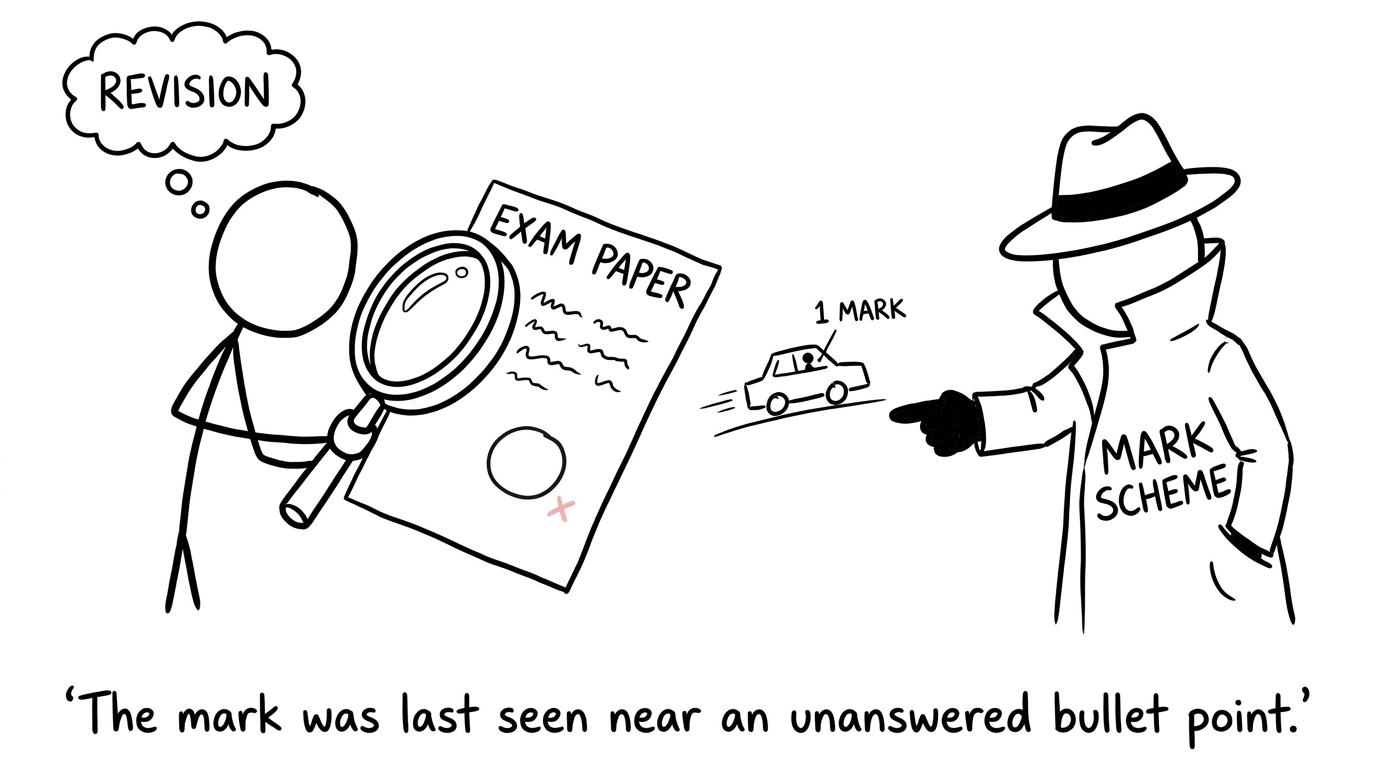 A mark scheme detective tracking down a lost mark
Common mistakes when comparing the tiers
Assuming Foundation requires little revision
It still assesses listening, speaking, reading and writing. Neglecting one skill can weaken the overall result because each contributes 25%25\%25%.
Choosing from speaking confidence alone
Conversational fluency is valuable, but the qualification also tests reading, writing, translation, grammar and responses shaped to specific tasks.
Believing a Foundation grade is labelled differently
A grade 555 achieved on Foundation represents the same grade as a grade 555 achieved on Higher. The tier is not shown as a separate achievement on the certificate.
Revising with the wrong qualification materials
AQA GCSE Bengali and Pearson Edexcel International GCSE Bangla are not interchangeable. Check the board, qualification and specification before downloading papers.
Memorising instead of preparing to adapt
A memorised answer can fail when the question changes direction. Learn reusable vocabulary, grammatical structures and ways to express opinions, reasons and time frames.
Treating one mock as a final verdict
One assessment is evidence, not destiny. Look for a pattern across several tasks and all four skills, then discuss it with your teacher.
The honest conclusion
So, is GCSE Bengali Foundation Tier actually easier? Yes, in the precise sense that it targets a lower grade range, uses a narrower range of grammar and includes shorter, less demanding tasks. No, if “easier” means that fluency at home or light revision will guarantee a strong result.
The best tier is the one that matches your demonstrated ability and intended grade range. Approach the choice calmly, using evidence rather than status.
Then apply the same discipline to maths. Use MathsGenie’s free revision lessons and practice questions to repair weak skills, mini tests to check progress, and past papers, predicted papers, mark schemes and video solutions to prepare for the real exam. A sensible tier gives you the right route. Consistent revision is what moves you along it.










