

GCSE Bengali Access Arrangements: How to Apply
GCSE Bengali access arrangements explained: request extra time, rest breaks or modified papers, provide evidence and meet the approval deadlines.
The hardest part of an exam should be showing what you know. It should not be reading a paper you cannot clearly see, writing through pain, or working at a speed that your disability makes unrealistic. If any of those barriers sound familiar, GCSE Bengali access arrangements may provide appropriate support, but the request needs to begin with your school or exam centre well before the assessment.
The short answer is simple: speak to your SENCo, exams officer or Bengali teacher as early as possible. The centre identifies your needs, gathers the required evidence and submits any formal application. You do not apply directly to AQA or JCQ yourself.
GCSE Bengali access arrangements checklist
- Confirm that you are entered for AQA GCSE Bengali rather than an International GCSE Bangla qualification.
- Tell your SENCo or exams officer what makes assessments difficult.
- Explain which support you normally use in lessons, internal tests and mock exams.
- Complete any assessment requested by the centre.
- Practise with the proposed arrangement before the real examination.
- Ask which arrangements require online approval and which the centre can provide directly.
- Confirm the arrangements separately for listening, speaking, reading and writing.
- Check that modified papers are ordered before the earlier modified-paper deadline.
- Request written confirmation of what will happen on each exam day.
First confirm which Bengali qualification you are taking
The name of the qualification matters. AQA currently offers GCSE Bengali specification 8638. It is a linear qualification with listening, speaking, reading and writing assessments. It has foundation and higher tiers, and a student must take all four papers at the same tier in the same series.
Pearson offers International GCSE Bangla 4BA0, which is a different qualification with different assessment arrangements. Do not rely on advice for International GCSE Bangla if your entry is AQA GCSE Bengali, or vice versa. Ask your exams officer for your awarding body, specification code and entry tier.
This distinction also matters for dictionary rules. AQA's GCSE Bengali specification states that dictionaries are not permitted during its tests. A bilingual dictionary that may be allowed in another GCSE subject is therefore not automatically allowed in Bengali. Being bilingual or having English as an additional language does not, by itself, create an entitlement to extra time in a Bengali language examination.
What access arrangements actually do
Access arrangements remove or reduce a barrier without changing the knowledge or skill being assessed. They are agreed before an examination and are based on the individual student's evidence of need and normal way of working.
Possible arrangements include:
- 25%25\%25% extra time or, in rarer cases, a different approved allowance
- supervised rest breaks
- a word processor
- a reader or computer reader where the assessment permits one
- a scribe or speech-recognition technology, subject to language-assessment restrictions
- a prompter
- coloured overlays or enlarged text
- Braille, modified enlarged or modified-language papers
- separate or smaller-room accommodation where justified
- arrangements connected with a temporary injury or medical condition
An arrangement is not a bonus and does not reduce the standard required for grades 9-1. It changes access to the assessment, not what the assessment is designed to measure.
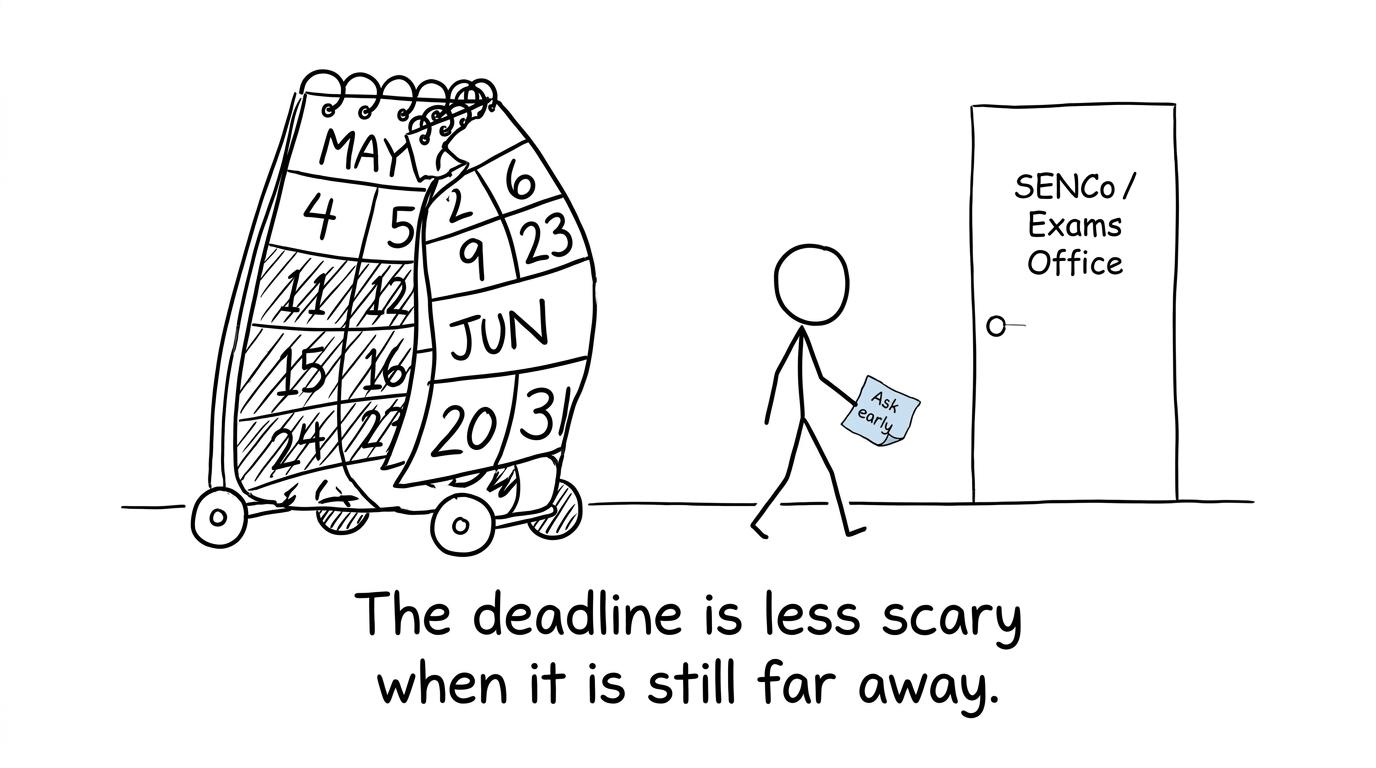 A student calmly reaches the exams office before a giant deadline calendar
How extended time works for GCSE Bengali
Extra time is usually considered when a disability, learning difficulty or other substantial impairment causes a persistent difficulty with processing, reading or writing speed. The familiar allowance is 25%25\%25%, but it is not automatic after a diagnosis. The centre must establish why it is needed and why it reflects the student's usual way of working.
For applications processed under the JCQ rules for the 2025/26 academic year, evidence for 25%25\%25% extra time may include the relevant JCQ form, assessment evidence where required, teacher observations and samples from internal tests or mock examinations showing how the extra time was used. Exact evidence requirements depend on the nature of the student's need.
The arrangement may also operate differently across Bengali components.
Listening assessment
A listening examination depends on controlled recordings and pauses. Extra time cannot simply mean independently stopping or replaying audio whenever desired. The exams officer must follow the awarding body's approved method for delivering the listening assessment and any specially prepared recording.
Ask how reading time, pauses and the audio will be managed before the examination. Rehearse that format in a mock so it does not feel unfamiliar.
Speaking assessment
Speaking tests measure spoken communication, interaction, pronunciation and fluency. Any adjustment must preserve those skills. An approved allowance may affect preparation or assessment time, but the centre must follow the board's instructions and stay within the permitted total.
Supervised rest breaks may sometimes be possible, although the recording and administration must follow the required procedure. Your Bengali teacher, SENCo and exams officer should agree the practical plan before the speaking window begins.
Reading assessment
A human or computer reader cannot read text in a section that is specifically testing reading ability. Doing so would change the skill being assessed. A reader may be able to read permitted instructions or English rubric, but not the Bengali material that the candidate is expected to understand independently.
Writing assessment
Modern foreign language writing assesses the candidate's own language production and spelling. JCQ rules therefore place tight restrictions on scribes. Where a scribe is permitted, the candidate normally has to dictate foreign-language words letter by letter. Because this is slow, additional extra time may also need consideration.
A word processor may be appropriate for some candidates, but it must normally be an established way of working. Spellcheck, grammar tools, predictive text and internet access are not simply available because a laptop is being used. The centre must configure the device according to the approved arrangement and examination rules.
How to request support through your school
Start with a clear conversation
Tell your SENCo, exams officer or teacher what happens during timed work. Specific information is more useful than saying that exams are difficult. For example, explain whether you lose your place while reading, need breaks because of pain, cannot write continuously, or require enlarged text.
Your parent or carer can support the conversation, but the school needs to understand your own experience too.
Let the centre build the evidence
Depending on the requested arrangement, the centre may collect:
- teacher feedback
- classwork and internal-assessment records
- mock papers showing the arrangement in use
- an assessment completed by the centre's appointed assessor
- medical or specialist evidence
- records of established classroom support
Do not arrange a private assessment and assume it will automatically satisfy JCQ requirements. Ask the SENCo what form of evidence is required before paying for anything.
Use the arrangement before the real exam
The phrase normal way of working is central. If you require extra time, a word processor or rest breaks, use that support during suitable lessons, timed tasks and mock examinations. This shows whether it genuinely removes the barrier and gives the school evidence of how it works.
The same principle can support maths preparation. Use the correct conditions when attempting resources from the GCSE Maths Revision hub, including your approved extra time or rest-break procedure. The MathsGenie revision planner can then help you schedule realistic timed practice.
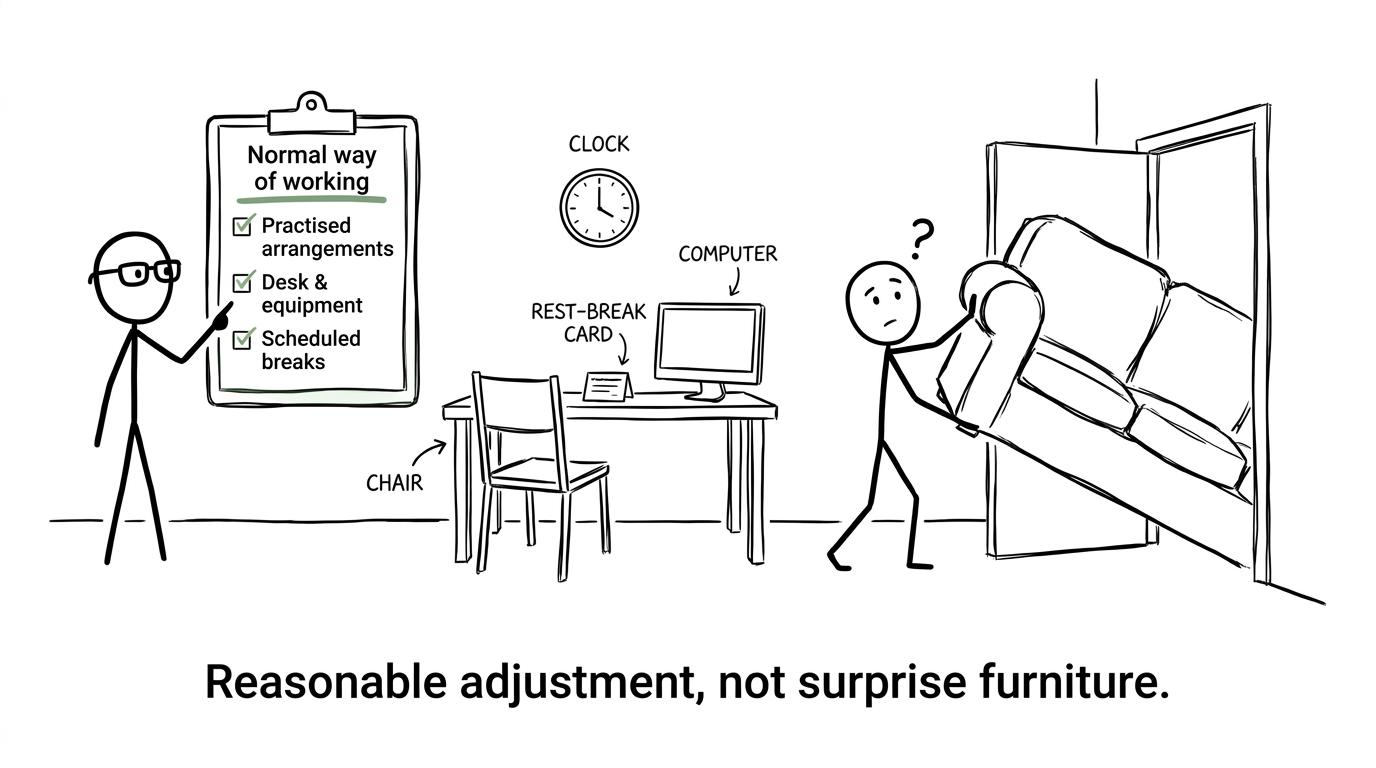 An invigilator checks normal exam arrangements while a student tries to bring in a sofa
The approval timeline
JCQ publishes regulations and deadlines for each academic year. The 2025/26 rules were valid from 1 September 2025 to 31 August 2026, with a final deadline of 31 January 2026 for modified papers and 21 March 2026 for other online access-arrangement applications in the June 2026 series. Those dates should not be reused automatically for a later series; your centre must check the current JCQ documents.
| Suggested point in the process | What should happen |
|---|---|
| Year 10 or early Year 11 | Raise the difficulty with the SENCo and begin gathering classroom evidence. |
| Before mock examinations | Trial the proposed arrangement under timed conditions. |
| Autumn term of Year 11 | Complete required assessments and confirm the candidate's normal way of working. |
| Before the modified-paper deadline | Order Braille, modified enlarged or other required modified papers. |
| Before the main online deadline | Submit arrangements requiring Access Arrangements Online approval. |
| Before speaking and written assessments | Confirm practical instructions, rooms, equipment and permitted support. |
| On exam day | Tell the invigilator immediately if the agreed arrangement is missing or incorrect. |
Some arrangements, including 25%25\%25% extra time, readers and scribes, generally require processing through Access Arrangements Online. Other arrangements may be delegated to the centre, meaning that prior online approval is not required. Delegated does not mean informal: the centre must still have evidence, records and a clear justification.
If you are a private candidate, contact an exam centre that accepts private entries well in advance. The centre still has responsibility for reviewing your evidence and administering the arrangement. It may also have an internal deadline earlier than JCQ's final deadline.
What if your need appears after the deadline?
A broken arm, sudden illness or newly identified condition can arise late. Contact the exams officer immediately. The response depends on the barrier, available evidence, exam-board rules and whether the centre can implement the support securely.
Do not confuse an access arrangement with special consideration. Access arrangements are agreed before an assessment to provide access. Special consideration is considered after an assessment when an eligible candidate has been temporarily disadvantaged by circumstances such as illness, injury or bereavement.
Keep your maths revision consistent with your arrangements
Access arrangements work best when they feel ordinary by exam day. If the support applies across your GCSEs, reproduce it during maths practice rather than waiting for the formal mock.
Choose the correct board through the Edexcel GCSE Maths revision area, AQA GCSE Maths revision area or OCR GCSE Maths revision area. Start with short Edexcel GCSE Maths mini tests, then build towards Edexcel predicted papers under your approved conditions.
Record when you use extra time, take a rest break or need particular software. That information may help your SENCo understand how the arrangement works across subjects, although Bengali's component-specific rules must still be followed.
Common mistakes when requesting access arrangements
Waiting until the examination timetable arrives
Evidence, assessments and modified-paper orders take time. Raise the issue as soon as a recurring barrier becomes clear.
Assuming a diagnosis guarantees extra time
A diagnosis may support the application, but the arrangement must address a demonstrated need and usually reflect normal classroom practice.
Assuming one arrangement works identically in every paper
Listening, speaking, reading and writing test different skills. Readers, scribes and extra time may be administered differently across the four components.
Treating EAL support as disability support
A student may be eligible for certain bilingual-dictionary arrangements in permitted subjects, but those rules are distinct from disability-related extra time. AQA GCSE Bengali itself does not permit dictionaries during the tests.
Not testing the practical details
A separate room can feel distracting if it is unexpected. A word processor can slow you down if you have not practised with it. Trial the exact arrangement in mocks and ask what will happen with timings, breaks and equipment.
Take the next step early
The calmest access-arrangement process begins before urgency takes over. Confirm your qualification, speak to your SENCo or exams officer, explain the barrier clearly and practise with the proposed support. Then ask for confirmation of how it will work in every Bengali component.
While your centre handles the formal process, keep building confidence across your other GCSEs. MathsGenie gives you free revision lessons, practice questions, mini tests, past papers, predicted papers, mark schemes and video solutions. Use them under your approved exam conditions so that, when the real paper arrives, both the maths and the routine feel familiar.











