GCSE Astronomy vs Physics Sixth Form Guide
GCSE astronomy vs physics sixth form guide: learn which subject admissions teams value, what A Level Physics requires and how to choose wisely.
Choosing a GCSE can feel strangely permanent. A subject selected at fourteen appears on a certificate at sixteen, just as sixth-form applications begin to matter. If you are comparing GCSE astronomy vs physics sixth form value, the short answer is this: GCSE Physics usually carries more practical weight for entry to A Level Physics, while GCSE Astronomy is an interesting additional qualification rather than a substitute for Physics or Combined Science.
That does not make Astronomy unimpressive. It means admissions decisions are generally driven by published entry requirements, relevant grades and your overall academic profile, not by which subject sounds more unusual.
The quick decision checklist
Before choosing, ask:
- Do you want to take A Level Physics?
- Does your school offer separate GCSE Physics, Combined Science, Astronomy, or some combination of these?
- What grades in Physics, Combined Science and Maths do your likely sixth forms require?
- Would Astronomy be an additional GCSE or replace another option?
- Which course are you more likely to enjoy, complete successfully and revise consistently?
- Can you manage the observational work required in GCSE Astronomy?
The safest rule is simple: if A Level Physics is a serious possibility, prioritise the science route accepted by your sixth form and protect your GCSE Maths grade. Choose Astronomy as an extra source of depth where your timetable allows it.
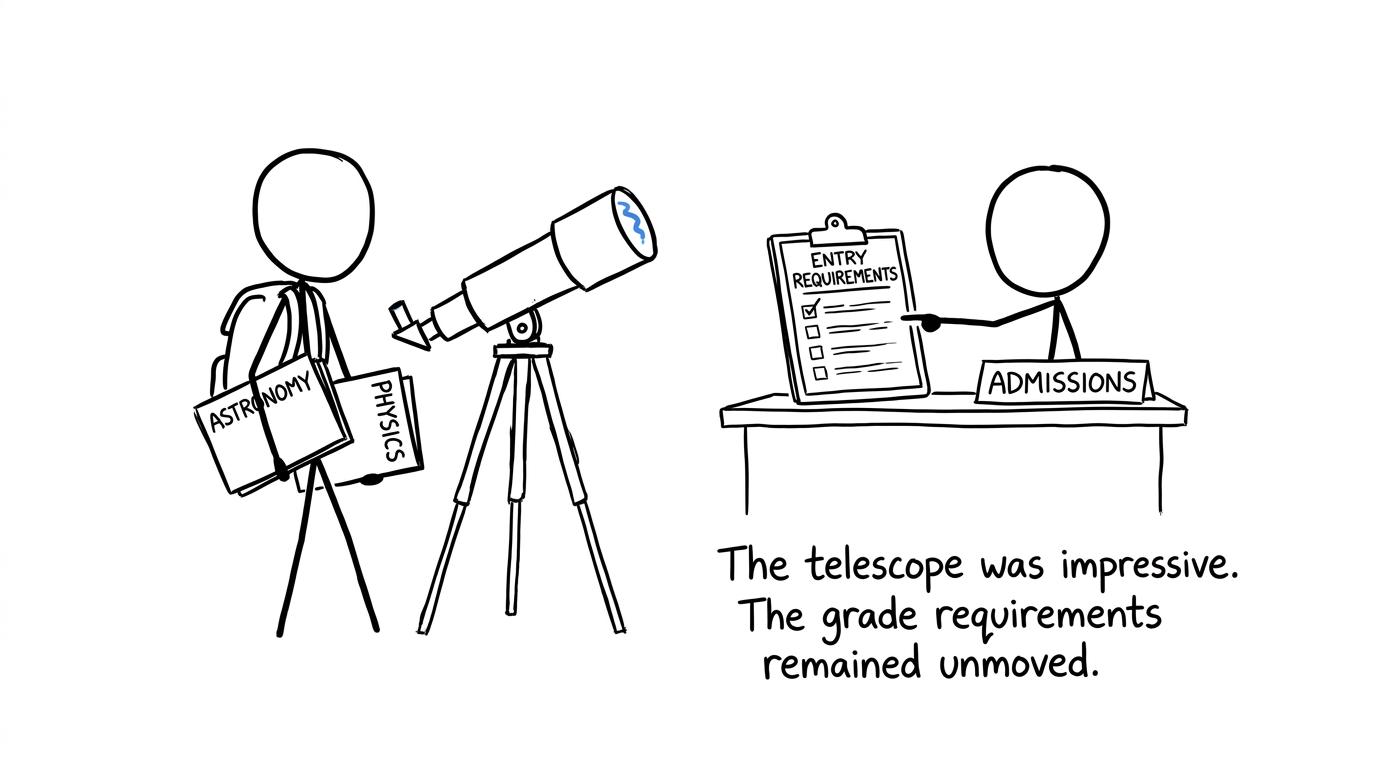 A telescope meets an unmoved sixth-form checklist
Do sixth forms favour GCSE Astronomy or GCSE Physics?
Most sixth forms do not publish a blanket preference between the two. Instead, they set course-specific requirements.
For A Level Physics, current entry criteria at a range of sixth forms commonly ask for a particular grade in separate GCSE Physics or suitable grades in GCSE Combined Science. They also commonly require a strong GCSE Maths grade. The precise threshold varies: some providers ask for grade 666, while more selective courses may ask for grade 777 in Physics or Combined Science and Mathematics.
GCSE Astronomy is not commonly listed as an alternative to these science requirements. A strong Astronomy grade may support an application by showing scientific curiosity, mathematical confidence and commitment, but it will not normally override a missing Physics, Combined Science or Maths requirement.
For non-Physics A Levels, the distinction usually matters less. Admissions teams are more likely to consider:
- whether you meet the general GCSE entry profile;
- whether you meet each subject's specific requirements;
- your grades across relevant subjects;
- the suitability and balance of your proposed programme;
- any further criteria stated in the provider's admissions policy.
So which “looks better”? Physics is more directly useful when applying for A Level Physics. Astronomy can add breadth, but its unusual title is not automatically more valuable.
GCSE Astronomy and GCSE Physics are not interchangeable
The names overlap because both courses look beyond everyday experience. Their purposes, however, are different.
| GCSE Astronomy | GCSE Physics |
|---|---|
| Focuses on the Earth, Moon, Solar System, stars, galaxies, observation and cosmology | Covers energy, electricity, particles, forces, waves, magnetism, atomic physics and space physics, depending on the specification |
| Currently offered as a Pearson Edexcel GCSE | Available through major science exam boards as separate Physics, with physics also taught within Combined Science |
| Requires aided and unaided astronomical observation | Includes practical science requirements set through the relevant specification |
| Assesses maths in an astronomical context | Develops the broad physical principles needed before A Level Physics |
| Usually acts as an additional specialist GCSE | Often forms part of the standard science pathway used for sixth-form entry |
Pearson's current GCSE Astronomy specification has two externally examined papers, each worth 50%50\%50% of the qualification. Students must undertake at least one aided and one unaided observation, although observational ability is assessed through the written examinations rather than coursework marks.
Ofqual's requirements state that at least 20%20\%20% of GCSE Astronomy marks must reward mathematical skills and at least 15%15\%15% must assess knowledge and understanding of observational work. It is a rigorous subject. It is simply narrower and more specialised than GCSE Physics.
GCSE Physics is also highly mathematical. Under national subject requirements, at least 30%30\%30% of the marks in a separate GCSE Physics qualification assess maths in a physics context. This helps explain why sixth forms pay close attention to both science and Maths grades when selecting students for A Level Physics.
Why GCSE Maths may matter more than the Astronomy label
A telescope may be the memorable part of Astronomy, but much of the reasoning happens through numbers. Students meet standard form, ratios, unit conversions, significant figures, graphs, geometry, proportional relationships and equation rearrangement.
Astronomical quantities are often expressed in the form
a×10n,1≤a<10,a \times 10^n, \qquad 1 \leq a < 10,a×10n,1≤a<10,while physical relationships frequently require confident substitution and changing the subject of a formula. These are not decorative skills. They are the language through which scientific ideas become testable.
That is why strengthening GCSE Maths helps whichever course you choose. Begin with the GCSE Maths revision hub, where you can select your exam board and tier. If very large and very small quantities cause difficulty, use the standard form GCSE lesson.
It is also worth checking the complete GCSE Maths topic list. Algebra, trigonometry, graphs and proportional reasoning are especially valuable preparation for further scientific revision.
 Two scientific paths meet at the strong maths gate
Which subject should you choose?
Choose Physics when progression is the priority
Prioritise separate GCSE Physics where it is offered if you are considering A Level Physics and your school allows the choice. It provides the clearest subject preparation and aligns directly with the wording used in many sixth-form entry requirements.
However, separate Physics is not always necessary. Many colleges explicitly accept strong Combined Science grades instead. Do not assume that triple science is compulsory when your chosen provider says otherwise.
Choose Astronomy when it adds genuine depth
Astronomy is a sensible option if you are fascinated by observation, planetary motion, stars and cosmology, and you can take it without weakening essential subjects. It may help you demonstrate a sustained interest in space science, but the best evidence will still be a strong result and a thoughtful reason for choosing it.
A specialist subject chosen only because it might “look impressive” can become expensive in time. Interest matters because interest makes repeated practice easier to sustain.
Choose both if the workload is realistic
Physics and Astronomy can complement each other. There is conceptual overlap in gravity, planetary motion and space, while Astronomy provides much greater observational and celestial depth.
But another qualification is useful only if it does not damage your core grades. Sixth forms often make offers using a collection of GCSE results, with separate thresholds for particular A Levels. A grade gained by stretching yourself too thin may be less helpful than stronger performance across Maths, English and science.
Use a realistic GCSE Maths revision timetable before deciding whether your week has room for an additional subject.
How to check what your chosen sixth form really wants
Course requirements vary, so general advice should never replace the provider's own admissions information.
Read the exact A Level Physics criteria
Look for the current prospectus or course page. Record separately:
- the general entry requirement;
- the required Physics or Combined Science grade;
- the required Maths grade;
- whether Higher tier is specified;
- whether A Level Maths is required or recommended alongside Physics.
Several current providers recommend A Level Maths with Physics, and some require students to take both. That is a course-level decision, not a universal national rule.
Ask what happens in your own science pathway
If your school offers Combined Science rather than separate sciences, ask whether it satisfies the entry criteria. In many published policies it does, provided the required grades are achieved.
If Astronomy is offered outside the normal timetable, ask how observations, teaching time and examination preparation are organised. A qualification's value includes your realistic chance of completing it well.
Keep evidence, not assumptions
Save the relevant admissions page and note when you checked it. Requirements can change between application cycles. If wording is unclear, contact the sixth form directly rather than relying on social media, an older sibling's experience or the reputation of a subject name.
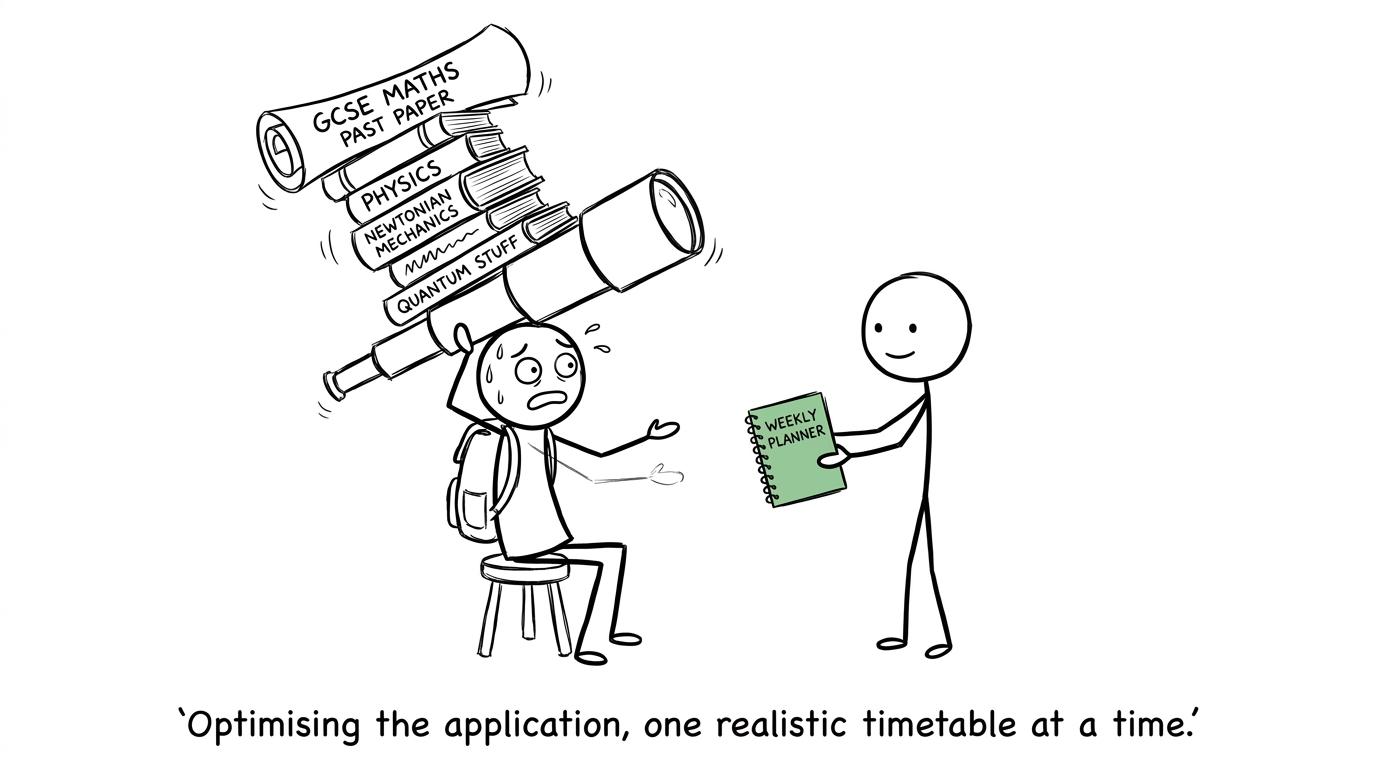 A realistic planner rescues an overloaded GCSE student
Build the maths profile sixth forms actually notice
Your subject choice is only one part of the application. The grade you earn in GCSE Maths can determine whether A Level Physics remains available.
A productive revision cycle is:
- complete a short diagnostic set;
- identify the exact topics losing marks;
- revisit the relevant revision lesson;
- answer targeted practice questions;
- mark them carefully;
- return later through a mini test or timed paper.
Do not rush into endless full papers. The guide to when to start GCSE past papers explains how to move from topic diagnosis towards timed practice. Closer to the exams, Edexcel GCSE Maths predicted papers can provide fresh practice alongside official papers, not instead of them.
This is the quiet advantage of good revision: it keeps options open. A secure Maths grade supports Physics, Astronomy and a much wider range of sixth-form courses.
Common mistakes when comparing the subjects
Assuming the rarer GCSE automatically looks better
Novelty may prompt interest, but admissions teams still apply stated criteria. A specialist title does not replace the required grades.
Treating Astronomy as a replacement for Physics
Astronomy is a recognised GCSE, but A Level Physics entry pages commonly specify Physics or Combined Science. Check before changing your science pathway.
Ignoring GCSE Maths
Both subjects use substantial mathematics, while A Level Physics entry commonly includes a Maths threshold. Weak algebra and graph skills can restrict progression even when your scientific knowledge is good.
Choosing around prestige rather than likely performance
A demanding extra subject is not automatically beneficial. Consider teaching quality, timetable space, observation commitments, enjoyment and your wider revision load.
Reading one college's rules as a national policy
There is no single sixth-form entry threshold used everywhere. Check every provider you may apply to and confirm uncertain wording directly.
Make the choice that keeps doors open
The GCSE Astronomy vs Physics decision is less about winning an admissions beauty contest and more about understanding prerequisites. For A Level Physics, GCSE Physics or an accepted Combined Science route has the clearer practical value. GCSE Astronomy is a worthwhile specialist qualification that can deepen your scientific profile, but it is usually an addition rather than a replacement.
Choose the pathway that meets your likely sixth form's requirements, suits your interests and leaves enough time to earn strong grades. Then make Maths the foundation beneath it.
Start with MathsGenie's free GCSE Maths revision resources. Use revision lessons and practice questions to repair weak topics, mini tests to check recall, and past papers, predicted papers, mark schemes and video solutions to turn understanding into exam marks. A sensible subject decision opens the door. Consistent revision helps you walk through it.