

GCSE Astronomy Remark Appeal: Is It Worth It?
GCSE astronomy remark appeal explained: learn how reviews and appeals work, what they cost, the risks, deadlines and when a request is worthwhile.
A result can feel final until it lands one mark below the grade you hoped for. Then every crossed-out sentence and calculation starts replaying in your mind. A GCSE astronomy remark appeal may be worthwhile when there is credible evidence of a marking error, especially if correcting it could change your qualification grade. But being close to a boundary, on its own, does not prove that the marking was wrong.
The sensible first step is usually to ask your school's exams officer about accessing the marked scripts. A teacher can then compare the examiner's decisions with the official mark scheme before you pay for a review.
The short answer: should you request a remark?
Consider requesting a review of marking if:
- your teacher identifies an answer that appears to have been marked incorrectly
- a page, question or continuation sheet may have been missed
- your result is significantly different from well-evidenced expectations
- the possible correction could change your overall qualification grade
- you understand that the mark can go down as well as up
- you can meet the awarding body's current deadline
Think carefully before requesting one if your only reason is disappointment or proximity to a grade boundary. Reviews check whether the original marking applied the mark scheme correctly. They are not a request for a more generous examiner.
This article reflects the Joint Council for Qualifications post-results framework and Pearson's arrangements for GCSE Astronomy. Deadlines, fees and service details can change between examination series, so your exams officer should confirm the current rules before any application is submitted.
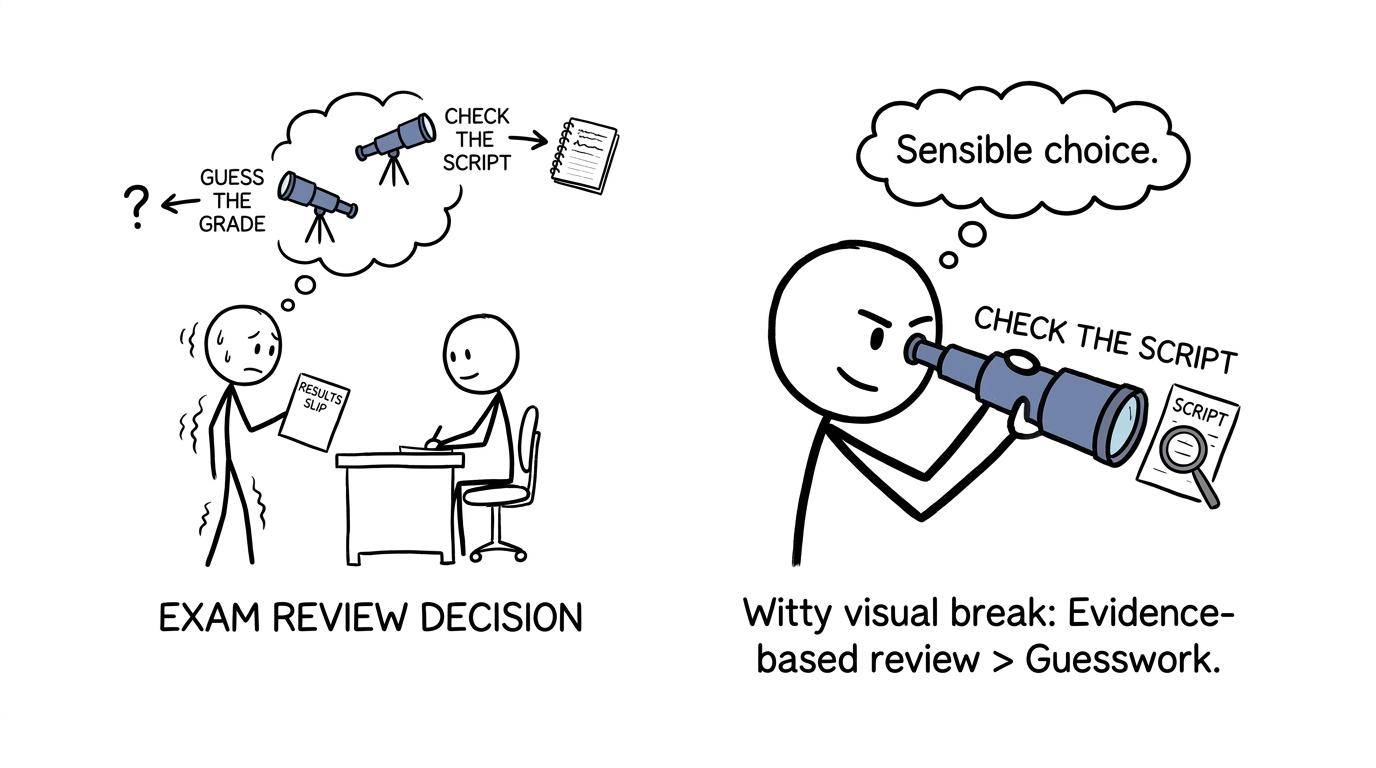 A student choosing to inspect the evidence rather than guess about an exam result
What students mean by a GCSE Astronomy remark
The word remark is widely used, but the formal service is normally called a review of marking. That distinction matters.
An awarding body does not simply give the paper to another examiner and ask them to mark it from scratch. The reviewer checks whether the original examiner applied the mark scheme correctly and whether any marking error occurred. Differences based only on legitimate academic judgement will not automatically produce a change.
Pearson Edexcel currently offers GCSE Astronomy. The qualification is assessed through two externally examined written papers, each worth 100100100 marks and 50%50\%50% of the qualification. Observational skills are examined through the written assessments rather than a separately marked coursework component.
Your final total can therefore be represented as:
T=P1+P2 T=P_1+P_2 T=P1+P2where P1P_1P1 and P2P_2P2 are the marks from the two papers. A review may be requested for one paper or both, but the important question is whether any resulting change affects the total qualification grade.
The post-results services you may encounter
Access to scripts
An access-to-scripts request allows your centre to obtain a copy of your marked paper, subject to the awarding body's rules and deadlines. For many students, this is the most useful starting point.
A teacher can inspect whether:
- every response has been marked
- marks appear to have been transferred correctly
- the mark scheme has been applied consistently
- an answer contains creditworthy material that may have been overlooked
- there is enough evidence to justify paying for a review
This turns an emotional decision into an evidence-based one. It is similar to using a mark scheme after a maths paper: the value lies not in hoping for more marks, but in identifying precisely where the assessment decision may be wrong. MathsGenie's guide to using Edexcel past papers properly explains the same disciplined approach to checking marked work.
Clerical re-check
A clerical re-check is narrower than a review of marking. It checks administrative matters such as whether all parts of the script were marked and whether the marks were recorded and added correctly.
It does not reconsider the examiner's academic judgement. This service may make sense if there is evidence of an unmarked page or a recording problem, but not when the dispute concerns how much credit an explanation deserved.
Review of marking
A review of marking checks whether the original marking contains an error. The reviewer considers the application of the mark scheme, including whether marks were awarded or withheld correctly.
The outcome may be:
- the mark stays the same
- the mark increases
- the mark decreases
Written candidate consent is normally required because a lower mark can lead to a lower qualification grade. Your school or college submits the request to the awarding body; students generally do not apply directly.
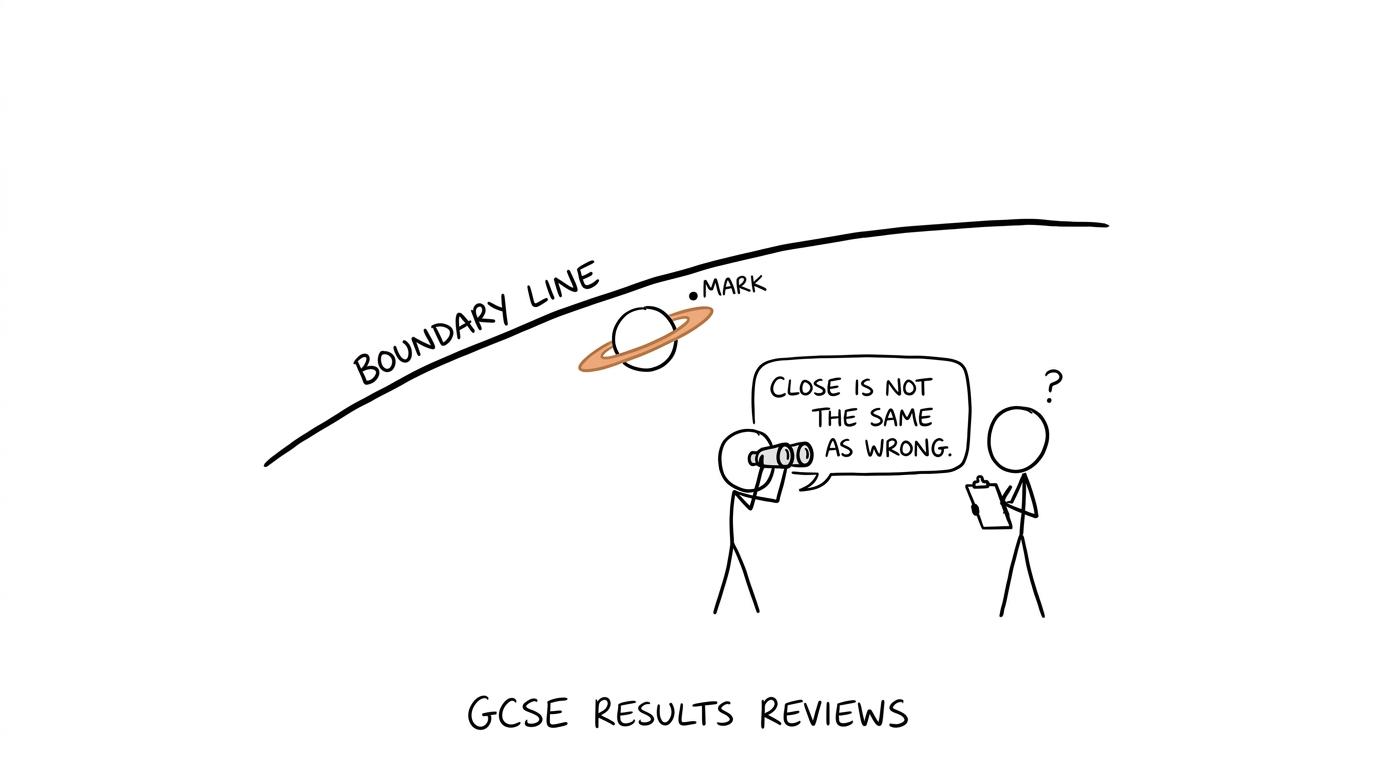 A tiny mark orbiting a grade boundary while a student remembers that close does not mean incorrectly marked
A remark and an appeal are not the same thing
An appeal is not usually the first stage. It normally follows the completion of the relevant post-results service, such as a review of marking.
Under the JCQ process, an awarding body appeal generally considers whether its procedures were followed properly and whether the outcome was reasonable in light of the evidence. It is not simply another opportunity to argue that the student deserves a higher grade.
The process commonly begins with a preliminary appeal. If the matter remains unresolved and the permitted grounds are met, it may progress to an appeal hearing. The centre normally brings the appeal on the candidate's behalf.
If your school refuses to request a review or support an appeal, ask for its internal appeals procedure. Centres are expected to have a process through which candidates can challenge certain decisions concerning post-results services. This does not guarantee that the awarding body will receive a request, but it gives you a formal route for asking the centre to reconsider.
How close are you to the grade boundary?
Let your total mark be MMM and the next grade boundary be BBB. The distance to that boundary is:
d=B−M d=B-M d=B−MA smaller value of ddd means fewer additional marks would be needed. However, it does not tell you whether those marks exist on the scripts.
This is the central misunderstanding around remarks. A student who is one mark below a boundary may have been marked perfectly accurately. Another student several marks away may have a clearly unmarked response. Evidence matters more than distance alone.
Ask your exams officer or teacher:
- What is my confirmed total mark?
- What was the published boundary for the grade above?
- Which paper would need reviewing?
- Has a subject specialist inspected the script?
- Which exact marking decisions appear questionable?
- Could any disputed marks reasonably change my overall grade?
Treat the boundary as context, not proof.
When the fee is genuinely worth considering
Exam-board fees change and schools may have their own payment arrangements. Some centres pay in selected cases, while others ask families to cover the cost. Ask for the current fee, whether there is an additional administration charge and what happens to the fee if the qualification grade changes.
A useful decision framework has three parts.
There is specific evidence
The strongest reason is an identifiable problem: an unmarked answer, a total that appears incorrect or a response where the mark scheme seems not to have been applied properly. A general feeling that the paper went better than the result is weaker evidence.
The possible change matters
A higher grade might affect sixth-form entry, a subject choice or another stated progression requirement. Check the actual requirement rather than assuming every one-mark difference will alter your next step. A conversation with the school may also reveal whether there is flexibility while a review is pending.
You accept the downside
Marks and grades can decrease. Consent should therefore be informed, not treated as paperwork to sign quickly. If the current grade is secure and important for progression, discuss the risk carefully with your teacher and exams officer.
You can think of the decision conceptually as:
value of review=strength of evidence+importance of change−cost and risk \text{value of review}=\text{strength of evidence}+\text{importance of change}-\text{cost and risk} value of review=strength of evidence+importance of change−cost and riskThis is not a numerical formula. It is a reminder that closeness to a boundary is only one factor.
The practical process to follow
The calmest route is usually:
- collect your result and confirm the component marks
- contact the school's exams officer promptly
- ask about access to scripts and the current deadlines
- have an Astronomy teacher compare the script with the mark scheme
- identify the exact questions or administrative issues causing concern
- compare the potential mark change with the published grade boundary
- read and sign the candidate consent form if proceeding
- wait for the review outcome before considering an appeal
- use the centre's internal appeals procedure if there is a disagreement about whether to submit a request
Do not delay. Post-results deadlines are fixed and can arrive quickly after results day. Keep copies of emails, forms and the reasons given for each decision.
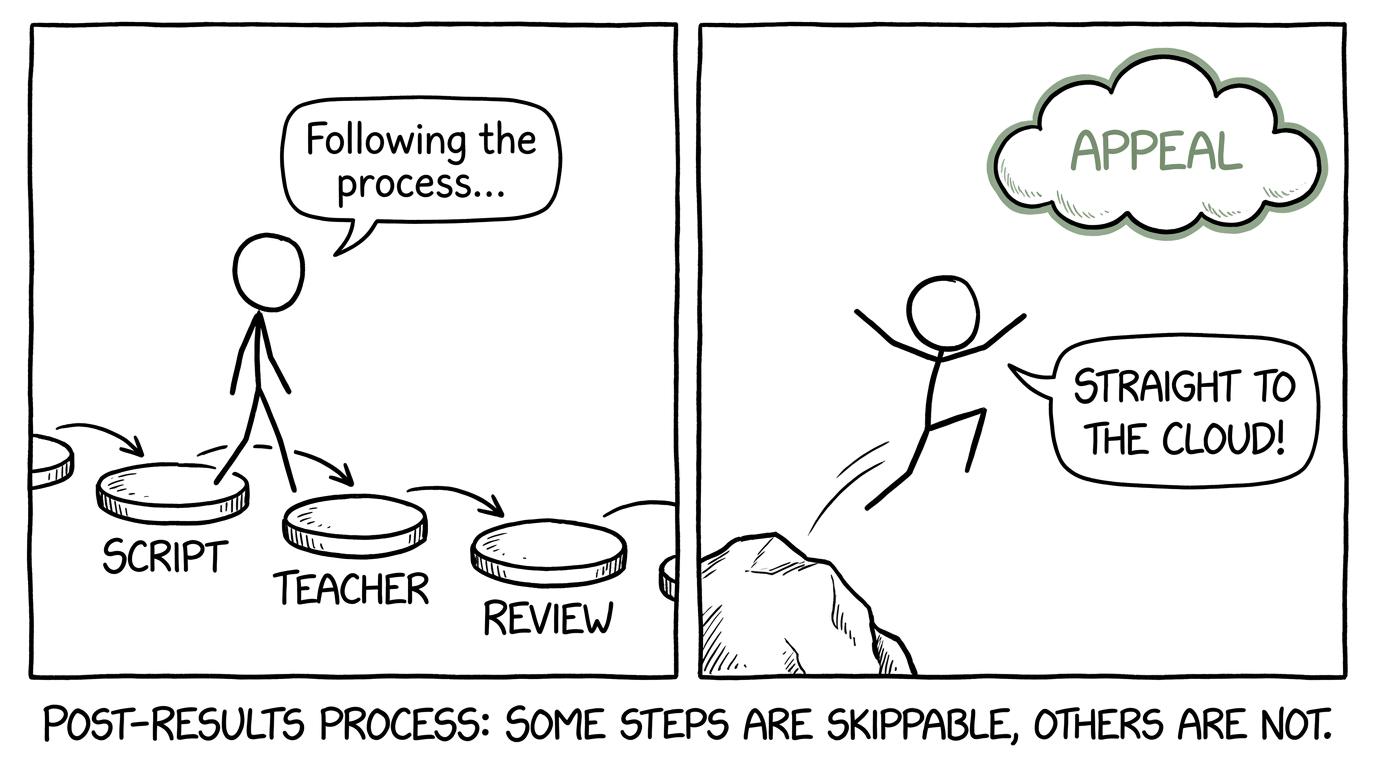 A student following the sensible script, teacher and review stepping stones instead of jumping straight to an appeal
Common mistakes with remarks and appeals
Assuming one mark below means one mark was missed
A boundary shows how grades were awarded across the examination series. It says nothing about the accuracy of your individual script. Look for a marking issue first.
Requesting a review without seeing the script
Where access is available in time, script inspection can prevent an unnecessary fee or reveal a stronger case than you initially expected.
Treating an appeal as a second remark
An appeal needs permitted grounds connected to the process or reasonableness of the decision. Simple disagreement with the mark is unlikely to be enough.
Forgetting that marks can decrease
A review can confirm, raise or lower the mark. Read the consent information and consider how a decrease might affect the current grade.
Missing the deadline
Do not rely on dates remembered from a previous year. Ask the exams officer for the deadline applying to your examination series and allow time for the school to process the request.
Paying without asking who covers the fee
Check the awarding-body charge, any centre administration cost and the centre's policy on refunds or waived charges when a qualification grade changes.
What this teaches you about future maths exams
A post-results review concerns Astronomy, but the lesson carries directly into GCSE and A Level maths: visible working makes assessment decisions easier to understand. Clear substitutions, units, diagrams and reasoning can help an examiner follow a valid method even when the final answer is wrong.
Build that habit before results day. Start with the free GCSE Maths revision hub, where revision lessons and practice questions develop reliable methods. Use GCSE mini tests to practise showing concise working, then move to the MathsGenie resources collection for mixed exam practice.
Past papers are most useful when you inspect your mistakes rather than merely record a score. The guide to when to start GCSE past papers helps you build that process gradually, while the best order for learning GCSE Maths topics provides structure when your revision feels scattered. You can also review the GCSE Maths topics that appear regularly before using mark schemes and video solutions to close specific gaps.
Make the decision from evidence, not hope
A GCSE Astronomy review is worth considering when a teacher can identify a plausible marking error and the potential correction could materially affect your grade. It is less persuasive when the argument begins and ends with being close to a boundary.
Start with the script. Check the mark scheme. Confirm the deadline, fee and risk with your exams officer. Request a review when the evidence supports one, and reserve an appeal for a genuine concern about how the process was handled.
Then turn your attention towards what you can still control. Use MathsGenie's free revision lessons, practice questions, mini tests, past papers, predicted papers, mark schemes and video solutions to make your next result less dependent on uncertainty. The strongest post-results strategy begins long before results day, with clear working, honest marking and one corrected mistake at a time.










