GCSE Astronomy Predicted Grade Process Explained
GCSE astronomy predicted grade process explained: see how mocks, class tests, observation skills, mark schemes and teacher judgement shape your forecast.
A predicted grade can feel strangely final. One number appears on a report, yet you may not know which mock, calculation or classroom task placed it there. The GCSE astronomy predicted grade process is usually an evidence-based forecast made by your teacher and checked under your school’s assessment policy. It is not a grade secretly assigned by Pearson, nor is there one national formula every school must use.
Teachers normally combine mock results, topic tests, exam-style classwork, progress over time and evidence covering different parts of the specification. They then use professional judgement to estimate the grade you are currently likely to achieve. Your school may moderate that decision across the department.
The important word is predicted. It describes a likely destination based on the evidence available now, not a result that has already been decided.
The predicted grade checklist
A GCSE Astronomy prediction will commonly consider:
- performance in timed mock examinations
- marks from specification-based topic tests
- the breadth and consistency of your subject knowledge
- success across knowledge, application and analytical questions
- mathematical and graphical skills
- understanding developed through observational work
- recent progress rather than one isolated result
- the school’s own assessment and moderation policy
There is no universal rule saying, for example, that one mock must contribute a fixed percentage. If you want to know the exact weighting used for your report, ask your teacher or consult your school’s published assessment policy.
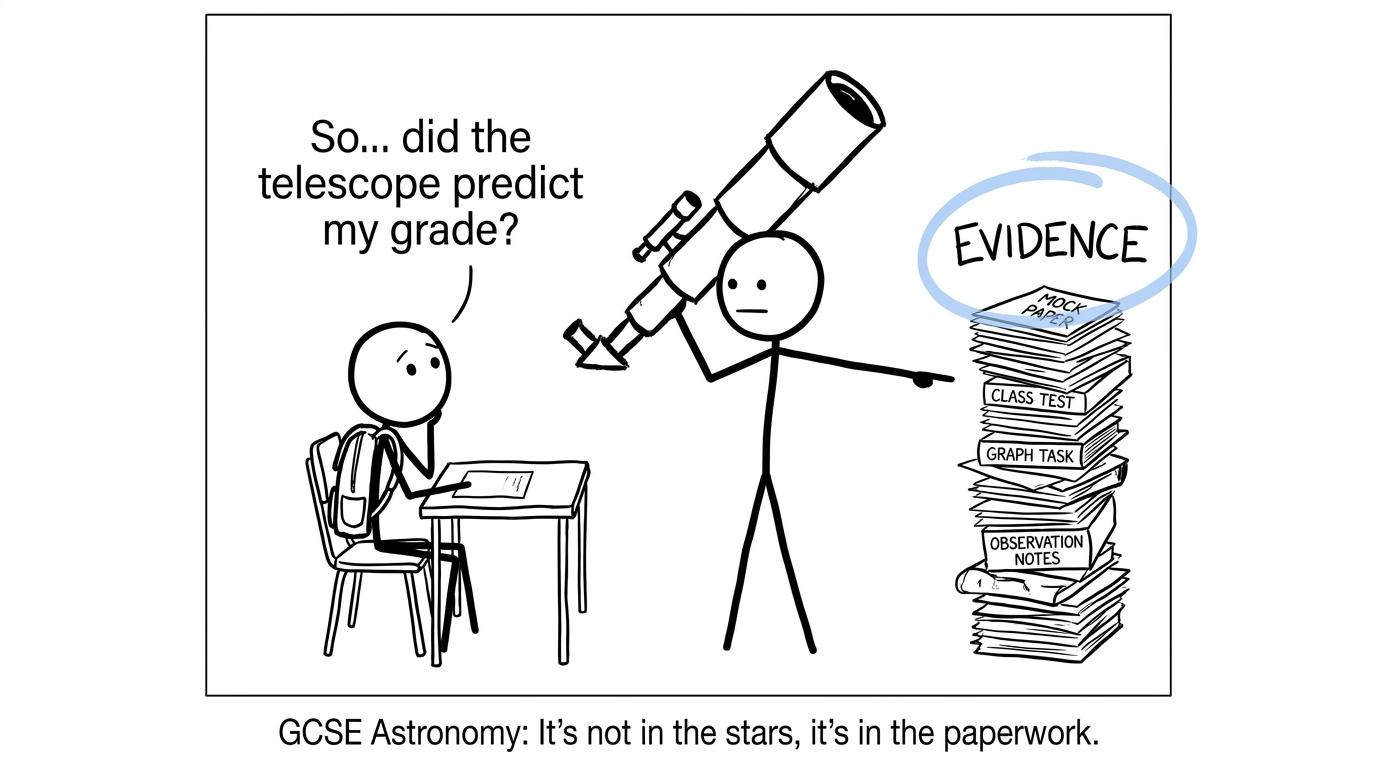 A student wondering whether a telescope predicted their grade while a teacher points to a stack of evidence
What a GCSE Astronomy predicted grade actually means
A predicted grade is a teacher’s forecast of your likely final outcome. Depending on the school, the term may mean the grade you are currently on track to achieve, or the grade you could reasonably achieve by the examination if progress continues. Those meanings are close, but not identical.
It is worth separating three labels:
- Target grade: an aspirational benchmark, sometimes set using prior attainment.
- Working-at grade: the standard demonstrated in recent assessed work.
- Predicted grade: the teacher’s evidence-based forecast of the likely final result.
Schools do not always use these terms in precisely the same way. A student can therefore remove a great deal of uncertainty by asking, “Does this prediction describe my present standard or my likely examination result?”
The final GCSE grade is different. For the current Pearson Edexcel GCSE Astronomy qualification, it comes from externally examined papers. Pearson sets the actual grade boundaries after students have sat the examinations and the papers’ difficulty can be considered. A school prediction cannot fix your eventual result or guarantee where a future boundary will fall.
The assessment structure behind the prediction
The current Pearson Edexcel GCSE Astronomy specification, code 1AS0, has two written papers:
- Paper 1: Naked-eye Astronomy, worth 50%50\%50% of the qualification
- Paper 2: Telescopic Astronomy, worth 50%50\%50% of the qualification
Each paper is worth 100100100 marks and lasts one hour and forty-five minutes. Across the qualification, the assessment objectives are weighted as follows:
- AO1 knowledge and understanding: 40%40\%40%
- AO2 application of knowledge and understanding: 40%40\%40%
- AO3 analysis, evaluation, judgement and conclusions: 20%20\%20%
This matters because a sound prediction should reflect more than remembered facts. A student may know the names of celestial objects yet lose marks when interpreting data or evaluating an observational method. Another may calculate accurately but leave extended explanations incomplete.
Teachers therefore look for evidence across the subject rather than treating one familiar topic as proof of an overall grade. Ofqual’s resilience guidance also emphasises that retained assessment evidence should cover a suitable breadth of content and assessment objectives. Although that guidance concerns the unlikely event that examinations cannot proceed, the same broad evidence can also support internal predictions.
The evidence teachers are most likely to use
Mock examinations
Mocks often carry significant influence because they can resemble the conditions of the final papers: a time limit, unseen questions, independent work and formal marking. A full mock can reveal whether you can retrieve knowledge and choose methods without prompts.
However, a mock is still one sample. Illness, unfinished content or poor timing may make it less representative. A teacher can consider those limitations alongside other evidence, subject to the school’s policy. This does not mean disappointing marks are ignored; it means they are interpreted in context.
Topic tests and exam-style work
Topic assessments provide repeated evidence. They can show whether your knowledge of planetary systems, stellar evolution, cosmology, coordinate systems and observational methods is secure across time.
Exam-style work is particularly useful when it is marked consistently with the relevant mark scheme. It reveals not only whether an answer is broadly correct, but whether it contains the scientific statements, calculations and evaluative reasoning needed for the marks.
Consistency and progress
A prediction is generally stronger when it rests on several pieces of evidence pointing in the same direction. Consistent performance suggests that the standard is repeatable.
Progress can matter too. If recent timed assessments show sustained improvement after earlier gaps were corrected, a teacher has better evidence that your current trajectory has changed. One excellent homework completed with unlimited support is less persuasive than repeated independent performance.
Professional judgement and moderation
Evidence does not organise itself. Teachers consider how demanding each assessment was, which content had been taught, whether work was completed independently and whether the evidence represents the full qualification.
Many schools then check predictions within a department or through a subject leader. This moderation can identify inconsistent marking or predictions that do not fit the available evidence. The details vary by school, which is why there is no single national GCSE Astronomy prediction calculator.
How observational work affects the forecast
Students must undertake at least one unaided and one aided astronomical observation. The school must confirm that this requirement has been completed. These activities develop the cycle of designing, making, analysing and evaluating observations.
A common misunderstanding is that the current observational tasks are a separately marked coursework component that directly contributes a fixed block of marks to the final grade. Under the current 1AS0 specification, the final qualification is assessed through the two written papers. Observational knowledge and skills are tested in those examinations.
Your observation records can still help a teacher understand your command of planning, data collection, uncertainty, safety and evaluation. A school may use related assessed work as part of its internal prediction evidence. Completing an observation alone, however, does not automatically raise a prediction. What matters academically is the understanding you can demonstrate.
Why mathematical evidence matters in Astronomy
At least 20%20\%20% of the marks in the written papers assess mathematical skills. Astronomy turns very large distances, tiny angles and changing quantities into questions that demand calm numerical reasoning.
Relevant skills include:
- rearranging and substituting into formulae
- converting units and working with scale
- interpreting tables, charts and graphs
- using ratios and proportional reasoning
- calculating gradients and drawing conclusions from data
- handling significant figures and standard form
- applying geometry and trigonometry where required
If these skills are weakening your assessment results, begin with MathsGenie’s free standard form revision resources, scatter graphs practice and SOHCAHTOA revision. Although the contexts differ, secure GCSE maths makes astronomical calculations and data interpretation more dependable.
How marks are translated into a predicted grade
Teachers may mark an assessment, compare the total with suitable historical grade boundaries and consider the standard demonstrated. But historical boundaries are guides, not promises. Boundaries can move from one examination series to another, and final boundaries are set after the live papers have been taken.
A sensible judgement therefore considers more than the nearest boundary. It asks:
- Was the assessment comparable with a real paper?
- Did it cover both sides of the course adequately?
- Was the work completed under controlled conditions?
- Is the same standard visible in other assessments?
- Is performance secure, improving or inconsistent?
Your teacher might also use notional paper boundaries when reviewing an individual mock paper, but the real qualification is awarded using the combined subject mark. Individual papers do not receive separate final GCSE grades.
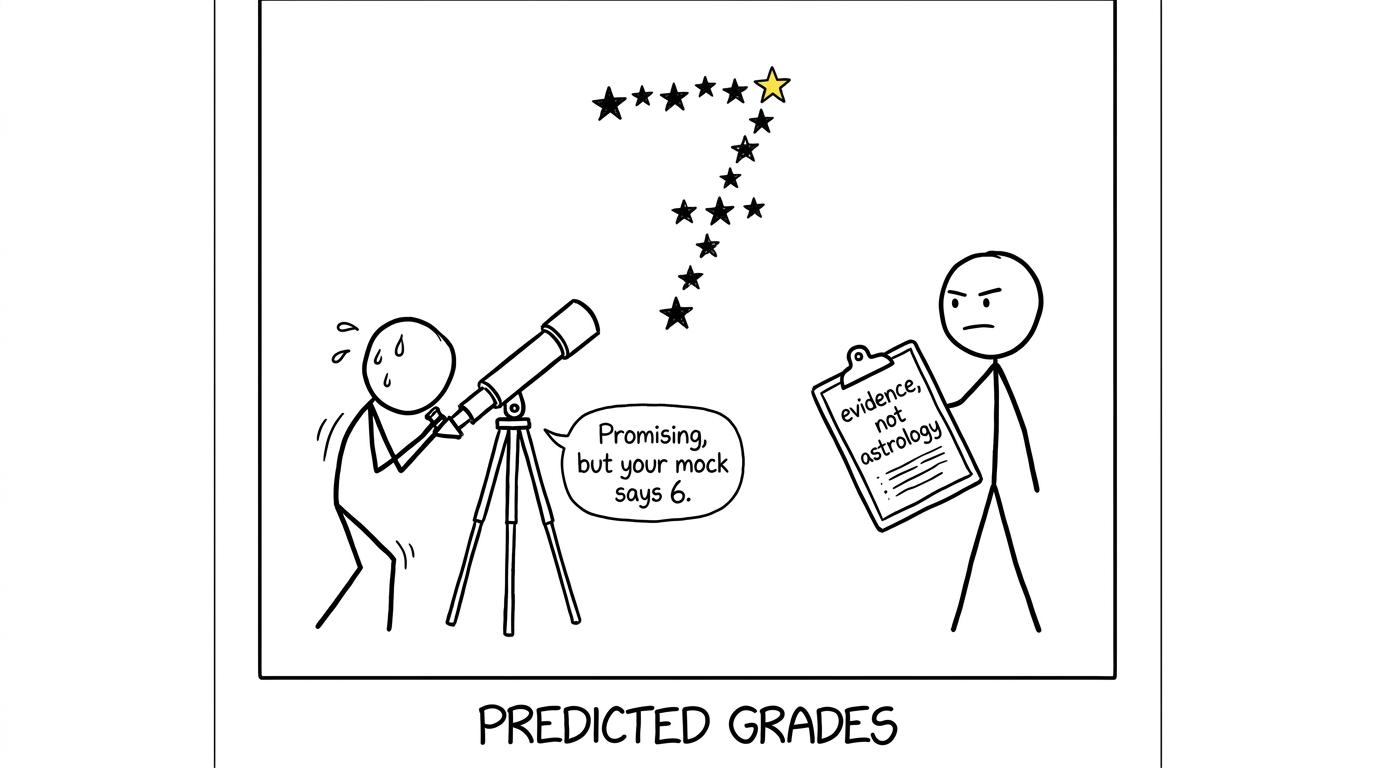 A student sees a grade-shaped constellation while the teacher insists predictions use evidence rather than astrology
What to do if the prediction seems wrong
Start with curiosity, not argument. Ask your teacher which evidence had the greatest influence and what would demonstrate the next grade securely.
Useful questions include:
- Which assessment objectives are limiting my result?
- Is my main issue knowledge, application or analysis?
- Which recent assessments best represent my prediction?
- What evidence would show sustained improvement?
- When will the prediction next be reviewed?
Bring specific evidence if you believe something has been missed, such as a later test or an agreed access arrangement that was not provided during a mock. Follow the school’s review or complaints procedure where necessary. A request based on evidence is more useful than saying that you need a particular grade.
Then turn the answer into a revision plan. MathsGenie’s guide to building a GCSE maths revision timetable and its one-month revision plan can help you organise mathematical practice around your Astronomy commitments.
Common mistakes about predicted grades
Treating the prediction as permanent
Predictions can change when a school issues a later report and stronger evidence becomes available. The published final result is determined by your examination performance, not by an earlier report grade.
Assuming the latest mock is the whole decision
A mock may be important without being the only evidence. Topic coverage, assessment conditions, consistency and other tests can all affect how teachers interpret it.
Comparing raw marks from different papers directly
Two papers with the same maximum mark are not necessarily equally difficult. Using one historical boundary as a permanent conversion rule can create false confidence or unnecessary panic.
Confusing observation completion with examination marks
The required aided and unaided observations must be completed and confirmed, but they are not a separately weighted coursework mark under the current specification. You still need to apply observational understanding in the written papers.
Revising only facts
Knowledge is essential, but the assessment also rewards application, data analysis, evaluation and mathematical reasoning. A prediction may remain below your target if recall improves while these other skills do not.
Turn the prediction into useful evidence
A predicted grade is most valuable when it changes what you do next. Identify the weakest assessment objective, practise it under timed conditions and check the result against a mark scheme. Repeat the process until the stronger performance becomes consistent.
For the mathematical side of Astronomy, use MathsGenie’s free GCSE and A Level revision hub for revision lessons, practice questions, mini tests and video solutions. Build examination discipline with Edexcel GCSE Maths past papers, then use predicted papers for fresh timed practice. The questions are mathematical rather than Astronomy-specific, but the habits transfer: show your method, interpret evidence carefully and learn from every lost mark.
The forecast on a report is a snapshot. Your next assessment is new evidence. Make it better evidence.