GCSE Astronomy Paper 2: What to Actually Expect
GCSE Astronomy Paper 2 explained: timing, topics, question styles, calculations, observational skills and a practical revision plan for exam success.
The unsettling thing about a second paper is not always its difficulty. It is the uncertainty. Does it contain harder questions? Does it require different maths? Should you revise it differently from Paper 1?
For GCSE Astronomy Paper 2, the practical answer is clear: it has the same timing, marks and broad range of question styles as Paper 1, but it covers a different half of the Pearson Edexcel specification. Its emphasis shifts towards telescopic astronomy, instruments, the Solar System, starlight, stellar evolution, the Galaxy and cosmology.
That change in content means Paper 2 often feels more data-heavy and technical. You may need to interpret spectra, compare observing methods, use unfamiliar information and connect evidence to astronomical conclusions. Knowing facts matters, but applying them matters just as much.
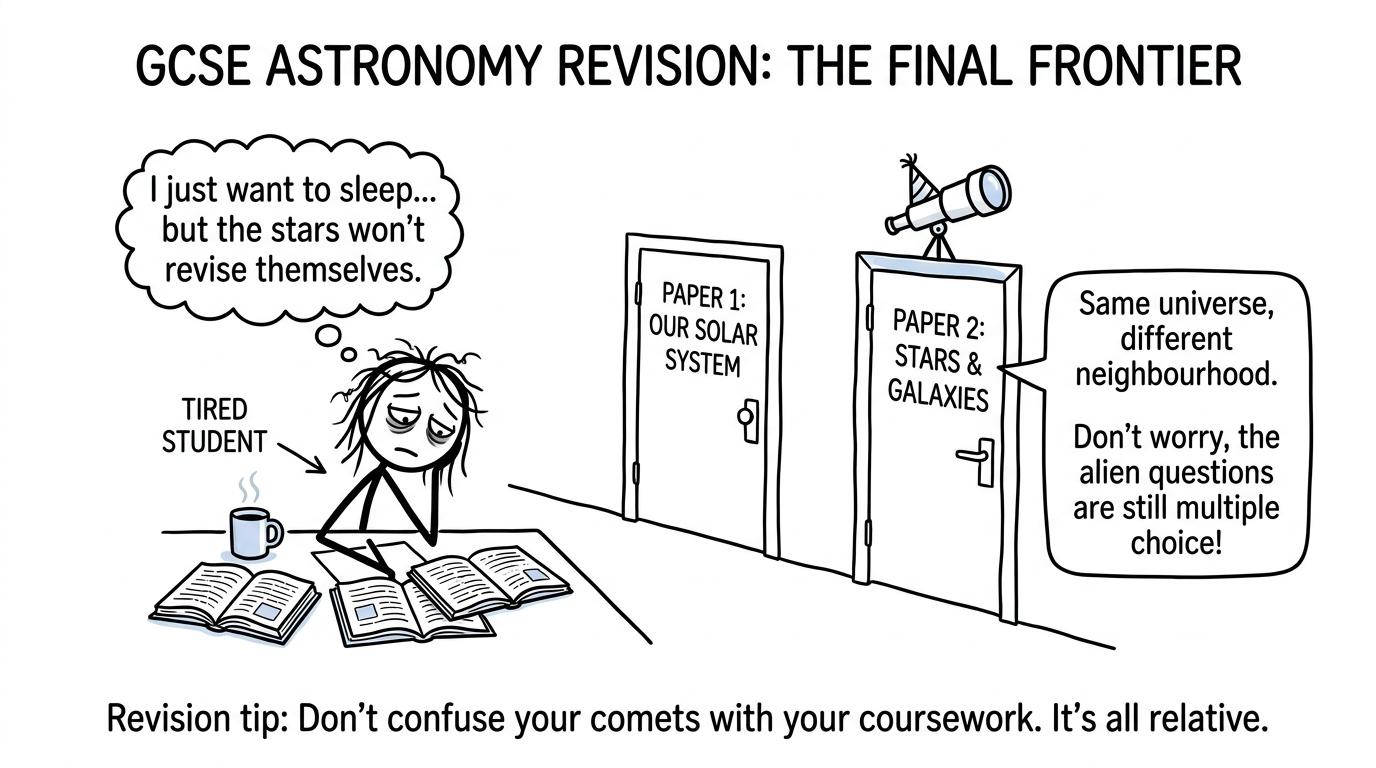 A student discovers that Paper 2 covers the same universe from a different neighbourhood
GCSE Astronomy Paper 2 at a glance
The current Pearson Edexcel GCSE Astronomy qualification is untiered. Unlike GCSE Maths, there are no separate foundation and higher papers: every candidate sits the same assessment.
| Feature | GCSE Astronomy Paper 2 |
|---|---|
| Official title | Telescopic Astronomy |
| Paper code | 1AS0/02 |
| Duration | 111 hour 454545 minutes |
| Total marks | 100100100 |
| Qualification weighting | 50%50\%50% |
| Main content | Topics 999 to 161616 |
| Calculator | Allowed |
| Questions | Multiple-choice, short-answer, calculation, graphical and extended open-response |
| Formulae and data | A formulae and data sheet is supplied |
You must answer every question. The paper contains ten whole questions, normally divided into several parts, and the level of demand generally rises as you move through a question.
A useful starting point is the Edexcel GCSE Astronomy revision hub, where you can bring lessons, questions, past papers and mark schemes into one revision routine.
What is actually different from Paper 1?
Paper 1 is called Naked-eye Astronomy and assesses Topics 111 to 888. Paper 2 is Telescopic Astronomy and assesses Topics 999 to 161616.
The clock does not change. The number of marks does not change. The broad question formats do not change either. What changes is the astronomical territory being examined.
Paper 2 covers:
- exploring the Moon
- solar astronomy
- exploring the Solar System
- the formation of planetary systems
- exploring starlight
- stellar evolution
- our place in the Galaxy
- cosmology
The word “telescopic” can be misleading if it makes you revise only telescope diagrams. Telescopes are important, but Paper 2 stretches far beyond them. It follows the evidence gathered by instruments: from lunar surfaces and solar activity to spectra, stars, galaxies and the development of the Universe.
There can also be synoptic assessment. That means knowledge associated with the other half of the course may provide context or support your reasoning. Treat Topics 999 to 161616 as the main boundary, not as permission to forget everything learned earlier.
The question types Paper 2 tends to favour
Pearson does not promise an identical distribution of topics or question types every year. Predictions should therefore be treated as revision guidance, not certainty. Even so, the Paper 2 content naturally lends itself to several recurring demands.
Interpreting unfamiliar information
A question may introduce a graph, image, table, spectrum or description of an observation. The information can look new even when the underlying astronomy is familiar.
Pause before searching your memory. Identify:
- what each axis, column or label represents
- the units being used
- the pattern or comparison visible in the data
- which specification idea explains that pattern
- whether the question asks you to describe, explain, analyse or evaluate
This distinction matters. A description states what happens. An explanation gives the astronomical reason. An analysis must normally use relevant evidence from the material provided.
Calculations with large and small quantities
Astronomy deals with immense distances and very small angles, so Paper 2 can test confident calculator use, powers, ratios, rearrangement, significant figures and standard form.
Numbers in standard form have the structure
a×10n,1≤a<10.a \times 10^n, \qquad 1 \leq a < 10.a×10n,1≤a<10.Revise this skill through the MathsGenie standard form revision guide. Although GCSE Maths pages may be organised by exam board, the underlying number skills transfer directly to astronomy.
Pearson examiner guidance has repeatedly stressed the importance of clear, structured working. This is especially important when a question says show that. The stated answer is not the achievement; the justified route to it is.
Write down the formula, substitute clearly, preserve calculator precision until the final step and give a sensible number of significant figures. Always include the unit when one is required.
Graphs and relationships
Paper 2 can ask you to read, plot or interpret graphical information. That might include identifying a trend, estimating from a graph, comparing rates of change or explaining what a relationship suggests physically.
Do not treat a graph as decoration. Read the scales carefully, notice whether they are linear or logarithmic, and use numerical evidence when the command word requires analysis.
If graph interpretation is a weak point, use the trigonometric and exponential graphs questions to strengthen your confidence with scales, curves and coordinates. The astronomy context will differ, but the habit of reading mathematical information precisely remains the same.
Extended astronomical explanations
Longer responses reward connected reasoning rather than a pile of isolated facts. A strong answer usually has a visible chain:
- make a relevant scientific statement
- explain why it is true
- connect it to the situation in the question
- use any data or evidence supplied
- evaluate limitations if requested
The marks shown beside the question are a clue to the expected depth. A response worth several marks normally needs several developed ideas. Repeating one correct fact in different words does not create a stronger argument.
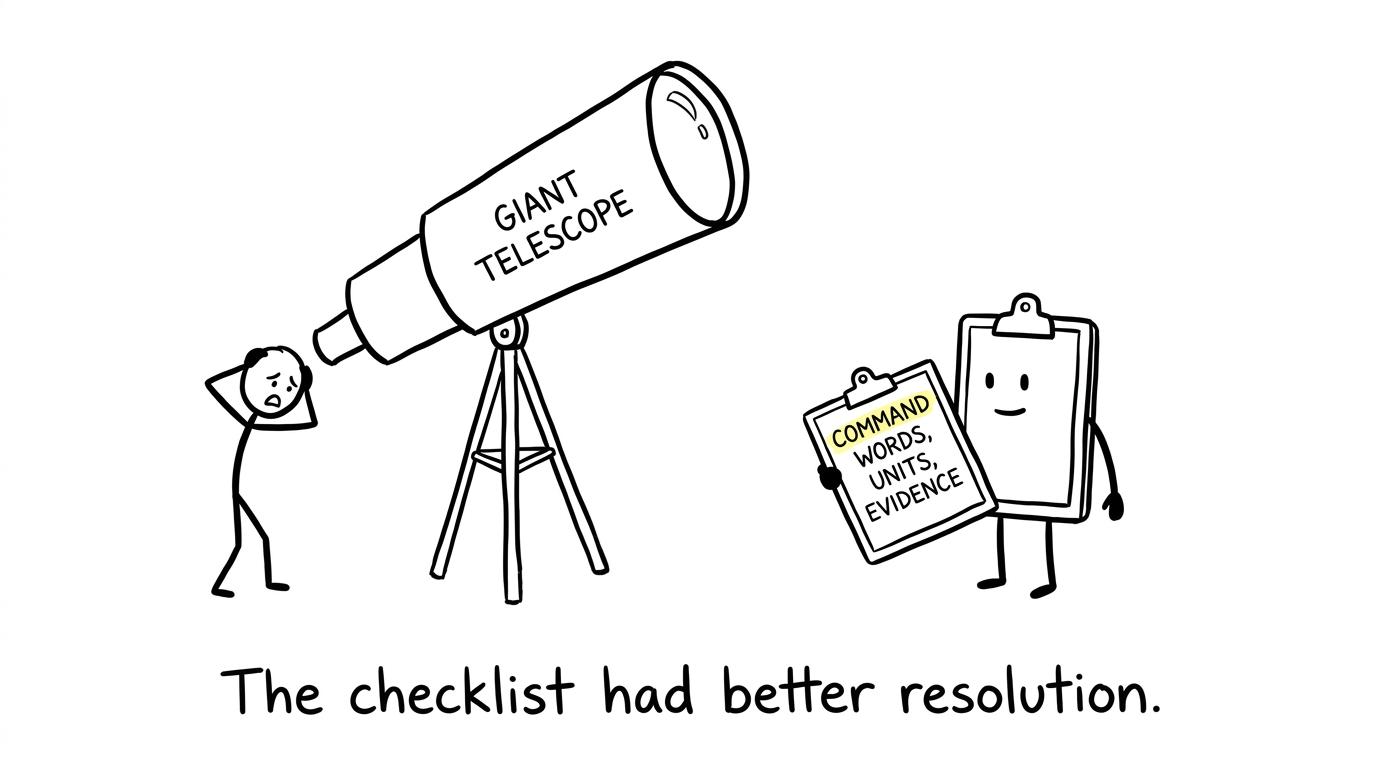 A revision checklist achieves better resolution than an enormous imaginary telescope
Observational skills still matter
The examination is written, but observational astronomy remains part of what is assessed. Students are required to undertake at least one unaided and one aided observation during the course, and knowledge of observational techniques and procedures can appear in the papers.
Paper 2 may ask you to think like an observer. You could need to consider:
- a suitable observing site and time
- the instrument and its relevant properties
- atmospheric conditions and light pollution
- safe observational practice
- repeated measurements
- how observations should be recorded
- reliability, limitations and realistic improvements
A generic statement such as “use better equipment” is rarely convincing. Name the relevant improvement and explain what it changes. Repeating observations may reduce the effect of random variation. Choosing a darker site may make fainter objects detectable. Using an appropriate instrument may improve resolution, sensitivity or field of view.
Solar observation deserves particular care. Never suggest looking directly at the Sun through binoculars or a telescope. Any proposed method must follow the safe technique specified in the course and question.
How to manage the timing
There are 105105105 minutes for 100100100 marks. That gives an average of
105100=1.05\frac{105}{100}=1.05100105=1.05minutes per mark.
This is a guide, not a rigid stopwatch rule. Some multiple-choice marks will take less time, leaving more for calculations and extended responses. However, a low-mark question should not absorb ten minutes simply because you feel close to remembering an answer.
A calm approach is to:
- read the command word before writing
- use the mark allocation to judge the expected depth
- move on if a question is consuming disproportionate time
- leave enough time to revisit calculations, units and unanswered parts
For practice, complete a full paper under the official time. Then mark it carefully. Separate lost marks into knowledge, application, maths, observational reasoning and exam technique. That diagnosis is more useful than the total alone.
 An exam clock and telescope compete in an unblinking staring contest
A focused revision checklist
Trying to reread every page equally is comforting because it feels thorough. It is often less effective than testing what you can retrieve.
Use this Paper 2 checklist:
- Can you explain the key ideas in Topics 999 to 161616 without notes?
- Can you interpret diagrams, spectra, tables and graphs?
- Can you select and rearrange equations from the data sheet?
- Can you use standard form and significant figures accurately?
- Can you describe a valid aided observation?
- Can you analyse evidence rather than merely repeat it?
- Can you evaluate a method with specific limitations and improvements?
- Have you completed a timed Paper 2 and used its mark scheme?
The maths is best repaired by skill rather than by vague intention. The GCSE Maths revision hub contains revision lessons, practice questions, mini tests and papers. For angular calculations and instrument geometry, revisit SOHCAHTOA and trigonometry where relevant to your course.
If your revision feels disorganised, the best order for learning GCSE Maths topics offers a useful learn-practise-test cycle. You can also use the MathsGenie self-assessment resources to identify weaknesses before spending time on material you already know.
Common mistakes on GCSE Astronomy Paper 2
Revising telescope facts but neglecting the Universe
Telescopic Astronomy includes planetary systems, stellar evolution, the Galaxy and cosmology. A narrow focus on lenses, mirrors and telescope types leaves large parts of the paper uncovered.
Giving knowledge when the question asks for evidence
If the command word is analyse, use the numerical or graphical information supplied. If it is evaluate, discuss strengths, limitations and their consequences. Correct background knowledge alone may not answer the question.
Hiding the working
An unexplained calculator answer can lose method marks. Show the equation, substitution and key stages, especially for show that questions.
Rounding too early
Keep the calculator value through the intermediate stages and round only at the end. Early rounding can push the final answer outside an accepted range.
Writing vague observational improvements
“Use a better telescope” does not explain what becomes better. Link the improvement to resolution, sensitivity, field of view, measurement precision or reliability.
Forgetting units and significant figures
Check whether the question expects seconds, years, kilometres or another unit. Use the precision of the supplied data as a guide when presenting your final answer.
Go into Paper 2 knowing what it is
GCSE Astronomy Paper 2 is not a mysterious harder sequel. It is an equally weighted examination of a different group of topics, with more emphasis on what instruments and evidence reveal about the Solar System, stars, galaxies and the Universe.
Revise the astronomy, but also practise the actions the paper rewards: interpreting, calculating, analysing, evaluating and planning observations. Start with the MathsGenie Edexcel Astronomy resources, complete past papers under timed conditions and inspect the mark schemes closely.
For the mathematical skills supporting your astronomy, and your GCSE Maths examinations, use MathsGenie's free revision lessons, practice questions, mini tests, predicted papers, mark schemes and video solutions. Let each paper show you the next weakness to fix. That is how uncertainty becomes a plan.