

GCSE Astronomy Grade 7 Meaning: What It Shows
GCSE astronomy grade 7 meaning explained: discover the ability it represents, how it compares with an old A, and how grade boundaries affect results.
A result can look simple on paper and still leave a large question behind it. You see a 777, know it is good, but wonder what it actually says about your ability.
The gcse astronomy grade 7 meaning is straightforward at first: it is a strong GCSE result, with the bottom of grade 777 aligned by Ofqual to the bottom of the old grade A. In Astronomy, it indicates secure knowledge across the course and a strong ability to apply that knowledge in calculations, observations, graphs and extended explanations. It does not mean you needed 70%70\%70%, nor does it mean you mastered every topic.
That distinction matters. A grade is not a personality test or a permanent verdict on how clever you are. It is a summary of how successfully you met the demands of particular papers in a particular exam series.
Grade 7 in GCSE Astronomy at a glance
Here is the short version:
- Grade 777 is one of the top three numerical grades, below grades 888 and 999.
- Its lower threshold is comparable with the lower threshold of the old grade A.
- It represents strong performance, not complete mastery of the specification.
- GCSE Astronomy is untiered, so there is no foundation or higher paper.
- The final grade is based on two written papers worth 100100100 marks each.
- Grade boundaries are set after the papers have been taken and can change each year.
- Mathematical skills account for at least 20%20\%20% of the written assessment.
- Observational skills account for at least 15%15\%15% of the written assessment.
The qualification discussed here is Pearson Edexcel GCSE Astronomy, specification code 1AS0. It contains Paper 1, Naked-eye Astronomy, and Paper 2, Telescopic Astronomy. Each paper lasts 111 hour 454545 minutes and contributes 50%50\%50% of the qualification.
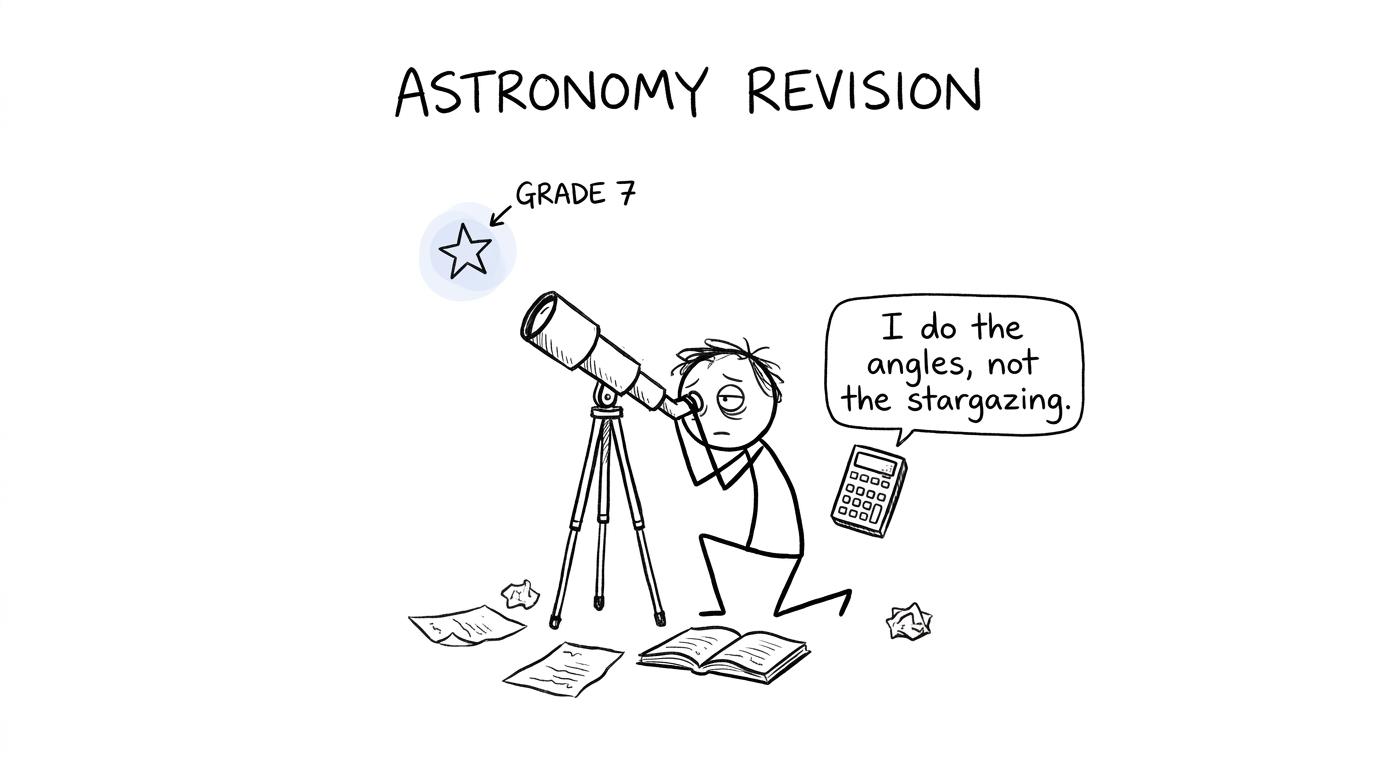 A GCSE student spots Grade 7 through a telescope while a calculator comments from the ground
What ability does a grade 7 actually represent?
A grade 777 suggests that you can do more than recall isolated facts about planets, stars and galaxies. You can usually select relevant knowledge, connect ideas and communicate scientific reasoning with reasonable precision.
Pearson divides the assessment into three objectives:
- AO1: demonstrate knowledge and understanding, worth 40%40\%40%.
- AO2: apply knowledge and understanding, worth 40%40\%40%.
- AO3: analyse information and ideas, interpret evidence and make judgements, worth 20%20\%20%.
A student working around grade 777 will normally be collecting marks across all three areas. Knowing a definition helps, but stronger performance comes from using that knowledge in an unfamiliar context, interpreting data correctly and explaining why a conclusion follows from the evidence.
Secure knowledge across a broad course
GCSE Astronomy contains 161616 topics. They range from the Earth-Moon-Sun system and planetary motion to stellar evolution, galaxies and cosmology.
A grade 777 does not require perfection in all 161616 topics. It does, however, usually reflect broad enough understanding that one weak area does not overwhelm the whole result. You may lose marks on an unfamiliar telescope question and recover them through stronger responses on lunar observations, orbital motion or stellar evolution.
This is why balanced revision is valuable. A careful topic order, similar to the approach in MathsGenie's guide to the best order for learning GCSE maths topics, helps you repair foundations before tackling more demanding applications.
Confident application of mathematics
Astronomy gives mathematics a physical setting. Angles describe positions in the sky. Graphs reveal patterns. Ratios compare scale, and standard form makes extremely large distances manageable.
At grade 777, a student is likely to handle many of these demands accurately, including:
- substituting into and rearranging formulae;
- working with ratios and proportional relationships;
- interpreting graphs and gradients;
- converting between units;
- using standard form;
- applying geometry and trigonometry;
- presenting suitable significant figures.
These are not decorative skills added to the science. Pearson requires at least 20%20\%20% of the written marks to assess mathematical skills.
If angles and triangles are costing you marks, MathsGenie's SOHCAHTOA trigonometry revision provides lessons, questions and revision support. You can also strengthen scientific notation through the standard form revision resources. Check that any page you use matches the mathematical skill you need, even when your school follows a different maths exam board.
Thoughtful observational reasoning
Astronomy is unusual because observation remains central even though the final grade is determined through written examinations. Students must undertake at least one unaided observation and one aided observation during the course. Knowledge of observational procedures is then assessed in the papers.
A strong candidate can think beyond what was seen. They can consider the method, equipment, conditions, accuracy, limitations and possible improvements. That means understanding why an observation may be unreliable, not merely stating that it is unreliable.
This ability to evaluate evidence is one of the clearest signs that performance has moved beyond simple recall.
How grade 7 compares with the old letter grades
The safest comparison is this: the bottom of grade 777 is aligned with the bottom of the old grade A.
That wording comes from Ofqual and is more precise than saying every grade 777 is exactly identical to an A. The numerical and letter scales do not have a perfect one-to-one conversion. Grades 777, 888 and 999 together cover the part of the old scale occupied by grades A and A*, with greater differentiation among high-attaining students.
So, as a practical guide:
- grade 777 is broadly comparable with an old grade A;
- grade 888 sits higher within the former A and A* range;
- grade 999 identifies the very highest performance on the numerical scale.
A grade 777 should not be described as an A* or as merely a B. It begins at the officially aligned old-A threshold.
Does a grade 7 mean 70 per cent?
No. This is one of the most persistent misunderstandings about GCSE grades.
Grade boundaries translate raw marks into grades. They are set for each exam series after the difficulty of the papers has been considered. A grade 777 boundary may therefore be above or below 70%70\%70%.
For example, Pearson's June 2025 overall boundary for grade 777 in GCSE Astronomy was 133133133 marks out of 200200200. As a percentage, that is:
133200×100=66.5%\frac{133}{200}\times 100=66.5\%200133×100=66.5%In June 2024, the grade 777 boundary was 124124124 out of 200200200, equivalent to 62%62\%62%. The difference does not mean that grade 777 changed its broad standard from one year to the next. It shows why boundaries move when papers differ in demand.
You can inspect the published figures on MathsGenie's Edexcel GCSE Astronomy grade boundaries page. Treat past boundaries as useful context, not as promises about a future examination.
How the two papers combine
Paper 1 and Paper 2 are each worth 100100100 marks, giving a total of 200200200. Your overall grade comes from the combined raw mark.
This has an encouraging consequence: you do not need identical performance on both papers. A weaker result on Naked-eye Astronomy can be balanced by a stronger Telescopic Astronomy paper, or the other way around. Individual paper boundaries sometimes published for guidance are not separate qualification grades; the overall combined boundary determines the result.
The papers include multiple-choice, short-answer, calculation, graphical and extended-open-response questions. Grade 777 performance is therefore built from many small decisions: using the right unit, reading a scale carefully, giving enough detail and returning to a difficult question rather than abandoning it.
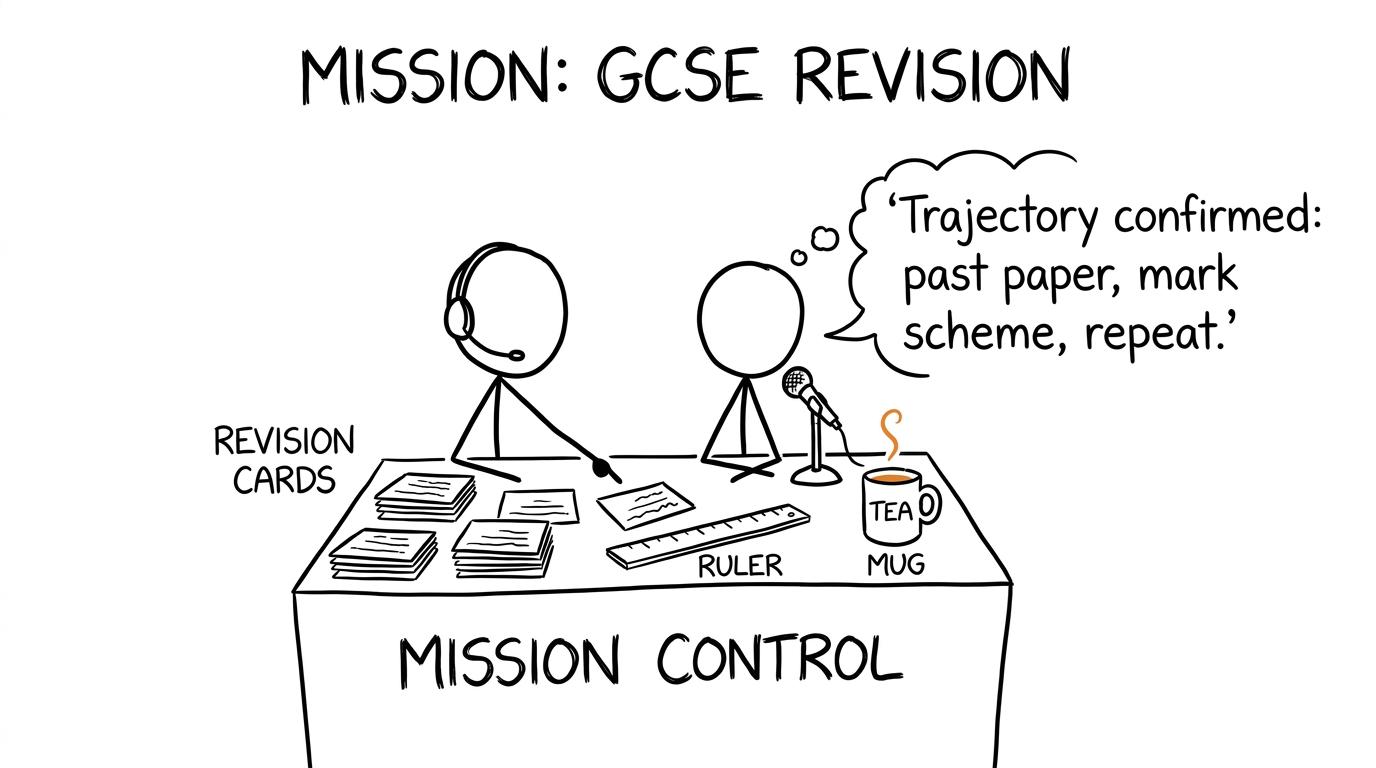 Stick figures at revision mission control plot a route through past papers and mark schemes
What should you do if you are aiming for grade 7?
Start by replacing the vague target of “get better at Astronomy” with a marks-based process.
Diagnose before revising
Complete a timed paper or substantial mixed set without consulting notes. Mark it carefully and classify each lost mark:
- missing knowledge;
- weak mathematical method;
- misunderstood command word;
- insufficient explanation;
- unit, rounding or calculator error;
- observational evaluation that lacked specificity.
MathsGenie's past papers platform demonstrates the useful paper-and-mark-scheme rhythm for maths revision. Apply the same discipline to official Astronomy papers supplied by your school or exam board.
Repair the mathematics underneath the astronomy
If calculations repeatedly break down, revising more astronomical facts will not solve the underlying problem. Isolate the mathematical skill and practise it separately.
MathsGenie's GCSE maths topics by exam board and tier can help you locate revision lessons and practice questions for equations, graphs, proportion, geometry and other supporting skills. Although Astronomy itself is untiered, your GCSE Maths course may be foundation or higher tier, depending on your entry.
Use a repeatable revision loop
A useful session has four parts:
- recall one topic without notes;
- complete exam-style questions;
- check the mark scheme;
- record one precise correction and retest it later.
If you need a longer structure, adapt the routine in the GCSE one-month maths revision plan. Short, regular retrieval is more informative than repeatedly reading a chapter that already feels familiar.
Predicted papers can provide fresh mathematical practice near an exam, but they should supplement rather than replace official past papers. MathsGenie's GCSE predicted papers include practice papers and solutions for strengthening the calculation and problem-solving habits that Astronomy also rewards.
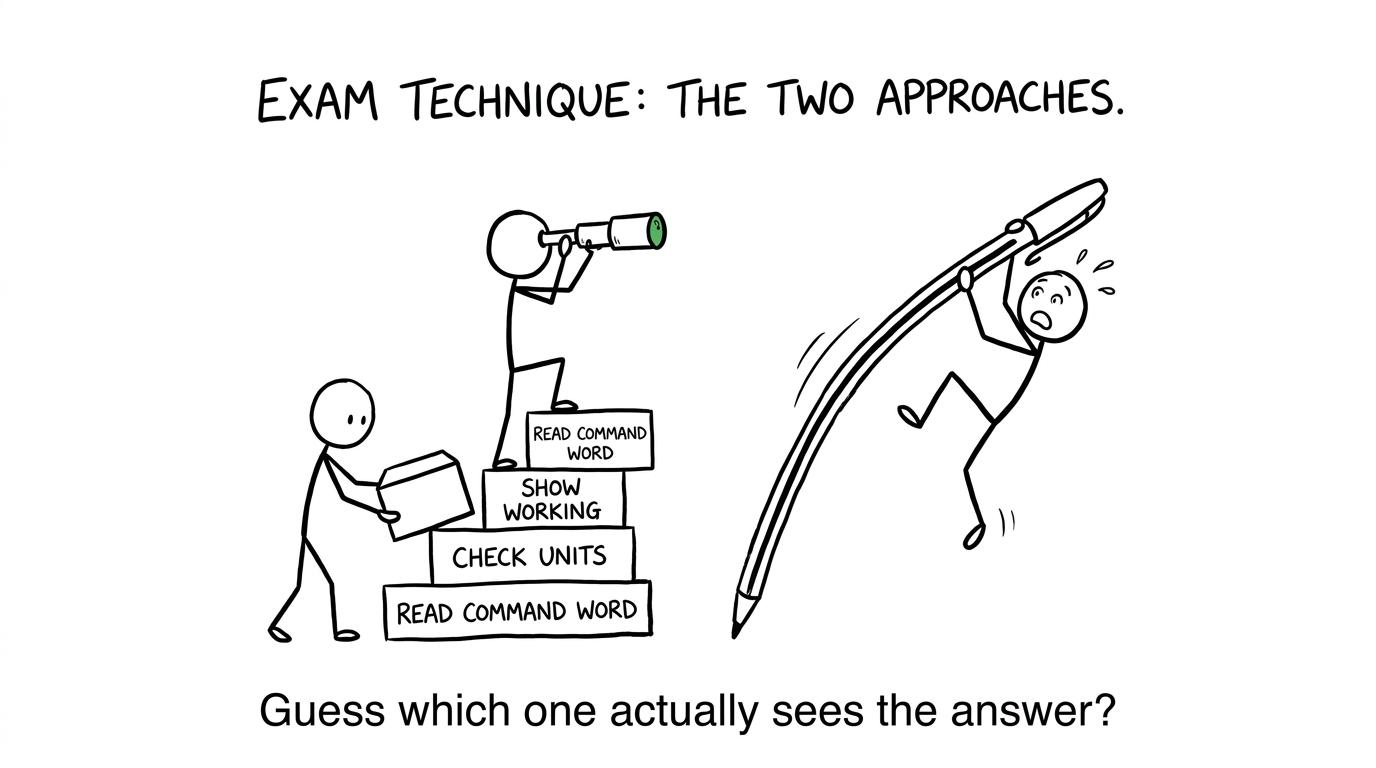 A student climbs exam-technique steps while another attempts an unwise shortcut
Common mistakes when interpreting or chasing grade 7
Treating the boundary as a fixed target
A previous boundary is not a forecast. Build a margin above it in practice rather than aiming for the exact historical mark.
Assuming factual recall is enough
Only 40%40\%40% of the assessment weighting is AO1. Application, analysis and evaluation account for the rest. Practise explaining and interpreting, not only memorising.
Ignoring mathematical working
An unsupported calculator answer can lose marks that a clear method might protect. Write substitutions, keep units visible and avoid rounding too early.
Revising only favourite topics
Comfort can disguise gaps. Use papers and mini tests to identify what actually costs marks, then begin the next session with that weakness.
Comparing percentages across different years
A mark of 124124124 had a different position relative to the grade 777 boundary in different series. Compare grades only through the correct boundary for that year.
Thinking one grade defines your potential
A grade 777 is strong evidence of achievement under examination conditions. It is not a ceiling. Grades 888 and 999 require greater consistency, precision and success on demanding questions, all of which can be developed.
A grade is a milestone, not the whole journey
The real GCSE Astronomy grade 777 meaning is not simply “old A” or a particular percentage. It represents a strong combined performance across knowledge, application, mathematics, observation and scientific judgement.
If you are already near that level, your next marks are often hidden in small habits: checking units, interpreting command words, showing calculations and giving evidence-based evaluations. If you are not there yet, the grade becomes more useful when you stop treating it as a distant label and start treating it as a collection of learnable skills.
Use MathsGenie as your free mathematics revision base. Strengthen weak methods with revision lessons, practise them through topic questions and mini tests, then test your accuracy with past papers, predicted papers, mark schemes and video solutions. The sky may be vast, but your next revision step should be small, specific and close enough to begin today.










