GCSE Art and Design Grade Boundaries Year to Year
GCSE art and design grade boundaries year to year usually move slightly. Compare recent shifts by board and understand why the marks change in practice.
A grade boundary can feel strangely powerful. One line in a table appears to decide whether months of sketches, experiments and refinements become a grade 666 or a grade 777.
But GCSE art and design grade boundaries year to year usually change by only a small number of marks. In the latest published summer figures, from June 2024 to June 2025, AQA's boundaries did not move at all, Edexcel's rose by 111 mark, and OCR's and Eduqas's generally rose by no more than 222 marks.
That does not mean future boundaries are fixed. Exam boards set them after marking and moderation so that the quality of work needed for each grade remains comparable. The useful lesson is simple: look at previous boundaries for context, but build a margin above them rather than treating last year's figures as a promise.
The short answer
Here is the practical overview:
- Art and Design boundaries can change every year, but recent annual movements have mostly been small.
- The exact movement depends on the exam board and specification.
- AQA, Edexcel, OCR and Eduqas use different maximum marks, so raw boundaries cannot be compared directly between boards.
- Boundaries are confirmed after assessment and moderation, not predicted reliably in advance.
- GCSE Art and Design is untiered, so there are no separate foundation and higher boundaries.
- The safest target is a mark comfortably above the previous boundary for your desired grade.
You can check historical figures through the MathsGenie grade boundaries centre, which separates results by board, subject and examination series.
How much did the boundaries actually move?
The clearest comparison uses the two most recent published summer series: June 2024 and June 2025. As of August 2026, summer 2026 boundaries have not yet been published, so June 2025 remains the latest confirmed summer data available.
| Exam board | Qualification maximum | Change from 2024 to 2025 | What happened |
|---|---|---|---|
| AQA | 480480480 scaled marks | 000 marks | Every grade boundary remained unchanged |
| Edexcel | 180180180 marks | +1+1+1 mark | Every boundary rose by 111 mark |
| OCR | 200200200 marks | +1+1+1 to +2+2+2 marks | Grades 999 to 555 rose by 111; grades 444 to 111 rose by 222 |
| Eduqas | 200200200 marks | 000 to +2+2+2 marks | Some boundaries stayed level; others rose slightly |
This is a picture of stability, not dramatic volatility. Even the largest annual change shown above was 222 marks out of 200200200:
2200×100=1%\frac{2}{200}\times 100=1\%2002×100=1%That is a movement of one percentage point of the available marks. Small, but still meaningful if a student's total sits directly on the boundary.
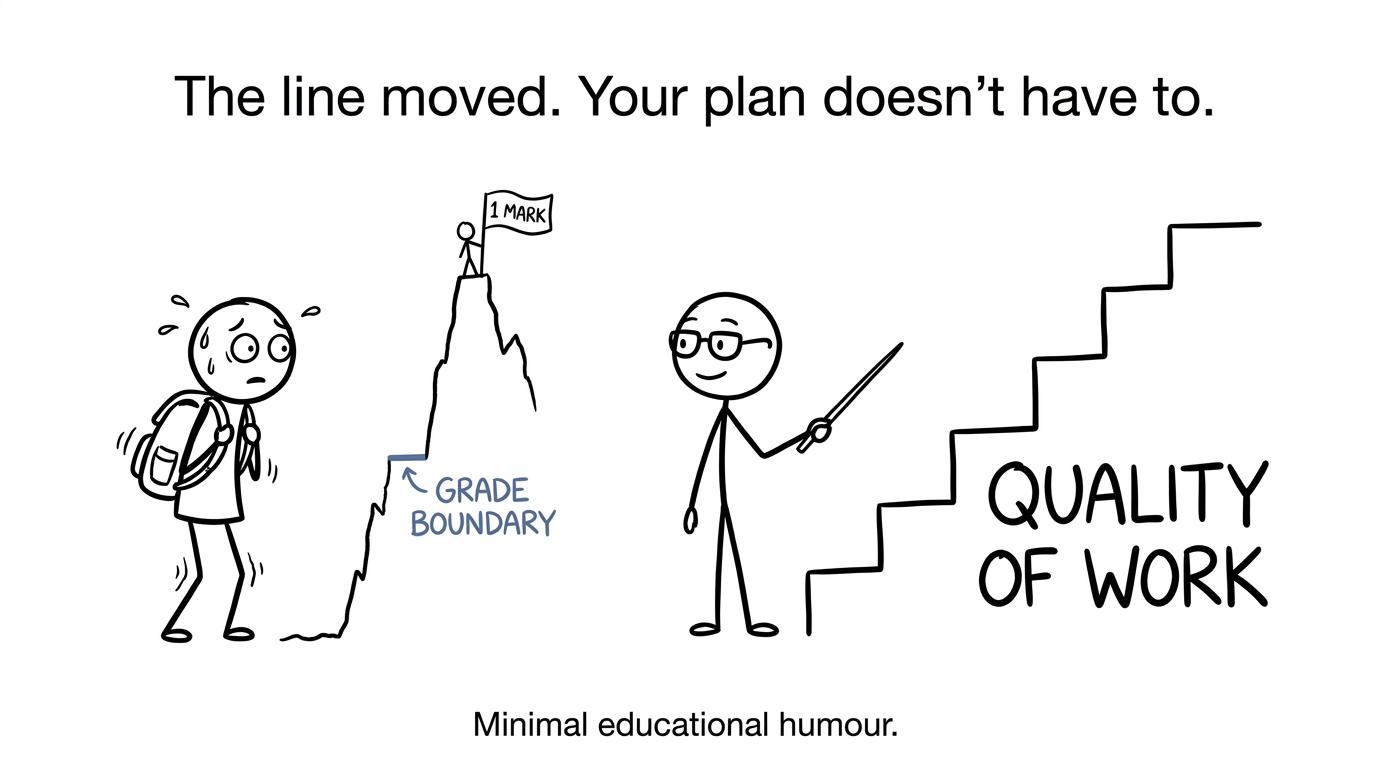 A student mistakes a small boundary movement for a mountain
Recent grade boundaries by exam board
AQA Art and Design
AQA's subject boundaries were identical in June 2023, June 2024 and June 2025 across its Art and Design titles. The published scaled boundaries included:
| Grade | 2023 | 2024 | 2025 |
|---|---|---|---|
| 999 | 403403403 | 403403403 | 403403403 |
| 777 | 340340340 | 340340340 | 340340340 |
| 555 | 266266266 | 266266266 | 266266266 |
| 444 | 230230230 | 230230230 | 230230230 |
| 111 | 404040 | 404040 | 404040 |
These are totals out of 480480480 scaled marks. AQA initially marks both components out of 969696, but scales the portfolio and externally set assignment to preserve their respective 60%60\%60% and 40%40\%40% weightings.
The unchanged boundaries are a useful reminder that exam boards are allowed to move thresholds, but do not move them merely because a new year has begun. Explore the full subject tables on the AQA GCSE grade boundaries page.
Pearson Edexcel Art and Design
Edexcel's boundaries stayed unchanged between June 2023 and June 2024. In June 2025, every listed boundary rose by exactly 111 mark.
| Grade | 2023 | 2024 | 2025 |
|---|---|---|---|
| 999 | 147147147 | 147147147 | 148148148 |
| 777 | 122122122 | 122122122 | 123123123 |
| 555 | 898989 | 898989 | 909090 |
| 444 | 737373 | 737373 | 747474 |
| 111 | 101010 | 101010 | 111111 |
The qualification total is 180180180 after component marks are scaled to represent the portfolio's 60%60\%60% weighting and the externally set assignment's 40%40\%40% weighting.
A one-mark rise does not mean the required artistic standard suddenly became harsher. It means the evidence from that assessment series supported placing the threshold slightly higher. See every grade and specialism on the Edexcel GCSE Art and Design boundaries page.
OCR Art and Design
OCR's recent movements have been slightly larger, although still modest. From June 2023 to June 2025, the grade 999 boundary rose from 187187187 to 188188188 out of 200200200. The grade 444 boundary moved from 110110110 to 114114114 over the same two-year period.
Between 2024 and 2025 alone, the increases were 111 mark at grades 999 to 555 and 222 marks at grades 444 to 111.
This illustrates why looking at several grades matters. An exam board's boundaries do not always move by an identical amount across the full scale. Awarders review evidence around key thresholds and interpolate other boundaries according to the awarding process.
Eduqas Art and Design
Eduqas also showed limited movement between June 2024 and June 2025:
| Grade | 2024 | 2025 | Movement |
|---|---|---|---|
| 999 | 187187187 | 188188188 | +1+1+1 |
| 777 | 163163163 | 165165165 | +2+2+2 |
| 555 | 127127127 | 129129129 | +2+2+2 |
| 444 | 110110110 | 111111111 | +1+1+1 |
| 111 | 202020 | 202020 | 000 |
Again, the qualification maximum is 200200200, with a 60%60\%60% portfolio and a 40%40\%40% externally set assignment. The complete historical figures are available through MathsGenie's Eduqas Art and Design boundary tables.
Why GCSE Art and Design grade boundaries change
Grade boundaries are not targets chosen months before students submit their work. They are set when marking and moderation are sufficiently complete to provide reliable evidence.
Awarding organisations consider quantitative information, including mark distributions and the prior attainment profile of the cohort. Senior examiners and moderators also review actual student work around possible boundaries and compare its quality with work from previous series.
The aim is comparability. A particular grade should represent a comparable standard from one year to the next, even if the raw mark required changes slightly.
Several factors can therefore influence the final threshold:
- how students performed across the complete qualification;
- the demand of that year's externally set task;
- evidence seen during marking and external moderation;
- the quality of work around important grade thresholds;
- differences in the prior attainment and composition of the cohort;
- changes to entry patterns or the specification.
There is no fixed quota limiting how many students can receive each grade. Prior attainment data helps exam boards understand the cohort nationally; it does not predetermine an individual student's result.
For a wider explanation of the process, read how GCSE grade boundaries work.
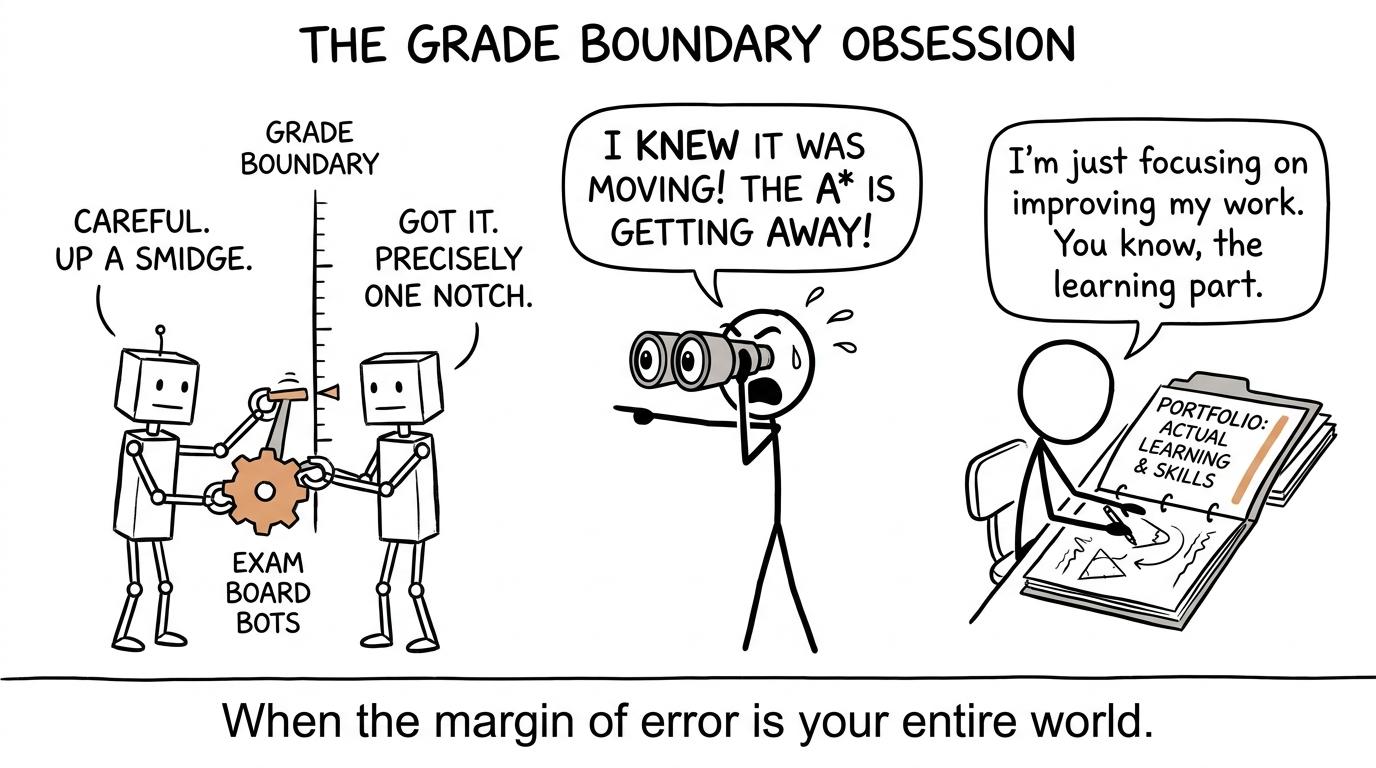 A student uses binoculars to monitor a one-notch boundary change
Why raw marks cannot be compared between boards
AQA's maximum of 480480480 scaled marks looks far larger than Edexcel's 180180180, but that does not make AQA easier or harder. The scales are different.
A fairer descriptive comparison converts a boundary into a percentage of the qualification maximum:
Boundary percentage=boundary markmaximum mark×100\text{Boundary percentage}=\frac{\text{boundary mark}}{\text{maximum mark}}\times 100Boundary percentage=maximum markboundary mark×100Even percentages should be interpreted cautiously. The boards use different assessment grids, scaling arrangements and moderation processes. Students should compare their mark only with the correct board, specification, subject title and examination series.
The same principle matters in maths. Foundation and higher tier boundaries, for example, belong to specific boards and papers. The GCSE Maths revision hub keeps board-specific lessons, questions and papers separate so students practise the qualification they will actually sit.
What students should do with past boundaries
A historical boundary is a reference point, not a revision target. If last year's grade 777 threshold was 123123123, aiming for exactly 123123123 leaves no protection against moderation, marking uncertainty in school estimates or a future boundary movement.
A better approach is to:
- confirm your exam board and exact Art and Design title;
- compare several years rather than selecting the most favourable one;
- ask your teacher which assessment-objective evidence is currently weakest;
- improve work across the portfolio rather than chasing isolated marks;
- target a sensible margin above the latest boundary;
- keep developing, refining, recording and presenting ideas across the assessment objectives.
For maths revision, the parallel is useful: do not aim for the lowest mark that happened to earn your desired grade last year. Use Edexcel GCSE Maths past papers, mark them accurately and repair the topics costing you marks. The guide to using GCSE past papers properly explains how to turn each result into a revision plan.
Common mistakes when reading Art and Design boundaries
Treating last year's boundary as a prediction
Past figures show a range of plausible outcomes, but the next boundary cannot be confirmed before the awarding process is complete.
Comparing raw marks across exam boards
A boundary of 148148148 out of 180180180 and one of 188188188 out of 200200200 belong to different qualifications. The raw numbers alone say nothing reliable about which board is more demanding.
Looking at a component boundary instead of the subject boundary
Exam boards may publish notional component boundaries for illustration. Your final GCSE grade is based on the overall qualification total after the relevant weighting and scaling have been applied.
Forgetting that Art and Design is untiered
Unlike GCSE Maths, Art and Design does not have separate foundation and higher tiers. Use the single boundary table for your specification and title.
Revising the boundary instead of improving the evidence
Knowing that a grade moved by 111 mark is interesting. Strengthening a weak assessment objective is useful. The first describes the past; the second can change your result.
Build a margin, not a prediction
Recent evidence gives a reassuring answer: GCSE Art and Design boundaries generally have not shifted dramatically from one year to the next. Across the major boards, the latest annual movements ranged from no change to 222 marks.
Still, a small movement matters when you are close to a threshold. Use boundaries to understand where grades have previously fallen, then focus on producing work that sits clearly above the line.
Apply the same calm approach to your maths preparation. Start with MathsGenie's free GCSE Maths revision resources, learn weak topics through revision lessons, practise with exam questions and mini tests, then test your progress using past papers and predicted papers. Mark schemes and video solutions show where the next marks can come from: one secure method at a time.