GCSE Arabic Useful Without A-level? The Real Value
GCSE Arabic useful without A-level? Explore its skills, sixth-form value and practical benefits, plus how to balance Arabic with GCSE maths revision.
A qualification can feel like a road that ought to lead somewhere obvious. GCSE maths might lead towards A-level Maths. GCSE Arabic might appear to lead towards A-level Arabic. But education is rarely that tidy.
If you are wondering whether GCSE Arabic is useful without A-level study, the short answer is yes. It gives you a recognised GCSE, develops four distinct communication skills and may contribute towards sixth-form or college entry requirements. It can also count as the language component of the English Baccalaureate. What it does not do is guarantee admission, replace required grades in English and maths, or commit you to continuing Arabic after Year 111111.
The real question is therefore not whether the qualification has value. It is whether that value justifies the preparation time within your particular GCSE timetable.
GCSE Arabic without A-level: a quick checklist
GCSE Arabic may be worth taking if:
- you can already understand, speak, read or write Arabic to a reasonable standard;
- the additional GCSE could support your sixth-form or college application;
- you want formal recognition of an important language skill;
- you are prepared for all four assessment areas, not just conversation;
- preparing for it will not damage your progress in compulsory subjects;
- your school or examination centre can enter and support you correctly.
Before deciding, confirm the exact qualification, specification, tier, examination arrangements and entry deadline with your school. You should also read the published admissions rules for every sixth form or college you are seriously considering.
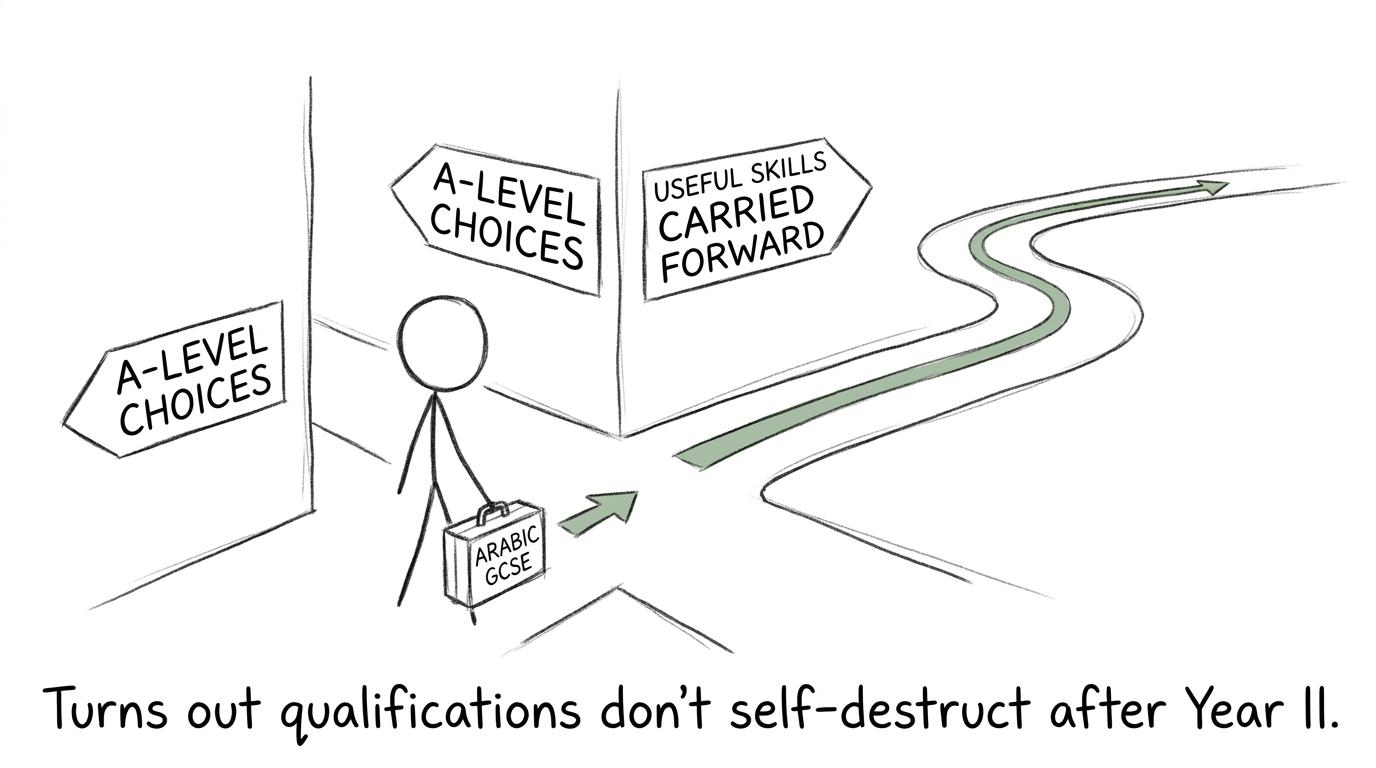 A student discovers that useful GCSE skills continue beyond Year 11
What GCSE Arabic actually gives you
A recognised academic qualification
GCSE Arabic is not merely a certificate saying that you can hold a conversation. It is a regulated GCSE graded on the familiar 999-111 scale.
The Pearson Edexcel GCSE Arabic specification used for the summer 202620262026 examination series assesses listening, speaking, reading and writing. Each skill contributes 25%25\%25% of the qualification. Students take either foundation or higher tier across all papers, rather than mixing tiers between components.
That structure matters. Someone who speaks Arabic confidently at home may still need focused preparation for formal reading, accurate writing, translation and examination instructions. Everyday fluency is valuable, but it is not automatically the same as exam readiness.
Arabic can also satisfy the language element of the English Baccalaureate. The EBacc is a school performance measure built around English, maths, sciences, history or geography, and a language. It is not a separate qualification that students receive, but completing its subject combination may demonstrate academic breadth.
Communication skills that remain useful
You do not lose a skill because you choose not to study it at A-level. Preparing properly for GCSE Arabic can strengthen:
- careful listening for detail;
- accurate reading across different types of text;
- clear spoken responses under time pressure;
- structured writing for a particular audience;
- translation between Arabic and English;
- awareness of register, vocabulary and cultural context.
These abilities can be useful in family life, travel, community settings and future employment. A GCSE alone does not prove professional interpreting or translation competence, and it should never be presented as though it does. It does, however, provide formal evidence that your language ability has been assessed.
Language revision also teaches a broader lesson: recognition is not the same as recall. Seeing vocabulary and thinking it looks familiar is easier than producing it accurately without help. The same distinction appears in maths. Watching a solution can feel comfortable; completing an unfamiliar question independently is the real test.
Can GCSE Arabic help with college requirements?
Potentially, but this is where careful checking matters most.
Many sixth forms and colleges set a general requirement involving a certain number of GCSEs at specified grades. They then add subject-specific conditions. A student applying for A-level Maths, for example, might need a stronger GCSE maths grade than the institution’s general minimum.
In those circumstances, GCSE Arabic may count towards the overall number of qualifying GCSEs. However, policies vary. Some institutions accept community-language GCSEs in the same way as other GCSE subjects. Others place restrictions on qualifications taken outside school, qualifications in a home language, or subjects that were not taught as part of the school timetable.
Therefore, do not rely on a broad claim such as ‘all GCSEs count everywhere’. Check:
- whether Arabic is included in the total GCSE count;
- whether there is a minimum grade for it to count;
- whether externally entered or home-language qualifications are accepted;
- which grades are required in English language and maths;
- the separate entry conditions for your intended Level 333 courses.
GCSE Arabic will not normally compensate for missing a compulsory English or maths requirement. If your intended course asks for a particular maths grade, that grade remains the priority. Use the free GCSE Maths Revision hub to select your exam board, tier and weakest topics before allocating extra time elsewhere.
Does it matter for university or employment?
Universities generally focus most heavily on Level 333 qualifications, such as A levels, alongside any course-specific GCSE conditions. UCAS guidance also makes clear that applicants must declare their completed and pending qualifications, including GCSEs. Your Arabic result therefore remains part of your educational record even if you stop the subject after Year 111111.
For most degree courses, GCSE Arabic will not be a substitute for the required A levels. Its value is more modest and more honest: it can show breadth, language competence and sustained effort. Some language courses offer beginner routes that do not require an A-level qualification in that language, although entry conditions differ considerably between universities and courses.
The same principle applies to employment. Arabic ability may be relevant in some roles, but a GCSE is evidence of a foundation rather than proof of professional fluency. If you continue using the language informally, your practical ability may grow even without taking A-level Arabic.
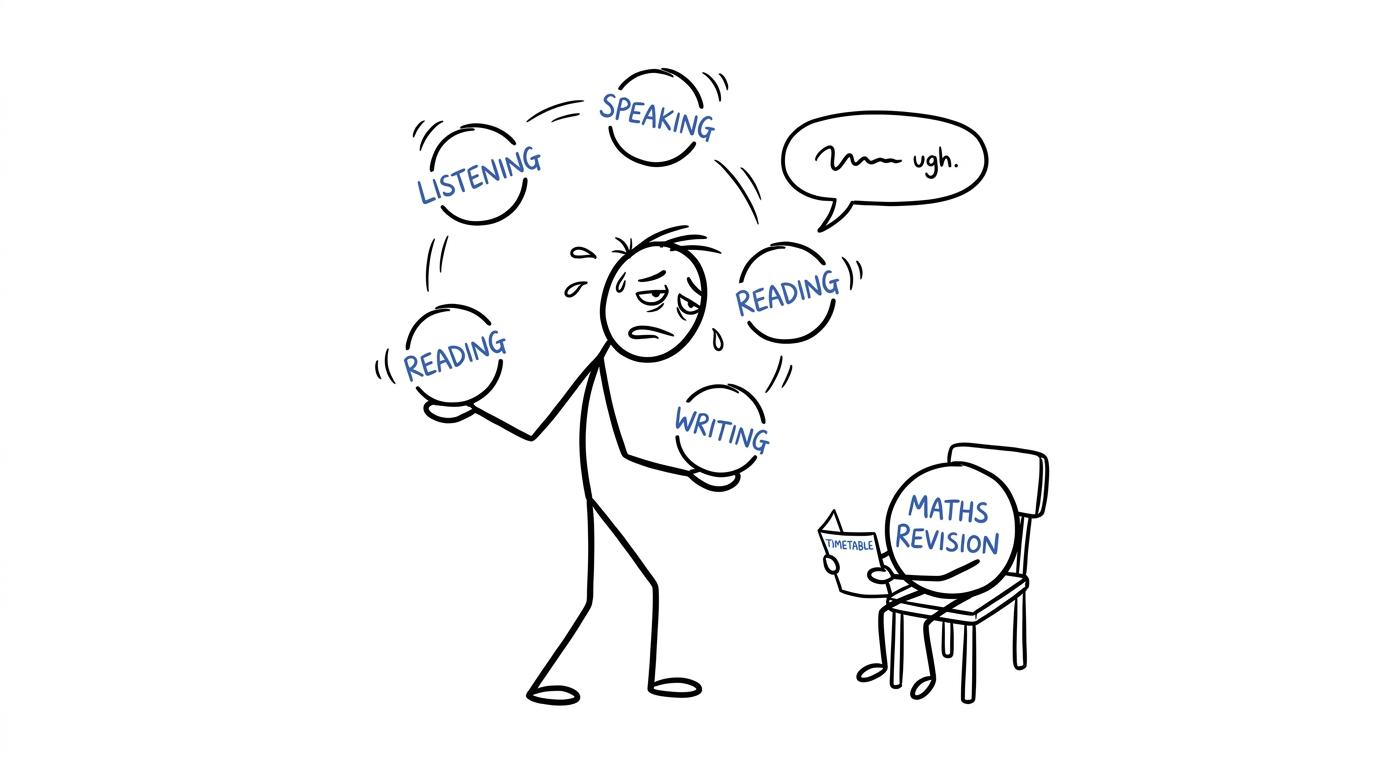 A GCSE student juggles four Arabic skills while maths revision waits with a timetable
Balancing Arabic preparation with GCSE maths
The hidden cost of an extra qualification is not the examination itself. It is the time that preparation removes from everything else.
Begin by separating three questions:
- Can I already use Arabic confidently?
- Can I perform the specific examination tasks?
- Can I prepare without neglecting priority subjects?
A student with strong spoken Arabic may need relatively little speaking practice but much more work on spelling, grammar or formal reading. Diagnose each component rather than assuming that one general label, ‘fluent’ or ‘not fluent’, describes everything.
Apply the same approach to maths. Start with a mini test or timed section, use the mark scheme to identify precise weaknesses, and then return to topic practice. The best order for learning GCSE maths topics can help when your gaps feel too broad to organise.
A manageable weekly pattern might include:
- one short Arabic reading or listening session;
- one Arabic writing or speaking session;
- several focused maths sessions based on current weaknesses;
- one timed maths paper section followed by careful marking;
- protected time for English, science and your other GCSE subjects.
Do not measure revision by hours alone. Measure what changed. Did you correct a recurring writing error? Did you learn how a maths method earns marks? Did you improve your response under timed conditions?
MathsGenie’s GCSE revision timetable guide explains how to combine topic work, review and paper practice. When you are ready for full exam questions, use the correct board collection, such as AQA GCSE Maths past papers, OCR GCSE Maths past papers or the Eduqas GCSE Maths revision hub.
Predicted papers have a different purpose. They are best used after topic gaps have been addressed, not as a replacement for learning. Students following Pearson Edexcel can use the Edexcel GCSE Maths predicted papers under timed conditions and then review every lost mark.
How to decide whether GCSE Arabic is worth it
Think in terms of opportunity cost rather than prestige. An additional GCSE can be valuable, but not if preparing for it causes grades in essential subjects to fall.
Taking GCSE Arabic is likely to be sensible when you have a genuine language foundation, understand the assessment demands and can fit targeted preparation into a balanced plan. It may be less sensible when you have had little exposure to formal Arabic, lack access to suitable teaching or are already struggling to meet required grades elsewhere.
Ask your Arabic teacher, examinations officer or school adviser for a realistic assessment. Then ask your intended sixth form how the qualification would be treated. Those two conversations are more useful than assumptions made from a course list or an online discussion.
Common mistakes when judging the value of GCSE Arabic
Assuming spoken fluency guarantees a high grade
The qualification assesses four equally weighted skills. Strong conversation does not remove the need to prepare for reading, writing, translation and precise examination responses.
Treating every college policy as identical
General admissions patterns are not universal rules. Check whether your chosen institution counts externally entered or community-language GCSEs and note any subject-specific requirements.
Using Arabic to distract from urgent maths gaps
A familiar language can feel more comfortable than a difficult maths topic. Comfort is not always priority. Use a diagnostic test and a revision planner to protect the subjects required for your next step.
Completing papers without reviewing them
A paper produces a score; review produces improvement. This applies to both Arabic and maths. The guide to starting GCSE past papers at the right time shows how to move from short diagnostics towards full timed practice.
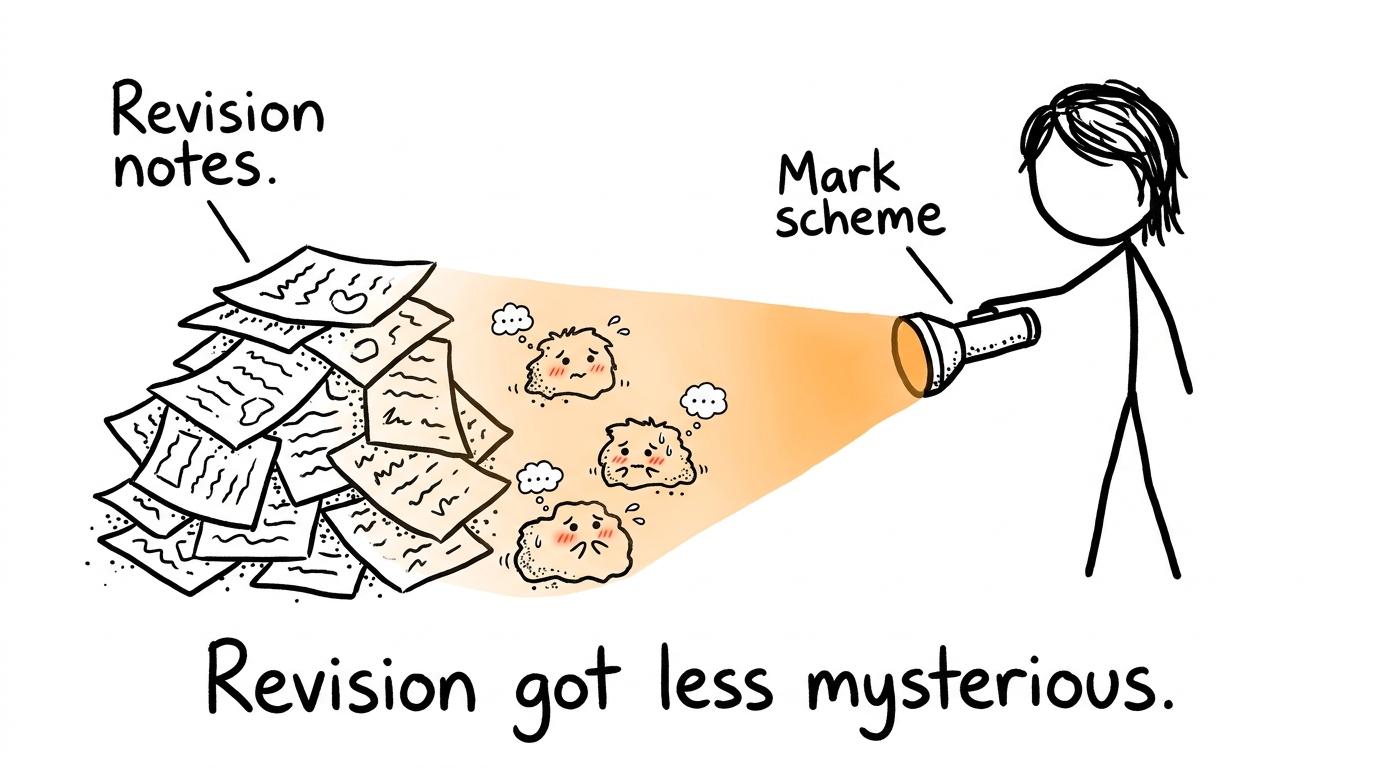 A mark scheme torch exposes three embarrassed revision mistake gremlins
A qualification can be useful without becoming your future
GCSE Arabic does not need to lead to A-level Arabic to have been worthwhile. It can recognise an existing ability, sharpen communication skills, support academic breadth and potentially contribute towards college entry totals. Its precise value depends on your grade, your institution’s policy and the effort required to achieve it.
Make the decision with evidence. Confirm the specification, inspect the assessment tasks, check college requirements and build a revision plan that protects your core subjects.
For maths, let MathsGenie’s free GCSE resources carry the organisation: revision lessons for understanding, practice questions for accuracy, mini tests for diagnosis, and past papers, predicted papers, mark schemes and video solutions for exam readiness. Choose one weak topic today, practise it properly and turn your next revision session into marks.