GCSE Arabic Tutor: Do You Really Need One?
GCSE Arabic tutor advice: learn when tuition can help, how to test the need, what to check before hiring, and how to protect your maths revision time.
Some GCSE decisions feel bigger because they involve money. If Arabic mock results are disappointing, hiring a GCSE Arabic tutor can seem like the obvious response. Sometimes it is the right one. But a tutor is most useful when you can identify a specific gap that ordinary revision, school support and regular practice have not fixed.
The short answer is this: consider tuition if you need individual feedback, lack structured teaching, repeatedly struggle with a particular assessed skill, or cannot turn fluent everyday Arabic into exam-ready Modern Standard Arabic. Do not hire someone simply because exams feel close. First diagnose the problem. Then decide whether a tutor is the right tool.
That matters especially when Arabic sits beside GCSE maths and several other subjects. Every extra lesson consumes time as well as money. The aim is not to create the busiest timetable. It is to create the one that produces the most useful improvement.
The quick decision checklist
A tutor may be worthwhile if several of these statements are true:
- Your school offers limited Arabic teaching or you are entering independently.
- You do not receive regular feedback on speaking or writing.
- Your mock or practice-paper mistakes show the same weakness repeatedly.
- You speak a regional dialect confidently but find formal written Arabic difficult.
- You understand the language but do not know the exam format or mark scheme.
- Independent revision keeps becoming unstructured or inconsistent.
- You need accountable, scheduled practice to keep progressing.
You may not need tuition yet if your main difficulty is missed practice, weak organisation or uncertainty about what to revise. Those problems can sometimes be solved with a clearer weekly plan, support from your teacher and disciplined use of specification-matched materials.
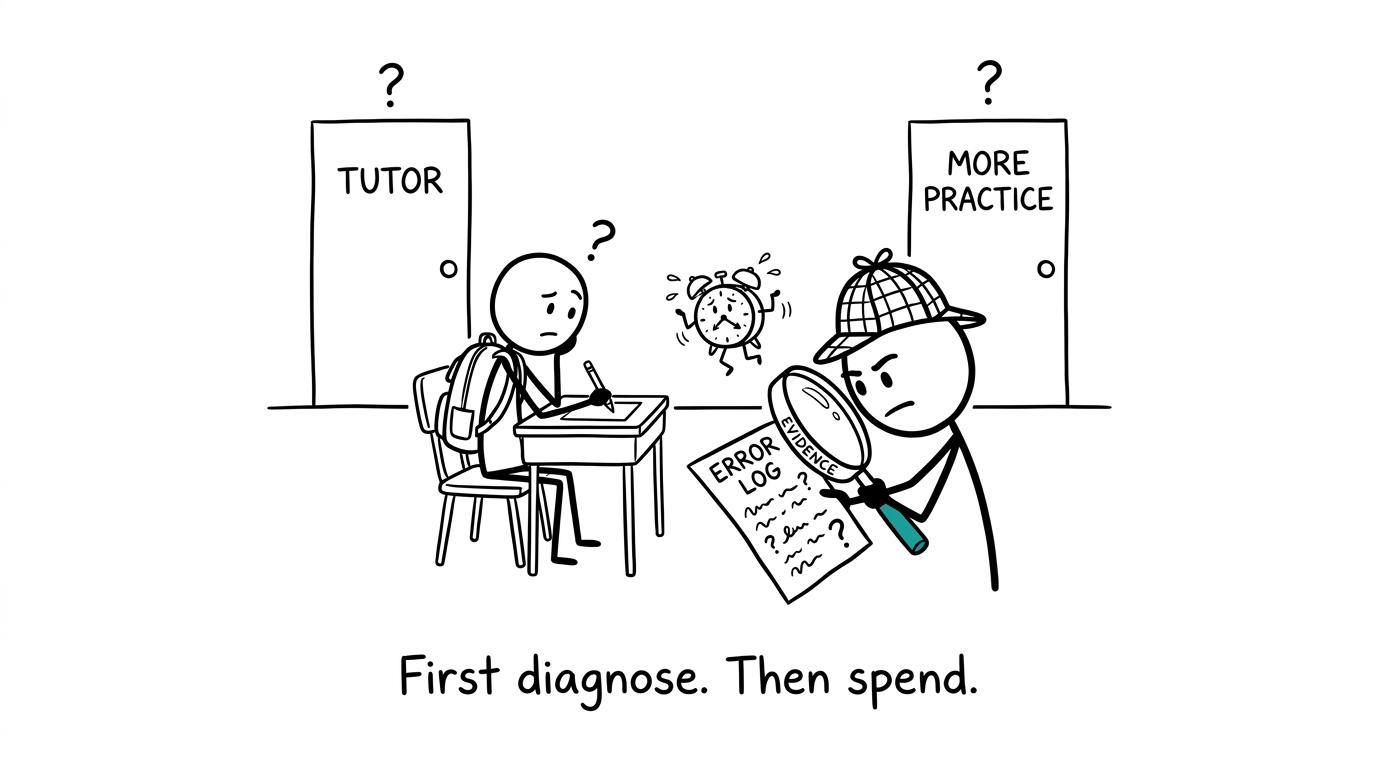 A student deciding between tuition and more practice while an evidence detective checks an error log
Understand what your GCSE Arabic qualification assesses
Before choosing a tutor, confirm the exact qualification and specification with your school or examination centre. GCSE Arabic and International GCSE Arabic are not interchangeable labels. Their papers, skills and assessment arrangements may differ.
For the current Pearson Edexcel GCSE in Arabic, students are assessed in four separate areas: listening, speaking, reading and writing. Each contributes 25%25\%25% of the qualification. Papers are available at foundation and higher tier, and a candidate must enter the same tier across the qualification. Dictionaries are not permitted in the assessments, including speaking preparation time.
This has an important consequence. General fluency is not the same as examination readiness.
A student might speak Arabic naturally at home but need support with accurate spelling, grammar, formal vocabulary or extended writing. Another might read well but struggle to respond spontaneously in the speaking assessment. Someone learning Arabic mainly through school may know the required structures yet need much more listening exposure.
A useful tutor should therefore begin by asking:
- Which qualification and specification are you taking?
- Are you entered for foundation or higher tier?
- Which skill is currently weakest?
- What evidence is available from mocks, marked writing or speaking feedback?
- When are the assessments, particularly the speaking assessment?
Be cautious if a prospective tutor promises a grade before seeing any of this information.
How to tell whether tuition would actually help
The strongest decision comes from evidence rather than anxiety. Use a short diagnostic period before committing to months of lessons.
Separate knowledge gaps from practice gaps
A knowledge gap means that you do not understand something essential: perhaps how to form accurate sentences, adapt register, handle a translation or organise an extended response. Direct teaching and immediate correction may help considerably.
A practice gap is different. You understand the task but have not practised it often enough. If you can improve through regular listening, vocabulary retrieval, timed writing and school feedback, paid tuition may add less value.
The distinction resembles good maths revision. A wrong answer does not automatically mean that you need another explanation. Sometimes you knew the method but misread the question or made a careless error. MathsGenie’s guide to finding your weakest GCSE topics explains how to classify mistakes instead of treating every lost mark as the same problem.
Apply that habit to Arabic. Label each difficulty as one of the following:
- missing vocabulary
- grammar or sentence construction
- spelling and written accuracy
- listening comprehension
- reading comprehension
- speaking fluency or spontaneity
- translation
- timing or task interpretation
If the same category appears repeatedly, a tutor has a clear target.
Ask whether individual feedback is the missing ingredient
Some skills are hard to assess alone. You can check a multiple-choice response, but evaluating pronunciation, spontaneity, grammatical range or the quality of a longer written answer is more difficult.
A specialist tutor can be valuable when they provide feedback that is:
- specific rather than encouraging but vague
- linked to the relevant assessment criteria
- followed by a practical correction task
- revisited later to check that the weakness has disappeared
The lesson itself is not the result. The result is what you can do independently afterwards.
Run a short, measurable trial
Agree a limited trial rather than making an open-ended commitment. Before the first lesson, record a baseline using a suitable speaking task, writing task or paper section. Set one narrow objective, such as improving written accuracy or answering speaking questions without memorised scripts.
After several sessions, repeat a comparable task under similar conditions. Look for better accuracy, greater independence, clearer timing or fewer repeated errors. If the tutor cannot explain what has improved and what still needs work, the arrangement may be producing activity without progress.
What to look for in a GCSE Arabic tutor
Subject knowledge matters, but it is only the beginning. A fluent speaker is not automatically an effective GCSE teacher, just as someone who can solve difficult equations is not automatically skilled at explaining them.
Current specification knowledge
The tutor should know your precise qualification, tier and assessment structure. Ask how they teach listening, speaking, reading and writing, and how they use past papers and mark schemes.
They should also understand the difference between conversational dialect and the formal Arabic required by the examination. A strong tutor respects the language you already speak while helping you adapt it to the specification.
A diagnostic teaching approach
Good tutors do not deliver the same lesson to every student. They inspect your work, identify patterns and choose tasks that address those patterns. Ask what they would do during the first lesson and how they would monitor improvement.
A convincing answer should include assessment, feedback, targeted practice and retesting. It should not rely entirely on worksheets, memorised model answers or predictions about likely topics.
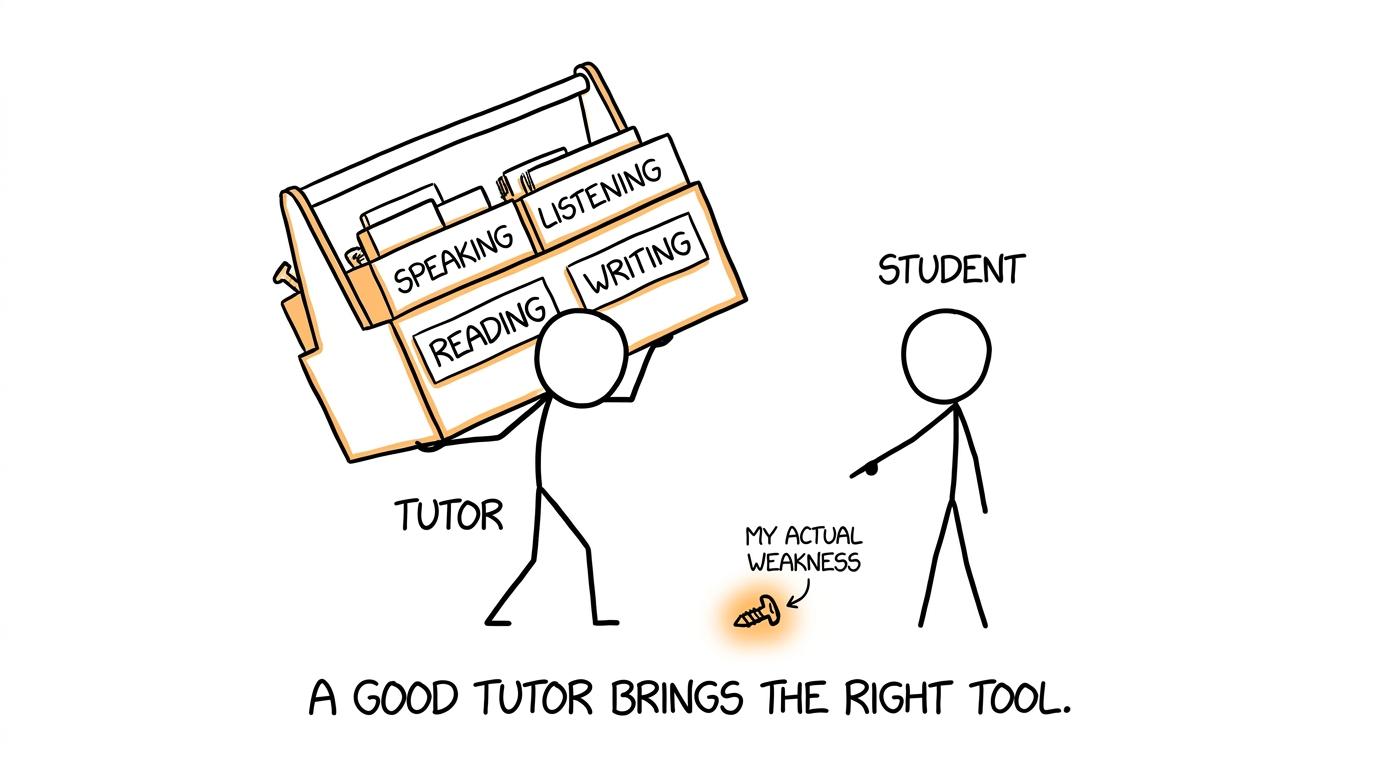 A tutor selects the right tool for a student's actual language weakness
Clear explanations and useful correction
Arrange an introductory meeting or trial lesson. Notice whether the tutor listens before explaining. Can they make a difficult point clearer? Do corrections help you understand the rule, or are you simply told that an answer is wrong?
The best feedback creates independence. Over time, prompts should become less necessary rather than more necessary.
Safeguarding and professional boundaries
For students under eighteen, a parent or carer should take an active role in selecting and arranging tuition. Verify the tutor’s identity, relevant qualifications and recent references. Ask about safeguarding procedures and view appropriate DBS information where available, remembering that a DBS certificate is evidence from a particular point in time rather than a guarantee of teaching quality or future safety.
Lessons should take place in a suitable, observable environment. For online tuition, communication, scheduling and payment should use parent-visible channels rather than private contact between tutor and student. Agree in advance which platform will be used, whether anything is recorded and how shared work is stored.
Qualifications, references and safeguarding checks are essential filters. The trial lesson then tells you whether the person can actually teach you effectively.
Questions to ask before hiring someone
Use these questions during your initial conversation:
- Which GCSE Arabic specifications have you taught recently?
- How will you identify my weakest assessed skill?
- How do you distinguish dialect fluency from formal written accuracy?
- What will I complete between lessons?
- How will you measure progress after the first few sessions?
- Do you use official-style papers and assessment criteria?
- Can you provide evidence of relevant qualifications, references and safeguarding checks?
- What are the cancellation, payment and communication arrangements?
Listen for precise answers. “We will work on everything” sounds reassuring, but it is not a plan. “We will analyse your marked writing, identify the two recurring grammar problems and retest them in a fresh timed task” is much more useful.
Protecting your GCSE maths revision time
A language tutor can help Arabic while accidentally making maths revision worse if the overall timetable becomes unrealistic. The answer is not to choose one subject emotionally. It is to allocate time according to evidence.
Start with the MathsGenie GCSE maths revision hub and identify the board you take, whether Edexcel, AQA, OCR or Eduqas, as well as your foundation or higher tier. Keep two or three fixed maths sessions in the week before adding tuition around them.
A sensible cycle is:
- diagnose a weak area
- learn or revisit the method
- complete practice questions
- mark the work carefully
- correct the error
- retest after a gap
The GCSE maths revision timetable guide can help you build that cycle around your other subjects. If exams are close, use the one-month GCSE maths revision plan rather than improvising each evening.
Paper practice should remain part of the schedule. MathsGenie provides Edexcel GCSE maths past papers, AQA GCSE maths past papers and OCR GCSE maths past papers, with mark schemes and worked support where available. The guide to using GCSE past papers properly shows how to turn each paper into a focused list of next actions.
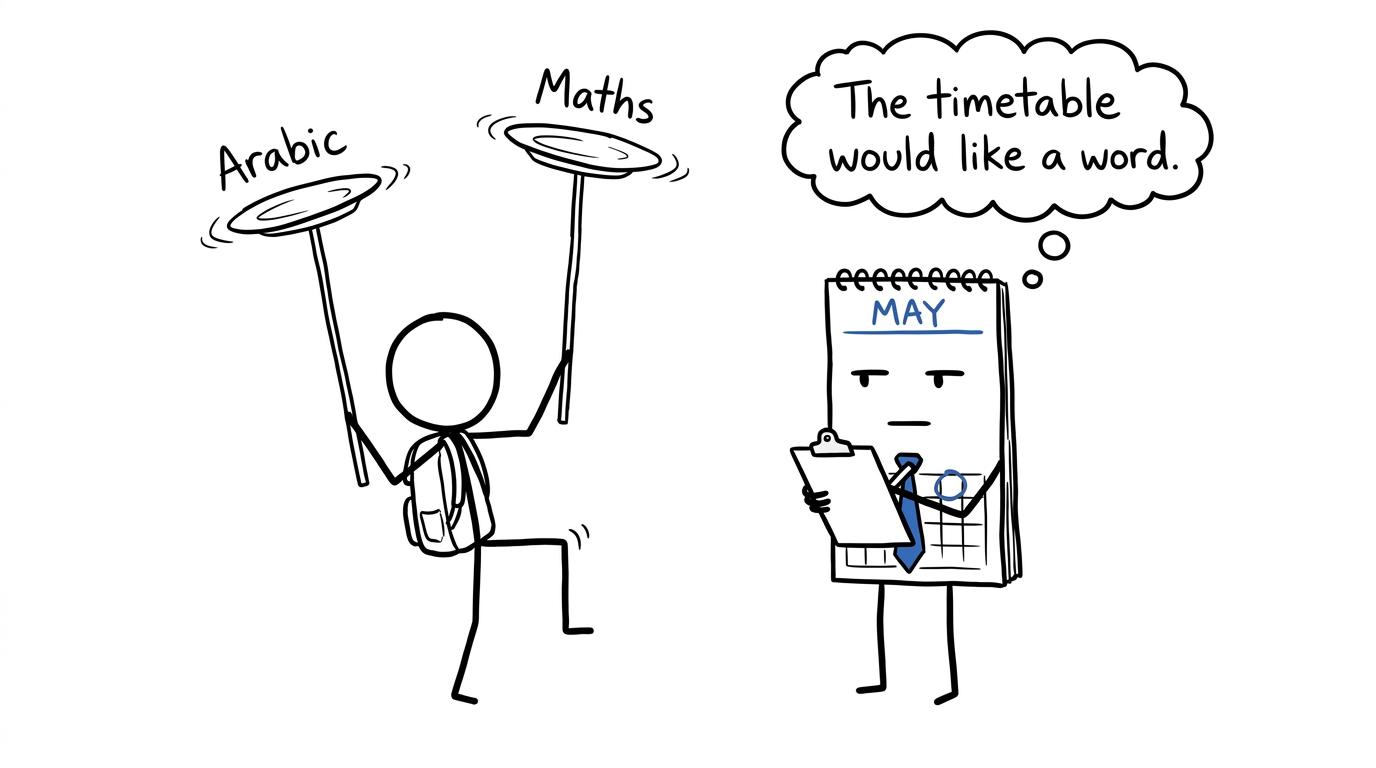 A student balances Arabic and maths revision while a calendar supervises
Common mistakes when choosing Arabic tuition
Hiring from panic rather than diagnosis
A disappointing mock can be useful evidence, but the total mark does not reveal the exact problem. Analyse the paper and teacher feedback first.
Choosing fluency over teaching ability
Native or fluent command of Arabic is valuable, but GCSE teaching also requires explanation, assessment knowledge, feedback and lesson planning.
Ignoring the exact qualification
A tutor experienced with a different International GCSE or an older specification may prepare you for tasks you will not sit. Confirm the qualification code, tier and current paper structure.
Paying for passive lessons
A session dominated by the tutor speaking or correcting every word for you may feel productive while creating dependence. You should spend meaningful time retrieving, speaking, writing and making decisions yourself.
Expecting tuition to replace independent practice
A weekly lesson cannot substitute for regular vocabulary recall, listening and written practice. Tuition should make independent revision more accurate and focused.
Overloading the timetable
Adding tuition without removing low-value activities can leave less energy for maths and other subjects. Protect sleep, schoolwork and focused paper practice.
Make the decision from evidence
You should get a GCSE Arabic tutor when a specialist can solve a defined problem that your existing support and independent revision cannot solve efficiently. Look for current specification knowledge, diagnostic teaching, precise feedback, measurable progress and sound safeguarding arrangements.
If the real problem is inconsistent practice, start by fixing the routine. If the problem is repeated and specific, trial tuition and judge it by the quality of your independent work afterwards.
Meanwhile, keep your maths preparation calm and visible. Use MathsGenie’s free revision lessons and practice questions to repair individual topics, mini tests to check recall, past papers to build timing, and Edexcel GCSE maths predicted papers for fresh exam-style practice nearer the examination. A good revision plan does not ask you to do everything. It helps you identify what matters next, and gives you the right tool for it.