

GCSE Arabic Tier Decision Timing Explained
GCSE Arabic tier decision timing explained: when schools choose Foundation or Higher, who has the final say, and when an entry may still change.
The hardest part of a tier decision is often not the paper. It is the uncertainty. You may be preparing for Higher tier while wondering whether your school has already entered you for Foundation, or treating a mock result as a final verdict when the conversation is still open.
The short answer on GCSE Arabic tier decision timing is that schools commonly form a provisional view during Year 11 and submit the official tier with their examination entries, normally in February for the summer series. The exam centre makes the formal entry. Students can and should contribute evidence, but they do not normally control the entry themselves. For Pearson Edexcel GCSE Arabic, the tier must be settled before the speaking assessment, and all four papers must be taken at the same tier.
The precise internal deadline varies by school, so ask rather than guess.
GCSE Arabic tier decision timing at a glance
Use this checklist to understand where you are in the process:
- Autumn of Year 11: teachers gather evidence from classwork, mocks and assessments across all four skills.
- January and early February: many departments discuss provisional Foundation and Higher entries.
- February: schools normally submit summer GCSE entries to the exam board.
- After the entry deadline: an amendment may be administratively possible, but it is not automatic and late processes or fees may apply.
- Before the speaking assessment: the Arabic tier must be confirmed because speaking is itself tiered.
- On the examination day: you cannot simply choose a different tier from the one entered.
For context, the standard UK centre entry deadline for the June 2026 series was 21 February 2026. Pearson’s dates change by series, so students should use that as an illustration of the usual timetable, not as a permanent annual deadline.
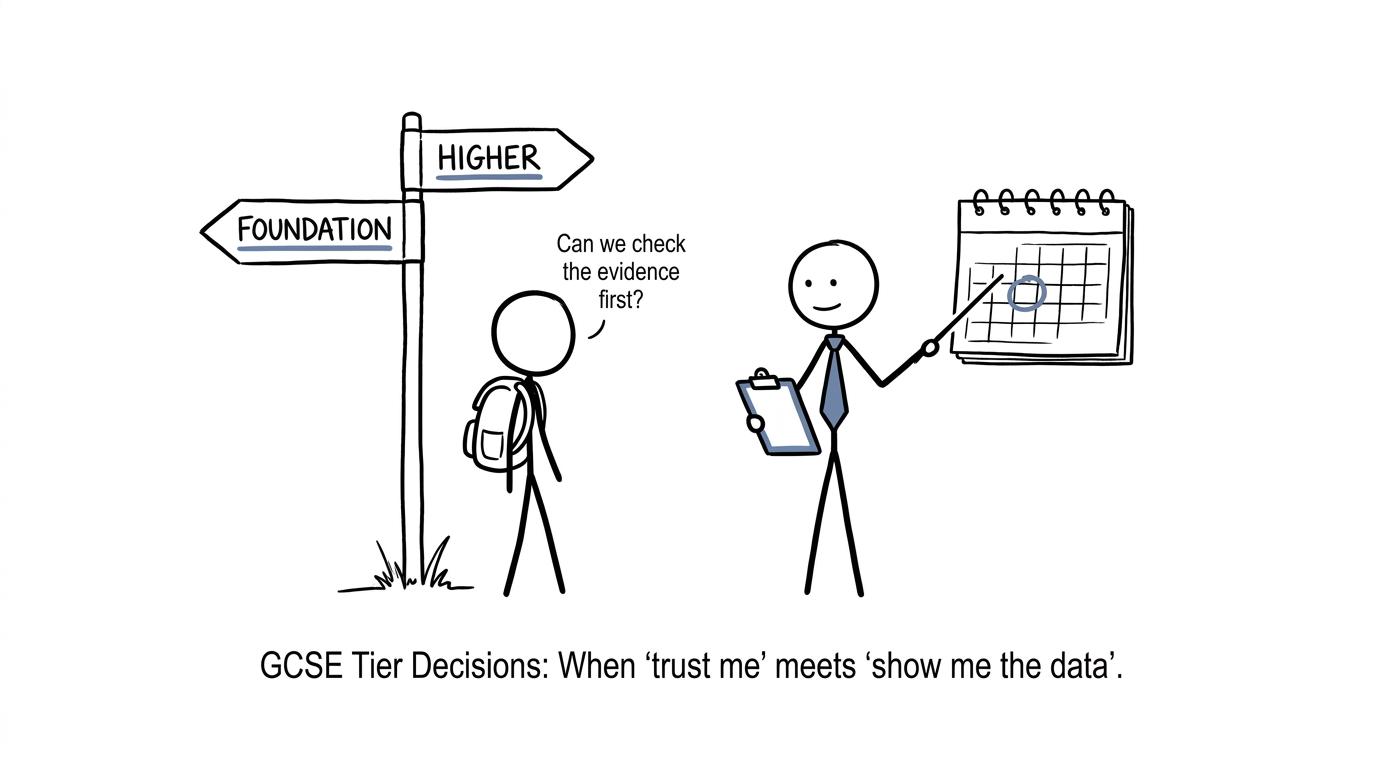 A student and teacher calmly checking evidence before choosing a GCSE tier
What does the school actually have to decide?
This article concerns the current Pearson Edexcel GCSE Arabic specification. Its assessment consists of listening, speaking, reading and writing papers. Each contributes 25%25\%25% of the qualification.
There are two entry options:
- Foundation tier, with grades 111 to 555 available
- Higher tier, principally covering grades 444 to 999, with a narrow grade 333 safety net for candidates who fall just below the grade 444 boundary
The important detail is that mixed-tier entry is not allowed. A student cannot take Foundation listening and Higher writing, for example. The chosen tier applies across the complete qualification.
That is why a school should not base the decision on a single strong skill. A student may write confidently but find Higher listening much less secure. Another may speak fluently at home while needing more practice with formal reading and writing. The sensible question is not simply, “Can this student do Higher work?” It is, “Which single tier gives this student the best overall route across every assessed skill?”
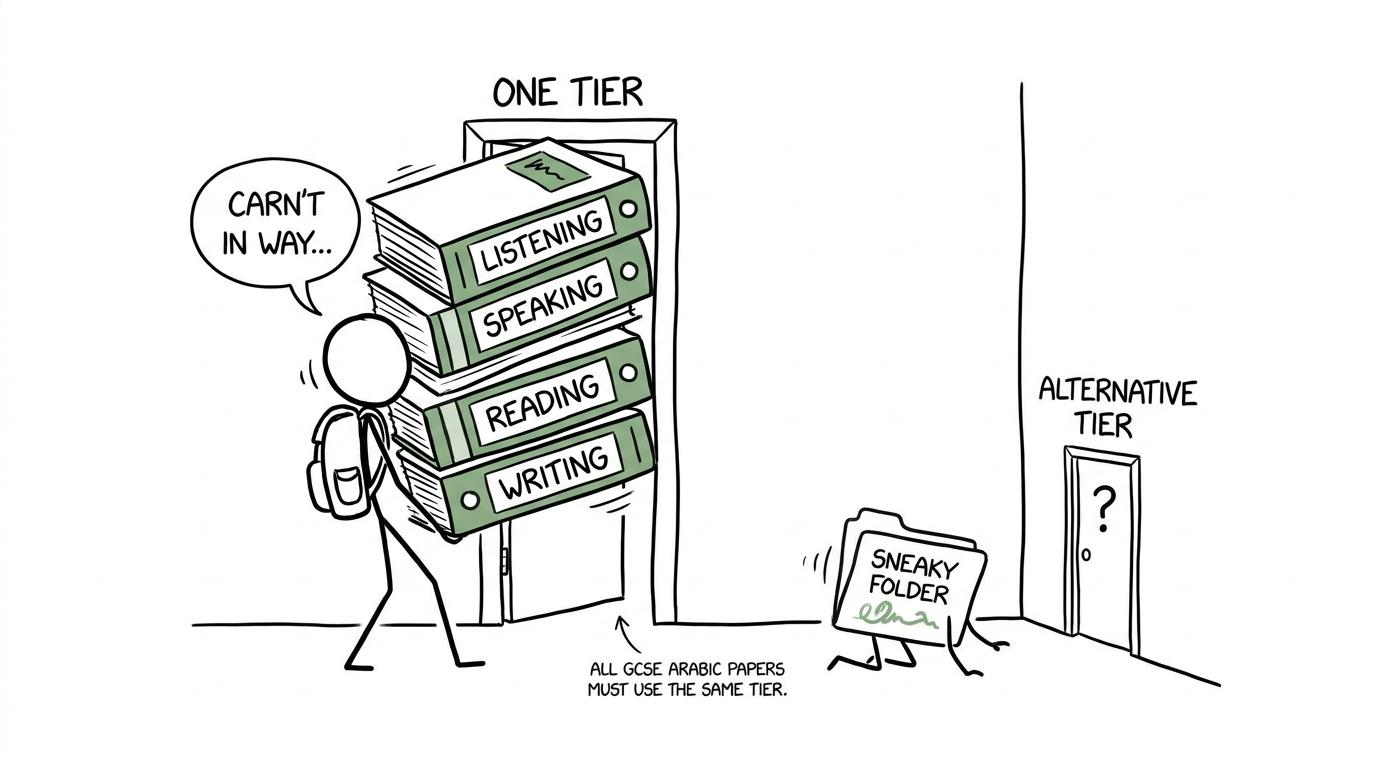 Four GCSE Arabic skill folders squeezing through one tier doorway
When do schools usually lock in Foundation or Higher?
The teaching decision often develops gradually
Schools rarely reach a meaningful tier judgement on one afternoon. Teachers usually build a picture from lesson performance, vocabulary knowledge, timed assessments, mock papers, speaking practice and the consistency of independent work.
A provisional recommendation may therefore appear during the autumn term. It can influence which practice papers you receive, but “currently working on Foundation material” does not necessarily mean the examination entry has already become irreversible.
The first formal milestone is the entry deadline
The exams officer submits an entry option to Pearson. For the June 2026 series, UK centres had a 21 February deadline, with late fees applying after that date. Schools often set their own deadline earlier so departments have time to check names, candidate details and tier choices.
This creates two different dates that students sometimes confuse:
- the school’s internal deadline for teachers to submit recommendations
- the awarding organisation’s official entry deadline
Your school may speak as though a tier is “final” before the external deadline because it needs an orderly process. That does not mean students should wait until February to raise concerns. Ask during the autumn or immediately after a mock while there is time to gather better evidence.
The speaking assessment creates a practical final boundary
Pearson requires centres to decide each candidate’s tier in advance of the speaking assessment. For summer 2026, the GCSE Arabic speaking window ran from 16 April to 21 May.
Because speaking tasks and arrangements are tier-specific, a school cannot treat the choice as something to settle casually after speaking has taken place. Pearson’s administrative guidance also states that tier decisions cannot be made on the day of an examination.
An entry amendment may sometimes be processed after the ordinary deadline, but this is a matter for the centre and awarding organisation. It may involve additional administration or fees, and it must remain compatible with the speaking assessment. A student should never assume that a late change is guaranteed.
How much say do students usually get?
The formal responsibility sits with the school or examination centre because it makes the entry. There is no standard national rule giving a student an independent right to select Higher tier against the centre’s judgement.
In practice, good tier decisions are conversations. Students often get an opportunity to discuss their target grade, recent evidence and willingness to address weaknesses. Parents or carers may also be involved, particularly when the evidence sits close to the overlap between tiers.
Your influence is strongest when you bring evidence rather than preference. Useful questions include:
- Which results are being used to recommend my tier?
- Are all four Arabic skills being considered?
- What performance would make Higher tier appropriate?
- When is the school’s internal deadline?
- Has my official examination entry already been submitted?
- When will the decision be reviewed again, if at all?
A calm conversation is more productive than saying that Higher “feels fairer”. Ask for measurable criteria. If listening is the concern, find out what level of consistency the teacher needs to see. If writing is holding you back, request specific feedback on what must improve.
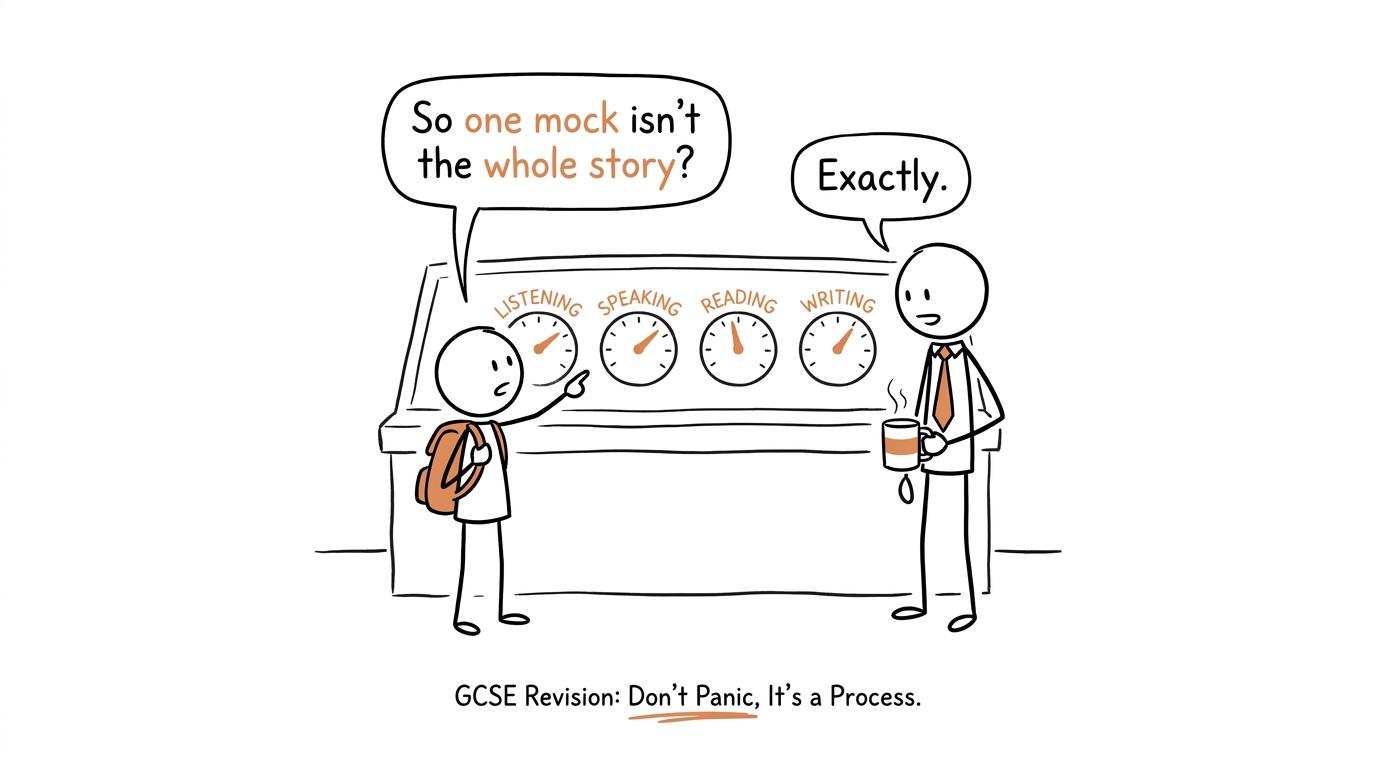 A teacher and student checking four skill gauges rather than trusting one mock
What evidence should inform the decision?
A secure decision should consider several pieces of evidence over time:
- performance on tier-appropriate mock papers
- results across listening, speaking, reading and writing
- whether marks are consistent or highly variable
- the student’s target grade and post-16 requirements
- performance under timed conditions
- how much improvement is realistic before the speaking and written assessments
- the risk attached to each tier
Foundation is not automatically the “easy” choice, and Higher is not automatically the “ambitious” one. They offer different grade ranges and different question demands. The best tier is the one that matches demonstrated performance and the grade the student realistically needs.
This principle will feel familiar to maths students. In GCSE Maths, a Foundation entry caps the available grade at 555, while Higher provides access to grades above 555 but carries a greater risk if the candidate is not secure around the lower Higher-tier standard. You can compare how boards organise content through the GCSE Maths topics by exam board and tier guide.
The subjects are assessed differently, but the decision-making habit transfers: use repeated evidence, understand the available grades and do not let one unusually good or bad paper control the whole judgement.
What to do if you disagree with the recommendation
Start by finding out whether you are discussing a provisional recommendation or a submitted examination entry. Those are not the same thing.
Then ask for a short meeting with your Arabic teacher, head of languages or examinations team. Explain your target clearly and request the evidence behind the recommendation. If the school permits a review, agree what you need to complete and by what date.
Do not promise vague improvement. Offer a process:
- complete an appropriate timed paper
- submit a piece of writing under controlled conditions
- attend speaking practice
- correct previous errors
- repeat an assessment to show that progress is secure
The same evidence-first approach strengthens maths revision. The MathsGenie GCSE Maths revision hub lets you select your board and work through lessons, questions and papers. If you need a repeatable schedule, use the GCSE maths revision timetable or the more focused one-month GCSE revision plan.
Common mistakes around GCSE Arabic tier decisions
Assuming the mock automatically decides everything
A mock is evidence, not the entire case. Ask whether the result matches your longer-term performance and whether every Arabic skill has been considered.
Waiting until the speaking assessment
By then, the practical room for change may have disappeared. Pearson requires the tier to be decided before speaking, so raise questions well in advance.
Believing different papers can use different tiers
GCSE Arabic requires one tier across listening, speaking, reading and writing. Mixed-tier entry is not permitted.
Focusing only on the highest available grade
Higher gives access to grades 444 to 999, but access is not the same as likelihood. Consider how securely you can perform across the whole qualification.
Assuming a late amendment is a right
Centres can process some entry amendments, but deadlines, fees and assessment arrangements matter. Only your school’s examinations officer can confirm what remains possible in your case.
Revising without checking the tier
This mistake also appears in maths. Before using a paper, confirm the board, tier and paper type. The Edexcel GCSE Maths past papers include tier-specific papers, mark schemes and solutions. The guide to using GCSE past papers properly explains how to turn the result into an error log rather than treating the score as a verdict.
Turn uncertainty into a clear next action
A tier decision can feel personal because it places a label on future possibilities. Administratively, however, it is a choice about the most appropriate set of papers. Treating it that way makes the conversation calmer.
Ask your teacher which tier is currently recommended, whether the official entry has been submitted, what evidence informed it and when any review must happen. Then focus on the part you can control: producing reliable evidence before the deadline.
Keep the same discipline in your maths preparation. Begin with free revision lessons and practice questions on the GCSE Maths revision hub, test your progress with GCSE predicted papers, and use past papers, mark schemes, video solutions and mini tests to identify what still needs attention. MathsGenie gives you the structure. Your next honest piece of evidence gives you the direction.










