GCSE Arabic Switch Tier: Foundation to Higher
GCSE Arabic switch tier guidance: learn when moving from Foundation to Higher is possible, who decides, key deadlines and how to make your case.
A tier decision can feel permanent when it appears on a school spreadsheet. It often is not. If you are considering a GCSE Arabic switch tier from Foundation to Higher partway through the course, the short answer is yes: a change can usually be made before the relevant examination-entry and speaking-assessment deadlines. However, your school makes the entry, all four Arabic papers must be taken at the same tier, and schools may set an earlier internal deadline.
That means the best time to ask is now, not after one more mock or another month of waiting. A thoughtful request supported by consistent evidence gives your teacher something useful to consider.
GCSE Arabic switch tier checklist
Before asking to move, establish these five facts:
- You are taking Pearson Edexcel GCSE Arabic, specification code 1AA0, rather than an International GCSE.
- Your current entry is Foundation tier.
- Your school has not passed its internal deadline for tier changes.
- You have not completed the speaking assessment at a different tier.
- Your performance across listening, speaking, reading and writing supports Higher tier entry.
The distinction between GCSE and International GCSE matters. Pearson Edexcel GCSE Arabic has Foundation and Higher tiers. A different Arabic qualification may have a different structure, so check the exact title and specification code with your teacher or exams officer.
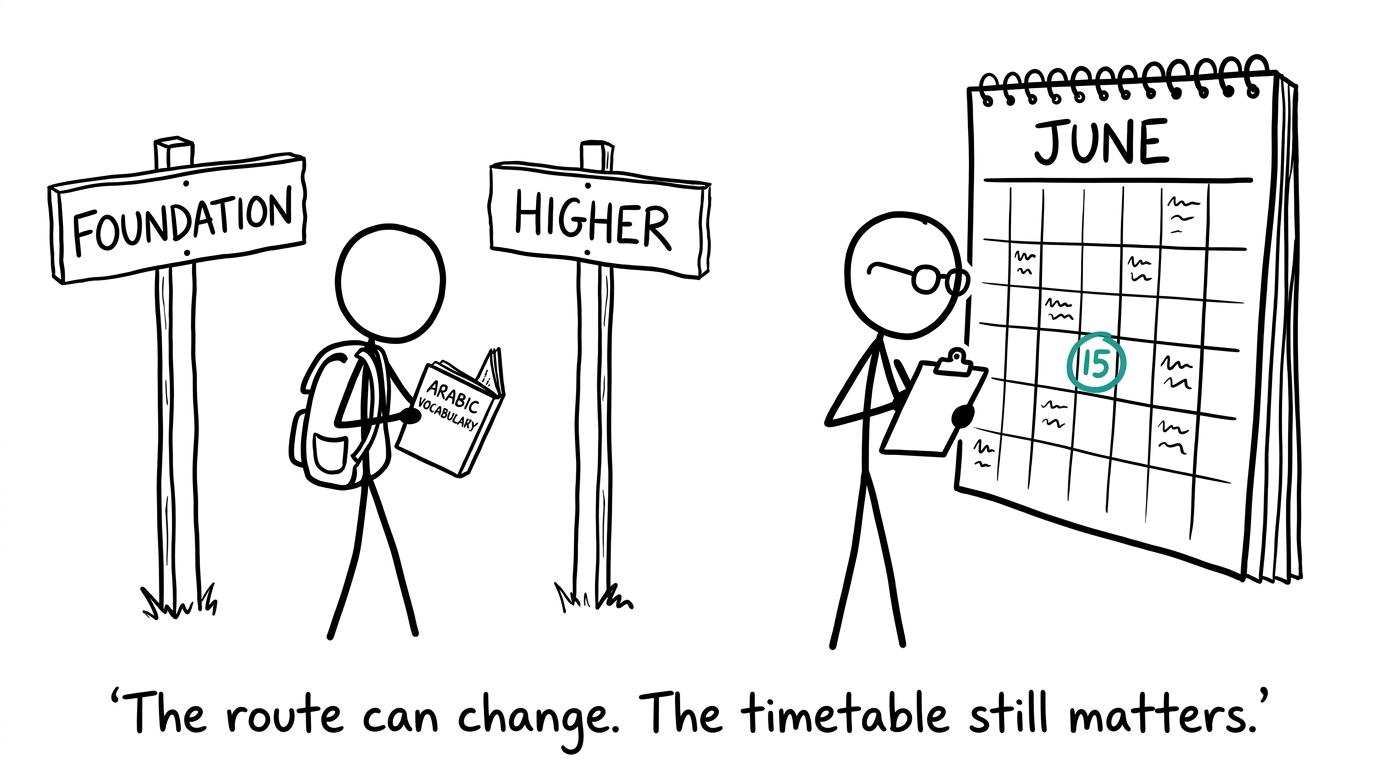 A student choosing between Foundation and Higher while an exams officer checks the calendar
Can you move from Foundation to Higher during the course?
Yes. Being taught in a Foundation group or completing Foundation assessments earlier in the course does not, by itself, permanently fix your final tier. Your school or examination centre controls the formal entry and can amend it while the awarding body's procedures still permit the change.
There are three different moments students sometimes confuse:
- A teaching decision: which material and classroom group you currently follow.
- An internal school deadline: when teachers want to settle entries and organise speaking assessments.
- An awarding-body deadline: when entries or amendments must be processed, sometimes with additional fees for late changes.
A school may stop considering ordinary requests before the awarding body's final administrative limit. That is not necessarily arbitrary. Teachers need time to judge performance, prepare the correct speaking materials and ensure that every examination entry is accurate.
For the June 2026 series, official Pearson and JCQ information set the GCSE entry deadline in February. Pearson also allowed amendments later in the cycle, with fees applying at later stages. These dates change between examination series, so students preparing for a future series should ask their exams officer for the current deadline rather than relying on an old calendar.
How late do schools usually allow a change?
There is no national date on which every school stops allowing tier changes. Schools create their own processes, and your teacher cannot promise a change simply because an awarding-body system remains technically open.
In practice, tier decisions are often reviewed after Year 11 mock examinations because mocks provide evidence across several skills. Some schools settle entries during the spring term; others set an earlier internal deadline. For GCSE Arabic, the decisive practical constraint is the speaking assessment: Pearson states that centres must decide each candidate's tier in advance of that assessment.
The safest timeline is therefore:
- Year 10 or early Year 11: discuss whether Higher content should be introduced.
- After autumn or winter mocks: present evidence and request a formal review.
- Before the school submits final entries: confirm the tier with your teacher and exams officer.
- Before the speaking assessment: treat this as the practical final boundary, not a moment to begin the conversation.
If the speaking examination has already taken place, changing tier becomes much more problematic because mixed-tier entry is not allowed. Speak to the exams officer immediately rather than assuming either that a change is impossible or that it can still be made.
Why all four Arabic skills affect the decision
Pearson Edexcel GCSE Arabic assesses listening, speaking, reading and writing through four papers. Each skill contributes to the qualification, and candidates must enter one tier across the complete set. You cannot take Higher reading and writing while keeping Foundation listening and speaking.
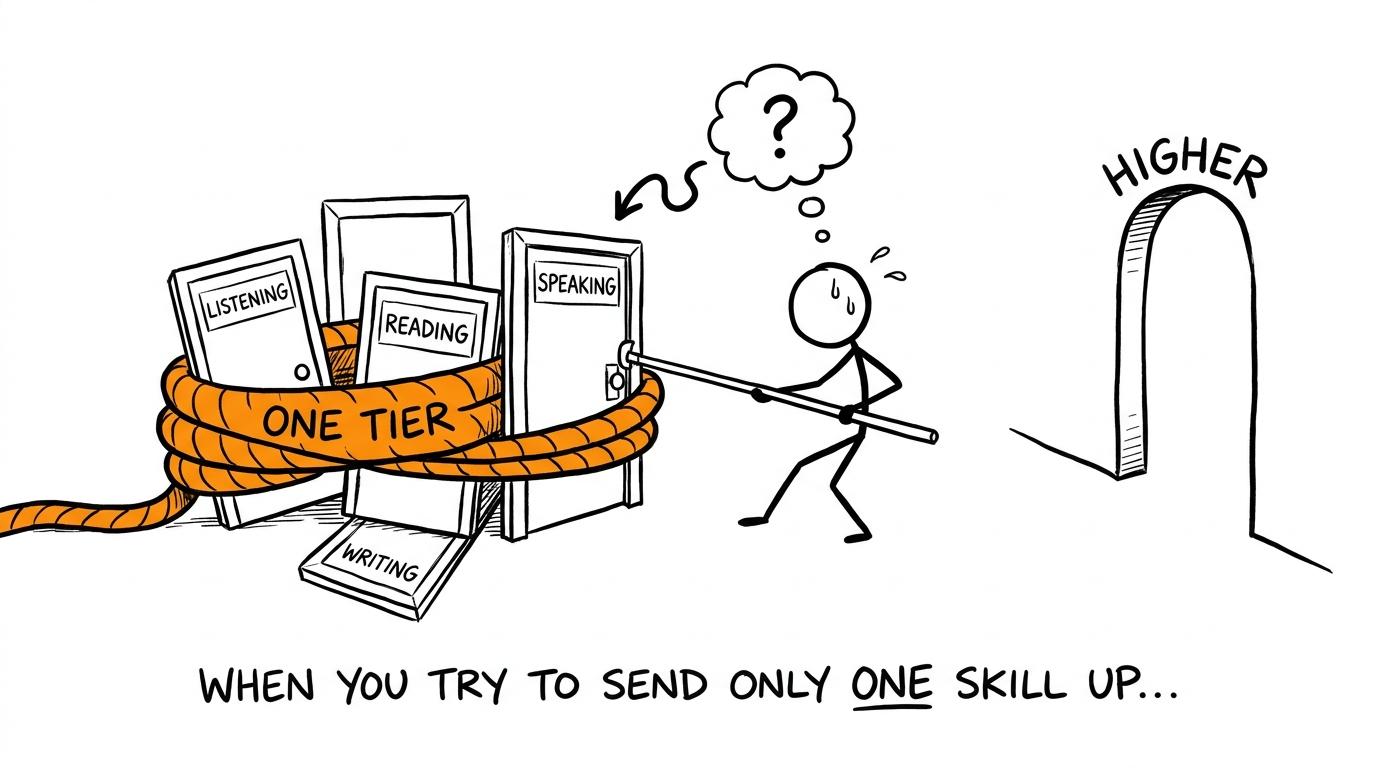 Four Arabic assessment doors tied together by one tier rope
This rule changes the question your teacher must answer. It is not simply, “Can this student complete a difficult writing task?” It is, “Is Higher tier appropriate across the complete qualification?”
Foundation papers target grades 111-555, so grade 555 is the highest available result. Higher papers target grades 444-999. There is a narrow grade 333 safety net for Higher candidates who fall just below grade 444, but it should not be treated as a guaranteed fallback. A candidate whose marks fall below that limited range can receive an unclassified result.
Higher is therefore not automatically the braver or better choice. It is useful when you need access to grades above 555 and your evidence shows that the additional demand is appropriate. Foundation may remain the more secure route when the main goal is achieving grade 444 or 555 reliably.
What evidence should you show your teacher?
A request based only on ambition is difficult to assess. A request supported by recent work begins a productive conversation.
Bring evidence from several sources:
- results from timed Foundation papers;
- attempts at Higher listening, reading and writing tasks;
- speaking performance under realistic preparation and timing rules;
- teacher-marked work showing control of vocabulary and grammar;
- a record of whether mistakes are caused by missing knowledge, timing or misunderstanding questions;
- consistency across topics rather than one unusually strong result.
Ask your teacher which Higher demands are currently preventing a switch. A specific answer gives you a revision target. “Improve listening” is vague; “follow longer passages without losing the sequence of events” is actionable.
The same evidence-led approach works in GCSE maths. MathsGenie's guide to moving from Foundation to Higher GCSE Maths explains why stable performance matters more than confidence alone. You can also use the GCSE Maths Revision hub to keep your maths preparation organised while resolving your Arabic entry.
How to prepare if Higher tier is being considered
Do not abandon Foundation material and rush towards the hardest available tasks. Higher papers still rely on secure core language. The sensible progression is to consolidate what you know, introduce the extra demand and then test it under timed conditions.
Compare the papers before committing
Ask your teacher for current specification materials and permitted practice papers at both tiers. Compare the length, pace, instructions and expected responses. Higher speaking tasks also run for longer than Foundation tasks, so preparation should reproduce the correct tier conditions.
Do not judge readiness by whether you recognise the vocabulary while reading a mark scheme. Complete the task first, without help, and then mark it.
Build a simple evidence cycle
Use this routine:
- complete one timed task;
- mark it against the official criteria;
- identify one language gap and one examination-technique gap;
- revise those weaknesses;
- attempt a fresh task under the same conditions;
- record whether the improvement remains after a short delay.
This is the same principle described in MathsGenie's guide to using GCSE past papers properly: the paper diagnoses the weakness, but the correction creates the improvement.
For maths revision alongside Arabic, the GCSE maths topics by board and tier guide can help you separate shared Foundation knowledge from Higher-only content. If you take Pearson Edexcel Maths, use the Edexcel GCSE Maths past papers with their mark schemes to build comparable evidence for your maths tier decisions.
Arrange a formal review
Ask for a short meeting with your Arabic teacher. A calm request might cover:
- your current formal tier;
- the school's internal change deadline;
- the evidence needed for Higher entry;
- a date for reviewing new work;
- whether the exams officer must approve or process the amendment.
If you are a private candidate, contact your registered examination centre. The centre submits your entry, so the awarding body cannot simply change your tier following a request from you alone.
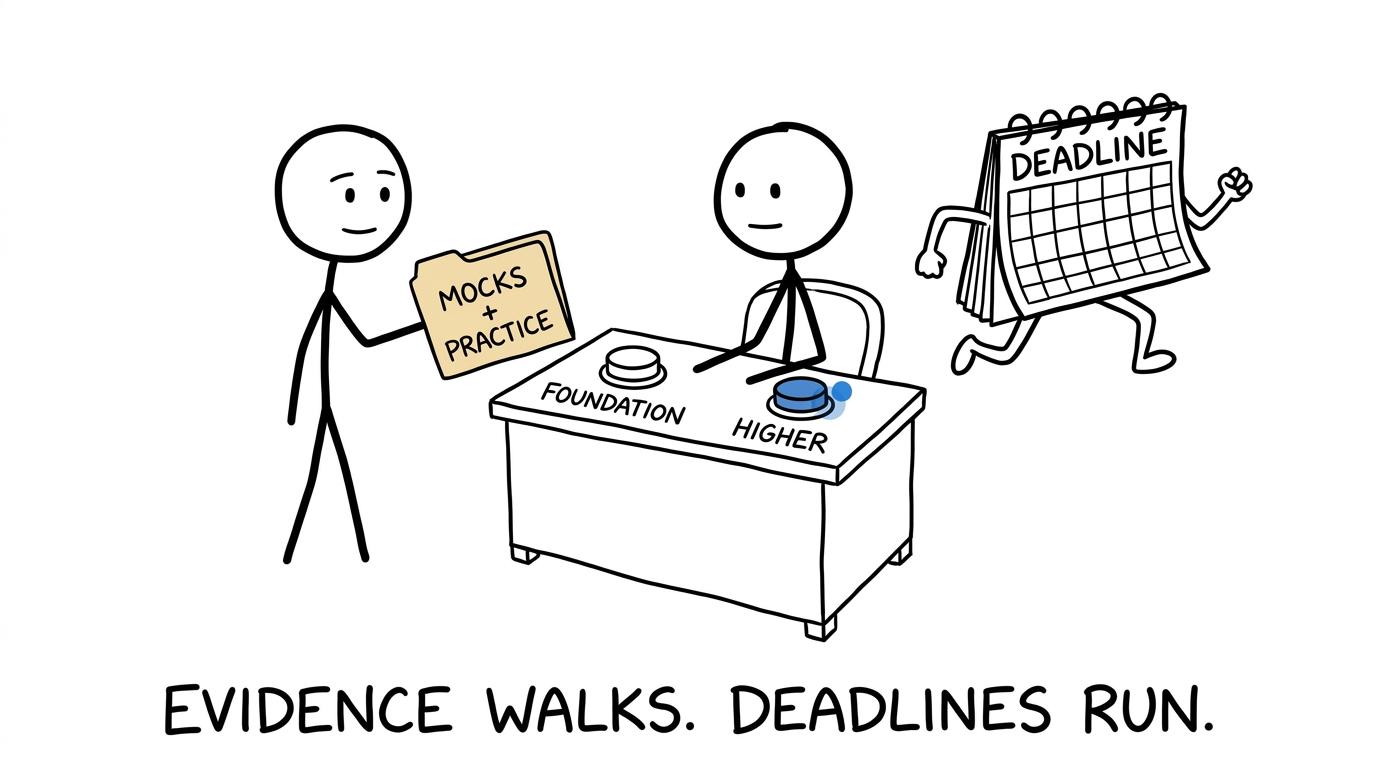 A student presenting mock evidence while the deadline calendar runs away
What if your school says no?
First, ask for the reason. A refusal may reflect current attainment, uneven performance across the four skills, a missed internal deadline or an assessment that has already taken place.
If the concern is attainment, ask what measurable improvement would justify another review. If the concern is timing, politely ask whether the formal entry has been submitted and whether an amendment remains administratively possible. The school still makes the final entry decision, but understanding the reason prevents wasted revision.
Do not let an Arabic tier discussion consume all your GCSE preparation. A clear weekly structure protects your other subjects. MathsGenie's guide to the best order for learning GCSE maths topics can help you maintain steady progress rather than revising whichever topic feels most urgent that evening.
Common mistakes when requesting a tier change
Waiting until the speaking assessment
The tier must be decided in advance of speaking. Raise the issue well before the assessment window so there is time to review evidence and process the correct entry.
Assuming the four papers can be mixed
They cannot. Listening, speaking, reading and writing must all be entered at one tier.
Treating one strong mock as proof
One result can be encouraging without being representative. Teachers will reasonably look for consistent performance across skills and more than one assessment.
Choosing Higher only because it offers grade 999
Access to a higher grade is valuable only when the paper gives you a realistic opportunity to demonstrate your knowledge. Higher also carries the risk of an unclassified result if the grade 333 safety-net threshold is not reached.
Revising without realistic conditions
Looking over answers or pausing audio repeatedly can create false confidence. Practise with the correct timing, preparation conditions and task format.
Using the wrong qualification materials
GCSE Arabic and International GCSE Arabic are not interchangeable. Confirm the awarding body, qualification title and specification code before using practice papers.
Make the decision early, then prepare for it properly
A move from Foundation to Higher GCSE Arabic is possible partway through the course, but it is not open-ended. Your school controls the entry, Pearson requires one tier across all four papers, and the decision must be made before the speaking assessment. Internal school deadlines may arrive earlier.
Ask now. Bring evidence. Find out exactly what must improve and agree on a review date. Whether the final decision is Foundation or Higher, certainty lets you practise the paper you will actually sit.
Then return that same disciplined approach to your maths exams. Start with MathsGenie's free GCSE Maths Revision resources, use revision lessons and practice questions to repair weak topics, and test your progress with past papers, predicted papers, mini tests, mark schemes and video solutions. The goal is not merely to choose the more ambitious route. It is to become ready for it.