GCSE Arabic Study Planner: Work Back From Exam Day
GCSE Arabic study planner for working backwards from exam day, balancing all four language skills with maths revision, past papers and rest.
The hardest part of revision is often not the work. It is deciding what deserves your attention today when several exams are approaching at once.
A GCSE Arabic study planner solves that problem by starting with each exam date and moving backwards. You identify what must be ready by exam day, divide the preparation into phases, and assign specific tasks to the weeks available. For students balancing Arabic with GCSE maths, this prevents one subject from quietly consuming all the available time.
The aim is not to fill every evening. It is to give each session a purpose.
Your backward-planning checklist
Before building the timetable, collect these details:
- your official Arabic exam dates and speaking assessment window
- your exam board, specification and tier
- the dates of your GCSE maths papers and other major exams
- your current strengths in listening, speaking, reading and writing
- the realistic number of sessions available each week
- school commitments, holidays and protected rest days
- at least one catch-up slot each week
Pearson Edexcel currently offers GCSE Arabic as four assessments covering listening, speaking, reading and writing. Each contributes 25%25\%25% of the qualification, and students take one tier across all four papers. The speaking assessment is conducted during the prescribed April or May window, while the other assessments take place in May or June.
Always confirm the dates and arrangements issued by your school. Do not build a plan from an old online timetable or assume that speaking will happen on the same date for every centre.
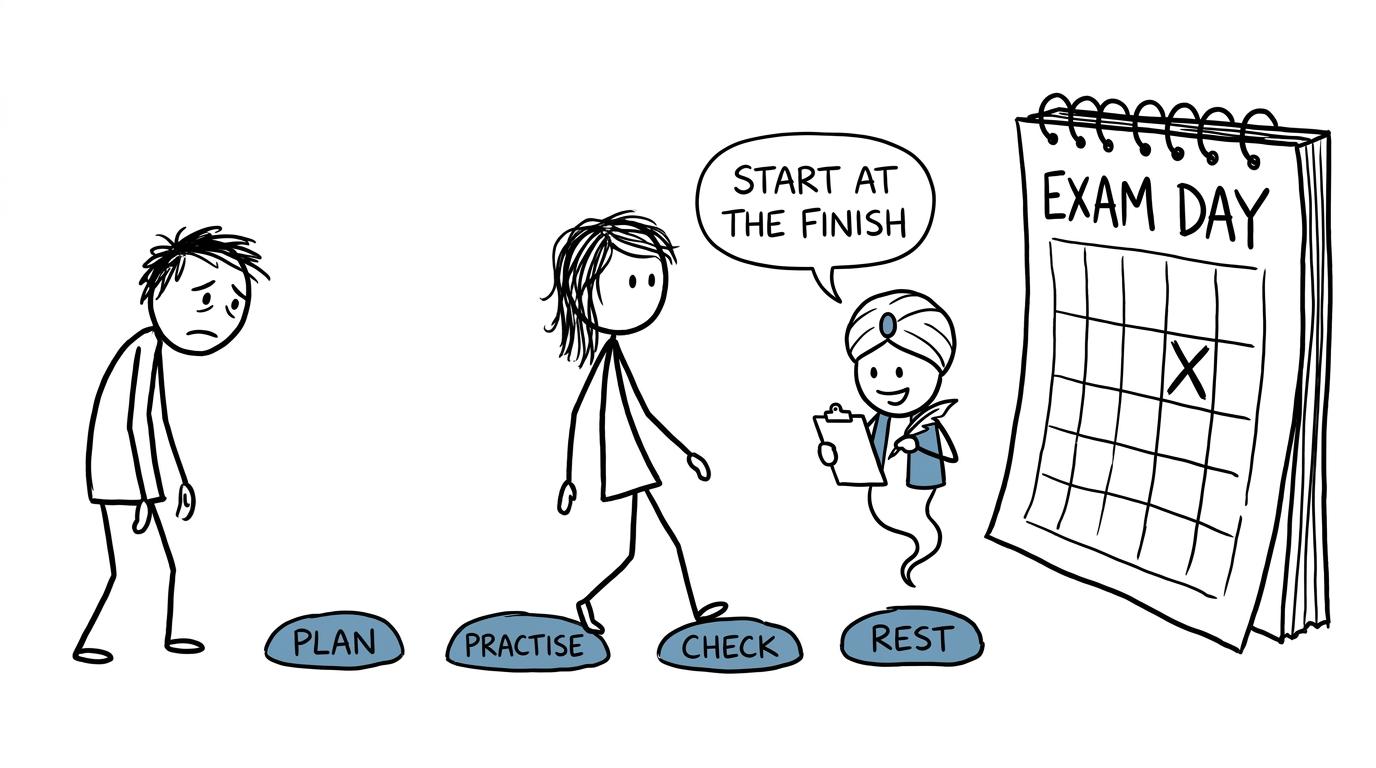 A student working backwards from exam day with a calm revision plan
Begin with the real finish lines
Arabic does not have one single finish line. Speaking may arrive before the written papers, while listening and reading may share an exam day and writing may follow later. Your plan therefore needs separate milestones.
Create a one-page assessment map containing:
- the speaking assessment window set by your school
- the listening paper date
- the reading paper date
- the writing paper date
- the dates of your maths and other GCSE papers
Then mark the week before each assessment as a consolidation period rather than a learning period. By that stage, you should be retrieving vocabulary, completing timed tasks and correcting recurring errors. New material should be limited to genuinely important gaps.
This distinction matters. A calendar says when an exam happens. A planner says what must become secure before it happens.
Audit your starting point before allocating time
Equal weighting does not automatically mean equal revision time. If listening is already reliable but writing regularly exposes gaps in vocabulary and grammar, an equal four-way split would waste useful hours.
Complete a short task in each skill under reasonably controlled conditions. Use material supplied by your teacher or taken from the current specification. Record the result in a simple traffic-light audit:
| Skill | Questions to ask | Planning response |
|---|---|---|
| Listening | Can I follow different speakers and identify details? | Schedule frequent short audio practice if details are missed. |
| Speaking | Can I answer spontaneously without memorising a script? | Add several brief speaking sessions each week. |
| Reading | Can I understand unfamiliar texts and translate accurately? | Combine vocabulary retrieval with timed passages. |
| Writing | Can I communicate clearly using varied language? | Schedule complete responses, correction and rewriting. |
Use evidence, not mood. A difficult session does not prove that you are bad at a skill, just as a comfortable session does not prove that it is exam-ready.
Maths revision should receive the same diagnosis. The MathsGenie GCSE maths revision hub helps you choose your board and find revision lessons, worksheets, exam questions and papers. If you are uncertain where your marks are disappearing, use the process in Find Your Weakest GCSE Topics before assigning maths sessions.
Divide the remaining time into revision phases
Working backwards becomes easier when the weeks have different jobs. Adjust the length of each phase to match the time you actually have.
Final week: protect accuracy and confidence
Plan backwards from each Arabic paper. During its final week:
- complete short timed sections rather than exhausting daily papers
- retrieve high-priority vocabulary without notes
- practise the exact skill being assessed next
- review corrections from earlier work
- preserve sleep and normal routines
If a maths paper falls close to Arabic, alternate shorter blocks rather than sacrificing one subject. The GCSE maths exam-week checklist offers a calm structure for selecting one weak topic, completing timed practice and making a short correction list.
Previous two or three weeks: use exam conditions
This is the performance phase. Introduce timed listening, reading and writing tasks, and rehearse speaking in the format required by your specification.
A completed paper is only useful when it changes the next session. After marking or receiving teacher feedback, classify each weakness:
- missing vocabulary
- misunderstanding the question
- grammatical inaccuracy
- weak translation
- insufficient detail
- poor timing
Apply the same cycle to maths: complete a paper, mark it, identify the topic gap, practise that topic and retest it. How to Use GCSE Past Papers Properly explains how to turn marks lost into specific revision decisions.
Earlier weeks: build language and repair foundations
The earlier phase should contain the largest amount of learning. Rotate through specification themes while continuing to practise all four skills.
A useful Arabic session might contain:
- vocabulary retrieval
- one focused grammar or translation task
- active listening, reading, writing or speaking
- immediate correction
- a brief note identifying what to revisit
For maths, use revision lessons and topic questions before moving towards full papers. The MathsGenie revision planner can help organise that route without asking you to make every decision from scratch.
Build a weekly rhythm that survives busy days
A planner fails when it assumes that every weekday will be quiet and productive. School deadlines, tiredness and unexpected events are normal. Build around them.
A balanced week could include:
| Session type | Main purpose |
|---|---|
| Arabic retrieval | Vocabulary and grammar recalled without notes |
| Arabic receptive skill | Listening or reading under light time pressure |
| Arabic productive skill | Speaking or writing followed by correction |
| Maths topic session | One weak skill learned and practised |
| Maths exam session | Mini test, paper section or full paper |
| Catch-up block | Missed work or the most urgent correction |
| Protected rest | Recovery without revision debt |
Do not schedule Arabic as one long weekly block. Speaking and vocabulary benefit from regular contact, while writing tasks need longer periods for completion and correction. Mix shorter and longer sessions according to the skill.
On crowded school days, the structure in the 20-minute maths revision routine can keep maths moving without displacing Arabic. On a weekend, a longer paper session may be more appropriate.
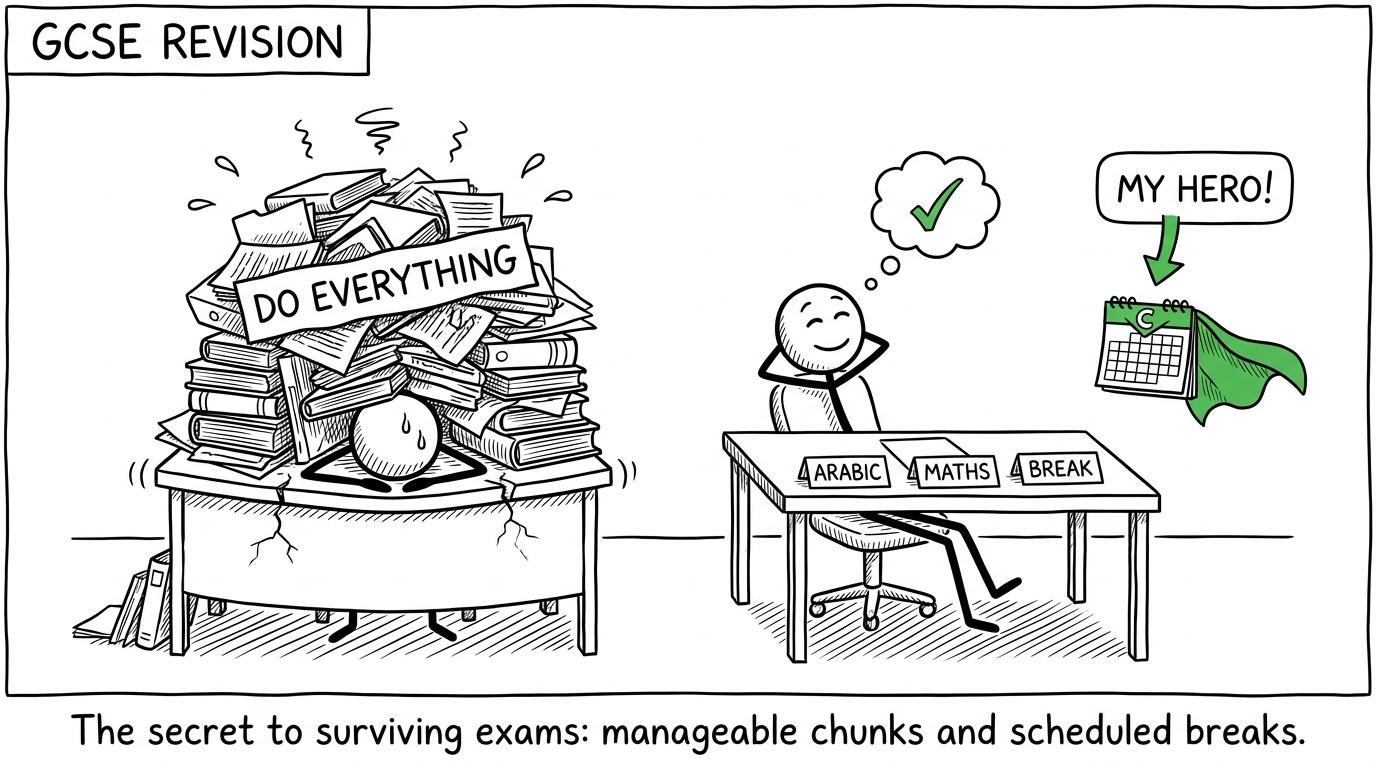 A simple revision desk defeats an impossible mountain of tasks
Put speaking earlier than feels necessary
Speaking is easy to postpone because it does not produce a neat pile of completed pages. It also commonly arrives before the written papers.
Begin with brief, frequent practice. Record answers, listen back and note where communication stops. Practise responding to unfamiliar follow-up questions rather than relying entirely on memorised paragraphs. Your teacher should guide you on the current task format, preparation rules and assessment arrangements.
As the speaking window approaches, increase realism. Practise maintaining communication when a word disappears from memory. Pausing, rephrasing and giving a simpler accurate answer are more useful than abandoning the response.
Once speaking is complete, move those sessions to the next Arabic priority. This is one advantage of backward planning: the timetable changes when a milestone passes.
Coordinate Arabic with GCSE maths papers
Students rarely revise one subject in isolation. A sensible plan looks across the whole examination timetable.
Place your maths papers beside your Arabic dates and identify congested weeks. Before those weeks arrive:
- complete substantial Arabic writing tasks earlier
- move full maths papers away from speaking-assessment days
- prepare short retrieval activities for busy evenings
- avoid scheduling two demanding timed papers on the same day
- leave one movable session for interruptions
Choose maths resources that match your board and tier. MathsGenie provides Edexcel GCSE maths past papers, AQA GCSE maths past papers and OCR GCSE maths past papers, with mark schemes and worked solutions where available.
Shorter tasks can be especially useful during Arabic-heavy weeks. The Edexcel GCSE maths mini tests provide focused timed practice without requiring the space of a complete paper.
Review the planner every week
Treat the plan as a forecast, not a contract. At the end of each week, ask:
- Which scheduled sessions were completed?
- Which Arabic skill is improving most slowly?
- Which mistakes appeared more than once?
- Is the next assessment receiving enough attention?
- Is maths being maintained as its paper dates approach?
- Does anything need moving rather than abandoning?
Keep the review brief. Move unfinished priority work into the catch-up slot, remove tasks that no longer matter and set clear outcomes for the next week. “Revise Arabic” is not an outcome. “Complete and correct one timed reading section” is.
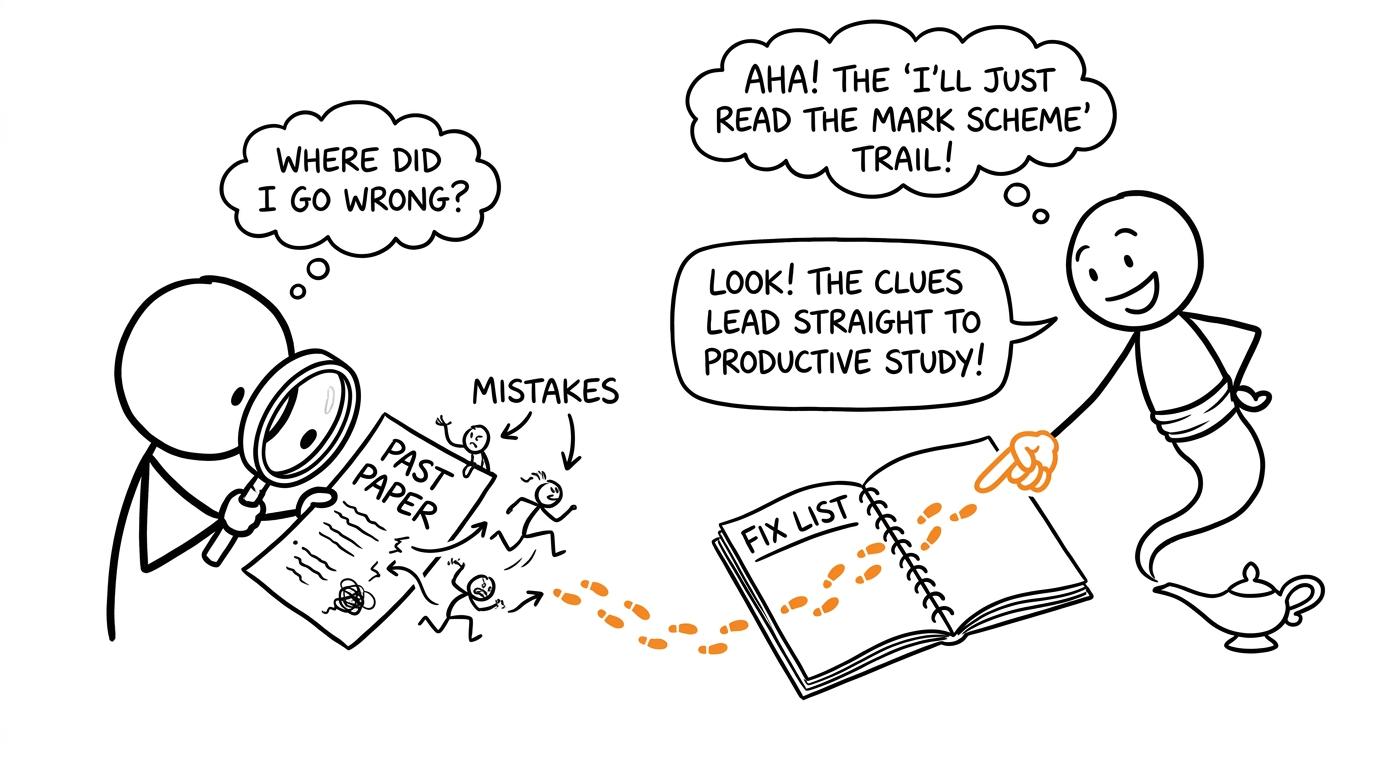 A revision detective tracks escaped mistakes into a fix list
Common GCSE Arabic planning mistakes
Planning from Monday instead of from exam day
A tidy weekly timetable can still prepare the wrong skill at the wrong time. Anchor every block to an assessment milestone.
Giving every skill identical time
All four Edexcel papers are equally weighted, but your weaknesses may not be equal. Allocate time according to evidence while continuing to maintain every skill.
Leaving speaking until the written exams feel close
Your school’s speaking window may come earlier. Put it on the calendar before distributing the remaining sessions.
Counting completion instead of correction
Finishing a task is not the end of revision. Correction, rewriting and retesting are where errors become less likely to return.
Creating a plan with no spare capacity
A timetable filled to 100%100\%100% breaks as soon as one evening changes. Include rest and catch-up time from the beginning.
Letting Arabic remove maths completely
Languages reward frequent contact, but maths methods also become less secure without practice. Maintain short maths sessions and increase timed work as each maths paper approaches.
Make the next session obvious
A strong GCSE Arabic study planner does not predict every good day or difficult day. It removes unnecessary decisions. You know which assessment comes next, which skill needs attention and what evidence will show that a session worked.
Start by confirming your dates. Audit the four Arabic skills. Work backwards through learning, timed practice and final consolidation, then place maths sessions around the busiest language milestones.
For the maths side of that plan, make MathsGenie your free revision base. Use revision lessons to rebuild understanding, practice questions and mini tests to strengthen individual skills, then move to past papers and predicted papers with mark schemes and video solutions. Open the revision planner today and give your next session one clear purpose.