GCSE Arabic Revision Book Reviews: Buying Guide
GCSE Arabic revision book reviews: check specification fit, audio access, answer quality, tier coverage and exam practice before spending your money.
A revision guide can look reassuring before you open it. The cover promises complete preparation. The reviews glow. The page count feels substantial. Yet none of those things tells you whether the book matches the examination you will actually sit.
That is why GCSE Arabic revision book reviews are worth reading before you buy, but star ratings should be the beginning of your investigation, not the end. Check the exact qualification, specification, tier, skill coverage, audio provision, answers and page design. If you cannot verify those basics, keep your money until you can inspect sample pages or borrow the book.
This matters especially when Arabic is competing with maths and several other subjects for limited revision time. A useful book reduces decisions. A poor one quietly creates more of them.
Your pre-purchase checklist
Before buying any GCSE Arabic revision guide, ask:
- Does it name the correct exam board and specification?
- Is it for UK GCSE Arabic rather than an International GCSE or another qualification?
- Does it cover your tier and current assessment structure?
- Are listening, speaking, reading and writing all supported?
- Is usable audio included, and can you test how it is accessed?
- Are answers detailed enough to explain improvement?
- Does the Arabic text display clearly from right to left?
- Are there realistic exam-style tasks rather than vocabulary lists alone?
- Can you see sample pages before paying?
- Does the book solve a genuine weakness in your revision plan?
A book does not need to be perfect. It does need to be right for you.
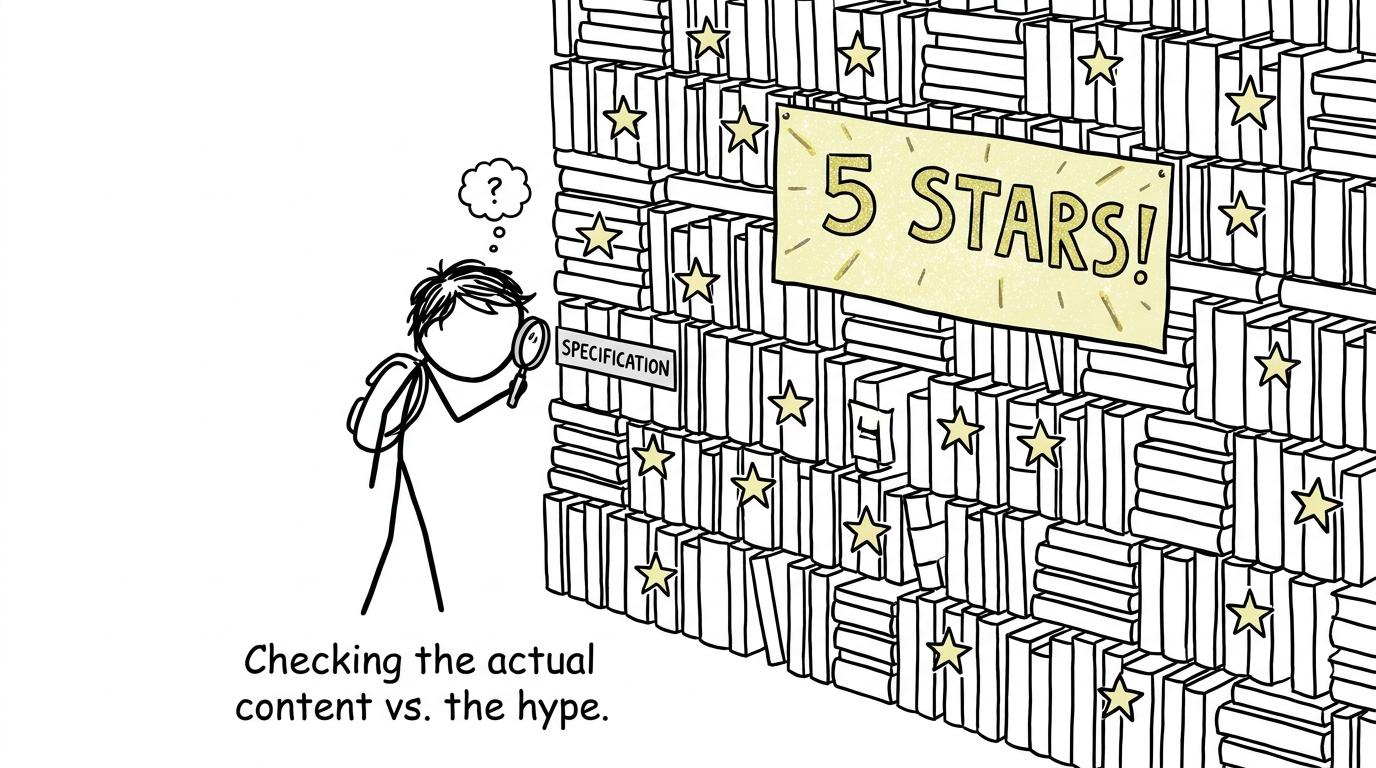 A student investigates the specification while a giant five-star sign tries to attract attention
Check the exact qualification first
The most important words may be printed in the smallest type.
For the current Pearson Edexcel GCSE Arabic specification, the qualification code is 1AA0. Pearson’s official specification describes four assessed skills: listening, speaking, reading and writing. Each contributes 25%25\%25% of the qualification. Foundation and Higher tiers are available, and a student is entered for the same tier across all four papers.
That gives you a precise test for any prospective book. It should not merely say “Arabic GCSE” on the cover. Look for the awarding organisation, specification code, intended exam series or edition, and tier coverage.
Be particularly careful not to confuse:
- Pearson Edexcel GCSE Arabic with an International GCSE;
- Arabic as a foreign language with Arabic as a first language;
- the current specification with an older or future course;
- a general language workbook with an exam-specific revision guide.
These qualifications can differ in their papers, tasks, themes and expectations. A well-written book for the wrong course is still the wrong book.
Specifications and resources can change, so confirm your course with your teacher and compare the book against the latest official exam-board information before purchasing. The publication date alone is not proof of alignment.
Look beyond “covers the whole course”
A contents page can list every theme while doing little to prepare you for assessment. Coverage is not just the presence of topics. It is the presence of the right kinds of practice.
The current Edexcel GCSE requires students to develop listening, speaking, reading and writing. A worthwhile guide should explain how it supports each one.
Listening needs accessible audio
Printed transcripts are useful after an attempt, but they cannot replace listening practice. Check whether the book provides audio, how long access lasts, whether an account or app is required, and whether the files work on your usual device.
Look for different speakers and exam-relevant question formats. If reviews repeatedly report broken links, missing tracks or awkward registration, take that seriously. Audio is not a bonus feature in a qualification with a dedicated listening paper.
Speaking needs prompts and feedback criteria
Speaking revision should involve more than memorising a model paragraph. The current course assesses interaction through structured speaking tasks, so check for prompts that encourage spontaneous answers, follow-up questions and development of ideas.
A strong resource should also help you judge an answer. Look for clear guidance on communication, accuracy, range and how to extend a response naturally. If the book only provides scripts to copy, it may create confidence without flexibility.
Reading needs more than translation
Translation is valuable, but reading practice should also test comprehension across varied text types. Inspect whether passages resemble the level and style expected at your tier. Questions should make you identify detail, understand opinions and infer meaning from context rather than simply match isolated words.
Writing needs meaningful correction
Model answers help only when you can see why they work. Look for annotations, planning guidance, grammar checks and comments about how a response could improve. A page of polished Arabic followed by “sample answer” may be impressive, but it gives a learner little route from their own draft to a stronger one.
Inspect the Arabic itself
Language books have a design problem that ordinary star ratings rarely capture: the text must remain readable while carrying a great deal of information.
Use sample pages to inspect:
- Arabic font size and clarity;
- correct right-to-left layout;
- spacing around punctuation and answer lines;
- whether English and Arabic sit together without becoming confusing;
- consistency of vocabulary and grammar explanations;
- whether any vocalisation is used purposefully rather than inconsistently.
Pearson states that students are not expected to use vocalisation in their writing, while examination materials may use it where needed for clarity. A revision guide should therefore help you read confidently without making you dependent on fully vocalised text.
Also consider the variety of Arabic presented. GCSE preparation should support the standard Arabic expected by the qualification. Cultural examples can come from across the Arabic-speaking world, but a resource should not leave you uncertain about whether a form is standard, colloquial or region-specific.
Judge the answers as carefully as the questions
A revision book is partly a feedback system. If its answers are thin, the system breaks.
Check whether the answer section includes:
- acceptable alternatives where appropriate;
- explanations for grammar choices;
- translations that preserve meaning rather than force one rigid wording;
- model responses at a realistic GCSE level;
- guidance linked to the demands of the task;
- transcripts for listening activities;
- enough detail to correct work independently.
This is the same principle that makes mark schemes useful in maths. Completing questions creates evidence; reviewing the answers turns that evidence into a next step. Maths students can apply that cycle through the GCSE maths revision hub, where resources are organised by exam board, or read how to find weak topics from mistakes.
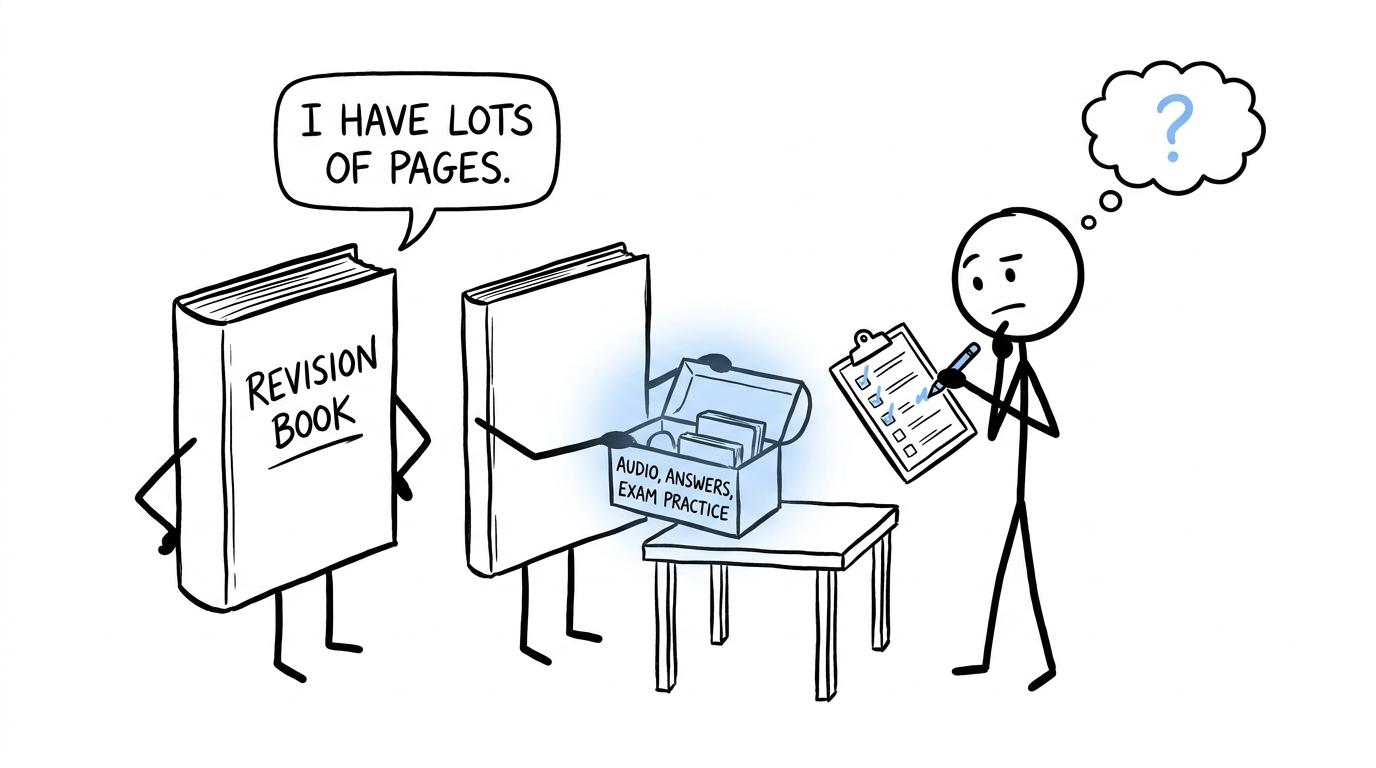 Two revision books audition while a student checks whether they provide useful tools
Read reviews like evidence, not verdicts
An average rating compresses many different experiences into one number. It cannot tell you whether the reviewer took your qualification, used the audio or needed the same level of explanation.
Instead, search reviews for repeated, specific observations:
- “The audio code had expired.”
- “The answers did not explain errors.”
- “The Higher-tier questions were limited.”
- “The Arabic font was difficult to read.”
- “The sample writing tasks matched the book’s stated specification.”
Specific comments are more useful than “brilliant book” or “too hard”. Difficulty is personal. Missing audio is factual.
Check the review date and, where possible, the edition reviewed. Online shops sometimes group feedback from several editions or formats. A complaint about an old edition may have been fixed; praise for an earlier version may not describe the copy currently on sale.
It is also sensible to compare independent reader comments with the publisher’s sample pages and contents list. Neither source is sufficient alone. Together, they give you a clearer picture.
Decide whether you need another book at all
Buying feels productive because it is immediate. Learning is slower.
Before purchasing, name the problem the guide must solve. Perhaps you need structured writing tasks, listening audio or a clearer grammar reference. If you cannot identify the gap, another book may simply duplicate school materials.
Try a short test:
- Borrow the guide from a library, school or friend if possible.
- Complete one section rather than browsing it.
- Check the answers and note what you learned.
- Decide whether the format makes you more likely to practise regularly.
The best resource is not necessarily the most comprehensive. It is the one that enters a repeatable cycle: learn, practise, check, correct and return later.
That cycle should protect time for your other GCSEs too. For maths, you can build it with Edexcel GCSE revision lessons and questions, shorter Edexcel GCSE mini tests and a realistic GCSE maths revision timetable.
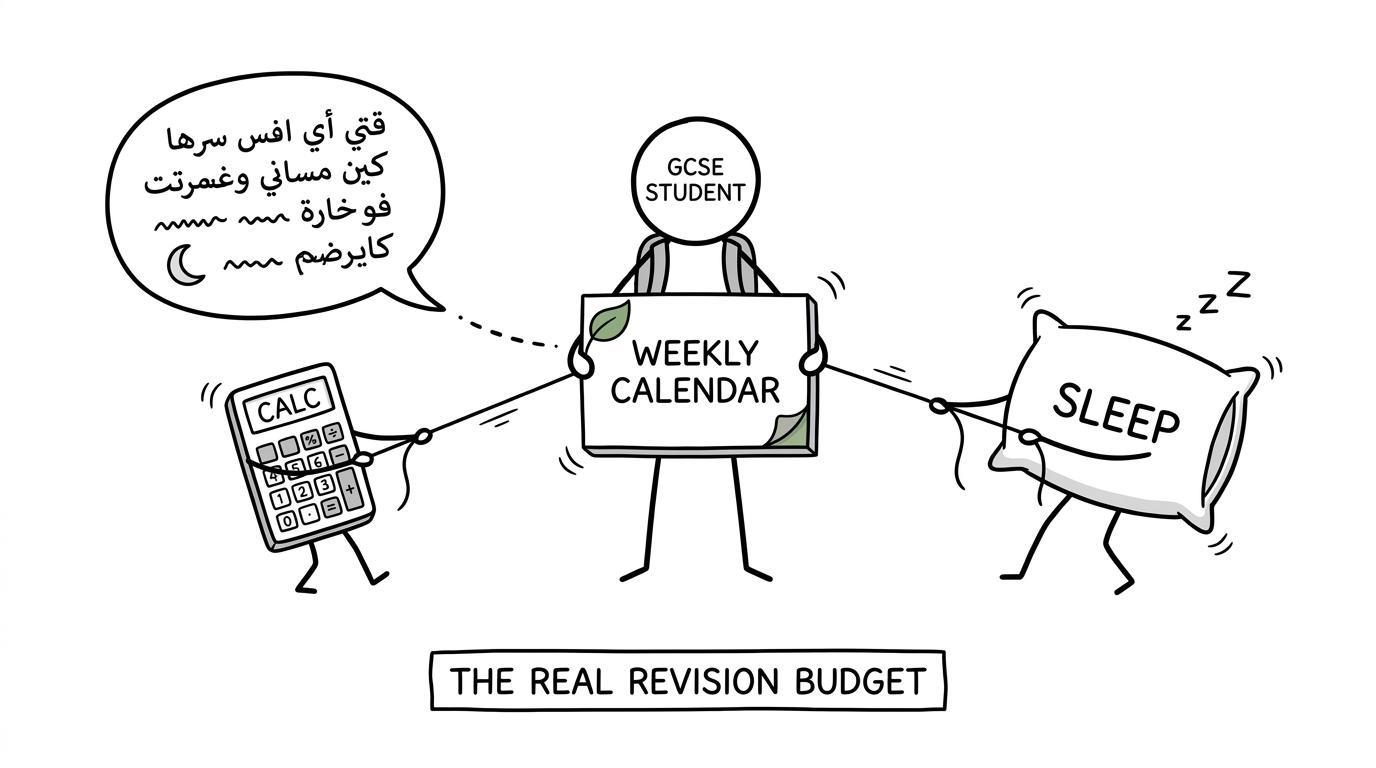 Arabic, maths and sleep compete gently for space in a student's real revision budget
Common mistakes when choosing a GCSE Arabic book
Trusting the title without checking the specification
“GCSE Arabic” is not precise enough. Verify the qualification, awarding organisation, specification code, tier and edition.
Buying from star ratings alone
Ratings measure satisfaction, not course alignment. Read recent comments for concrete information about audio, answers, errors and exam-style practice.
Assuming a thick book offers better revision
Page count can mean depth, repetition or simply larger formatting. Inspect how much active practice and useful feedback the book contains.
Ignoring digital access conditions
Audio may depend on a code, website, app or account. Check compatibility and whether access is reusable, especially when buying second-hand.
Choosing a book that only suits your strongest skill
A vocabulary-heavy guide may feel comfortable if reading is already your strength. Buy for the gap that costs you most, while ensuring all assessed skills receive suitable attention.
Letting one subject consume the whole timetable
Arabic and maths both improve through repeated retrieval and correction. Preserve a balanced weekly plan. The guide on when to begin GCSE past papers can help you phase maths practice rather than leaving it until every topic feels finished.
A good purchase should make the next action obvious
The right revision guide does not merely contain information. It tells you what to do next, allows you to check the result and makes weaknesses visible.
So yes, reviewing a GCSE Arabic book before buying it is worthwhile. Confirm the exact qualification first. Then inspect the four-skill coverage, audio, answer quality, Arabic layout, exam realism and digital access. Treat star ratings as clues, never proof.
Once the book has earned a place in your timetable, apply the same disciplined approach across your GCSEs. Use MathsGenie as your free maths revision base: choose your board and tier, learn through revision lessons, practise with topic questions and mini tests, then move into past papers and predicted papers with mark schemes and video solutions. The guide to revising GCSE maths efficiently will help you turn those resources into a calm, repeatable routine.
Buy fewer resources. Examine them better. Then spend the saved time doing the work that earns marks.