GCSE Arabic Resit Entry: Late Entry Guide
GCSE Arabic resit entry explained: late deadlines, exam-centre steps, speaking-test rules and what to do after missing the usual summer sitting in 2027.
Missing an exam entry can feel strangely final. One deadline passes, one email remains unanswered, and suddenly months of preparation seem to be balanced on an administrative detail.
But a missed deadline is not always a missed qualification. A GCSE Arabic resit entry must be made through an approved exam centre, and UK GCSE Arabic is normally available in the summer series rather than the November resit series. If you missed the June 2026 sitting, the next confirmed Pearson Edexcel opportunity is June 2027. If you have only missed a centre's normal entry deadline, a late entry may still be possible; but availability, extra fees and the speaking assessment all matter.
The first step is therefore simple: contact your school, college or private exam centre immediately. Ask whether you are already entered, whether a late entry is still possible, and which exam series and specification they offer.
GCSE Arabic resit entry checklist
Before revising another vocabulary list, confirm these practical details:
- Qualification: Pearson Edexcel GCSE Arabic, specification code 1AA0, if that is the course you studied.
- Exam series: GCSE Arabic is available in the May/June series. Do not assume there is a November sitting.
- Candidate status: ask whether your school will enter you or whether you need a private-candidate centre.
- Tier: Foundation or Higher must be selected across the whole qualification.
- Speaking assessment: confirm whether the centre can conduct and submit it.
- Previous speaking mark: if you are resitting, ask whether it can be carried forward from the previous series.
- Deadlines and fees: request the centre's own dates and a complete written quotation.
- Access arrangements: discuss these at once rather than after paying.
- Statement of entry: check your name, specification, tier and component details when it arrives.
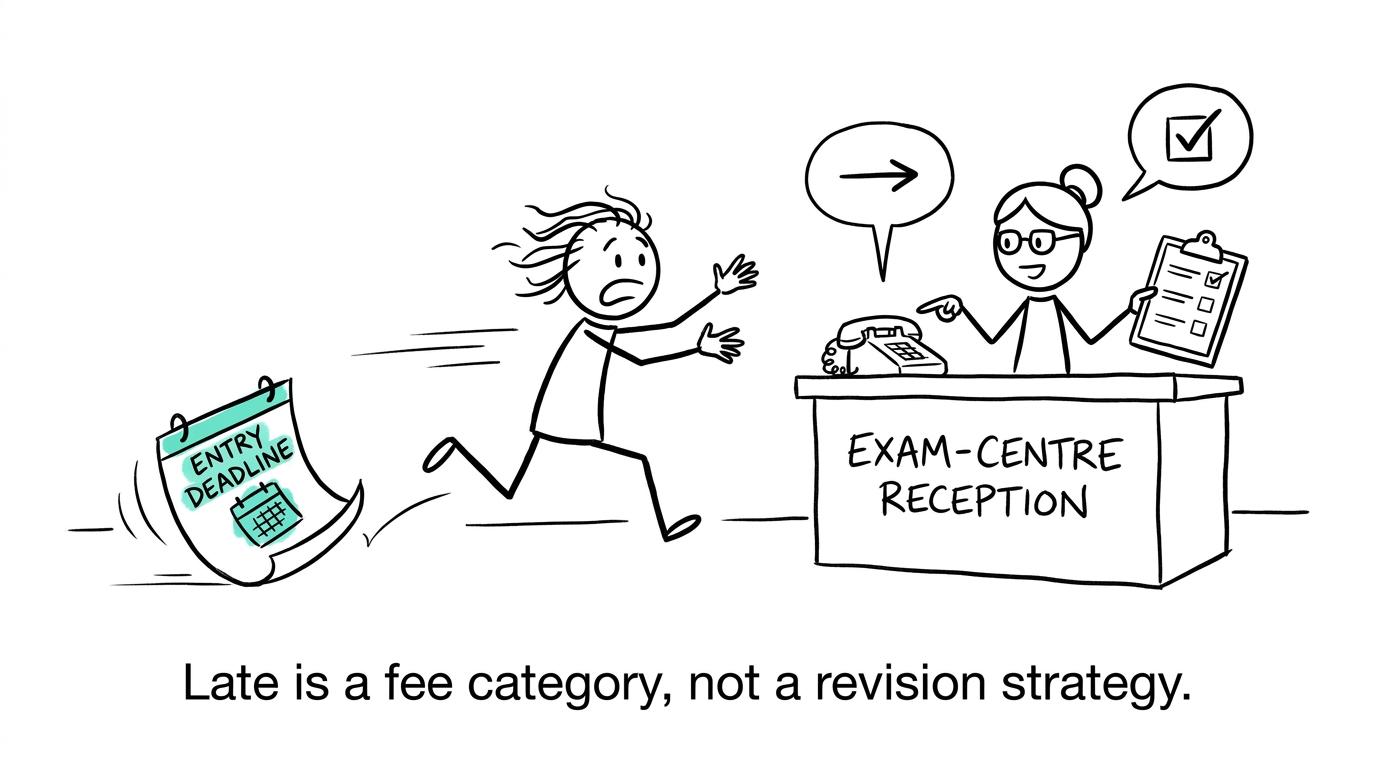 A student chasing an entry deadline towards an exam-centre desk
Is a late entry the same as a resit?
No. The distinction matters because it changes what you should ask the exams officer.
A late entry means the centre submits your entry after the awarding body's standard deadline but before the relevant assessment arrangements make participation impossible. Extra awarding-body and centre fees may apply.
A resit means taking the qualification again in a later exam series after a previous attempt. You may be resitting to improve your grade, because you were absent, or because you did not complete all the required assessments.
If the written examinations have already taken place, a late entry cannot take you back into that series. Your practical route is the next series in which the qualification is available. For the current Pearson Edexcel UK GCSE Arabic specification, that means waiting for the following summer rather than expecting an autumn resit.
This differs from GCSE English Language and GCSE Mathematics, for which November opportunities are commonly available to eligible candidates. It also differs from Pearson's International GCSE Arabic qualifications. Always check whether your course is the UK GCSE, an International GCSE or another qualification before interpreting a timetable.
The late-entry windows for June 2027
Pearson's published 2026/27 key dates show the following dates for UK-centre GCSE entries in the June 2027 series:
| Entry stage | Pearson date for June 2027 |
|---|---|
| Entry window opens | 20 November 2026 |
| Standard entry deadline | 21 February 2027 |
| Late fees begin | 22 February 2027 |
| High late fees begin | 22 April 2027 |
Pearson states that an entry fee is doubled from the late-fee date and trebled from the high-late-fee date. However, that does not tell you the total amount a private candidate will pay. Centres can add their own administration, accommodation, invigilation and speaking-assessment charges.
More importantly, these are awarding-body dates, not promises that every centre will accept an entry until then. A centre may close applications weeks earlier because it needs time to verify identification, arrange rooms, process access arrangements and organise the speaking test. It may also reach capacity.
Think of the published deadline as the edge of the map, not the target. Your safe deadline is the one your chosen centre gives you in writing.
What happens if you missed the usual sitting?
Your next action depends on what was actually missed.
You missed your school's internal deadline
Speak to the exams officer immediately. The school may still be able to enter you, especially if the awarding body's standard deadline has not passed. If late fees already apply, ask who is expected to pay them.
Do not rely on a verbal conversation. Request written confirmation of the specification code, tier, exam series and total charge.
You were entered but missed an examination
Contact the centre that entered you. It can explain how your absence was recorded and whether any formal process applies to your circumstances. Do not assume that missing one component automatically creates a separate resit for that paper.
For GCSE Arabic 1AA0, the qualification includes listening, speaking, reading and writing. The written papers must be taken together in one terminal series, so a future attempt is generally an entry for the qualification rather than a booking for one isolated written paper.
You missed the entire summer series
If the assessment window and written papers have passed, you cannot enter retrospectively. For someone who missed June 2026, the next confirmed UK GCSE Arabic series is June 2027.
Use the extra time deliberately. Confirm the centre first, then build revision around the exact Foundation or Higher specification rather than revising indefinitely without an entry.
Your previous school will not enter you again
You can approach an approved centre that accepts private candidates. JCQ defines a private candidate as someone who takes examinations at an approved centre without being enrolled there as a student.
Not every centre accepting private candidates offers every subject. Arabic requires a speaking assessment, so ask specifically whether the centre accepts Pearson Edexcel GCSE Arabic 1AA0, not merely whether it accepts Pearson candidates.
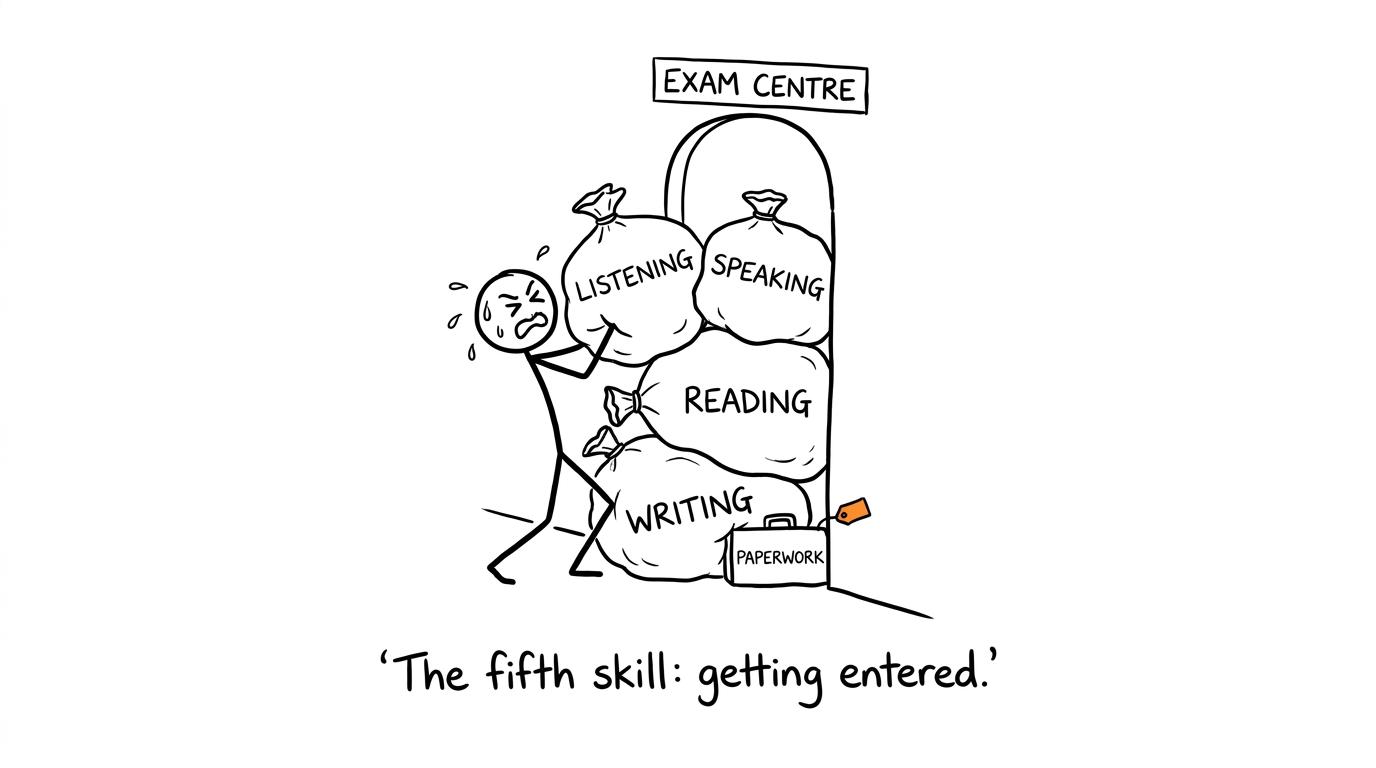 A student carrying the four GCSE Arabic skills through an exam-centre doorway
How the GCSE Arabic assessment affects late entries
Pearson Edexcel GCSE Arabic has four compulsory components: listening, speaking, reading and writing. Candidates enter either Foundation or Higher tier and must use the same tier across all papers.
For June 2027, Pearson has confirmed a GCSE Arabic speaking window from 15 April to 20 May 2027. The written timetable should also be checked once the final version is available.
The speaking window is one reason a theoretically available late entry may still be refused. A centre needs suitable staff, secure assessment materials, recording equipment and time to submit the recording correctly. An entry made very close to the speaking period can therefore be impractical even if an online entry system remains open.
If you are resitting, Pearson permits the Paper 2 speaking mark to be transferred from the previous examination series. Specific entry options are available for Foundation and Higher candidates using a transferred speaking result. This is not automatic: ask the centre to check your previous result, eligibility and correct entry option before submitting anything.
The remaining written components still need to be taken in the new terminal series. You cannot casually combine separate listening, reading and writing marks collected across different years.
What to ask an exam centre
A short, precise email is easier for an exams officer to answer. Include your intended exam year and ask:
- Do you accept private candidates for Pearson Edexcel GCSE Arabic 1AA0?
- Can you conduct and submit the speaking assessment?
- Do you offer Foundation, Higher or both tiers?
- What is your standard entry deadline?
- What are your late and high-late-entry deadlines?
- What is the complete fee, including the speaking component and centre charges?
- Can a previous speaking mark be transferred, if eligible?
- Which identification and previous candidate details do you require?
- Can you support any necessary access arrangements?
- When will I receive my statement of entry and timetable?
If you have sat public examinations before, provide your existing candidate details when requested. Keeping records consistent helps the centre connect the new entry with your examination history.
Never pay on the strength of a vague promise that the centre “does languages”. Get the exact subject, specification, tier, series and assessment arrangements confirmed in writing.
Keep your maths revision moving while entries are arranged
Administrative uncertainty can absorb every spare hour because it feels urgent but has no obvious finishing point. Separate it from revision.
Give the entry problem a checklist and a defined weekly follow-up time. Then return to the work that improves your marks. If you are also preparing for GCSE Mathematics, begin with the GCSE Maths revision hub, where resources are organised by exam board and tier.
Use GCSE past papers by exam board to diagnose gaps, then review the method with revision lessons and practice questions. MathsGenie's guide to using GCSE past papers properly explains the useful cycle: complete, mark, diagnose, repair and retest.
When a full paper feels too large, use Edexcel GCSE Maths mini tests or follow the 20-minute GCSE maths revision routine. Closer to the examination, GCSE predicted papers can provide fresh practice after official past papers.
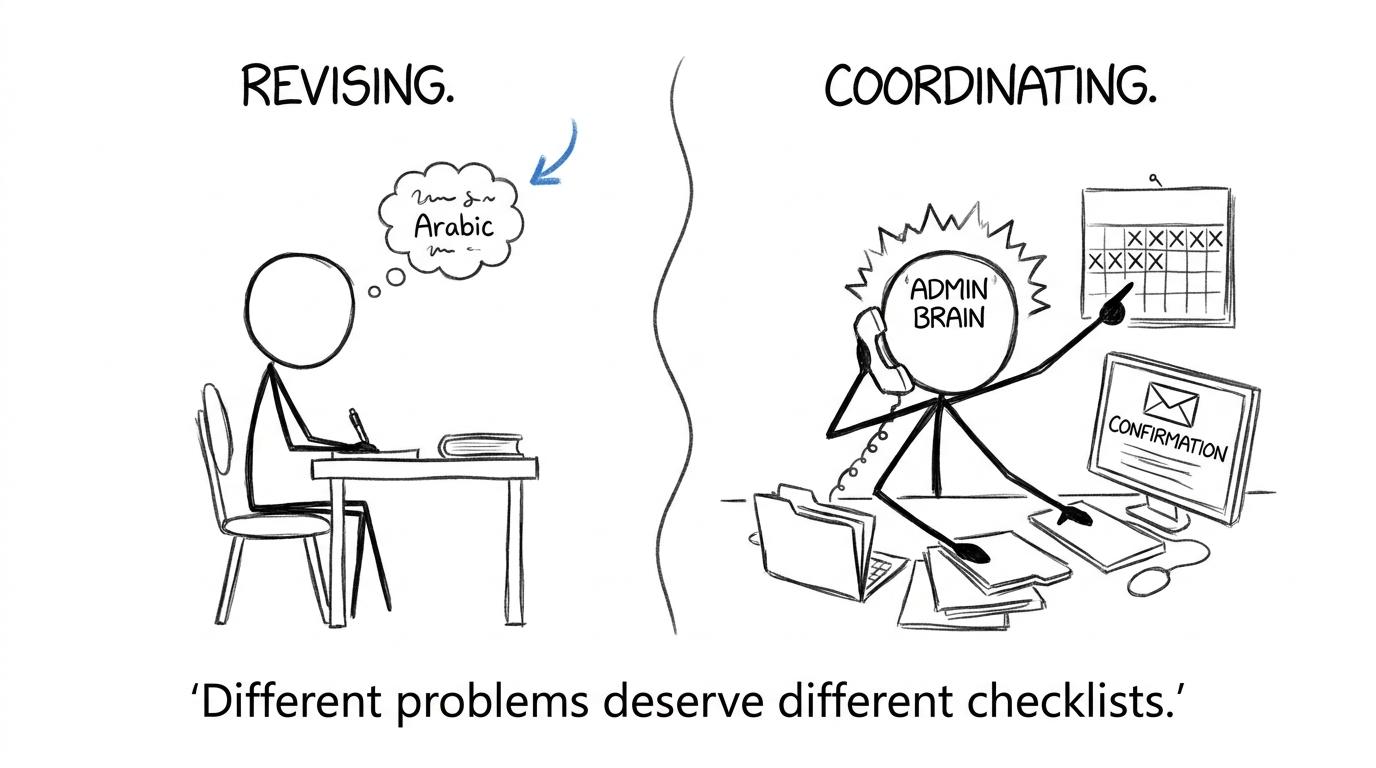 A revision brain and an administration brain following separate checklists
Common GCSE Arabic resit entry mistakes
Assuming there is a November Arabic resit
The familiar November resit route for GCSE English Language and Mathematics does not mean every GCSE subject is offered then. Current UK GCSE Arabic entries are available in the summer series.
Confusing GCSE Arabic with International GCSE Arabic
They have different specifications, assessment structures and series availability. Confirm the qualification title and code before booking.
Treating the awarding-body deadline as the centre deadline
Centres can set earlier internal deadlines and refuse entries when capacity or assessment arrangements make acceptance impractical.
Forgetting the speaking assessment
A centre that can host written papers may not necessarily be willing to conduct GCSE Arabic speaking. Confirm this before paying.
Choosing a tier informally
Foundation and Higher are formal entry choices covering the whole qualification. The centre must decide the tier before the speaking assessment.
Assuming a previous speaking mark will transfer automatically
Carry-forward arrangements require the correct entry option and eligibility checks. Ask the exams officer to confirm both.
Letting one entry problem derail every subject
Once you have contacted suitable centres and scheduled a follow-up, return to your revision plan. If you are preparing for another attempt at GCSE Mathematics too, the GCSE maths resit revision plan offers a structured starting point. You can also use MathsGenie's past-paper features to keep attempts, marks and corrections organised.
Turn uncertainty into a confirmed plan
A missed sitting is a delay, not a verdict. Establish whether you need a late entry or a genuine resit, confirm Pearson Edexcel GCSE Arabic 1AA0 with a willing centre, check the speaking arrangements, and obtain every deadline and fee in writing.
For June 2027, act well before 21 February 2027. Waiting for the late-entry period increases the cost and reduces the chance that a centre can accommodate the speaking assessment.
Then let administration become boring again. Keep building your other subjects with MathsGenie's free revision lessons, practice questions, mini tests, past papers, predicted papers, mark schemes and video solutions. Secure the entry, make a realistic plan, and return your attention to the next mark you can earn.