

GCSE Arabic Paper 4: What to Actually Expect
GCSE Arabic Paper 4 explained: timings, Foundation and Higher questions, translation, marking priorities and a calm revision plan for exam day.
The unsettling thing about an exam called Paper 4 is that it can sound like the final chapter of a story everyone else has already understood. In reality, GCSE Arabic Paper 4 has a clear purpose: it is the writing paper for Pearson Edexcel GCSE Arabic. You write responses of different lengths, address specified content, communicate opinions and complete a translation into Arabic.
The current Pearson Edexcel specification gives Foundation students 111 hour 202020 minutes and Higher students 111 hour 252525 minutes. Both papers are worth 606060 marks, representing 25%25\%25% of the qualification. There is no dictionary.
This guide concerns Pearson Edexcel GCSE Arabic specification 1AA0. International GCSE Arabic is a different qualification, so check the code on your school documents and practice papers before revising.
GCSE Arabic Paper 4 at a glance
Here is the structure you should recognise before entering the exam room:
| Feature | Foundation tier | Higher tier |
|---|---|---|
| Official duration | 111 hour 202020 minutes | 111 hour 252525 minutes |
| Total marks | 606060 | 606060 |
| Qualification weighting | 25%25\%25% | 25%25\%25% |
| Open-response tasks | Three | Two |
| Translation | English into Arabic | English into Arabic |
| Dictionary allowed | No | No |
| Questions to complete | All required questions, choosing the stated option where offered | All required questions, choosing the stated option where offered |
The essential checklist is short:
- know your tier and specification code;
- recognise the expected word count for each task;
- respond to every bullet point;
- use opinions, reasons and suitable timeframes;
- reserve time for the translation;
- check spelling, verb forms, agreement and omitted words.
 A student discovers that Paper 4 is writing rather than a mysterious sequel
What is different about GCSE Arabic Paper 4?
Paper 4 is an assessment of productive language. Listening and reading ask you to understand language that someone else has created. Writing asks you to create the language yourself.
That changes the nature of the challenge. You cannot simply recognise a familiar word and move on. You must retrieve vocabulary, select an appropriate verb form, organise ideas and write accurately enough for your meaning to remain clear.
The paper draws vocabulary and structures from across the specification's themes and topics. It does not reward memorising one impressive paragraph and forcing it into every answer. The context can change, while the underlying writing skills remain stable.
Paper 4 particularly favours students who can:
- communicate relevant information directly;
- develop an answer with opinions and reasons;
- move accurately between timeframes;
- adapt familiar language to an unfamiliar prompt;
- translate meaning rather than mechanically replacing individual words;
- maintain accuracy across a sustained response.
This is why knowing Arabic socially is not automatically the same as being ready for the examination. Everyday fluency helps, but the paper assesses written Arabic under formal conditions and against a mark scheme.
Foundation tier question types
Foundation Paper 4 contains three open-response questions followed by a translation into Arabic. The tasks increase in demand and expected length.
The shortest response
The opening task asks for a brief response based on the material provided. Its purpose is not to invite a long essay. It tests whether you can produce simple, relevant and understandable sentences.
A student can lose time here by treating the smallest question as an opportunity to display everything they know. A safer principle is to meet the task precisely, check the language and continue.
The middle-length response
The next task requires a more developed answer and normally offers a choice of contexts. Read both options before deciding. Choose the one for which you can answer every bullet point, not merely the one containing the most familiar title.
You need connected writing rather than isolated statements. Straightforward linking phrases, a clear opinion and an explained reason are often more valuable than ambitious vocabulary used inaccurately.
The extended Foundation response
The longer Foundation task expects a response of roughly 808080 to 909090 words. It carries more demand because you must sustain your meaning and cover the specified content while controlling your language.
Pearson has clarified its marking language around timeframes. For the highest relevant linguistic band, successful use of three timeframes matters; the band below requires at least two. That does not mean inserting unrelated past, present and future sentences. Each timeframe must contribute naturally to the answer.
Translation into Arabic
The final task tests translation from English into Arabic. It is worth 121212 marks. Translation exposes small gaps that a prepared paragraph can hide: pronouns, negatives, possession, verb tense, agreement and ordinary vocabulary.
Translate the intended meaning of each sentence. If one word is uncertain, preserve as much accurate meaning as possible rather than abandoning the whole section.
Higher tier question types
Higher Paper 4 is shorter in the number of tasks but more demanding in the depth of writing. It contains two open responses and one translation into Arabic.
The shorter Higher response
The first response is approximately 808080 to 909090 words. You are expected to cover the prompt fully while showing organised communication and an appropriate range of language.
The word count is a guide to the required scale. Writing far below it can leave ideas undeveloped or bullet points unanswered. Writing far beyond it creates more opportunities for errors and consumes time needed elsewhere.
The extended Higher response
The second response is approximately 130130130 to 150150150 words and is the centre of gravity of the paper. It rewards sustained communication, development, linguistic range and control.
A strong answer usually has a visible shape: it addresses the task, develops opinions with reasons, moves naturally across relevant timeframes and remains understandable throughout. Complexity helps only when it is controlled. A shorter accurate sentence can be more effective than a tangled sentence whose meaning disappears halfway through.
Higher translation
The Higher translation is also from English into Arabic and is worth 121212 marks. The language is likely to demand closer control of structures and vocabulary than the Foundation translation.
Do not treat it as an optional final extra. Those marks are part of the paper from the beginning, so your time plan should protect them.
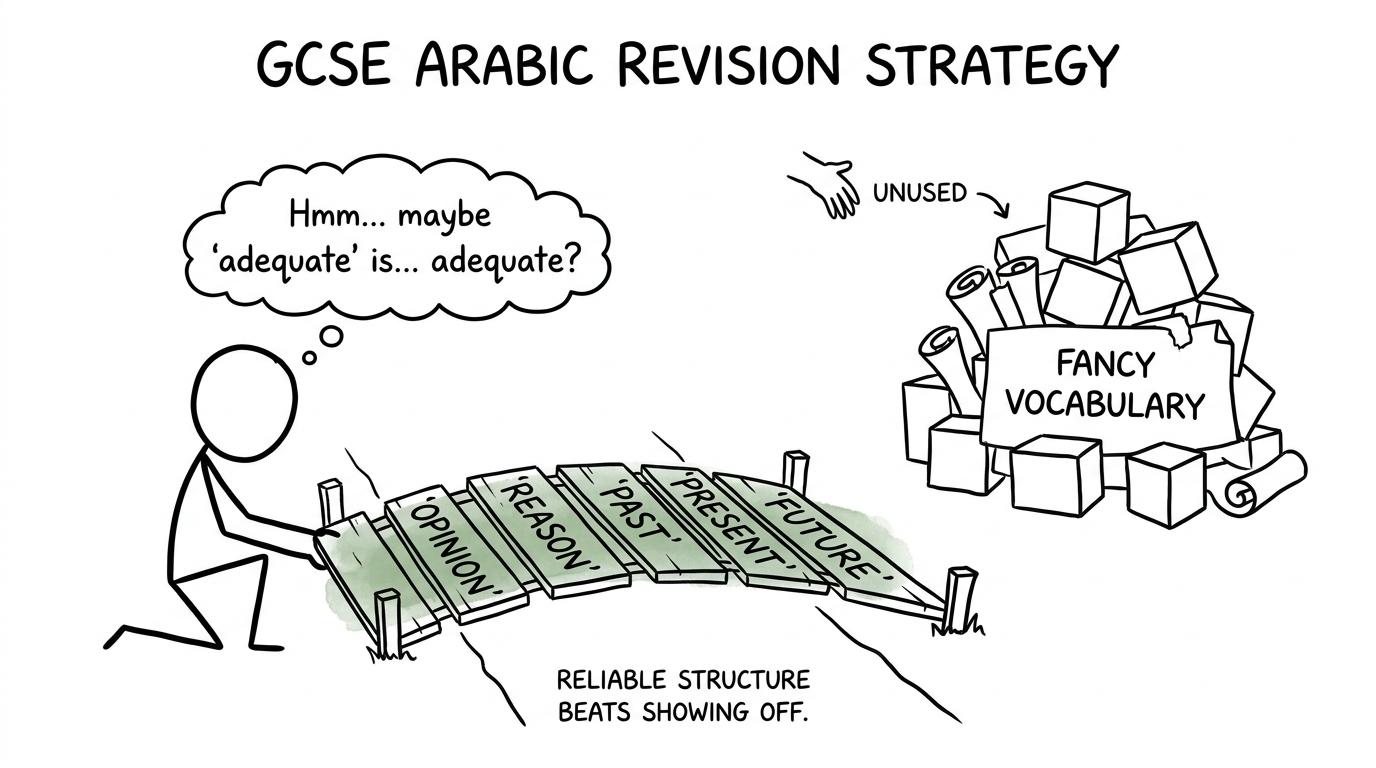 A student builds a reliable bridge from opinions, reasons and timeframes
How Paper 4 is marked
Paper 4 is assessed through the quality of your written communication. For open responses, examiners consider how successfully you communicate and develop the required content, alongside your range and accuracy of language. Translation is marked by how successfully the meaning is transferred into Arabic.
Four principles follow from this:
Relevance comes first
A polished paragraph that ignores a bullet point cannot fully answer the question. Tick each bullet as you cover it.
Opinions need development
An opinion becomes more useful when it is followed by a reason, explanation or consequence. This also creates natural opportunities for connectives and more varied structures.
Range must remain controlled
Varied vocabulary and structures can lift a response, but accuracy still matters. Aim slightly beyond your safest language, not far beyond what you can control.
Accuracy protects meaning
Errors are not all equally damaging. A minor spelling slip may leave the meaning obvious; an incorrect verb, pronoun or negative can reverse or obscure the message. Prioritise checks that protect meaning.
A sensible timing plan
Pearson does not require you to divide your time in one particular way. The following allocations are practical starting points that you should test with official practice papers.
| Foundation task | Suggested time |
|---|---|
| Short response | 101010 minutes |
| Middle response | 151515 minutes |
| Extended response | 303030 minutes |
| Translation | 151515 minutes |
| Final checking | 101010 minutes |
The total is:
10+15+30+15+10=80 minutes. 10 + 15 + 30 + 15 + 10 = 80\text{ minutes}. 10+15+30+15+10=80 minutes.| Higher task | Suggested time |
|---|---|
| First response | 252525 minutes |
| Extended response | 404040 minutes |
| Translation | 121212 minutes |
| Final checking | 888 minutes |
This gives:
25+40+12+8=85 minutes. 25 + 40 + 12 + 8 = 85\text{ minutes}. 25+40+12+8=85 minutes.If your practice shows that translation takes longer, adjust the plan before exam day. The purpose of timing is not to obey a perfect schedule. It is to prevent one difficult sentence from consuming the time intended for an entire task.
The same habit improves maths performance. MathsGenie's guide to using Edexcel GCSE Maths past papers properly explains how timed attempts, careful marking and targeted corrections turn practice into progress.
How to revise for the writing paper
Do not begin by trying to memorise dozens of complete essays. Build reusable pieces of language instead: ways to express an opinion, justify it, describe the past, discuss current circumstances and make a future plan.
Then practise adapting those structures to different specification themes. A phrase is genuinely useful when you can reshape it rather than reproduce it in only one context.
Use this revision cycle:
- complete one task without notes;
- compare your response with the official mark scheme and teacher feedback;
- identify omissions, inaccurate structures and repeated vocabulary;
- rewrite only the weak sections;
- attempt a different prompt several days later;
- finish with complete timed papers.
This resembles the diagnose, practise and retest cycle described in MathsGenie's guide to finding your weakest GCSE topics. The subject changes, but the logic does not. Evidence is more useful than a vague feeling that revision went well.
Spacing also matters. The guide to stopping GCSE content from being forgotten shows how retrieval, spaced practice and later retesting create stronger recall than repeatedly rereading notes.
 A student remembers to leave time for the final check
Common mistakes on GCSE Arabic Paper 4
Ignoring part of a bullet point. A prompt may contain more than one instruction. Underline its separate demands before writing.
Choosing an option too quickly. Scan both choices and test whether you have vocabulary for every required point.
Using memorised material regardless of relevance. Adapt prepared structures to the exact context rather than forcing in a rehearsed paragraph.
Listing ideas without reasons. Develop key opinions so that the response communicates rather than merely catalogues.
Forcing timeframes into unrelated sentences. Past, present and future references should answer the task naturally.
Writing far beyond the suggested length. Extra writing does not automatically earn extra marks. It can reduce checking time and increase the number of errors.
Leaving translation until the final few minutes. Protect its time allocation from the start.
Checking only spelling. Also inspect verbs, gender and number agreement, pronouns, negatives, omitted words and whether every sentence says what you intended.
Turn exam knowledge into a repeatable routine
Paper 4 becomes less mysterious when you stop treating it as one enormous test of fluency. It is a sequence of manageable decisions: select the right option, cover the prompts, communicate clearly, use controlled variety, translate the meaning and check what matters.
Use official Pearson papers that match Edexcel Arabic specification 1AA0, your tier and the current format. Confirm current arrangements with your school because specifications and timetables can change.
For the maths exams sitting alongside Arabic in your GCSE timetable, make MathsGenie's free GCSE Maths revision hub your next stop. Diagnose gaps with lessons and practice questions, build stamina through the past-paper library, and use Edexcel GCSE Maths past papers with mark schemes and worked solutions. Near the exams, add Edexcel predicted papers and organise the work with a realistic GCSE revision timetable.
Knowing what to expect does not write the paper for you. It does something quieter and almost as important: it lets your preparation begin in the right place.










