GCSE Arabic No Background Knowledge: Is It Realistic?
GCSE Arabic no background knowledge guide: check whether starting from zero is realistic, what the exam tests and how to catch up without harming maths revision.
A new GCSE can look deceptively small on a timetable. It is only one subject box, after all. But behind that box sits a vocabulary bank, a writing system, grammar, listening practice and an examination structure you may never have met.
So, is GCSE Arabic with no background knowledge realistic? Yes, technically: the current Pearson Edexcel GCSE Arabic specification states that there are no formal prior-learning requirements. In practice, however, starting from zero is demanding. It is most realistic when your school permits the entry, you have regular teaching or tutoring, and you have enough time to develop listening, speaking, reading and writing together.
If the exam is only a few months away and you cannot yet read Arabic script confidently, the sensible answer may be not yet. That is not failure. It is an honest assessment of the distance involved.
The short answer and your starting checklist
Before committing, confirm these points with your school:
- Qualification: Is it Pearson Edexcel GCSE Arabic, or an International GCSE intended for first-language learners?
- Exam entry: Will the school enter you and administer the speaking assessment?
- Tier: Will you take foundation or higher tier across all four papers?
- Current level: Can you recognise, read and write the Arabic alphabet accurately?
- Teaching support: Who will correct your pronunciation, grammar and written work?
- Time available: Can you practise frequently without neglecting compulsory subjects, especially GCSE maths and English?
- Evidence: Have you tried official sample material rather than judging the course from an app or beginner lesson?
The qualification may not impose a prerequisite, but your school can still decide whether it can offer the course or enter an independent candidate. Ask early. Speaking assessments require specific arrangements, and exam entries cannot be organised casually at the last minute.
What GCSE Arabic actually assesses
For the current Pearson Edexcel GCSE Arabic qualification, students complete four externally assessed components:
| Skill | Weighting | What it demands |
|---|---|---|
| Listening | 25%25\%25% | Understanding standard spoken Arabic in familiar social and public contexts |
| Speaking | 25%25\%25% | Communicating and interacting in Arabic |
| Reading | 25%25\%25% | Understanding written Arabic and translating a short passage into English |
| Writing | 25%25\%25% | Producing responses in Arabic and translating into Arabic |
There is no hidden shortcut in that structure. A student who has learnt vocabulary but rarely listens will still have a quarter of the qualification exposed. Someone who speaks a family dialect but cannot write accurately may face a different gap.
The assessed themes include identity and culture; local area, holidays and travel; school; future aspirations, study and work; and international and global issues. Students take either foundation or higher tier, using the same tier across all papers. Dictionaries are not permitted in the assessments.
That final detail matters. Recognition must become retrieval. You cannot depend on looking up every unfamiliar word when the pressure rises.
Why beginning Arabic from zero is unusually demanding
Arabic is not simply a list of English words with different spellings. A complete beginner must build several systems at once.
The script must become automatic
Arabic is written from right to left, and letters can change form according to their position within a word. Early progress can feel quick because the alphabet is finite. Fluency takes longer: you must recognise joined letters at normal speed, distinguish similar shapes and write legibly without stopping to reconstruct every character.
Reading letter by letter is a useful beginning, but it is not yet examination reading. In a timed paper, common words and patterns need to register as units.
The examination uses standard Arabic
GCSE Arabic assesses standard language rather than relying on one regional dialect. A heritage speaker may understand conversations at home yet still need substantial work on formal vocabulary, grammatical structures, spelling and written expression.
Conversely, a complete beginner who learns Modern Standard Arabic systematically may develop useful exam habits from the start. Background knowledge helps, but it is not the same as complete examination readiness.
Four skills grow at different speeds
Reading may improve before spontaneous speaking. Memorised writing may look stronger than genuine listening comprehension. That unevenness is normal, but the equal assessment weightings mean it cannot be ignored.
The aim is not to make every skill feel equally comfortable. It is to prevent one skill from becoming a serious marks leak.
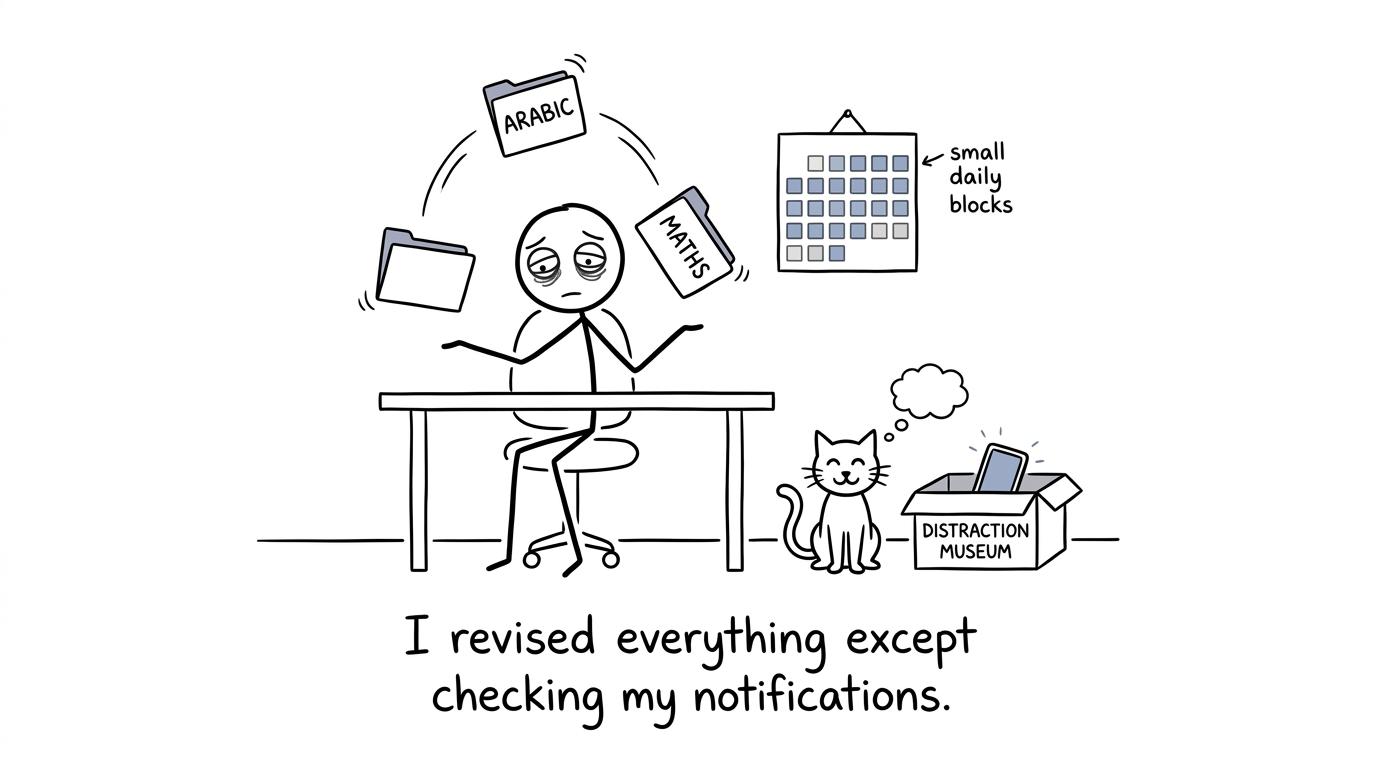 A student balancing Arabic and maths revision while a cat guards the phone
Decide whether your timeline is realistic
There is no universal number of weeks that guarantees readiness. Your starting point, teaching time, target grade and access to feedback matter too much for that.
A useful diagnostic is more honest than a promise. Ask whether you can currently:
- read unfamiliar Arabic words without transliteration;
- write connected script from memory;
- understand short, clearly spoken passages;
- answer basic personal questions aloud;
- form accurate sentences about past, present and future events;
- learn vocabulary consistently while maintaining your other GCSE subjects.
If most answers are no, you are at the beginning rather than in the revision stage. Catching up may still be possible with a long runway and strong support, but it should be treated as learning a course, not polishing one.
If you are already in Year 11, request a diagnostic from a qualified Arabic teacher before committing. The key question is not, “Could somebody do this?” It is, “Can I close my particular gaps within the available time and still prepare properly for my other exams?”
How to catch up fast if your school allows it
Fast progress rarely comes from doing everything at once. It comes from placing skills in the right order, then revisiting them often.
Secure script and sound first
Begin with letter recognition, joined forms, short and long vowel patterns, and accurate sound production. Avoid depending on transliteration for too long. Transliteration can help at the first encounter, but continued dependence delays direct reading.
Use audio alongside script from the beginning. Arabic spelling and pronunciation should become connected memories, not two separate subjects.
Build vocabulary around the specification
Organise vocabulary by the assessed themes rather than collecting random phrases. Learn high-utility language for opinions, reasons, comparisons, time references, descriptions and questions.
Retrieve vocabulary in both directions. Recognising an Arabic word is not the same as producing it in speech or writing. Cover the answer, recall it, check it and return to it later.
Learn sentence patterns, not isolated words
Vocabulary provides ingredients; grammar allows you to combine them. Focus on reusable structures that let you discuss familiar topics across different time frames, express and justify opinions, ask questions and connect ideas.
A teacher should check these patterns. Repeating an inaccurate sentence makes the error more familiar, not more correct.
Train all four skills every week
A balanced week should include:
- short listening with repeated playback and a transcript where available;
- reading for the main message, details and opinions;
- speaking responses recorded and reviewed;
- short writing completed without translation software;
- vocabulary retrieval and grammar correction.
Speaking cannot be postponed until the final weeks. It depends on quick recall, understandable pronunciation and the ability to recover when a response does not go as planned.
Move towards exam conditions gradually
Start with small tasks. Then remove notes, add time limits and combine topics. Use official specification material supplied by your school or awarding organisation so that the language level and question format are appropriate.
The most useful loop is simple: attempt, mark, identify the precise weakness, practise it and retest it. It is the same principle that makes GCSE maths past-paper practice effective.
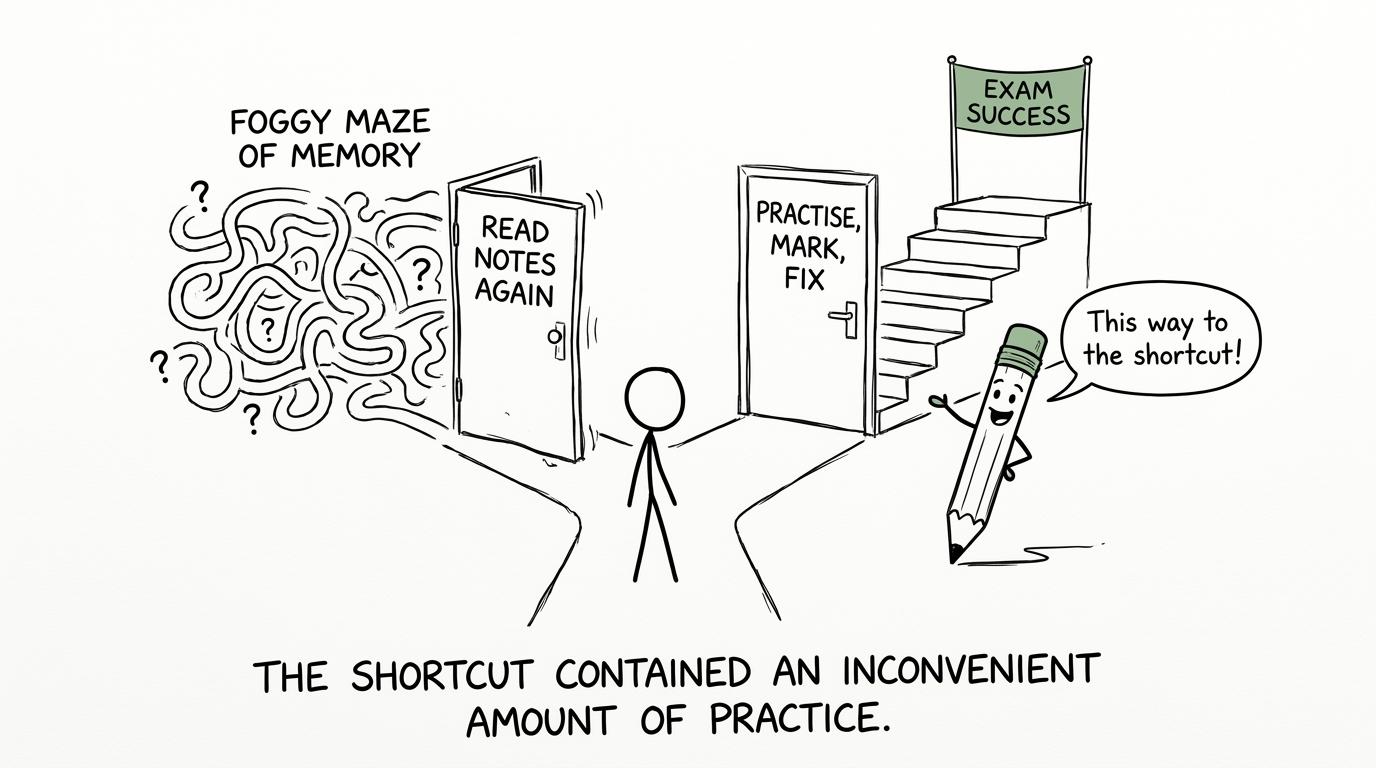 Two revision routes show why practice, marking and correction beat rereading
Protect your GCSE maths revision while adding Arabic
An optional language should not quietly consume the time needed for a compulsory subject. Maths is cumulative: leave algebra, ratio or geometry untouched for several weeks and the rust appears when you return.
Use a weekly plan with fixed boundaries. Arabic benefits from frequent, shorter contact because vocabulary, script and listening need repetition. Maths also needs regular retrieval and problem solving. The MathsGenie GCSE revision timetable guide can help you organise both without turning every evening into a marathon.
Keep a minimum maths routine even during an Arabic catch-up phase:
- one or two focused topic sessions;
- one short mini test or mixed question set;
- immediate marking and correction;
- regular paper practice as the exams approach.
Use the GCSE maths revision hub to choose resources for Edexcel, AQA, OCR or Eduqas. If your gaps feel scattered, follow the best order for learning GCSE maths topics rather than jumping randomly between difficult questions.
Nearer the exams, build stamina with the correct board and tier. Edexcel students can use Edexcel GCSE maths past papers, while Eduqas students can start from the Eduqas GCSE maths revision area. GCSE predicted papers are valuable for fresh practice, but they should complement official past papers rather than replace them.
Common mistakes when starting GCSE Arabic late
Assuming no formal prerequisite means an easy beginner course
It means the specification does not require a previous qualification. It does not mean the final assessment begins at alphabet level.
Confusing spoken dialect with full GCSE readiness
Conversational experience is valuable, but standard reading, formal writing, grammar and translation may still require deliberate practice.
Relying on transliteration
Transliteration can become a comfortable bridge that you never leave. The examination requires direct engagement with Arabic script.
Memorising impressive paragraphs without understanding them
A memorised response can collapse when the question changes. Build adaptable language and learn what each structure means.
Ignoring listening or speaking
Reading notes feels controlled; live audio and spontaneous speech feel less comfortable. That is precisely why they need regular practice.
Sacrificing maths revision to rescue another subject
A crowded timetable creates false urgency: the newest problem receives all the attention. Protect recurring maths sessions and use a clear cycle of lesson, practice questions, marking and retesting.
A realistic final judgement
Taking GCSE Arabic without the usual background knowledge is possible, but permission and possibility are not the same as readiness. Confirm the exact qualification, ask your school about entry and speaking arrangements, complete a proper diagnostic, and obtain feedback from someone who understands the specification.
If you have enough time, structured teaching and the willingness to practise all four skills, starting from zero can be a serious but realistic project. If the examination is close and the script is still unfamiliar, postponing the qualification may be the wiser decision.
Whatever you decide, keep your core revision steady. MathsGenie gives you free revision lessons, practice questions, mini tests, past papers, predicted papers, mark schemes and video solutions. Start at the GCSE maths revision hub, choose your board and tier, and turn the next available revision session into one clear action rather than another open tab.