GCSE Arabic Last Minute Revision Plan: Calm 3 Days
GCSE Arabic last minute revision plan with three calm, focused days for vocabulary, listening, reading, writing and practical exam preparation.
Three days before an exam, the mind becomes an unreliable narrator. It says there is too much to learn, too little time and no sensible place to begin. Panic then encourages the least useful response: opening everything at once.
This GCSE Arabic last minute revision plan offers a calmer answer. Spend the first day diagnosing gaps and rebuilding useful vocabulary, the second practising the skills your next paper assesses, and the third rehearsing under controlled conditions before stopping early enough to rest.
The aim is not to relearn the whole course. It is to make the Arabic you already know easier to retrieve, reduce avoidable mistakes and enter the exam with a clear method.
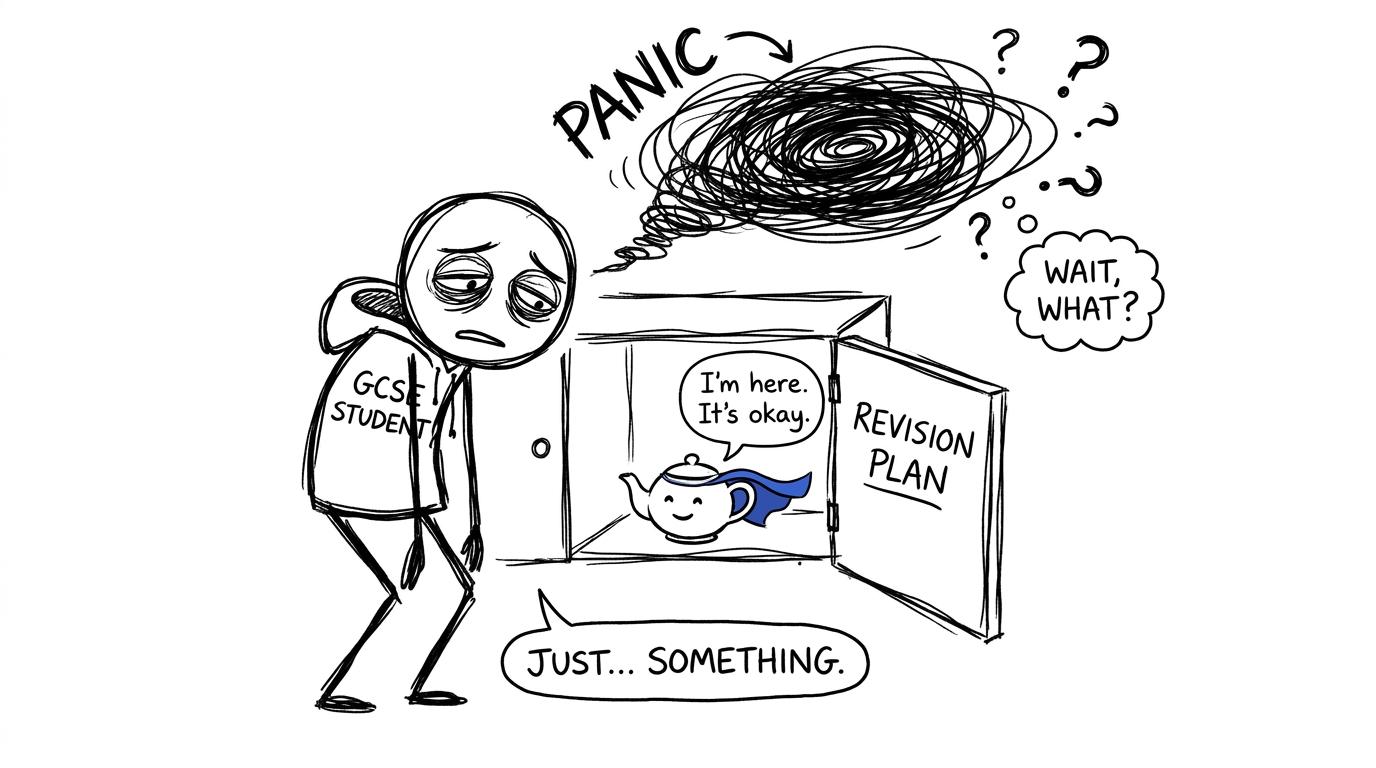 A tiny revision-plan teapot calmly confronting a cloud of exam panic
Your three-day checklist
Before starting, confirm these details with your teacher, examination timetable or official exam-board materials:
- your exact qualification and specification;
- whether you are entered for foundation or higher tier;
- which paper comes next;
- its duration and permitted materials;
- which question instructions require English or Arabic answers;
- the topics and vocabulary included in your specification.
For the current Pearson Edexcel GCSE Arabic specification, the assessment covers listening, speaking, reading and writing. Each skill contributes 25%25\%25% of the qualification, and students take the same tier across all four papers. Dictionaries are not permitted, including during speaking preparation time. Other qualifications, including International GCSE courses, can have different structures, so do not revise from a timetable or paper format simply because it says “Arabic” on the front.
Your plan in brief is:
- First day: identify the next paper, diagnose weaknesses and recover essential vocabulary.
- Second day: practise the exact skills required by that paper and correct every error.
- Third day: complete a short timed rehearsal, review your error list and prepare for the exam.
This is the same evidence-led principle used in MathsGenie’s guide to finding your weakest GCSE topics quickly: test first, identify the leak, then repair it.
First day: replace vague panic with evidence
The first day is about selection. You cannot revise everything equally, and trying to do so gives familiar material the same attention as serious gaps.
Begin with the paper that is actually next
If reading is next, do not spend the morning perfecting a speaking presentation. If writing is next, passive listening should not consume your best concentration. Speaking requires its own preparation, particularly because the Edexcel assessment contains a role play, a picture-based task and a conversation.
Write the name of your next paper at the top of a page. Underneath, divide your preparation into three categories:
- Secure: language you can recognise or produce without help.
- Uncertain: language you know slowly or confuse with something similar.
- Missing: vocabulary, grammar or exam instructions you cannot currently use.
Use a short section from an official specimen or past paper as your diagnostic. Work without a dictionary because that reflects Edexcel’s examination rules. You are not trying to earn a reassuring score. You are trying to discover what tomorrow’s revision must contain.
Build a small, useful vocabulary bank
Use your specification vocabulary list, class materials and errors from the diagnostic. Prioritise:
- common verbs and their tense forms;
- time markers and sequencing language;
- opinions with reasons;
- negatives and contrasting expressions;
- question words;
- topic vocabulary connected to the next paper;
- words you repeatedly misread or misspell.
Test in both directions. Seeing an Arabic word and recognising its English meaning is not the same as producing it in Arabic during a writing paper. Say answers aloud where appropriate, then write the words you will need to produce.
Do not copy a long vocabulary list beautifully. Cover the answers, retrieve them, check them and place uncertain items into a smaller retest pile.
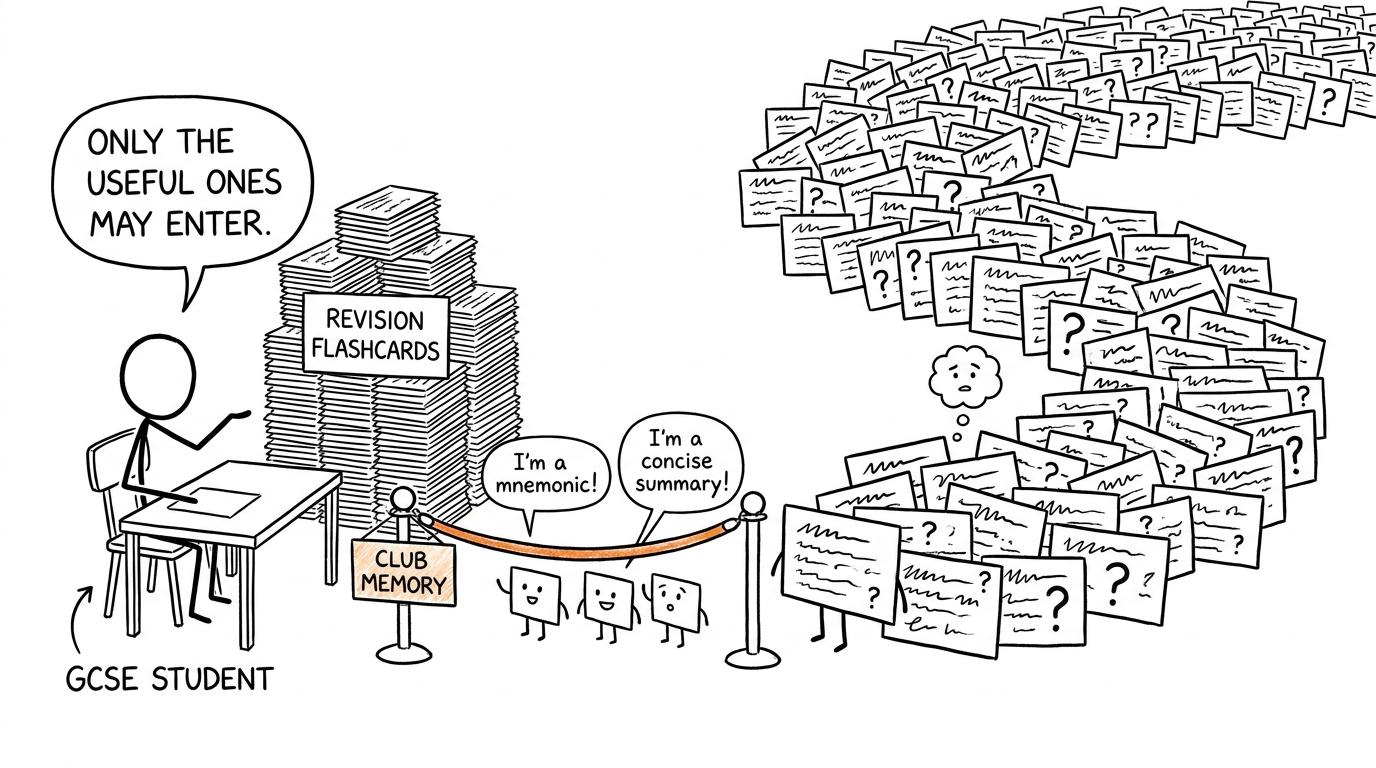 A strict student admitting only useful flashcards into revision
Protect your maths revision as well
Many students discovering an Arabic exam is close also have GCSE maths papers competing for attention. Do not allow one emergency to erase the rest of your timetable.
Use one defined maths block rather than repeatedly switching subjects. The free GCSE Maths revision hub lets you choose your exam board and move directly to relevant lessons, questions and papers. Edexcel students can use the shorter GCSE Maths mini tests when a full paper would take too much time.
Finish the first day with a one-page list containing vocabulary to retest, two grammar weaknesses and three exam-technique reminders. Then stop. A useful list is better than another unfocused hour.
Second day: turn recognition into exam performance
The second day should contain more doing than reading. Choose the section below that matches the next assessment rather than attempting every activity.
If listening is next
Read each question before the recording begins and predict what kind of information is required: a person, place, opinion, time or reason. Listen for negatives, changes of opinion and contrasts rather than relying on one familiar word.
After completing a listening section, use the transcript if your authorised practice materials provide one. Identify whether each error came from unknown vocabulary, failure to distinguish sounds, losing concentration or misunderstanding the question. Replay only the relevant part and write the clue you missed.
If reading is next
Practise scanning for names, dates, opinions and connective language before translating every word. In Edexcel reading, students encounter different text types and a translation from Arabic into English. Follow the language requested by each section carefully.
When an unfamiliar word appears, use the sentence around it. Ask whether the missing word is likely to be positive or negative, a noun or verb, or part of a contrast. Do not let one unknown word erase the meaning you can recover from the rest of the passage.
If writing is next
Plan responses around coverage and control. Make sure every bullet point is addressed, then include accurate opinions, reasons and time frames where the task allows. A smaller range of language used correctly is more valuable than memorised complexity that does not fit the question.
Check verb agreement, tense, gender, spelling and whether the response stays relevant. Respect the recommended response length shown on your paper. Practise handwriting clearly enough that a marker can distinguish letters and words.
If speaking is next
Practise answering aloud, not silently. Prepare flexible language for opinions, reasons, past experiences and future plans rather than memorising one answer that collapses when the question changes.
For a role play, identify every required detail. For a picture-based task, practise moving from description to interpretation and opinion. For conversation, ask a teacher or family member to vary the order and wording of questions so that retrieval remains genuine.
End the day by correcting your diagnostic and completing a fresh, shorter section. In maths, this “test, mark, fix, retest” loop is explained in how to use GCSE past papers properly, and the principle transfers well to language revision.
Third day: rehearse calmly, then reduce the load
The final day is not the moment to triple your workload. It is for proving that your method works when notes are removed.
Complete one controlled rehearsal
Choose an official past-paper or specimen section matching the next assessment. Use the correct time allowance for that section, put your phone away and follow the permitted-material rules. Do not pause to look up vocabulary.
Mark with the official mark scheme where available. Record mistakes under four headings:
- vocabulary not known;
- grammar or spelling error;
- instruction misunderstood;
- timing or concentration problem.
Correct the highest-value errors, then retest only those points. Avoid starting a second full paper simply to escape the discomfort of reviewing the first.
Use a final retrieval sheet
Your last sheet should be short enough to review without becoming overwhelmed. Include:
- easily confused vocabulary;
- a few reliable opinion-and-reason structures;
- essential tense reminders;
- common question words;
- recurring spelling or agreement errors;
- the language required for each section of your paper.
Pack your equipment, check the examination time and location, and arrange breakfast and travel. Then set a firm stopping time.
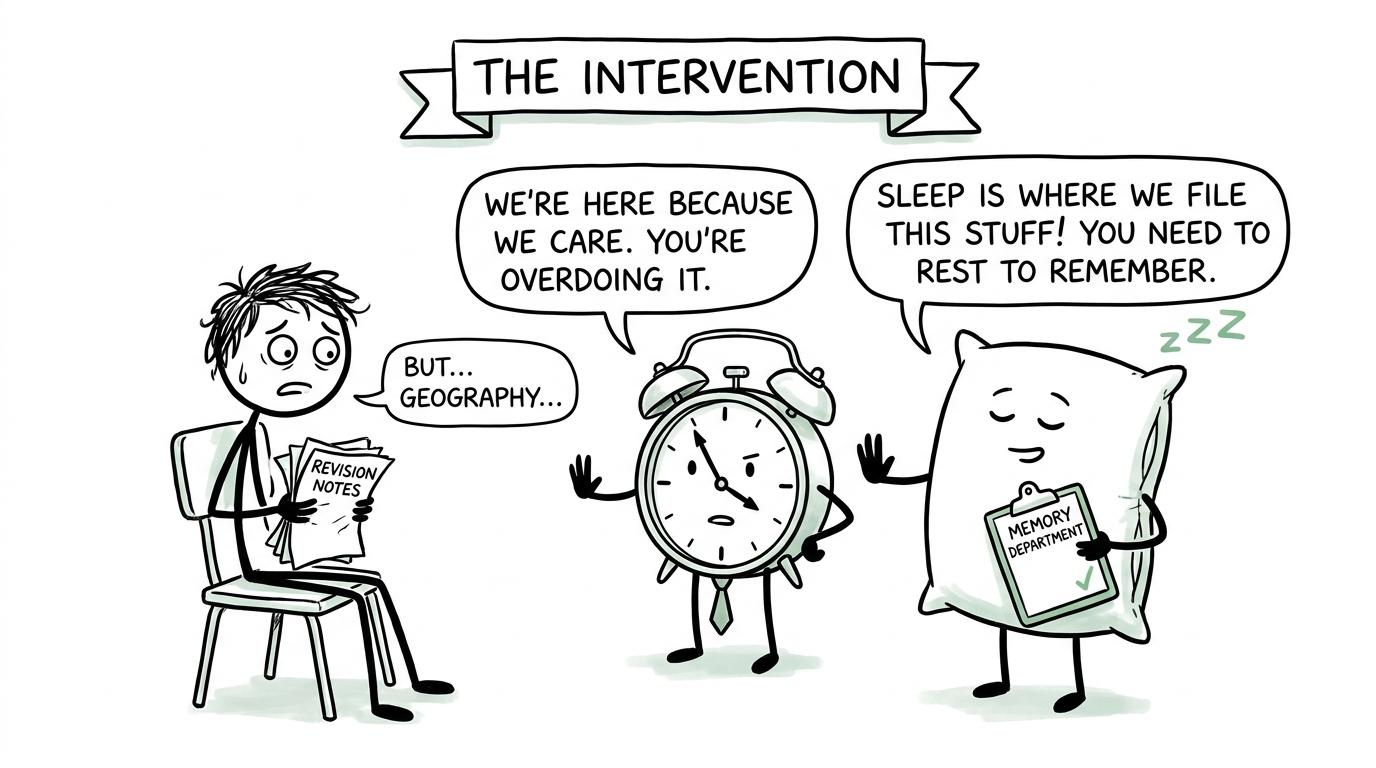 A pillow from the memory department staging an intervention
If maths also needs attention, use a short board-specific task from the AQA GCSE Maths revision hub, OCR GCSE Maths revision hub or Edexcel GCSE Maths past papers. Mark it, note one correction and finish. The night before an exam should narrow your focus, not widen it.
Common last-minute revision mistakes
Treating all four skills as identical
Recognising vocabulary in reading does not prove that you can hear it at natural speed, pronounce it clearly or write it accurately. Match revision to the next assessment.
Using the wrong specification
GCSE Arabic and International GCSE Arabic are not interchangeable labels. Paper structures, timings and assessment objectives may differ. Confirm your exam board, specification code and tier before using any paper.
Revising only comfortable topics
Familiar vocabulary feels productive because recall is quick. Your diagnostic should decide what receives time, not your preference.
Ignoring the language of the instructions
In Edexcel listening and reading, different sections can require responses in different languages. Read the instruction on the actual question instead of relying on habit.
Completing papers without learning from them
A paper produces evidence, not improvement by itself. Mark it, classify each error and complete a targeted correction. MathsGenie’s GCSE night-before revision plan applies the same disciplined approach to maths.
Sacrificing sleep for low-quality rereading
Late-night rereading can create familiarity without reliable recall. Stop at a planned time, prepare your equipment and give yourself the best chance to concentrate during the assessment.
Three calm days can still matter
Three days cannot manufacture an entire language course. They can, however, remove uncertainty. You can identify the paper in front of you, retrieve the most useful vocabulary, practise the correct skill and prevent familiar mistakes from following you into the examination room.
Keep the plan small enough to follow: diagnose, practise, mark, correct and retest. Then stop.
For the maths exams surrounding your Arabic paper, make MathsGenie’s free GCSE Maths resources your revision base. Use revision lessons to repair methods, practice questions and mini tests to check understanding, mark schemes and video solutions to correct errors, then past papers and predicted papers to rehearse under exam conditions. Calm does not mean doing nothing. It means knowing what to do next.