GCSE Arabic Group Chat Study Tips That Work
GCSE Arabic group chat study tips to turn messages into useful revision, practise every language skill and protect time for GCSE maths exam preparation.

A class chat can look productive while achieving almost nothing. Someone asks what is on the exam. Three people reply with memes. A screenshot appears without context. Then an hour disappears.
Effective GCSE Arabic group chat study works differently. Give the chat a clear purpose, use short retrieval prompts, correct answers carefully and move substantial practice away from the phone. The group should help everyone remember, speak, read and write more accurately. It should not become another place to scroll.
There is a second benefit for students preparing for several GCSEs: a disciplined Arabic chat leaves more time and attention for maths. You can finish a focused language task, mute the conversation and move to free GCSE maths revision without carrying the noise into your next session.
The quick group chat checklist
Before sending another revision message, agree on these rules:
- Give the group one purpose: GCSE Arabic revision.
- Keep membership private and limited to known classmates.
- Follow your school's rules on messaging platforms.
- Set a daily prompt rather than allowing constant notifications.
- Attempt questions from memory before checking notes.
- Cover listening, speaking, reading and writing across the week.
- Correct ideas politely and verify uncertain answers with a teacher or official material.
- Do not share personal information, private recordings or secure assessment content.
- End each chat session with an individual task away from the phone.
- Mute the group during maths practice, sleep and timed papers.
The principle is simple: the chat should create action. If it only creates messages, it is not yet a revision system.
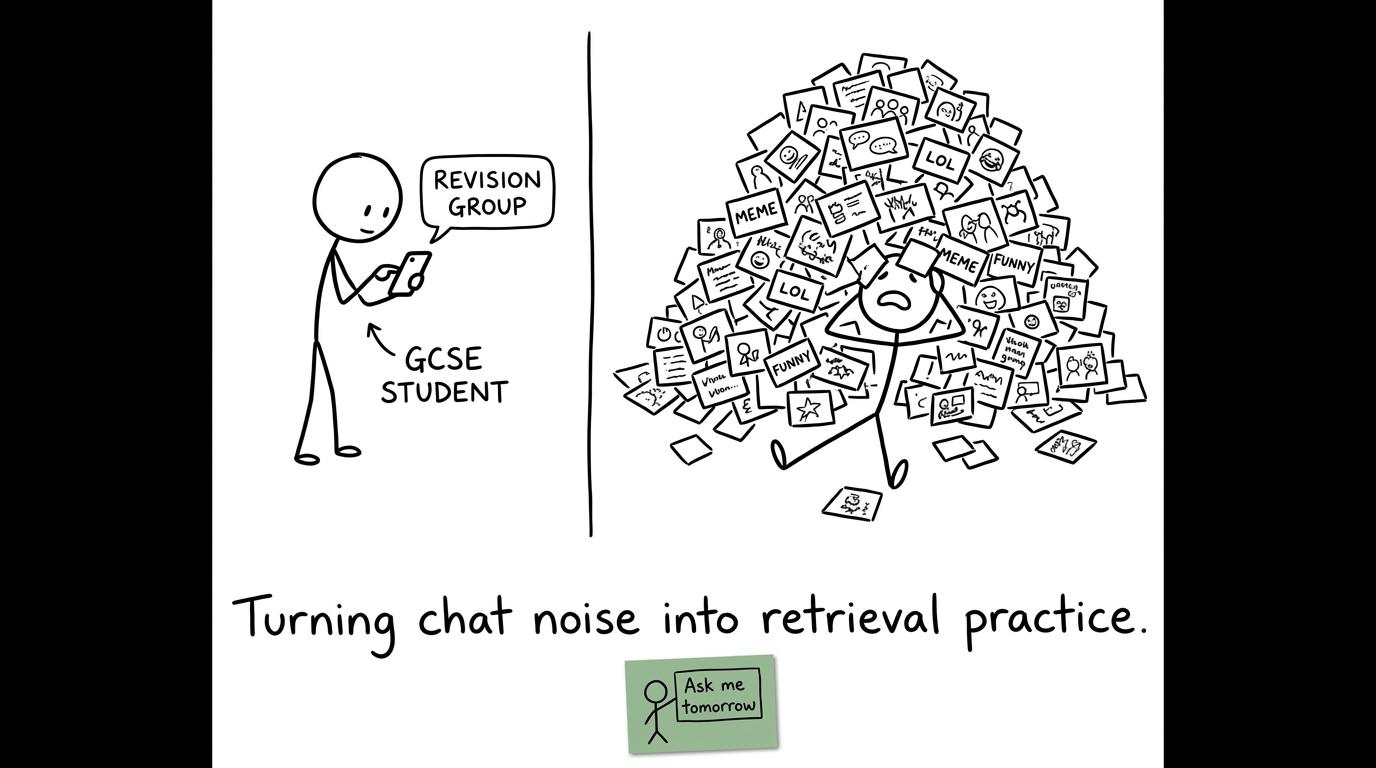 A useful flashcard survives an avalanche of revision chat memes
Give the GCSE Arabic group chat a narrow job
Most group chats fail because they are expected to do everything. They become a noticeboard, social space, help desk and revision lesson at once. Nobody knows whether a message requires an answer, and useful material vanishes beneath conversation.
A better group description might set three boundaries:
- Purpose: short GCSE Arabic recall and speaking prompts
- Posting window: one agreed period after school
- Response rule: attempt first, check second, explain corrections kindly
Choose one or two student admins to maintain the description, pin the weekly plan and stop unrelated posts taking over. This is organisation, not authority. Students should never present themselves as replacing a teacher or moderating a school-sanctioned space unless the school has explicitly approved that arrangement.
Privacy matters too. UK online-safety guidance consistently recommends a clear purpose, controlled membership, suitable privacy settings and rules about bullying or inappropriate content. Check platform age requirements, review who can add you to groups and remember that other members may be able to see identifying details such as your telephone number. If a message is threatening, abusive or unsafe, save the relevant evidence and tell a trusted adult or your school's safeguarding lead. Do not try to solve a safeguarding concern through a revision poll.
Build the chat around the actual Arabic assessment
For the current Pearson Edexcel GCSE Arabic specification, listening, speaking, reading and writing each contribute 25%25\%25% of the qualification. Students take foundation or higher tier and must be entered for the same tier across all four papers. Dictionaries are not permitted in the assessments, including speaking preparation time.
That makes passive vocabulary sharing a poor match for the exam. Knowing a word when it appears on a colourful list is not the same as retrieving it under pressure, understanding it in speech or using it accurately in a sentence.
Your weekly chat cycle should therefore include every skill.
| Day | Group-chat activity | Individual follow-up |
|---|---|---|
| Monday | Closed-book vocabulary prompts | Review errors and make a short recall list |
| Tuesday | Brief voice-note listening task | Write what you understood before replaying |
| Wednesday | Reading prompt with a gist question | Identify evidence in the text |
| Thursday | Speaking question or role-play cue | Record a fuller answer privately |
| Friday | Short writing challenge | Check accuracy against trusted material |
| Weekend | Mixed quiz and error review | Revisit the weakest skill away from the chat |
This is a framework, not an exam-board substitute. Always use your own specification, teacher guidance and assessment materials for the exact task requirements.
Use retrieval instead of recognition
Research on learning distinguishes between looking again and trying to remember. Retrieval practice asks you to bring knowledge to mind before seeing the answer. Evidence reviews also indicate that retrieval is more useful when it is purposeful and followed by feedback, while spacing revisits learning over separate sessions rather than compressing it into one evening.
A group chat can support both ideas remarkably well.
One person posts a concise prompt. Everyone answers independently without opening notes. The sender later posts the checked answer or asks the teacher about any genuine disagreement. The same idea returns several days later in a different form.
Useful prompt types include:
- translate a short phrase without consulting a vocabulary list;
- identify the tense or time frame conveyed by a sentence;
- respond to a speaking question with a brief voice note;
- summarise the main point of a short passage;
- improve an answer by adding a justified opinion;
- recall a previously corrected spelling or grammatical pattern.
Do not reward the fastest reply. Speed encourages copying and can make quieter students feel that the task is already over. Give everyone an agreed response window, then reveal or discuss the answer.
The same retrieval habit transfers neatly to maths. Before reading a method, attempt the question. Then mark it and repair the gap. MathsGenie's guide to stopping forgotten GCSE maths content explains how spaced revisits and active recall can fit into an exam-focused routine.
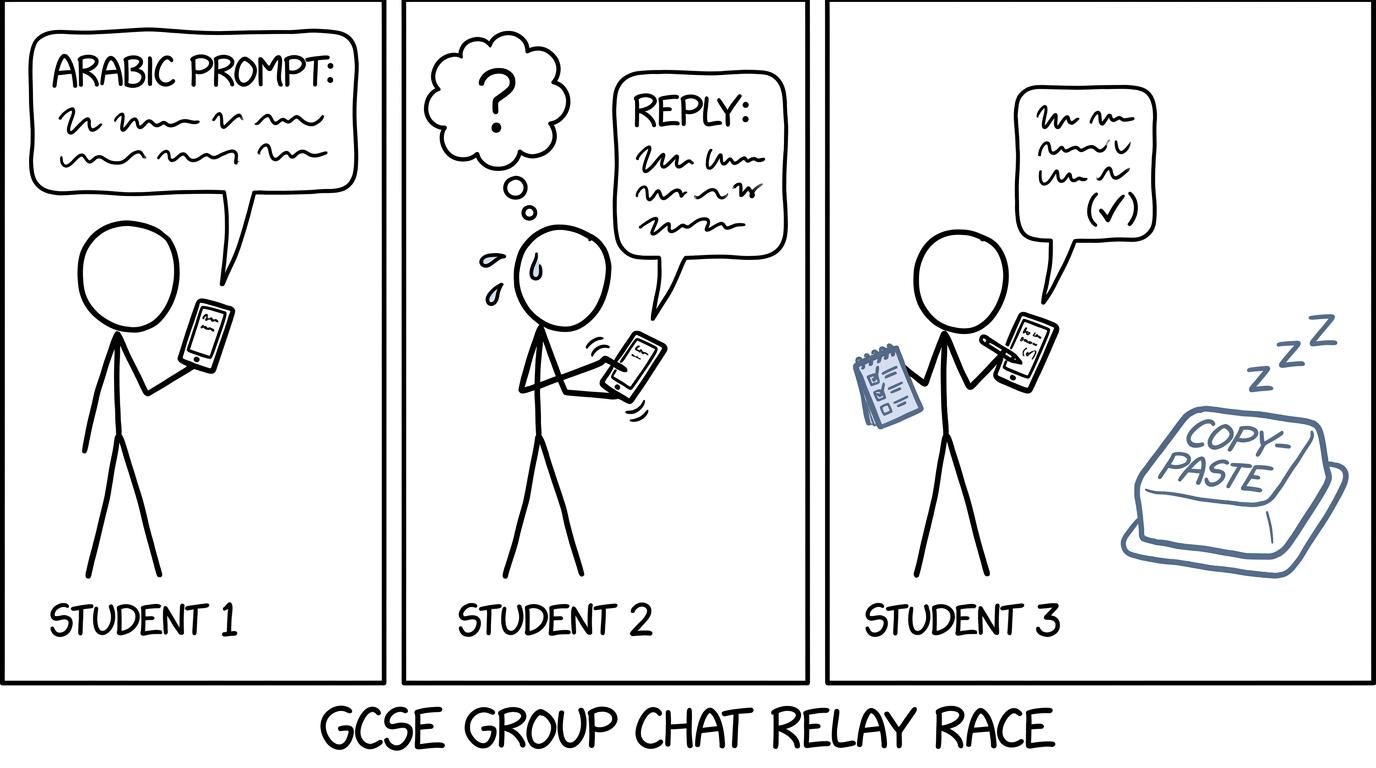 Students pass a recall prompt while the copy button sleeps
Make voice notes useful rather than intimidating
Speaking improves through speaking, but a busy group can make recording feel performative. Reduce that pressure with a predictable format.
Post one suitable question. Allow brief responses. Ask listeners to notice one successful feature and one possible improvement, focusing on clarity and the task rather than a classmate's voice or accent. If pronunciation is uncertain, flag it for verification instead of letting the most confident student become the unofficial authority.
Students should obtain permission before downloading, forwarding or using another person's recording. A classmate's voice note is not public revision material. Anyone who prefers not to post audio should be able to complete the task privately or use an alternative agreed with their teacher.
Long rehearsed monologues are also easy to read aloud without learning much. Short prompts encourage genuine retrieval. The fuller speaking practice should happen individually, ideally under conditions that resemble the task being prepared for.
Separate peer support from reliable correction
A group is good at generating attempts. It is not automatically good at verifying them.
When an answer is challenged, use three labels:
- Checked: supported by teacher-approved notes or official material
- Possible: plausible, but not yet verified
- Ask: the group cannot resolve it confidently
This prevents uncertain advice from becoming accepted simply because it has been repeated. It also keeps correction civil. Replace blunt messages such as “wrong” with a precise observation: the response may not address the full prompt, the time frame may be inconsistent, or a spelling needs checking.
For maths, mark schemes perform a similar role. They show what earns marks rather than what merely feels convincing. Read how to use GCSE mark schemes effectively, then apply the same discipline: attempt, check, diagnose and try again.
Protect your maths revision from the chat
The Arabic group is one tool inside a larger GCSE timetable. It should not remain open while you practise algebra, geometry or statistics.
Use a clean handover routine:
- Complete the day's Arabic prompt.
- Write down one language error to revisit.
- Mute the group for a defined study block.
- Put the phone beyond reach.
- Open one maths topic, mini test or paper.
- Check the work only after making a genuine attempt.
If time is tight, follow the GCSE 202020-minute maths revision routine. For a quick diagnostic task, use GCSE mini tests. These resources turn a vague intention to “do maths” into a visible next step.
When you need a longer session, select material for your actual exam board and tier. MathsGenie organises Edexcel GCSE maths past papers, AQA GCSE maths past papers and OCR GCSE maths past papers with mark schemes and available solutions.
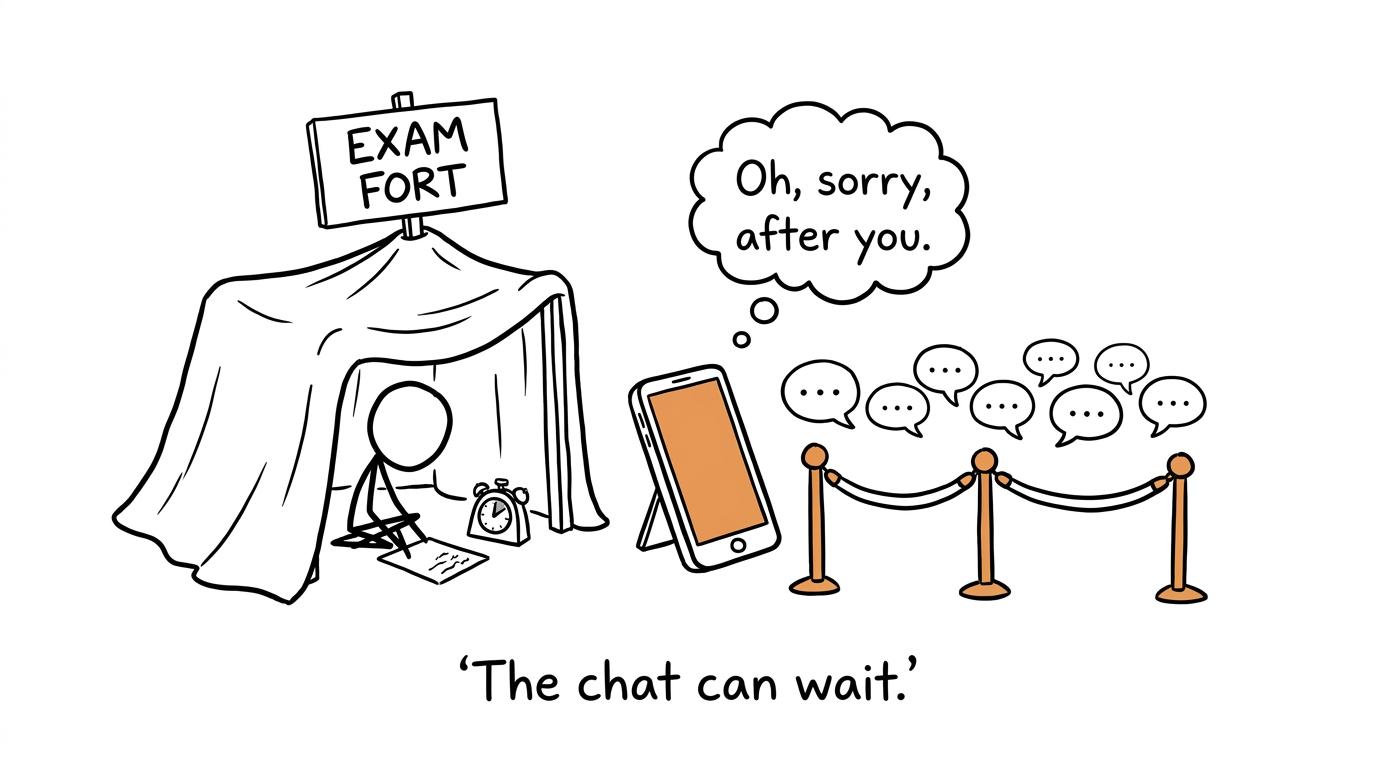 Notifications wait outside while a student completes focused exam practice
Common group chat revision mistakes
Sharing answers before anyone attempts the task
An instant answer removes the effort that makes retrieval useful. Post the prompt first and delay the checked response.
Treating message volume as progress
A long discussion may produce less learning than one carefully chosen question. Measure completed prompts, corrected errors and later recall, not the number of notifications.
Copying polished paragraphs
Shared model writing can become a substitute for thinking. Study the useful features, close the message and produce your own response to a fresh prompt.
Letting confident guesses become facts
Fluent Arabic speakers can still misread an assessment requirement, while a grammatically possible answer may not fulfil the task. Mark uncertainty openly and verify it.
Posting private or restricted material
Do not circulate personal details, embarrassing screenshots, recordings without consent or confidential assessment content. Follow school rules and report safeguarding concerns to an adult.
Revising only vocabulary
Vocabulary matters, but the qualification assesses listening, speaking, reading and writing. Plan activities that require understanding and communication, not just recognition.
Keeping notifications on during every subject
Constant switching fragments attention. Finish the short collaborative task, mute the chat and give maths its own uninterrupted space.
Turn the chat into a starting line
The best GCSE Arabic group chat study habit is modest: one useful prompt, one honest attempt, one checked correction and one later revisit. The chat creates accountability, but individual practice creates exam readiness.
Then close it. Move to the next subject with a clear head.
For maths, make MathsGenie GCSE revision your free home base. Use revision lessons to rebuild a weak method, practise with exam questions and mini tests, check mark schemes and video solutions, then test your progress with past papers and predicted papers. A helpful group can start the work. A focused routine finishes it.