GCSE Arabic Grade Boundaries Explained
GCSE Arabic grade boundaries explained clearly: learn why marks are scaled, why thresholds change each year, and how to set a safer revision target.
A mark can feel wonderfully definite. You count the ticks, total the score and expect a grade to follow as neatly as an answer from a calculator. Then you compare two exam years and discover that the same mark could have produced a different result.
That is why GCSE Arabic grade boundaries explained properly means looking beyond a simple percentage. Your grade depends on the exam board, specification, tier, examination series and the final boundary set after marking. For Pearson Edexcel GCSE Arabic, marks from four papers are also scaled so that listening, speaking, reading and writing each contribute equally.
The short answer is this: a grade boundary is the minimum total subject mark needed for a grade in one particular examination series. It is not a permanent percentage, and it is not normally decided before students sit the papers.
The essential checklist
Before interpreting any Arabic mark, check:
- the qualification is GCSE Arabic rather than International GCSE Arabic;
- the exam board and specification code;
- whether the entry is foundation or higher tier;
- the correct examination series and year;
- whether you are looking at a paper raw mark or the scaled subject total;
- the overall qualification boundary, not a notional paper boundary.
For the specification discussed here, use the dedicated Edexcel GCSE Arabic grade boundaries page. The wider Edexcel GCSE grade boundaries hub is useful when checking other subjects.
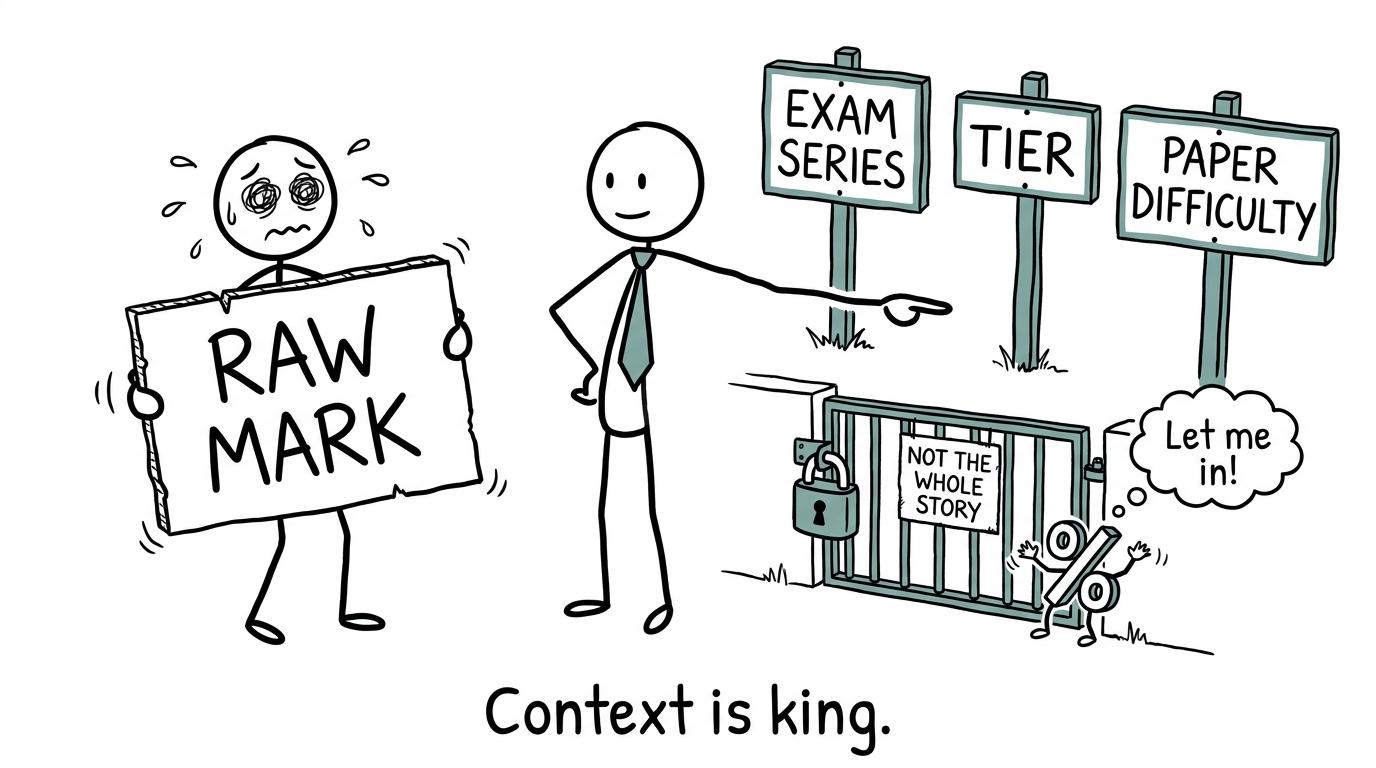 A student discovers that a raw mark is not the whole grade-boundary story
What a GCSE Arabic grade boundary actually means
A boundary is a threshold. If the grade 777 boundary were 179179179, then 179179179 would be the lowest total receiving grade 777. A total immediately below it would fall into the next available grade band.
The important word is total. Pearson Edexcel GCSE Arabic, specification 1AA01AA01AA0, assesses four skills:
- Paper 111: listening;
- Paper 222: speaking;
- Paper 333: reading;
- Paper 444: writing.
Individual papers do not receive final GCSE grades. The qualification grade is awarded from the combined subject mark after any required scaling.
This is the same broad distinction maths students meet when interpreting overall qualification boundaries. The mark on one paper gives useful feedback, but it does not independently decide the certificate grade. MathsGenie’s guide to how GCSE grade boundaries work explains that wider principle across subjects.
Why your mark is not just a percentage
A percentage can describe your performance, but it cannot decide your grade without the correct boundary table.
The basic percentage calculation is:
Percentage=mark achievedmaximum mark×100\text{Percentage}=\frac{\text{mark achieved}}{\text{maximum mark}}\times 100Percentage=maximum markmark achieved×100That tells you what proportion of the available marks you earned. It does not tell you automatically that a particular percentage always equals grade 444, 777 or 999.
There are three reasons.
Grade boundaries change between examination series
Exam papers cannot be made perfectly identical in difficulty. One year’s listening extracts may prove slightly more demanding; another year’s reading questions may be more accessible. New boundaries are therefore set for each series so that the standard of work required for a grade remains comparable over time.
This does not mean exam boards casually raise or lower grades after seeing whether results “look right”. Ofqual’s published grading guidance describes a process using statistical evidence alongside senior examiners’ scrutiny of student work around possible boundaries. Boundaries are finalised when marking is nearly complete.
There are no fixed quotas requiring a certain number of students to pass or fail. The purpose is to maintain the standard represented by each grade while allowing for differences between papers.
The four Arabic papers have different raw totals
Under the Pearson Edexcel specification used for the confirmed June 202520252025 boundaries, the four papers carry different raw maximum marks:
| Paper | Raw maximum | Qualification weighting | Scaled maximum |
|---|---|---|---|
| Listening | 505050 | 25%25\%25% | 707070 |
| Speaking | 707070 | 25%25\%25% | 707070 |
| Reading | 505050 | 25%25\%25% | 707070 |
| Writing | 606060 | 25%25\%25% | 707070 |
Simply adding the raw maxima gives:
50+70+50+60=23050+70+50+60=23050+70+50+60=230But each skill must contribute 25%25\%25% of the qualification. Pearson therefore scales listening, reading and writing so that every skill contributes a maximum of 707070 subject marks. The final maximum becomes:
70+70+70+70=28070+70+70+70=28070+70+70+70=280This is why a mark from a listening paper cannot be compared directly with the same numerical mark from speaking. They have different raw maxima and are treated accordingly before the overall grade is awarded.
Tier changes the available grades
Foundation tier offers grades 111 to 555. Higher tier targets grades 444 to 999, with a narrow grade 333 safety net for candidates who fall just below the grade 444 boundary. A result below that safety-net threshold is unclassified.
A grade 444 or 555 has the same value whether achieved through foundation or higher tier. The certificate does not show the tier. Tier entry is therefore about choosing an assessment appropriate to the student, not making one version of grade 555 more valuable than another.
What recent boundaries reveal
At the time of writing, June 202520252025 is the latest confirmed complete summer series available for a reliable historical comparison. Any suggested boundary for a later series before official publication is only a prediction.
The confirmed Pearson Edexcel GCSE Arabic maximum was 280280280. Selected overall boundaries were:
| Tier and grade | June 202420242024 | June 202520252025 |
|---|---|---|
| Higher grade 999 | 225225225 | 237237237 |
| Higher grade 777 | 168168168 | 179179179 |
| Higher grade 444 | 103103103 | 112112112 |
| Foundation grade 555 | 158158158 | 164164164 |
| Foundation grade 444 | 136136136 | 144144144 |
The higher grade 777 threshold moved from 168168168 to 179179179. As proportions of the 280280280 subject marks, those boundaries were:
168280×100=60%\frac{168}{280}\times 100=60\%280168×100=60%and
179280×100≈63.9%\frac{179}{280}\times 100\approx 63.9\%280179×100≈63.9%The grade standard did not simply become “worth” a permanent new percentage. The later boundary reflected evidence from that particular series. This is why historical boundaries are useful context but poor promises.
How exam boards set the final boundaries
The process begins with trained examiners marking responses against agreed mark schemes. Quality-assurance procedures are used to support consistent marking.
When marking is nearly complete, the awarding organisation considers evidence including:
- how students performed across the assessment;
- how the cohort compares with previous cohorts;
- whether the papers appeared more or less demanding than earlier papers;
- samples of work at and around possible boundaries;
- the standard demonstrated by comparable work from previous years.
Senior examiners review scripts around the proposed thresholds and use professional judgement alongside the statistical evidence. Final boundaries are then recommended and confirmed.
The National Reference Test provides additional evidence for maintaining standards in GCSE English language and maths. It does not directly set GCSE Arabic boundaries. Arabic is still graded through the awarding process using evidence relevant to that qualification.
How to use boundaries without letting them control revision
A boundary is helpful when it turns a vague ambition into a sensible range. It becomes unhelpful when treated as an exact forecast.
Suppose recent boundaries sit near your current practice-paper total. The risky response is to aim for the lowest historical threshold and hope the next series behaves similarly. A calmer response is to build a buffer above it. Boundaries can move; secure knowledge and stronger exam technique move with you.
Use this routine:
- complete the correct board, tier and specification paper;
- mark each response strictly using the official mark scheme;
- apply any published scaling before estimating an overall subject mark;
- compare only with the boundary from that same series;
- identify whether marks were lost through language knowledge, misunderstanding, accuracy, timing or an incomplete response;
- practise the weakest skill before attempting another paper.
Maths students can use exactly the same discipline. Start from the free GCSE maths revision hub, then use short Target Tests to diagnose gaps before moving into complete papers.
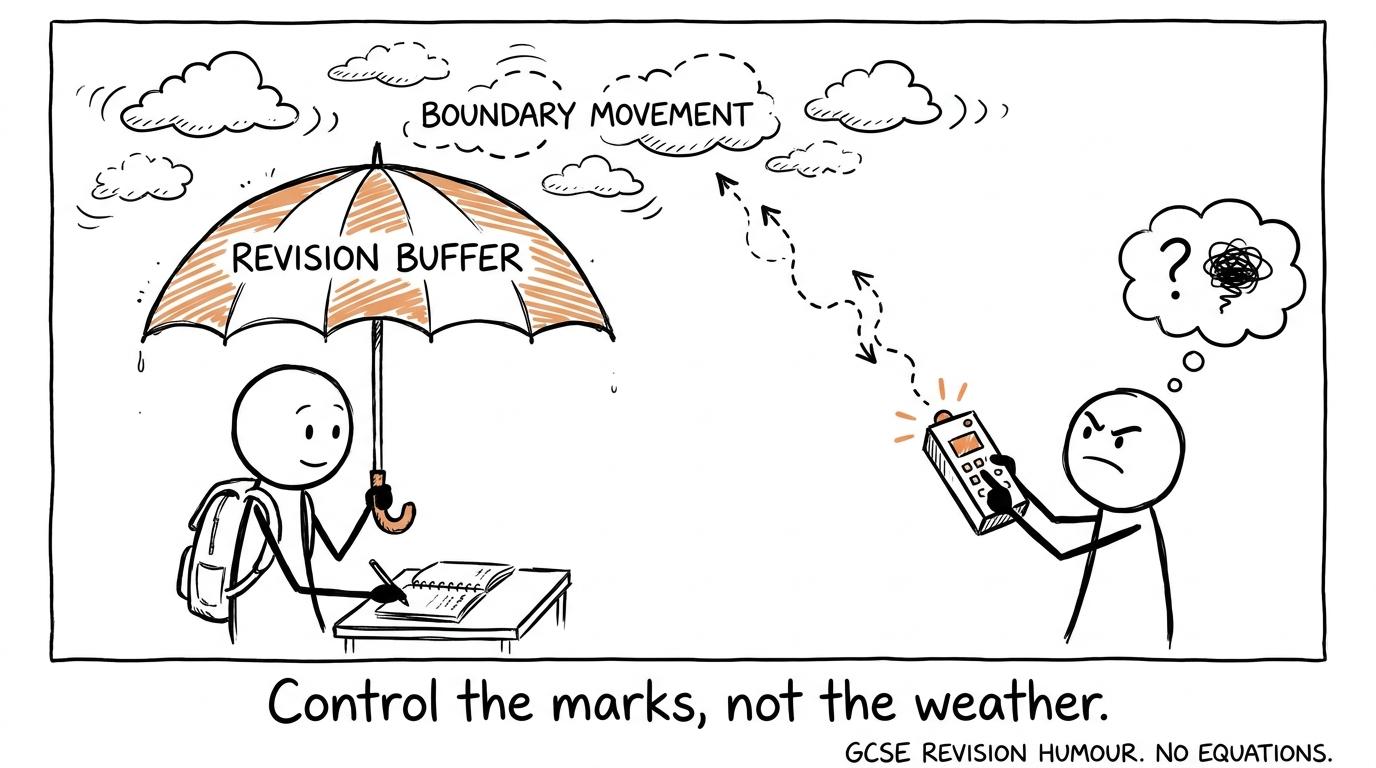 A revision buffer protects a student from unpredictable boundary movement
Common mistakes when reading Arabic grade boundaries
Treating a percentage as a permanent grade
There is no universal rule saying that a fixed percentage always earns a particular GCSE Arabic grade. Use the official table for the correct series.
Adding unscaled paper marks
The four raw paper maxima total 230230230, but the qualification subject mark is out of 280280280 because each skill is weighted equally. Check whether the figures you are using are raw or scaled.
Giving an individual paper a final grade
Published component boundaries may be labelled notional. They can help teachers interpret performance, but the certificate grade comes from the overall qualification total.
Mixing foundation and higher boundaries
The papers and available grade ranges differ. Always match the boundary to the tier entered across the qualification.
Mixing GCSE and International GCSE Arabic
These are separate qualifications with different assessment structures, totals and boundaries. Even when the subject title looks similar, the figures are not interchangeable.
Treating predictions as confirmed boundaries
A predicted boundary is an estimate. Official boundaries are set after the examination and marking process. Past figures can suggest a range, but they cannot reveal the next threshold in advance.
The same caution applies when preparing for maths. Past papers used properly reveal weaknesses; they do not predict a guaranteed grade. For a structured approach, the one-month GCSE maths revision plan turns each mark loss into a specific next action.
Focus on the part you can control
Grade boundaries matter, but they are weather rather than steering. You cannot set the threshold or know it exactly in advance. You can improve the total that eventually meets it.
Use the historical GCSE Arabic boundary tables for context, then return to the work: accurate responses, careful timing and honest marking. For maths preparation, make MathsGenie your free revision base. Move from revision lessons to practice questions, then test yourself with mini tests, past papers and predicted papers. Use mark schemes and video solutions to understand every lost mark.
Do not revise towards one fragile percentage. Build enough knowledge, accuracy and exam experience that a small movement in the boundary no longer decides the story.