

GCSE Arabic Grade 6 Meaning: A Clear Guide
GCSE Arabic grade 6 meaning explained: understand the ability it represents, how it compares with old letter grades and what the result means for you.
What does a grade 6 in GCSE Arabic mean?
A result can look precise while still leaving you with questions. You see a 666 beside GCSE Arabic, but what does that say about your actual language ability, and is it really the same as an old grade B?
The short answer to the GCSE Arabic grade 6 meaning is this: it is a strong result above the standard pass level. It indicates that you can understand and communicate Arabic across listening, speaking, reading and writing with a generally secure level of accuracy. In old-grade terms, it sits within the broad range previously covered by grades B and C, although there is no exact one-to-one conversion.
It is not simply a measure of whether you can speak Arabic socially. It reflects your combined performance across the specific tasks and assessment objectives in the qualification.
Here is the essential picture:
- Grade 666 is above the government-defined standard pass of grade 444.
- It is also above the government-defined strong pass benchmark of grade 555.
- It sits below grade 777, whose lower boundary was designed to align with the lower boundary of the old grade A.
- It is commonly described informally as being close to an old grade B, but Ofqual does not define grade 666 as an exact replacement for B.
- Your final result represents combined performance in listening, speaking, reading and writing.
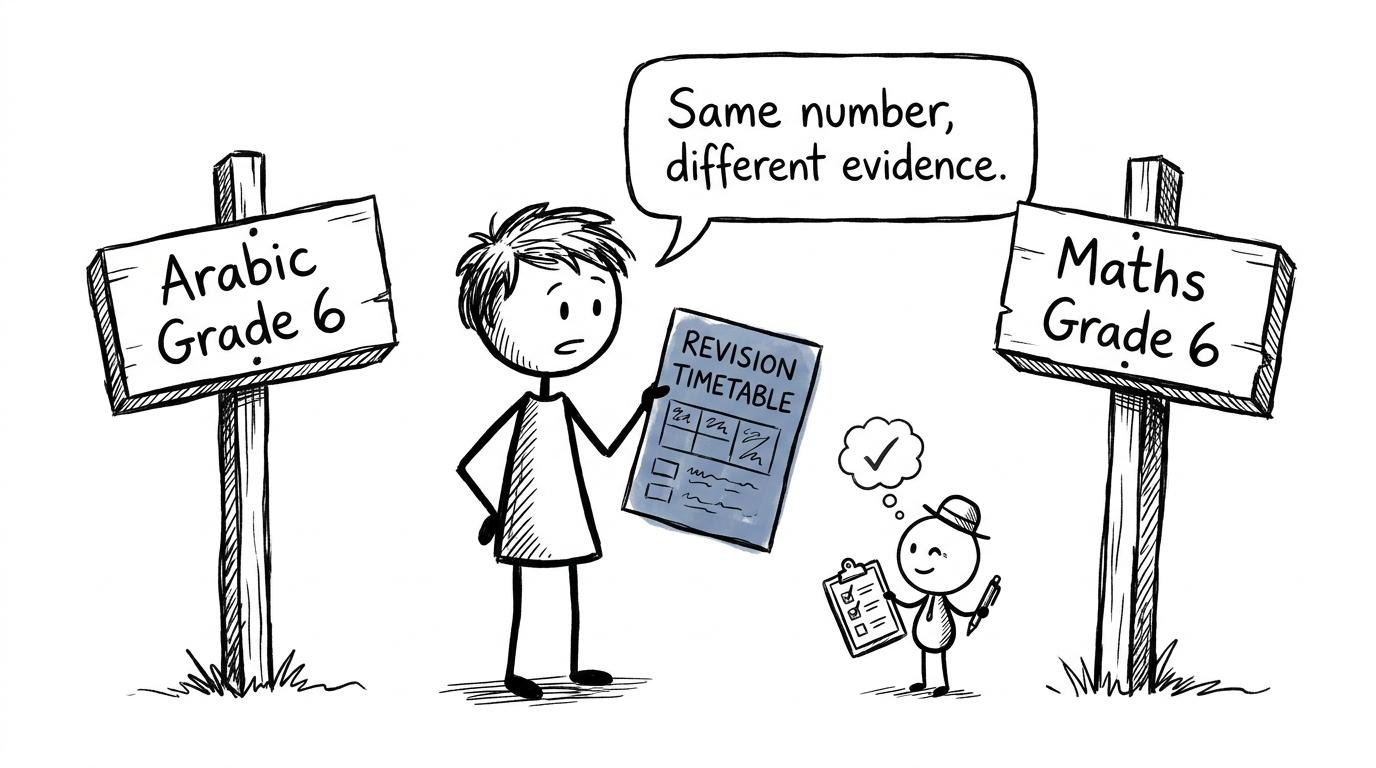 A student notices that the same GCSE grade can represent different subject skills
How grade 6 compares with the old letter grades
The numbered GCSE scale runs from 999 at the top to 111 at the bottom. It replaced the old A* to G scale in England, but the relationship between the two systems is often oversimplified.
Ofqual established comparable points at selected boundaries:
- The bottom of grade 777 aligns with the bottom of the old grade A.
- The bottom of grade 444 aligns with the bottom of the old grade C.
- The bottom of grade 111 aligns with the bottom of the old grade G.
There is no officially aligned old-grade boundary at grade 666. Ofqual explains that grades 444, 555 and 666 collectively provide greater differentiation across the part of the old scale covered by grades B and C.
So is grade 666 equivalent to a B? Approximately, but not exactly. Calling it a B is a useful shorthand in ordinary conversation, particularly because it sits immediately below the grade 777/old-A alignment. However, the safest formal description is that grade 666 falls within the old B/C performance range and is toward the upper end of that range.
This distinction matters when checking sixth-form, college or course requirements. Use the numbered grade requested by the institution rather than converting it yourself. If a course asks for grade 666, an old-grade comparison cannot replace the actual entry condition.
What ability does a grade 6 represent?
Official modern foreign language descriptors are published at grades 222, 555 and 888, not at every individual grade. Consequently, there is no official paragraph describing a grade 666 candidate word for word.
A sensible interpretation begins with the grade 555 descriptor. At that level, candidates are expected to understand overall messages, key points, details and opinions in some extended spoken and written material. They should be able to develop conversations, respond to some unpredictable questions, and communicate ideas and opinions in writing with reasonable accuracy.
A grade 666 indicates performance above that standard, although not yet at the grade 888 benchmark, where students handle more complex and extended language effectively, justify ideas in detail and manipulate vocabulary and grammar mostly accurately.
Listening
A grade 666 student should generally be able to follow spoken Arabic across familiar themes and identify more than isolated words. They can usually recognise the main message, retrieve relevant details and distinguish opinions, even when a recording becomes longer or less predictable.
That does not mean understanding every word. Language examinations often reward the ability to infer meaning from context and continue listening after an unfamiliar phrase. Missing one expression is not the same as losing the whole message.
Speaking
In speaking, grade 666 suggests that the student can sustain interaction rather than rely entirely on memorised statements. They should be able to express and develop opinions, use a range of language, refer to different time frames and respond reasonably well when a question is not exactly the one rehearsed.
Errors may remain, especially when attempting ambitious grammar. The important question is whether communication remains clear and whether the student can manipulate language rather than only recite it.
Reading
At this level, a student should normally understand the overall meaning, important details and viewpoints in a range of texts. They may cope with some unfamiliar vocabulary by using context, word families and grammatical clues.
Reading ability is therefore broader than translating every line literally. It includes selecting the detail that answers the question and recognising when the writer is giving a fact, preference or opinion.
Writing
Grade 666 writing generally communicates ideas clearly and uses a reasonable range of vocabulary and grammar. The student should be able to develop answers, express opinions and move between relevant time frames, while maintaining enough accuracy for the message to remain secure.
It does not imply flawless spelling or grammar. A student can earn a strong grade while making mistakes, provided those mistakes do not repeatedly obscure meaning and the response meets the task.
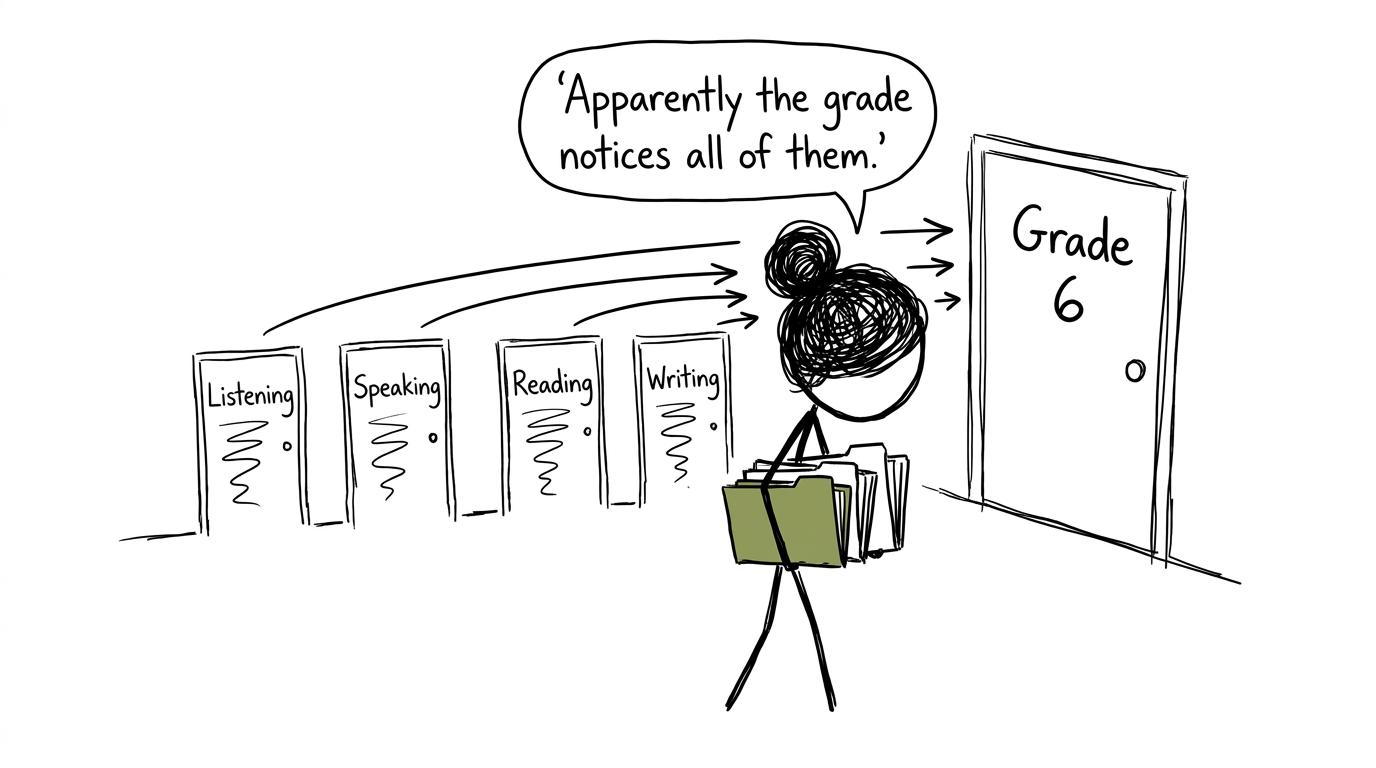 Four language skills combine to create one GCSE result
How the GCSE Arabic result is calculated
For the current Pearson Edexcel GCSE Arabic specification, the qualification assesses four skills through four papers:
- listening and understanding;
- speaking;
- reading and understanding;
- writing.
Each skill contributes 25%25\%25% of the qualification. The overall outcome can be represented as:
Overall result=0.25L+0.25S+0.25R+0.25W\text{Overall result}=0.25L+0.25S+0.25R+0.25WOverall result=0.25L+0.25S+0.25R+0.25WHere, LLL, SSS, RRR and WWW represent the standardised contribution from each skill, not simply the raw mark printed on each paper. The papers have different raw-mark totals, so adding raw marks without using the exam board's published conversion and grade-boundary information can be misleading.
Students are entered for one tier across all four papers. Foundation tier is targeted at grades 111 to 555, while higher tier is targeted at grades 444 to 999. A grade 666 therefore normally comes from higher-tier entry.
A useful consequence is that one weaker skill does not automatically prevent a grade 666. Stronger performance elsewhere may compensate because the final grade reflects the qualification as a whole. But balance still matters: each skill controls one quarter of the result.
Why a grade is not a fixed percentage
Students often ask what percentage is needed for a grade 666. There is no permanent answer.
Exam boards set grade boundaries after the papers have been sat and marked. Boundaries can move from one examination series to another to account for differences in paper demand while maintaining the intended standard. A raw percentage from a mock or an older paper is therefore evidence of current performance, not a guaranteed future grade.
This is familiar territory for maths students. A mark is data; a grade is an interpretation of that data against a particular boundary. The difference matters.
Use the official grade boundaries for the exact specification, tier and examination series when reviewing a completed Arabic paper. For maths, the same discipline applies when using GCSE past papers effectively: mark accurately, diagnose the lost marks and avoid treating one score as a permanent label.
What grade 6 says, and what it does not say
A grade 666 says that your assessed GCSE performance was strong. It provides evidence that you can understand and communicate Arabic beyond the grade 555 benchmark across the required examination skills.
It does not certify native or professional fluency. GCSE Arabic assesses performance against a specification, under particular exam conditions. Everyday conversation, dialect knowledge, cultural familiarity and formal written Arabic can develop at different rates.
This is particularly important for students who use Arabic at home. Familiarity may help, especially with listening and speaking, but examination success also depends on reading the exact task, controlling formal written language, managing time and understanding the mark scheme. Being a confident speaker does not remove the need to prepare for translation, structured writing or target-language questions.
Equally, a student who did not grow up speaking Arabic can still earn grade 666 through secure knowledge, deliberate practice and effective exam technique.
Using the result to plan your next step
If you have already achieved grade 666, begin with the requirement that matters. A sixth form may consider the grade alongside your wider GCSE profile, while any decision about further Arabic study should also reflect your confidence across individual skills. Entry policies vary, so check them directly.
If grade 666 is your target, turn the number into a revision question: which skill is currently keeping the overall performance below that level? Separate listening, speaking, reading and writing rather than describing Arabic as one large weakness.
The same principle makes maths revision more manageable. The MathsGenie GCSE maths revision hub organises free resources by exam board and topic, while the GCSE topics by board and tier guide helps students distinguish the content relevant to Edexcel, AQA, OCR and Eduqas.
A calm revision cycle is:
- complete an appropriately tiered task;
- mark it using the official mark scheme;
- identify the exact skill that lost marks;
- practise that skill separately;
- return to timed assessment;
- compare progress across several attempts.
For maths, you can build this routine with a realistic GCSE maths revision timetable, then use GCSE predicted papers nearer the examination as focused practice rather than as a promise of exact questions.
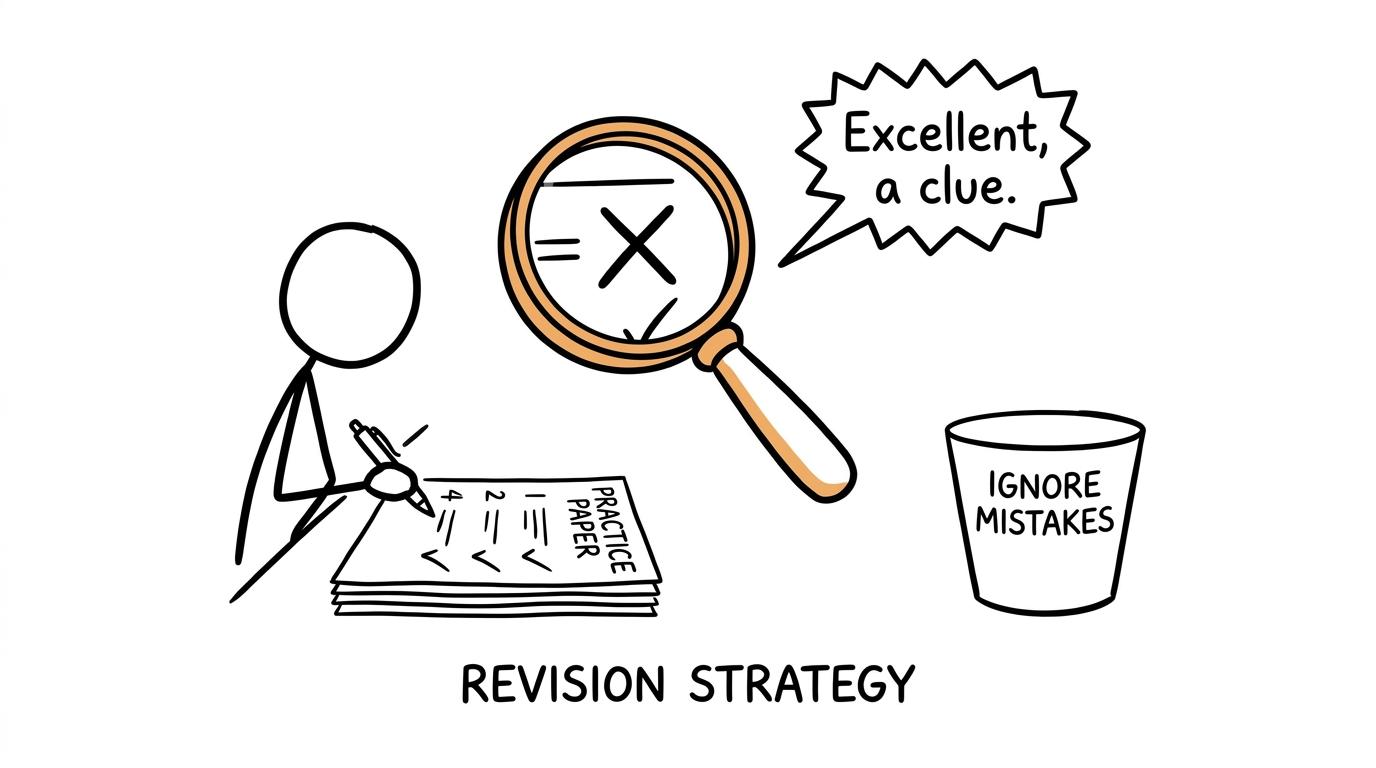 A magnifying glass treats every revision mistake as useful evidence
Common mistakes when interpreting a grade 6
Calling it an exact old grade B
Grade 666 is often described as roughly equivalent to B, but the official scales do not have a direct alignment at this grade. Say that it sits in the broad old B/C range, toward its upper end.
Assuming it proves fluency
The result is evidence of GCSE examination performance across four assessed skills. It is not a universal certificate of fluency in every Arabic-speaking context.
Treating one mock boundary as permanent
Grade boundaries vary by series. Always match the boundary to the correct year, specification and tier, and use several assessments to judge progress.
Ignoring an uneven skill profile
The final number can hide differences between listening, speaking, reading and writing. Review component feedback or marked practice to decide what to improve next.
Comparing Arabic and maths as if they test the same ability
A grade 666 represents a comparable position on the GCSE grading scale, not identical knowledge or assessment demands across subjects. Arabic rewards language communication; maths rewards mathematical understanding, reasoning and problem-solving.
If maths is the subject currently causing concern, the advice in GCSE maths revision when stuck at a pass grade helps turn a broad grade target into specific actions.
Make the grade useful
The most helpful interpretation of a grade is not a label but a direction. Grade 666 in GCSE Arabic is a strong achievement above a strong pass, broadly located around the old B/C range and commonly viewed as close to B. More importantly, it represents secure communication across four different language skills under examination conditions.
Once you understand that, the number becomes less mysterious. It tells you where the performance sits, but your marked work tells you what to do next.
Bring the same approach to maths. Start with MathsGenie's free GCSE maths revision resources, learn individual methods through revision lessons and practice questions, then test them with past papers, mini tests and predicted papers. Use the mark schemes and video solutions to turn every lost mark into a precise next step. A grade describes one result; good revision builds the next one.










