

GCSE Arabic Foundation vs Higher: Key Differences
GCSE Arabic Foundation vs Higher explained: compare grades, papers, timings, vocabulary, grammar, question styles and the risks of each tier.
Choosing a tier can feel strangely personal. Foundation may sound like a judgement on your ability; Higher may sound like proof that you are ambitious. Neither interpretation is useful. The real GCSE Arabic Foundation vs Higher decision is about which set of papers gives you the best opportunity to demonstrate what you know.
For the current Pearson Edexcel GCSE Arabic specification, both tiers assess listening, speaking, reading and writing across the same five themes. What changes is the available grade range, the linguistic demand, the length and structure of some tasks, and the amount of unfamiliar or complex language you must handle. You take one tier across all four papers; you cannot mix Foundation listening with Higher writing.
The right tier is therefore not simply the hardest one you can survive. It is the one on which you can collect marks consistently.
The GCSE Arabic tier checklist
Before comparing the papers in detail, keep these facts in view:
- Pearson Edexcel GCSE Arabic has four compulsory papers: listening, speaking, reading and writing.
- Each skill contributes 25%25\%25% of the qualification.
- Foundation tier offers grades 111 to 555.
- Higher tier offers grades 444 to 999, with a narrow grade 333 safety net for students just below the grade 444 boundary.
- A grade 444 or 555 has the same value whichever tier you take.
- Your certificate does not show the tier entered.
- You must take the same tier for every paper.
- Dictionaries are not permitted, including during speaking preparation.
- Individual papers do not receive separate grades. Your overall subject mark determines the final grade.
If you are also making this choice in maths, read MathsGenie's guide to GCSE Foundation vs Higher Maths. The subject content is different, but the central principle is identical: choose from evidence, not pride or fear.
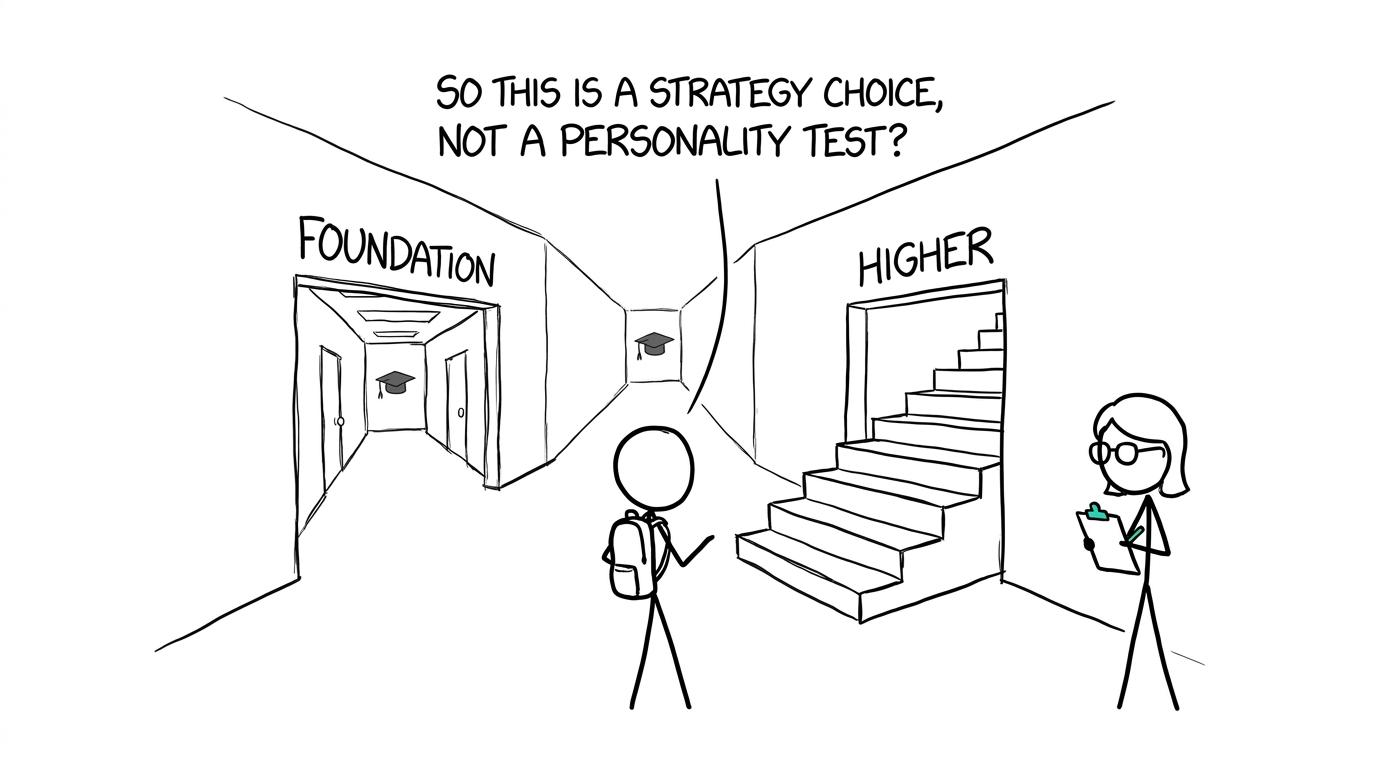 A student realises that tier entry is a strategy choice rather than a personality test
GCSE Arabic Foundation vs Higher at a glance
The current Pearson Edexcel qualification code is 1AA0. AQA, OCR and Eduqas offer other language qualifications, but students should not assume that their formats apply to GCSE Arabic. Check your entry with your school and revise from the Pearson specification and materials matching your tier.
| Feature | Foundation tier | Higher tier |
|---|---|---|
| Available grades | 111 to 555 | 444 to 999, plus a narrow grade 333 safety net |
| Listening | 35 minutes, including 5 minutes' reading time | 45 minutes, including 5 minutes' reading time |
| Speaking | 7 to 9 minutes, plus 12 minutes' preparation | 10 to 12 minutes, plus 12 minutes' preparation |
| Reading | 50 minutes | 1 hour 5 minutes |
| Writing | 1 hour 20 minutes | 1 hour 25 minutes |
| Writing structure | Three open responses and one translation into Arabic | Two longer open responses and one translation into Arabic |
| Language demand | Mostly familiar language and straightforward communication | Wider vocabulary, extended passages and more complex structures |
| Maximum grade | Grade 555 | Grade 999 |
Longer Higher papers do not merely give you extra thinking time. They contain longer or more demanding material. The additional minutes are part of a different assessment design.
What changes in listening and reading?
At both tiers, listening tests your understanding of standard spoken Arabic in public and social settings. Reading uses different text types, including messages, advertisements, letters, articles and literary material. Both papers include questions written in English and Arabic, while reading also includes translation from Arabic into English.
The key difference is the depth of comprehension expected. Foundation questions tend to focus more heavily on accessible information, familiar contexts and relatively direct meaning. Higher questions can require you to follow extended material, distinguish details, identify viewpoints and cope with less predictable language.
The listening paper is 35 minutes at Foundation and 45 minutes at Higher, with five minutes' reading time included at both tiers. Foundation begins with its English-language section, whereas Higher begins with questions and instructions in Arabic. That changes the opening experience of the paper: Higher candidates must settle immediately into reading Arabic as well as processing the recording.
The reading paper lasts 50 minutes at Foundation and 1 hour 5 minutes at Higher. Both contain multiple-response and short-answer questions, but Higher includes greater scope for open responses in the Arabic-language section. Translation is present at both tiers, although the Higher passage demands a broader command of vocabulary and structure.
There is some overlap between tiers through common questions. This helps examiners maintain a comparable standard for grades 444 and 555. It does not mean the papers are interchangeable; the questions around that overlap are targeted differently.
What changes in the speaking assessment?
The three-part structure remains the same:
- a role play;
- a picture-based task;
- a conversation covering two themes.
Both tiers receive 12 minutes of supervised preparation for the role play and picture-based task. The Foundation assessment lasts 7 to 9 minutes, while Higher lasts 10 to 12 minutes.
Higher is not simply Foundation with a longer conversation. It expects more sustained interaction, more developed responses and greater flexibility when questions become less predictable. In the role play, both tiers use five prompts, but Foundation requires the student to ask one question, while Higher requires two. Higher also includes a prompt requiring a past-tense response.
The conversation matters because prepared material alone is not enough. Strong Higher performance involves extending ideas, justifying opinions, moving between time frames and responding spontaneously. Foundation still rewards communication, interaction and accurate language, but the expected range and sustained detail are more manageable.
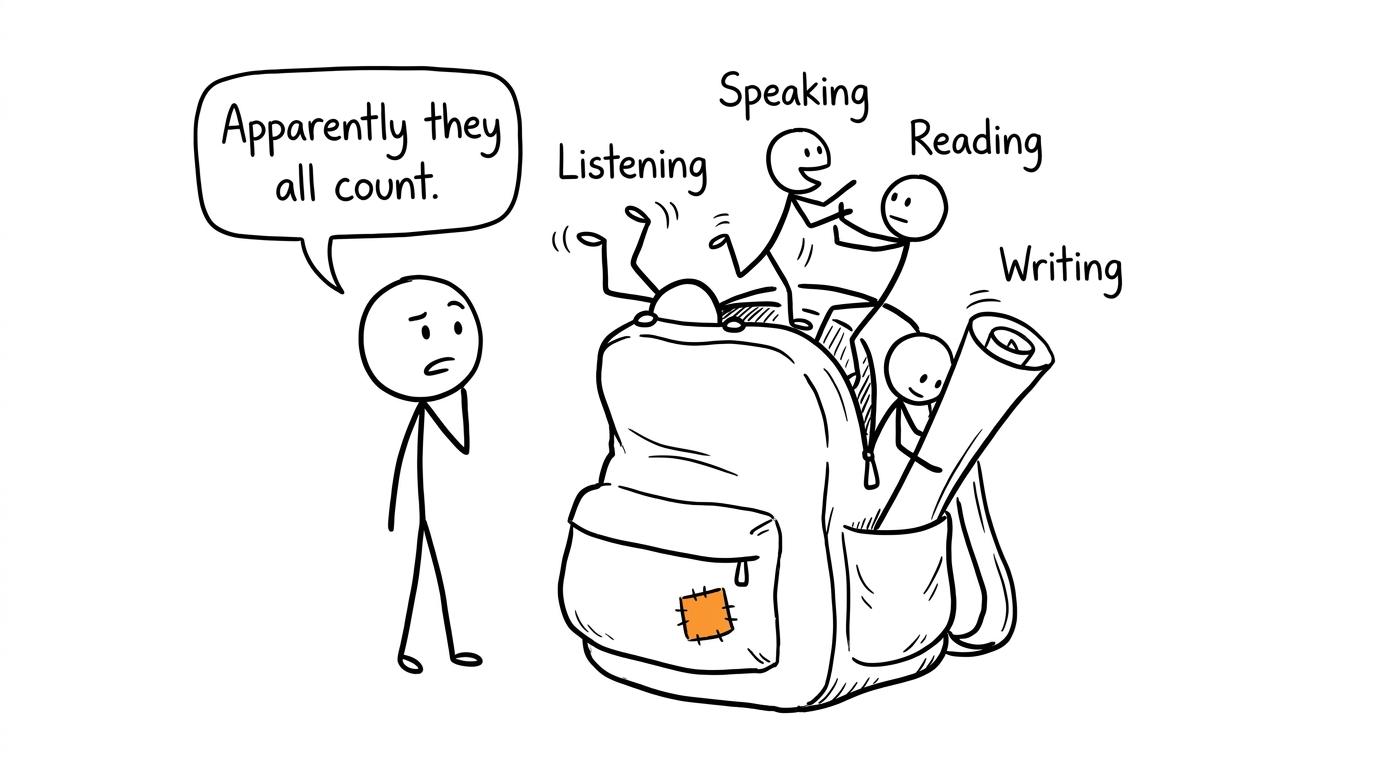 Listening, speaking, reading and writing discover that they all have to fit into the revision plan
Writing is structurally different, not merely harder
Writing shows the tier difference especially clearly. The Foundation paper lasts 1 hour 20 minutes and contains three open-response questions plus a translation from English into Arabic. Its tasks build from shorter communication towards an extended response.
The Higher paper lasts 1 hour 25 minutes, but contains two open responses and one longer translation. The expected response lengths are approximately 80 to 90 words and 130 to 150 words. This creates fewer separate tasks, but each demands more planning, development and control.
At Higher tier, you need to sustain meaning across longer responses. Opinions should be developed rather than merely stated. Vocabulary and structures need enough variety to match the purpose, and accuracy must survive as sentences become more ambitious. Appropriate formal or informal register can also matter according to the task.
Foundation writing is not consequence-free writing. You still need to address every bullet point, communicate clearly and control familiar grammar. Its structure simply offers more support through shorter, staged tasks.
Vocabulary and grammar go beyond the same topics
Both tiers cover the same five broad themes:
- identity and culture;
- local area, holiday and travel;
- school;
- future aspirations, study and work;
- international and global dimension.
Higher does not unlock a secret sixth theme. Instead, it expands what you are expected to understand and produce within those themes.
Pearson's specification separates Foundation vocabulary from additional Higher vocabulary. Higher candidates therefore need the Foundation vocabulary as well as the extra Higher-tier language. They should also expect occasional unfamiliar words where meaning can be inferred from context.
The same layered approach applies to grammar. Higher includes all Foundation grammar, then adds structures such as more complex noun constructions, comparative and superlative forms, wider pronoun use, additional verb patterns and more demanding methods of negation and sentence construction.
This distinction matters for revision. Memorising another list of nouns may improve recognition, but Higher success depends on manipulating language: changing person or time frame, linking clauses, explaining reasons and maintaining agreement accurately.
That resembles a useful principle from maths revision. Additional Higher content rests on secure core skills rather than replacing them. MathsGenie's GCSE maths topics by board and tier explains how this layering works in maths.
Which tier is the safer choice?
Foundation may be the sensible entry if your priority is securing a grade 444 or 555 and your performance is more reliable on shorter, familiar tasks. A grade 555 from Foundation is not a lesser grade 555. Ofqual requires grades 444 and 555 to be comparable between tiers.
Higher is necessary if you are aiming for grades 666 to 999. It is most appropriate when you can already deal confidently with Foundation material and can sustain accurate, developed Arabic under timed conditions.
The risk is asymmetric. Foundation limits the maximum result to grade 555. Higher opens the top grades, but students who fall well below grade 444 may receive an unclassified result. The grade 333 safety net is narrow, not an automatic fallback.
Do not base the decision on one excellent homework response or one difficult mock. Look for a pattern across all four skills. Since each contributes 25%25\%25%, fluent speaking cannot completely hide fragile reading, and strong writing cannot erase repeated listening difficulties.
Maths students can apply the same evidence-first approach using the MathsGenie GCSE revision hub, where resources are organised by exam board and tier.
A revision plan after your tier is chosen
Start by matching every resource to the correct specification and tier. Then use a simple cycle:
- complete a timed task without notes;
- mark it using the official mark scheme;
- classify the lost marks by vocabulary, grammar, comprehension, communication or timing;
- practise the precise weakness;
- return to a similar task after a short gap.
Do not only revise the skill you enjoy. Four equally weighted papers make balanced preparation valuable. Keep vocabulary retrieval short and frequent, but connect words to sentences, time frames and themes. For speaking, practise responding without reading a complete prepared script. For writing, plan around every required bullet point before adding complexity.
MathsGenie's guide to using past papers properly gives a useful paper-mark-fix-retest routine that transfers well to language revision. For your maths preparation, combine that method with Edexcel GCSE Maths mini tests, Edexcel predicted papers and a realistic GCSE maths revision timetable.
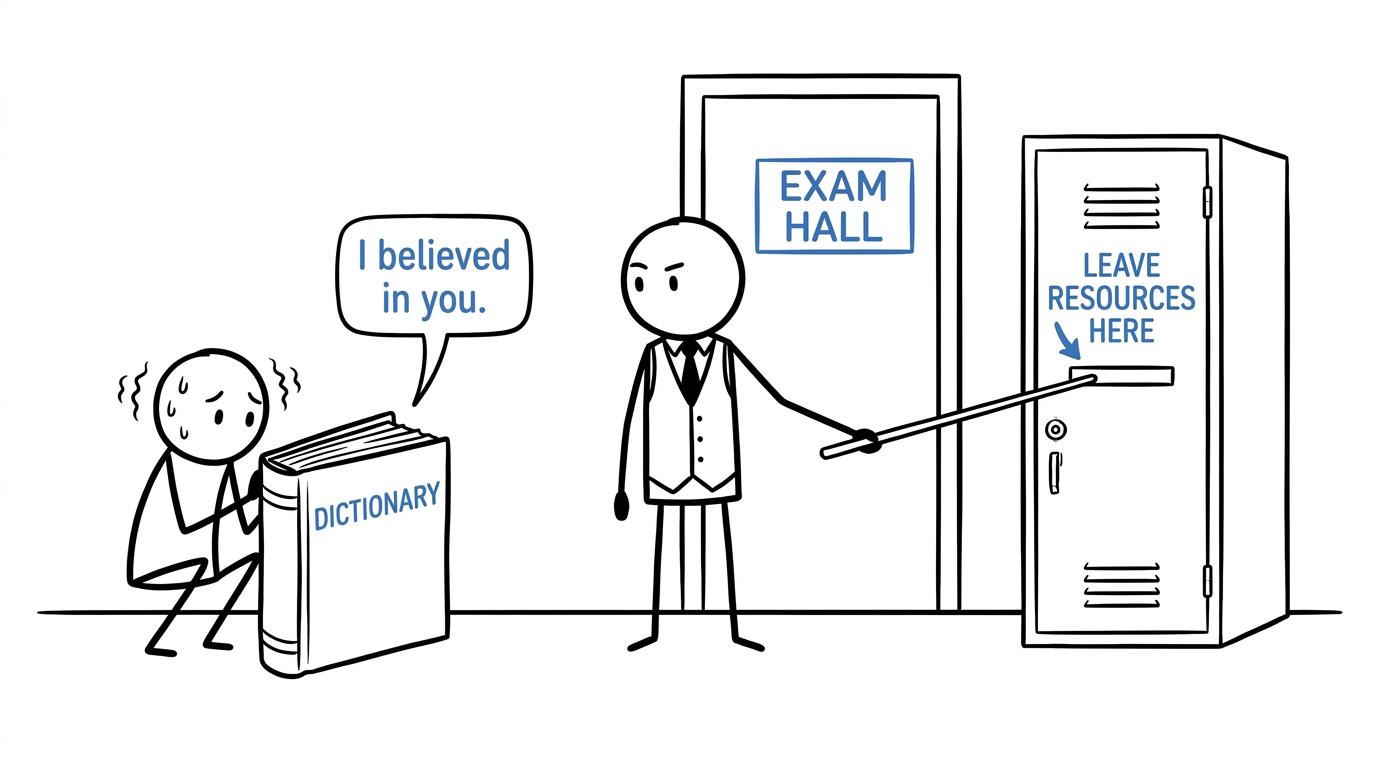 A dictionary offers emotional support before being left outside the exam room
Common mistakes when comparing the tiers
Assuming Higher gives more marks for the same response
Higher offers access to higher grades because its assessments demand more. It is not a multiplier applied to an otherwise identical answer.
Believing Foundation cannot produce a strong result
Foundation can award grade 555. If that matches your target and current evidence, it can be the more reliable route.
Revising Higher-only language before securing the core
Every Higher candidate still needs Foundation vocabulary and grammar. Complex structures are useful only when the basic message remains clear.
Preparing one strong skill and neglecting the others
Listening, speaking, reading and writing each contribute 25%25\%25%. Revision should reflect that balance.
Using the wrong paper format
Do not confuse GCSE Arabic with International GCSE Arabic or with reformed French, German and Spanish specifications. Confirm that your materials say Pearson Edexcel GCSE Arabic, code 1AA0, and match your tier.
Expecting a dictionary in the examination
Dictionaries are not allowed in any of the four assessments, including the supervised preparation period for speaking. Retrieval practice must therefore be part of revision, not an optional extra.
Choose the paper that lets your knowledge show
The meaningful difference between GCSE Arabic Foundation and Higher is not a label. It is the range of grades available and the kind of language performance the papers ask you to sustain. Foundation provides shorter, more accessible routes through the same four skills. Higher adds wider vocabulary, more advanced grammar, longer interaction and greater demand for inference, development and spontaneity.
Ask your teacher which tier your evidence supports, then prepare for that exact format. And when you turn back to maths, make MathsGenie your free revision base: use its Edexcel GCSE Maths revision lessons, practice questions, mini tests, past papers, predicted papers, mark schemes and video solutions. Good revision makes uncertainty measurable and once it is measurable, it becomes much easier to improve.










